
Determine the necessary mass, volume, or concentration for preparing a solution.
| Activity Type | Relation | Activity value | Units | Action Type | Journal | PubMed Id | doi | Assay Aladdin ID |
|---|
≥99% for sensitive chromatographic and analytical workflows requiring minimal baseline interference.
Store at -20°C Ships Ice chest + Ice pads Check lot-specific COA for exact specifications.
SDS, COA, datasheet, and spec sheet available for download. Lot-specific COA accessible via lot number lookup.
Cited in 0 peer-reviewed publications across chromatography, organic synthesis, and cross-coupling reactions.
Information
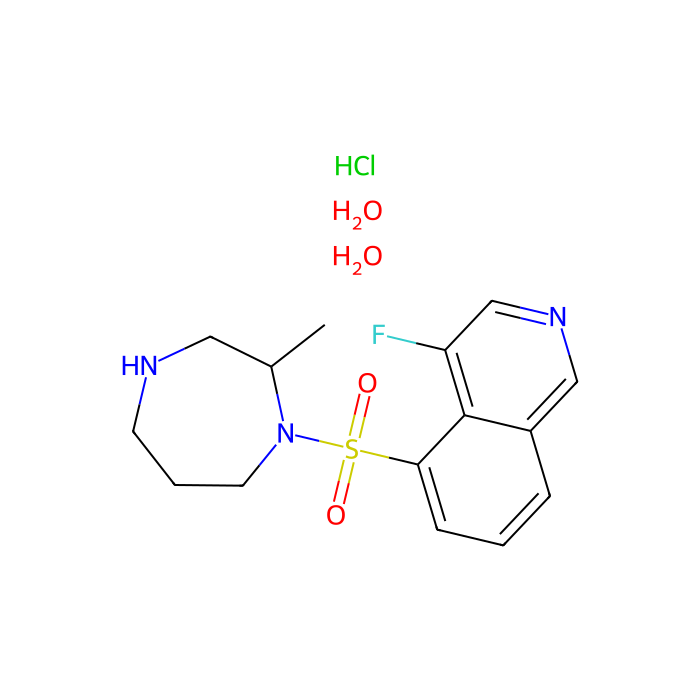
Ripasudil (K-115) hydrochloride dihydrate is potentROCKinhibitor withIC50of 51 nM and 19 nM for ROCK1 and ROCK2, respectively, used for the treatment of glaucoma and ocular hypertension.
Targets
ROCK2 (Cell-free assay); ROCK1 (Cell-free assay) 19 nM; 51 nM
In vitro
In monkey trabecular meshwork (TM) cells, Ripasudil induces retraction and rounding of cell bodies as well as disruption of actin bundles. In Schlemm\'s canal endothelial (SCE) cells, Ripasudil significantly decreases transendothelial electrical resistance (TEER), increases the transendothelial flux of FITC-dextran, and disrupts cellular localization of ZO-1 expression.
In vivo
In albino rabbits and monkeys, topical instillation of Ripasudil significantly reduces intraocular pressure (IOP) with maximum IOP reduction of 8.55 mmHg and 4.36 mmHg at 0.5 % and 0.4%, respectively. Ripasudil (1 mg/kg daily, p.o.) exerts a neuroprotective effect on retinal ganglion cell (RGC) after optic nerve crush (NC) by suppressing oxidative stress through pathways involving the Nox family in a mouse model.
| ALogP | 0.739 |
|---|---|
| HBD Count | 1 |
| Rotatable Bond | 2 |
| Canonical Smiles | CC1CNCCCN1S(=O)(=O)C2=CC=CC3=CN=CC(=C32)F.O.O.Cl |
|---|---|
| IUPAC Name | 4-fluoro-5-[[(2S)-2-methyl-1,4-diazepan-1-yl]sulfonyl]isoquinoline;dihydrate;hydrochloride |
| InChIKey | CMDJNMACGABCKQ-XVSRHIFFSA-N |
| INCHI | 1S/C15H18FN3O2S.ClH.2H2O/c1-11-8-17-6-3-7-19(11)22(20,21)14-5-2-4-12-9-18-10-13(16)15(12)14;;;/h2,4-5,9-11,17H,3,6-8H2,1H3;1H;2*1H2/t11-;;;/m0.../s1 |
| Isomeric SMILES | C[C@H]1CNCCCN1S(=O)(=O)C2=CC=CC3=CN=CC(=C32)F.O.O.Cl |
| PubChem CID | 11625386 |
| Molecular Weight | 395.88 |
Comprehensive hazard, handling, storage, and regulatory compliance document.
Download SDS →Lot-specific quality data. Enter your lot number to retrieve the exact COA.
Look up COA →Full quality attributes and acceptance criteria for this grade.
View spec sheet →Taxonomy Tree
| Kingdom | Organic compounds |
|---|---|
| Superclass | Organoheterocyclic compounds |
| Class | Isoquinolines and derivatives |
| Subclass | Not available |
| Intermediate Tree Nodes | Not available |
| Direct Parent | Isoquinolines and derivatives |
| Alternative Parents | 1,4-diazepanes Pyridines and derivatives Organosulfonamides Benzenoids Aryl fluorides Sulfonyls Heteroaromatic compounds Dialkylamines Azacyclic compounds Organofluorides Organic oxides Hydrochlorides Hydrocarbon derivatives |
| Molecular Framework | Aromatic heteropolycyclic compounds |
| Substituents | Isoquinoline - 1,4-diazepane - Diazepane - Aryl fluoride - Aryl halide - Pyridine - Benzenoid - Organosulfonic acid amide - Heteroaromatic compound - Sulfonyl - Organosulfonic acid or derivatives - Organic sulfonic acid or derivatives - Secondary aliphatic amine - Azacycle - Secondary amine - Organonitrogen compound - Organofluoride - Organohalogen compound - Amine - Hydrocarbon derivative - Organic nitrogen compound - Organic oxide - Organic oxygen compound - Organosulfur compound - Hydrochloride - Aromatic heteropolycyclic compound |
| Description | This compound belongs to the class of organic compounds known as isoquinolines and derivatives. These are aromatic polycyclic compounds containing an isoquinoline moiety, which consists of a benzene ring fused to a pyridine ring and forming benzo[c]pyridine. |
| External Descriptors | Not available |
| Activity Type | Relation | Activity value | Units | Action Type | Journal | PubMed Id | doi | Assay Aladdin ID |
|---|
| Activity Type | Relation | Activity value | Units | Action Type | Journal | PubMed Id | doi | Assay Aladdin ID |
|---|
Find and download the COA for your product by matching the lot number on the packaging.
| Lot Number | Certificate Type | Date | Item |
|---|---|---|---|
 G2206442 G2206442 | Certificate of Analysis | Jan 20, 2026 | R413902 |
| G2206451 | Certificate of Analysis | Jan 20, 2026 | R413902 |
| G2206452 | Certificate of Analysis | Jan 20, 2026 | R413902 |
| G2206453 | Certificate of Analysis | Jan 20, 2026 | R413902 |
| Solubility | Solubility (25°C) In vitro Water: 79 mg/mL (199.55 mM); DMSO: 26 mg/mL warmed with 50ºC Water: bath (65.67 mM); Ethanol: 5 mg/mL warmed with 50ºC Water: bath (12.63 mM); |
|---|---|
| Sensitivity | moisture sensitive |
| DMSO(mg / mL) Max Solubility | 26 |
| DMSO(mM) Max Solubility | 65.67646762 |
| Water(mg / mL) Max Solubility | 79 |
| Water(mM) Max Solubility | 199.5554208 |
| Molecular Weight | 395.900 g/mol |
| XLogP3 | |
| Hydrogen Bond Donor Count | 4 |
| Hydrogen Bond Acceptor Count | 8 |
| Rotatable Bond Count | 2 |
| Exact Mass | 395.108 Da |
| Monoisotopic Mass | 395.108 Da |
| Topological Polar Surface Area | 72.700 Ų |
| Heavy Atom Count | 25 |
| Formal Charge | 0 |
| Complexity | 482.000 |
| Isotope Atom Count | 0 |
| Defined Atom Stereocenter Count | 1 |
| Undefined Atom Stereocenter Count | 0 |
| Defined Bond Stereocenter Count | 0 |
| Undefined Bond Stereocenter Count | 0 |
| The total count of all stereochemical bonds | 0 |
| Covalently-Bonded Unit Count | 4 |