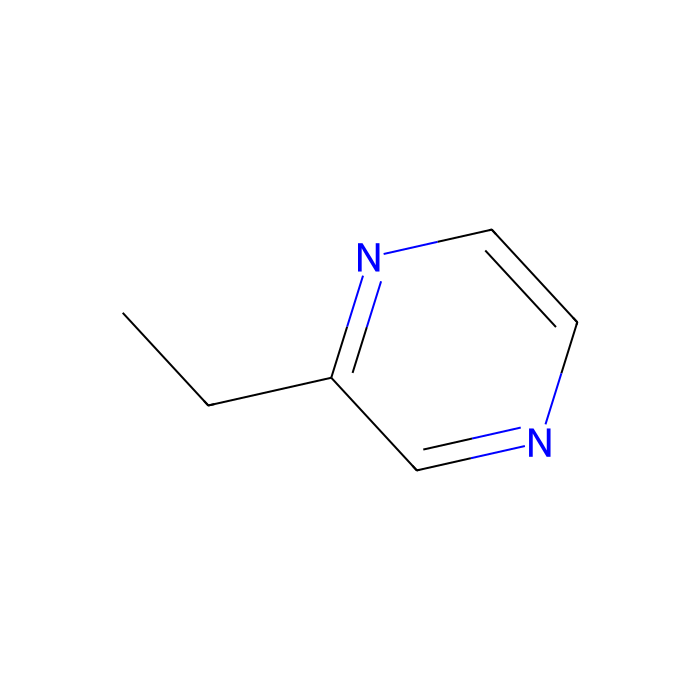
This compound belongs to the class of organic compounds known as pyrazines. These are compounds containing a pyrazine ring, which is a six-member aromatic heterocycle, that consists of two nitrogen atoms (at positions 1 and 4) and four carbon atoms.
External Descriptors
pyrazines
1. Djoumbou Feunang Y, Eisner R, Knox C, Chepelev L, Hastings J, Owen G, Fahy E, Steinbeck C, Subramanian S, Bolton E, Greiner R, and Wishart DS. ClassyFire: Automated Chemical Classification With A Comprehensive, Computable Taxonomy. Journal of Cheminformatics, 2016, 8:61.
Determine the necessary mass, volume, or concentration for preparing a solution.
Dilution Calculator
Determine the dilution needed to prepare a stock solution.
Reconstitution Calculator
Reviews
Customer Reviews
Application Protocols
No vendor-tested bioassay or immunoassay protocols are specified for this item. For analytical use (general guidance only):
GC–MS reference standard preparation (research use):
Prepare a stock at 1–10 mg/mL in methanol or dichloromethane.
Store sealed vials to minimize headspace loss; include internal standards as needed (e.g., alkylpyrazine homologues).
Inject 0.2–1 µL with split/splitless as appropriate; monitor characteristic ions for pyrazines.
Purification/handling:
For silica chromatography, add 0.1–1% Et3N to reduce tailing.
For aqueous workups, anticipate partial water solubility; salt out with brine before extraction.
These are general research practices; adapt to your method and instrumentation. No diagnostic or clinical use is intended.
Biological Roles
Item-specific biological data: Not specified for this item; refer to CoA/Spec Sheet/SDS.
General/biochemical context (literature; not item-specific):
Pyrazines, including 2-ethylpyrazine, are prominent volatile components generated in Maillard reactions of amino acids and reducing sugars during roasting and thermal processing. They contribute nutty/roasted notes and are extensively studied in food chemistry and flavoromics.
Biosynthesis: while many alkylpyrazines arise from non-enzymatic pathways, certain microorganisms can produce related alkylpyrazines via condensation and cyclization of amino acid–derived fragments during fermentation.
Interaction with biomolecules: as a small, weakly basic, aromatic heterocycle, 2-ethylpyrazine can act as a hydrogen-bond acceptor and engage in π–stacking/hydrophobic interactions, which underlies its detectability by olfactory receptors in sensory studies.
Metabolic fate (general): small pyrazines are typically oxidized and conjugated in mammals, increasing polarity for excretion; specifics vary by substitution pattern and species.
Note: The above is general biochemical background to aid research planning and analytical method design. It does not imply suitability for biological administration; this product is for research use only.
Buffer Applications
2-Ethylpyrazine is not a conventional buffering agent and is not typically used to prepare buffer systems. Its weak basicity and volatility make it unsuitable for precise pH control.
Practical guidance:
For work requiring controlled pH with heteroaromatics present, choose standard buffers (e.g., phosphate, acetate, HEPES) compatible with your analyte and analytical method.
If studying 2-ethylpyrazine behavior across pH, prepare buffered media separately and add the compound as a solute; monitor headspace due to volatility.
Green Alternatives
As a heteroaromatic reagent, 2-ethylpyrazine is not replaceable in a strict sense when its scaffold is required. However, greener choices can be made for solvents and oxidants used with it.
Greener selections (literature/general):
Solvent substitutions:
Replace THF with 2‑MeTHF or CPME for metalations and nucleophilic steps; both offer better lifecycle metrics and reduced peroxide concerns (vs THF), with comparable coordination properties.
Prefer EtOAc or MeTHF over DCM for extractions and oxidations when feasible.
Use aqueous ethanol or propylene carbonate where compatible (e.g., for benign oxidations or benign workups).
Oxidant choices:
H2O2/urea adduct (urea–hydrogen peroxide) or percarbonate as alternatives to peracids for N‑oxidation under controlled conditions.
Energy and emission considerations:
Conduct reactions at ambient temperature/pressure when chemistry permits; use sealed systems and headspace capture to minimize VOC emissions from this moderately volatile compound.
Illustrative comparison (general):
THF vs 2‑MeTHF: similar coordinating ability for organolithiums; 2‑MeTHF is bio‑derived, has higher boiling point (facilitates room‑temperature operations), and simplifies phase separations. Tradeoff: slightly different lithiation kinetics/regioselectivity; pilot before scale‑up.
DCM vs EtOAc: EtOAc is less toxic and has a better environmental profile; tradeoff is reduced halide solubility and different extraction behavior.
Pharmaceutical Uses
Item-specific pharmacopeial/excipient status: Not specified for this item; refer to CoA/Spec Sheet.
General context (literature; non-clinical):
2-Ethylpyrazine is primarily encountered in research on flavor chemistry and as a heteroaromatic building block. It is not a common pharmaceutical excipient.
Potential roles in R&D settings include:
Analytical reference standard in flavor/aroma method development (GC–MS/GC–FID).
Synthetic intermediate toward more complex pyrazine-containing scaffolds that may be evaluated in medicinal chemistry campaigns.
Manufacturing considerations: if used in a GMP context (e.g., as a process intermediate or reference), tight controls on residual solvents, non-volatile residue, and identity/purity by GC–MS/NMR are expected.
No therapeutic or clinical claims are made for this material. It is supplied strictly for research and laboratory use.
Physical Properties
Item-specific physical specifications: Not specified for this item; refer to CoA/Spec Sheet.
Literature/general properties (for reference; not item-specific):
Physical state/appearance: colorless to pale yellow liquid with characteristic pyrazine odor (literature).
Boiling point: typically reported ~168–170 °C at 1 atm (literature).
Melting point: low; generally liquid at room temperature (literature).
Density: commonly cited around 0.97–1.00 g/mL at 20–25 °C (literature).
Refractive index: often reported near nD20 ≈ 1.49–1.50 (literature).
Vapor pressure/volatility: moderate for a C6 heteroaromatic; noticeable odor at ambient conditions (literature).
Solubility: miscible with many organic solvents (alcohols, ethers, chlorinated solvents); limited but appreciable solubility in water due to the diazine ring polarity (literature).
pKa/basicity: ring nitrogens are weakly basic; conjugate acid pKa typically ~0–1 for pyrazines; overall behaves as a weak base with significant hydrogen-bond acceptor character (literature).
LogP/logD: modest hydrophilicity; logP often cited around 0.4–0.8 (literature).
Notes for practice (general):
Hygroscopicity: low; however, material can absorb atmospheric odors/contaminants—store tightly sealed.
Spectral features: UV absorption in the 250–300 nm region typical for diazines; strong bands in IR ~1600 cm−1 (C=N/C=C) (literature).
Quality & Grades
Item-specific grade/purity: Not specified for this item; refer to CoA/Spec Sheet.
Guidance on grades and implications (general knowledge):
Research grade vs. analytical grade: analytical (AR) or ≥99% grades offer lower levels of non-volatile residue and trace metals, beneficial for spectroscopic work or when using sensitive catalysts (e.g., Pd-catalyzed couplings after halogenation of the ring). Research grade is typically suitable for most synthetic and screening activities.
Low-UV/HPLC grades: when 2-ethylpyrazine is used as an internal standard, flavor reference, or chromatographic comparator, low-UV background and peroxide-free status (for ethers/oxidizable media) can matter; for pyrazines, UV-absorptivity is intrinsic, so “HPLC grade” primarily refers to impurity control and filtration.
Stabilizers: pyrazines generally ship without stabilizers; if a stabilizer were present, it would be listed on the CoA. Stabilizers can complicate downstream transformations (e.g., quaternization), so verify on receipt.
Documentation: request the batch CoA for precise assay (GC), identity (GC–MS/1H NMR/IR), residual solvents, and water content (Karl Fischer) when these parameters are critical to your application.
Reaction & Applications
Practical roles of 2-ethylpyrazine in synthesis and analysis (literature/general):
Building block for heteroaromatic diversification: the electron‑deficient pyrazine ring enables strategic transformations after appropriate activation, facilitating libraries of alkylpyrazines used in materials, agrochemical, and flavor chemistry research.
Directed metalation: C3-lithiation is achievable with strong bases (s‑BuLi or n‑BuLi, often with TMEDA) at low temperature, enabling subsequent electrophile quench (e.g., carbonyls, halogens). N‑oxide formation can further direct and enhance lithiation/regioselectivity.
Oxidation chemistry: selective formation of the N‑oxide (e.g., with mCPBA) provides a handle for subsequent substitution or rearrangement pathways (e.g., Polonovski‑type chemistry on related systems).
Hydrogenation: ring hydrogenation under catalytic conditions (e.g., Pd/C, Raney Ni) can access partially or fully saturated diamines in research settings; conditions must be tuned to avoid over-reduction and to manage N-poisoning of catalysts.
Quaternization and salt chemistry: alkylation at ring nitrogens (e.g., with MeI) yields pyrazinium salts useful as phase-transfer reagents or as activated intermediates for nucleophilic attack on the ring.
Analytical/flavor research: 2-ethylpyrazine is a well-known volatile in Maillard systems; used as a reference/standard in food aroma profiling and GC–MS method development (non-regulatory, research context only).
Tips:
Maintain anhydrous conditions for organolithium chemistry; pre-dry glassware. Control temperature rigorously (−78 to 0 °C) to minimize side reactions and over-lithiation.
Reaction Conditions
General literature guidance (not item-specific; verify experimentally):
Directed metalation at C3:
Reagents: s‑BuLi (1.1–1.5 equiv) with TMEDA (1–2 equiv).
Solvent: anhydrous THF, 0.1–0.5 M.
Temperature/time: −78 °C to −40 °C for 0.5–2 h; then add electrophile at ≤0 °C.
Quenches: carbonyls (PhCHO, DMF for formylation), I2/Br2 for halogenation, CO2 for carboxylation.
N‑oxidation:
Oxidant: mCPBA (1.1–1.5 equiv) in DCM or EtOAc at 0–25 °C, 1–3 h.
Workup: wash with aqueous Na2CO3/NaHCO3 to remove acids; isolate N‑oxide by concentration and crystallization if solid, or chromatography.
Side-chain oxidation (ethyl → acetyl or carboxyl):
Reagents: SeO2 (allylic/benzylic-like oxidation analogs) or KMnO4 under controlled conditions; solvent: dioxane/water or AcOH; temp: 50–90 °C. Monitor carefully to avoid ring oxidation.
Hydrogenation (ring/skeleton):
Catalyst: Pd/C (5–10 wt%), H2 (1–5 bar), solvent: EtOH or EtOAc, 20–50 °C, 2–16 h. Note potential catalyst poisoning by nitrogen; preconditioning may be required.
Quaternization (pyrazinium salt formation):
Alkyl halide (e.g., MeI, EtI), solvent: MeCN or acetone, 25–60 °C, 2–24 h; isolate salt by precipitation.
Yields are transformation- and substrate-dependent; consult primary literature and run small-scale scouting before scale-up.
Safety & Handling
Item-specific hazard/GHS information: Not specified for this item; refer to SDS.
General safety guidance for 2-ethylpyrazine (literature/typical for alkylated pyrazines; not item-specific):
Likely hazards: combustible liquid and vapor; causes eye/skin/respiratory irritation; harmful if swallowed or inhaled. Always confirm with the product SDS.
Personal protective equipment (PPE): lab coat, safety glasses or splash goggles, and appropriate gloves (e.g., nitrile). Handle in a fume hood to control vapors/odor.
Storage: store at room temperature (per Product Data) in a tightly closed container. Keep away from ignition sources, strong oxidizers, and strong acids. Segregate from peroxides and acylating agents.
Handling: minimize inhalation; avoid skin contact. Use grounding/bonding when transferring bulk volumes. Wipe spills promptly; absorb with inert material.
First aid (overview; consult SDS):
Inhalation: move to fresh air; seek medical advice if symptoms persist.
Skin contact: wash with soap and water; remove contaminated clothing.
Eye contact: rinse cautiously with water for several minutes; remove contact lenses if present and easy.
Ingestion: rinse mouth; do not induce vomiting unless directed by medical personnel.
Fire-fighting: use alcohol-resistant foam, dry chemical, or CO2. Cool containers with water spray. Combustion may produce nitrogen oxides and carbon oxides.
Waste: collect organic waste according to institutional and local regulations; avoid release to the environment.
Solvent Selection
This product is a heteroaromatic liquid reagent, not a solvent. Selection of a working solvent will depend on the intended transformation.
General solvent compatibility and selection (literature/guidance):
Polarity and miscibility: 2-ethylpyrazine is polar aprotic and mixes well with common organic solvents (EtOH, MeOH, acetone, MeCN, THF, DCM, toluene). Water solubility is limited but non-negligible; biphasic workups are often straightforward.
Preferred media by transformation:
Directed metalation (e.g., lithiation): dry THF, MTBE, or CPME at −78 to 0 °C.
N-oxidation: DCM, EtOAc, or MeOH with peracids or H2O2/urea complexes.
Electrophile trapping after lithiation: THF/THF–toluene mixtures improve solubility and control.
Hydrogenation: protic (EtOH, AcOH) or aprotic (EtOAc) solvents under H2.
Chromatography: silica gel elution typically with EtOAc/hexanes or DCM/MeOH gradients; basic modifiers (0.1–1% Et3N) can reduce tailing due to ring basicity.
When to choose alternatives:
If odor control and volatility are concerns, perform reactions in closed systems or substitute with a solid pyrazine derivative if feasible. For greener choices, consider 2-MeTHF or CPME in place of THF, and EtOAc in place of DCM.
Storage & Reconstitution
Storage (from Product Data): store at room temperature. Shipments are made under normal conditions.
Container: keep tightly closed in an amber glass bottle or other vapor‑tight container to minimize volatilization and odor transfer. Purge headspace with inert gas if long-term storage is planned, although the compound is generally air-stable.
Incompatibilities: avoid strong oxidizers and strong acids. Keep away from ignition sources.
Stability: under dry, room‑temperature conditions, alkylpyrazines are typically stable for extended periods. Check appearance and GC purity periodically if using as an analytical standard.
Reconstitution: not applicable (neat liquid). For solution preparation, use dry, oxygen-free solvents when required by the intended reaction (e.g., organolithium chemistry). Prepare fresh analytical solutions to minimize volatility losses.
Freeze–thaw: not applicable; do not freeze unless required for a specific protocol, as freezing is unnecessary and may stress containers.
Research use note: For research use only (per Product Data).
Structure & Identity
Concise description: 2-Ethylpyrazine is a monoalkylated diazine (pyrazine) in which an ethyl group occupies the 2-position of the aromatic N,N-diazine ring. The ring contains two nitrogens at positions 1 and 4, giving an electron‑deficient, planar heteroaromatic system.
Item-specific identifiers (from Product Data):
CAS: 13925-00-3
SKU: E156371
InChIKey: 190483 (as listed in Product Data)
Molecular formula: Not specified for this item; refer to CoA/Spec Sheet.
Molecular weight: Not specified for this item; refer to CoA/Spec Sheet.
SMILES: Not specified for this item; refer to CoA/Spec Sheet.
Literature/general identifiers (for reference; not item-specific):
Core functional groups: heteroaromatic diazine (pyrazine), ethyl substituent at C2
2D structural description (general):
A six-membered aromatic ring with nitrogens at positions 1 and 4 (para to each other). The C2 position bears a –CH2–CH3 substituent. Ring carbons at C3, C5, and C6 are CH; C2 is quaternary due to substitution; N atoms contribute to ring aromaticity and basicity (weakly basic). No stereocenters present; molecule is achiral.
Synthetic Utility
Key reactivity features (literature/general):
Electron-deficient N,N-diazine: reduced susceptibility to electrophilic aromatic substitution; enhanced potential for nucleophilic aromatic pathways after activation (e.g., N-oxidation or formation of pyrazinium salts).
Site-selective deprotonation: C3 (adjacent to the ethyl at C2) can be selectively metalated using strong bases (e.g., s‑BuLi/TMEDA), enabling introduction of diverse electrophiles (carbonyls, halogens, chalcogens).
N‑functionalization: quaternization with alkyl halides affords pyrazinium salts; N‑oxide formation (e.g., mCPBA) alters electronics and can direct further substitution or enable rearrangements.
Redox transformations: catalytic hydrogenation can access saturated diamine frameworks; oxidative pathways (e.g., with KMnO4/SeO2 on side chain) allow side‑chain editing to carbonyls or carboxylates.
Cross‑coupling strategies: while the parent 2‑ethylpyrazine lacks a handle, halogenation (e.g., at C3 following metalation) installs a coupling site for Suzuki, Negishi, or Buchwald–Hartwig chemistry in subsequent steps.
Retrosynthetic value:
2-Ethylpyrazine serves as a convergent node for building pyrazine-based libraries: side-chain modifications (oxidation, homologation) and ring functionalizations (via directed metalation or N‑oxide strategies) enable rapid exploration of SAR around the pyrazine core.
Target Specificity
Not applicable. This product is a small-molecule heteroaromatic reagent, not an antibody, enzyme, or targeted biological. No antigen/epitope or species reactivity applies.
Frequently Asked Questions
What is the purity of this product, and how is it determined?
This product is supplied at ≥99% purity, determined by gas chromatography (GC). Lot-specific values are stated on the Certificate of Analysis.
How should this product be stored?
Store at room temperature.
How is this product shipped?
This product ships under standard ambient conditions. No temperature-controlled packaging is required.
What are the CAS number, molecular formula and molecular weight?
The CAS Number is 13925-00-3, the molecular formula is C6H8N2, and the molecular weight is 108.14 g/mol. InChIKey KVFIJIWMDBAGDP-UHFFFAOYSA-N.
What documentation is provided?
Available product documentation, including Certificates of Analysis (COA), Safety Data Sheets (SDS), and specification sheets, is shown in the product document area. Document availability and access follow the current site policy.
We use cookies to ensure the website functions properly and, where permitted, to improve your experience. You can manage your preferences at any time in Settings. Learn more in our Cookie Policy.
Shall we send you a message when we have discounts available?
Remind me later
Thank you! Please check your email inbox to confirm.
Products are supplied to verified businesses, institutions, and qualified professionals for research and development use only. Not for use in humans, animals, diagnosis, or therapy.

 B2219125