
Structure and Applications of Pyrazine-Based Compounds: An Analysis of Core Electronic Effects, Substituents, and Substitution Positions
Structure and Applications of Pyrazine-Based Compounds: An Analysis of Core Electronic Effects, Substituents, and Substitution Positions
Introduction
In the literature, reagent catalogs, and experimental protocols, many compounds are classified as “pyrazine-based compounds”: 2-methylpyrazine is commonly seen in flavor analysis; 2-chloropyrazine is often used for further derivatization; pyrazine-2-carboxylic acid can be used for polarity modulation or coordination studies; pyrazine N-oxide is often used for comparing electronic effects; while bipyrazine and quinoxaline appear more frequently in coordination chemistry, medicinal chemistry, and functional materials research.
Although these compounds share a pyrazine core, their experimental applications are not the same. The key factors determining these differences are not simply whether a molecule “contains a pyrazine ring,” but the combined effects of the following three structural factors:
① the electronic properties of the pyrazine core;
② the functions provided by substituents on the ring;
③ the spatial orientation and symmetry introduced by the substitution positions.
Understanding these three factors helps researchers judge, from the structure itself, whether a pyrazine-based compound is more suitable for flavor analysis, synthetic modification, drug fragment design, coordination assembly, or materials performance tuning.
1 Structural Evaluation Framework for Pyrazine-Based Compounds: Core, Substituents, Positions, and Experimental Objectives
Pyrazine is 1,4-diazabenzene, with the molecular formula C₄H₄N₂. Its two nitrogen atoms are located at the 1,4-positions of a six-membered aromatic ring; therefore, it is also known as 1,4-diazine or p-diazine.
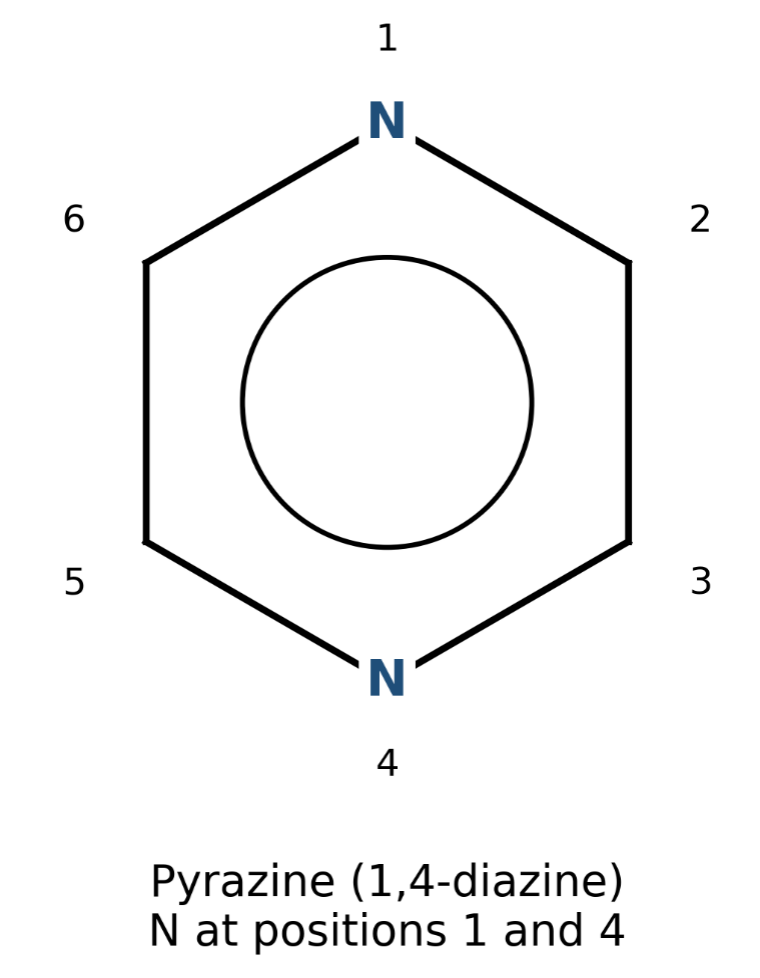
The 1- and 4-positions are ring nitrogen atoms, while the 2-, 3-, 5-, and 6-positions are the commonly substituted carbon sites. In practice, the applications of a specific compound are usually determined by the substituents at these positions. When evaluating a pyrazine-based compound, it is useful to first consider four questions.
Evaluation Question | Structural Information to Focus On | Influence on Experimental Selection |
What are the electronic properties of the core? | The pyrazine ring itself is relatively electron-deficient | Affects nucleophilic substitution, cross-coupling, hydrogen-bond acceptor ability, electron transport, and coordination behavior |
What function does the substituent provide? | Alkyl, halogen, carboxylic acid, amide, cyano, N-oxide, fused aromatic ring, etc. | Determines whether the compound is suitable for flavor analysis, synthetic modification, polarity modulation, coordination studies, or materials research |
Where is the substitution position? | Relative positions such as 2,3-, 2,5-, and 2,6- | Affects functional-group distance, molecular symmetry, coordination direction, reaction selectivity, and crystal packing |
What is the final experimental readout? | GC-MS, GC-O, reaction yield, selectivity, solubility, coordination structure, electrochemical properties, etc. | Determines whether to choose a standard, synthetic intermediate, ligand, positional isomer, or electronic-effect control compound |
Here, GC-MS refers to gas chromatography-mass spectrometry, and GC-O refers to gas chromatography-olfactometry, a technique used to record the odor characteristics of volatile components after chromatographic separation.
2 Electronic Effects of the Pyrazine Core: How the Diaza Structure Influences Reactivity, Recognition, and Coordination
Pyrazine is not simply a “nitrogen-containing benzene ring.” The two ring nitrogen atoms lower the electron density of the aromatic ring, giving pyrazine an electron-deficient character. This property further influences reaction pathways, molecular recognition, and coordination behavior.
2.1 Electron Deficiency Influences Subsequent Reaction Design
Compared with benzene, the pyrazine ring more readily exhibits the reactivity characteristics of an electron-deficient aromatic heterocycle. For derivatives such as halopyrazines and cyanopyrazines, the ring nitrogen atoms and electron-withdrawing substituents jointly influence the feasibility and selectivity of nucleophilic aromatic substitution, SNAr, or transition-metal-catalyzed coupling reactions.
Therefore, when selecting pyrazine-based intermediates in a synthetic route, it is not enough to consider only “whether a halogen is present” or “whether there is a reactive site.” One should also evaluate:
① the influence of the ring nitrogen atoms on the electron distribution;
② the position of the halogen or other leaving group;
③ whether other substituents further enhance or reduce reactivity;
④ whether the target reaction is SNAr, Suzuki-Miyaura coupling, Buchwald-Hartwig amination, or stepwise substitution for library construction.
The value of halopyrazines lies in their ability to convert the pyrazine ring into a synthetic intermediate that can be further modified. For polyhalogenated pyrazines, more reactive sites provide greater opportunities for subsequent library construction, but positional selectivity and control of side reactions become more important.
2.2 Hydrogen-Bond Acceptor Ability Influences Drug Fragment Design
The nitrogen atoms on the pyrazine ring can act as hydrogen-bond acceptors and can also alter molecular polarity, dipole distribution, and binding orientation. In medicinal chemistry, introducing a pyrazine ring is often used to tune the physicochemical properties of a molecule and its target-binding mode.
It should be noted that the pyrazine ring itself should not be equated with the source of pharmacological activity. Whether a compound containing a pyrazine structure is active depends on the overall molecular conformation, target-binding mode, solubility, permeability, metabolic stability, and safety profile. The role of the pyrazine ring is to provide tunable electronic properties, polarity, and hydrogen-bond acceptor positions.
2.3 Coordination Acceptor Ability Influences Metal Complexation and Structural Construction
The two nitrogen atoms of pyrazine can participate in metal coordination and are especially suitable for forming bridging structures. The actual coordination outcome is also related to the substituents, metal center, counterions, solvent, pH, temperature, and crystallization conditions.
Pyrazine derivatives containing hydroxyl or carboxylic acid groups may participate in coordination through the ring nitrogen atoms and may also influence crystal structures through O-atom coordination, hydrogen bonding, halogen bonding, and π-π interactions. The specific mode depends on the metal center and crystallization conditions. Related studies have shown that pyrazine-2,5-dimethanol-type ligands can form one-dimensional coordination polymers or three-dimensional coordination networks with different metal halides, demonstrating that substituents and noncovalent interactions can significantly change the final structure.
3 Effects of Substituents on the Properties and Applications of Pyrazine-Based Compounds
The pyrazine core provides electron deficiency and two nitrogen sites, but the experimental applications are usually determined by the substituents on the ring. Different substituents are key factors in modifying volatility, reactivity, polarity, coordination ability, and electronic properties. Common structural variations of pyrazines are shown below.
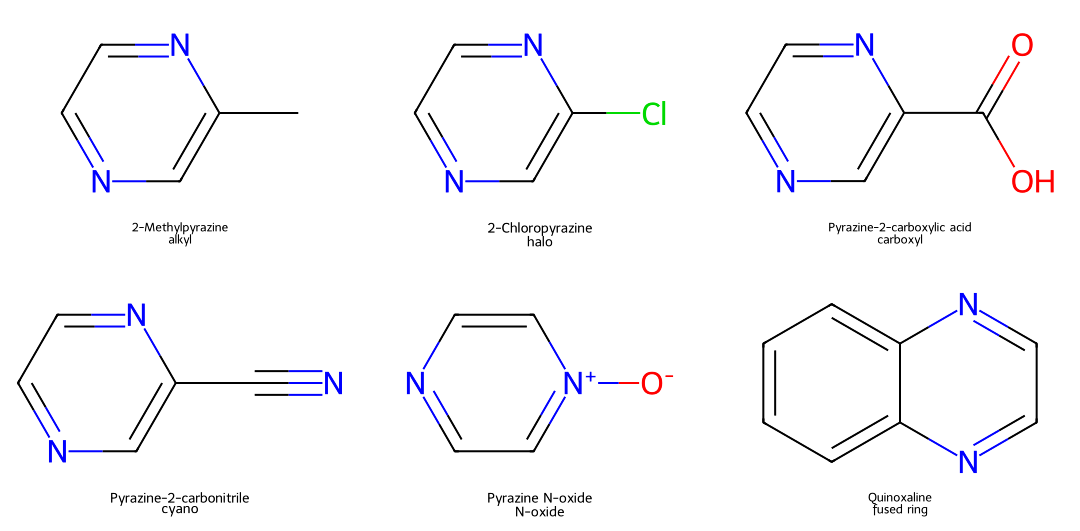
3.1 Alkyl Groups: Bringing Pyrazines into Flavor Analysis Research
Alkyl substitution changes the hydrophobicity, volatility, and odor profile of pyrazine molecules. Many alkylpyrazines are associated with roasted, nutty, cereal-like, cocoa-like, and popcorn-like aromas and are commonly found among volatile compounds produced by the Maillard reaction.
However, in flavor research, beyond determining whether “pyrazines are detected in the sample,” it is also necessary to consider:
① which specific alkylpyrazine is detected;
② whether its concentration reaches a level that contributes to sensory perception;
③ whether the food matrix affects volatile release;
④ whether appropriate standards or isotope-labeled internal standards are used;
⑤ whether GC-MS quantitative results are consistent with GC-O sensory results.
For example, studies using Maillard reaction models have shown that lysine-related dipeptide and tripeptide structures can affect the types and amounts of pyrazines generated. In some models, dipeptide systems produced higher levels of pyrazines than tripeptide systems and free amino acid control systems. Other studies have shown that temperature, heating time, and short-chain peptides can significantly affect the formation of pyrazine volatiles in sunflower-seed-protein-related models.
3.2 Halogens: Turning Pyrazines into Synthetic Intermediates for Further Modification
Halogen substituents such as chlorine, bromine, and fluorine can serve as sites for subsequent reactions, enabling pyrazine derivatives to be used in structural assembly and compound library construction. Different halopyrazines require different experimental considerations.
Structural Type | Main Evaluation Points | Common Experimental Purpose |
Chloropyrazines | Commonly used in SNAr; relatively advantageous in cost and availability | Introduction of amine, alcohol, thiol, and other nucleophilic fragments |
Bromopyrazines | Commonly used in transition-metal-catalyzed cross-coupling | Connection of aryl, heteroaryl, or other organic fragments |
Polyhalogenated pyrazines | Can undergo multistep substitution, but positional selectivity must be controlled | Rapid construction of substituted pyrazine compound libraries |
Pyrazines containing both halogens and electron-withdrawing groups | Higher reactivity, but side reactions and stability need to be evaluated | Fine functionalization and synthesis of medicinal chemistry intermediates |
In route design, the choice of a halopyrazine should be guided by the next reaction step. If the target is nucleophilic substitution, priority should be given to the leaving group, degree of electron deficiency, and compatibility of the nucleophile. If the target is cross-coupling, the halogen type, catalytic system, substrate coordination behavior, and functional-group tolerance should be considered.
3.3 Carboxylic Acids, Esters, and Amides: Turning Pyrazines into Structural Units with Tunable Polarity and Connectivity
Carboxylic acid, ester, and amide substituents can significantly alter the solubility, hydrogen-bonding network, and subsequent transformation pathways of pyrazine-based compounds.
Substituent | Main Role | Experimental Significance |
Carboxylic acid | Increases polarity, can form salts, can participate in coordination | Used for solubility modulation, coordination studies, and as a precursor for amidation |
Ester | Can serve as a protected form of a carboxylic acid or as a transformation intermediate | Used for temporary protection in synthetic routes and subsequent hydrolysis |
Amide | Provides a combination of hydrogen-bond donor and acceptor functions and changes polarity | Used in drug fragment design, molecular recognition, and physicochemical property tuning |
In medicinal chemistry, pyrazinecarboxylic acid and pyrazinecarboxamide structures are often used to tune polarity, hydrogen-bonding ability, and binding orientation. In coordination chemistry, carboxylic acid groups can also serve as metal-coordination anchors and work together with the nitrogen atoms on the pyrazine ring to influence structural connectivity.
3.4 Cyano Groups and N-Oxides: Fine-Tuning Electronic Effects
The cyano group is a strong electron-withdrawing group and can further enhance the electron-deficient character of the pyrazine ring. N-oxides significantly alter the electronic state of the nitrogen atom, molecular polarity, reaction sites, and coordination behavior through the N→O structure; their electronic effects should not be regarded as those of a simple electron-withdrawing substituent.
These structures are suitable for the following types of studies:
① comparing the effects of electron-withdrawing substituents or N-oxide structures on reaction activity and electronic distribution;
② studying changes in the electronic distribution of nitrogen-containing aromatic heterocycles;
③ regulating coordination behavior and intermolecular interactions;
④ tuning energy levels, packing, and charge transport in organic semiconductors or optoelectronic materials.
For example, cyano-functionalized pyrazines, as highly electron-deficient structural units, have been used in studies of solid additives for organic solar cells, OSCs. Related work has shown that 3,6-dibromopyrazine-2-carbonitrile and 3,6-dibromopyrazine-2,5-dicarbonitrile can regulate intermolecular interactions and molecular packing, thereby improving the power conversion efficiency, PCE, of devices.
3.5 Fused Pyrazine Systems: How Benzo-Fused Structures Change Conjugation, Planarity, and Molecular Properties
Quinoxaline can be regarded as a benzopyrazine structure. After fusion with a benzene ring, the π-conjugated system of the molecule is enlarged, and its planarity, hydrophobicity, optoelectronic properties, and target-binding mode all change. Quinoxaline is suitable as an extended conjugated heteroaromatic structure for medicinal chemistry, optoelectronic materials, coordination chemistry, and organic synthesis research.
4 Influence of Substitution Positions on the Spatial Configuration and Reaction Behavior of Pyrazine-Based Compounds
For disubstituted pyrazines, the experimental behavior of 2,3-, 2,5-, and 2,6-isomers may differ. This is because the substitution positions determine the distance, direction, and symmetry between functional groups. Positional isomers of dihalopyrazines are illustrated below.
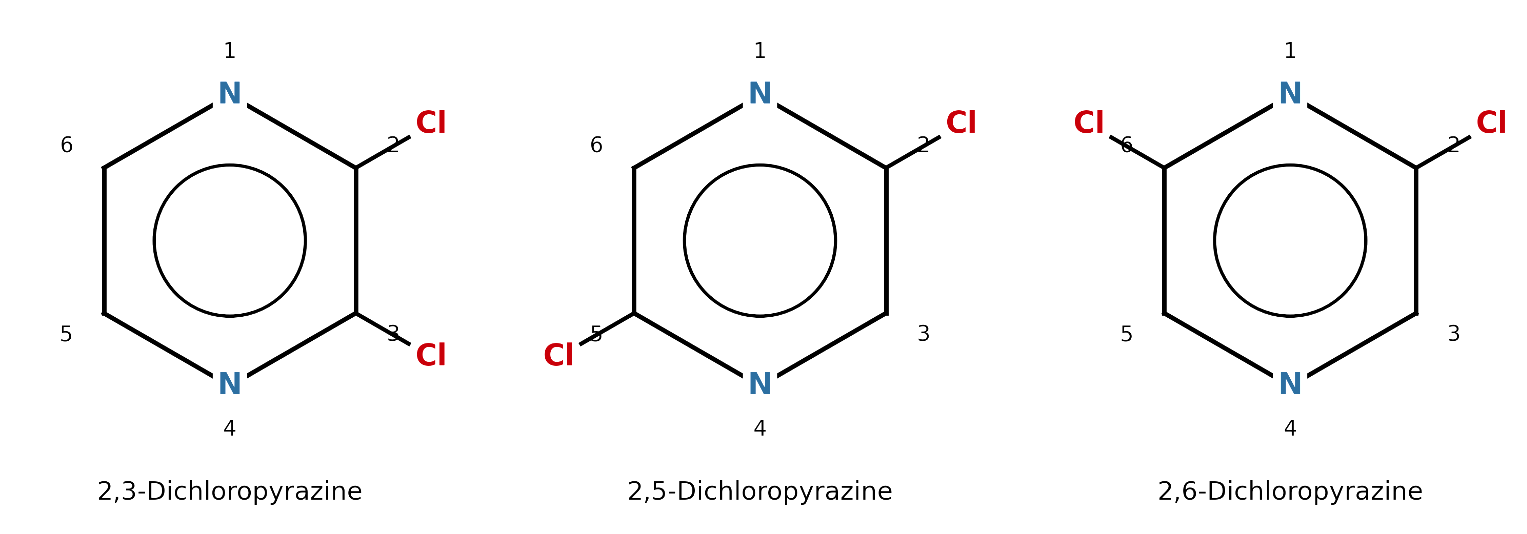
4.1 Functional-Group Distance Influences Interaction Modes
When two substituents are close to each other, stronger steric hindrance may arise, and intramolecular interactions or chelation tendencies may also occur. When two substituents are farther apart, extended connectivity or regular arrangement is more favorable. Taking pyrazinedicarboxylic acids as an example, different positions of the carboxylic acid groups can affect metal coordination direction, hydrogen-bonding networks, and crystal structures. Taking dihalopyrazines as another example, different halogen positions can affect selectivity in subsequent stepwise substitution or coupling reactions.
4.2 Symmetry Influences Structural Predictability
Symmetrically substituted compounds are usually more suitable for constructing regular structures, such as coordination polymers, metal-organic frameworks, MOFs, or systems for crystal engineering. Unsymmetrically substituted compounds are more suitable for introducing directional differences to modulate local interactions or build asymmetric molecules.
Therefore, when selecting compounds for experiments, it is also necessary to further assess:
① whether the two functional groups are adjacent;
② whether the molecule has relatively high symmetry;
③ whether the substituent orientation matches the target connectivity;
④ whether positional isomers are needed as controls.
4.3 Substitution Positions Influence Subsequent Reaction Selectivity
Subsequent reactions of polysubstituted pyrazines are often jointly influenced by three types of factors:
① Electronic effects: ring nitrogen atoms and electron-withdrawing substituents can alter the reactivity of different carbon positions.
② Steric effects: existing substituents may hinder the approach of nucleophiles, metal catalysts, or coupling partners to the reaction site.
③ Differences in leaving groups: chlorine, bromine, fluorine, and other leaving groups behave differently in different reaction systems.
For dihalogenated or polyhalogenated pyrazines, the key issue in reaction design is not simply “whether the reaction can occur,” but how to control whether the first and second reactions occur at the desired positions.
5 Key Points for Experimental Selection of Pyrazine-Based Compounds
5.1 What Experimental Problem Needs to Be Solved?
Different experimental objectives correspond to different structural requirements.
Experimental Objective | Structural Factors to Prioritize |
Flavor analysis | Alkyl substitution, volatility, threshold values, standards, and internal standards |
Synthetic modification | Transformable sites such as halogens, boronic acids, amino groups, aldehydes, and carboxylate esters |
Medicinal chemistry | Polarity, hydrogen-bond acceptors, amide/carboxylic acid structures, and substitution orientation |
Coordination chemistry | Ring N atoms, carboxylic acid/hydroxyl groups, polynitrogen ligands, and substitution symmetry |
Materials research | Conjugation length, electron-withdrawing groups, molecular planarity, and packing mode |
Method validation | Structurally similar standards, isotope-labeled internal standards, and positional isomer controls |
5.2 What Function Does the Key Substituent Provide?
Alkyl groups mainly affect volatility and odor characteristics. Halogens mainly provide reactive sites for subsequent transformations. Carboxylic acids, esters, and amides mainly affect polarity, salt formation, coordination, and subsequent transformations. Cyano groups and N-oxides are mainly used to tune electronic effects. Fused structures expand the conjugated system and alter the overall molecular properties.
5.3 Does the Substitution Position Affect Directionality?
For disubstituted and polysubstituted pyrazines, position must be considered. Differences among 2,3-, 2,5-, and 2,6-substitution patterns can affect the distance between functional groups, molecular symmetry, coordination angle, subsequent reaction sites, crystal packing, and molecular arrangement in materials. If the experimental objective involves coordination, assembly, stepwise substitution, or comparison of positional isomers, the substitution position is often more critical than the functional-group type alone.
5.4 What Is the Final Experimental Readout?
Different research directions have different evaluation metrics. Flavor analysis focuses on GC-MS quantification, GC-O olfactometry results, odor activity values, and matrix effects. Synthetic studies focus on yield, regioselectivity, functional-group compatibility, and purification difficulty. Medicinal chemistry focuses on activity, solubility, permeability, metabolic stability, and safety. Coordination and materials research focuses on crystal structure, coordination dimensionality, energy levels, packing, electrochemical response, and device performance.
5.5 Are Control Compounds Needed?
In pyrazine-related research, control compounds often determine whether the results are reliable.
① Flavor quantification requires standards; in complex matrices, isotope-labeled internal standards should be prioritized.
② Electronic-effect studies require comparisons between electron-withdrawing and electron-donating substituents.
③ Positional-effect studies require isomeric controls such as 2,3-, 2,5-, and 2,6-isomers.
④ Coordination studies require comparisons of different substituents and metal centers.
⑤ Medicinal chemistry studies require structurally similar analogues to validate structure-activity relationships.
6 Representative Product Classification Tables Related to Structural Variables and Research Applications of Pyrazine-Based Compounds
Table 1 Basic Cores, Isotope-Labeled Internal Standards, and Volatile Pyrazine Products
Category | CAS No. | Aladdin Cat. No. | Name | Specification or Purity | Product Features and Applications |
Unsubstituted pyrazine core | 290-37-9 | Pyrazine | ≥99% | Basic pyrazine core, used for comparing the properties of electron-deficient diaza aromatic rings, establishing volatile-compound analytical methods, and serving as a structural reference for derivatives | |
Deuterated pyrazine internal standard | 1758-62-9 | Pyrazine-d4 | ≥98 atom% D, ≥98% | Deuterated pyrazine, used for volatile pyrazine quantification, internal-standard analysis, instrument response correction, and matrix-effect evaluation | |
Monomethyl volatile pyrazine | 109-08-0 | 2-Methylpyrazine | ≥98% (GC) | Monoalkyl-substituted pyrazine, used for the analysis of nitrogen-containing volatile compounds in thermally processed foods, fermented samples, and roasted flavor systems | |
Monoethyl volatile pyrazine | 13925-00-3 | 2-Ethylpyrazine | ≥99% (GC) | Ethyl-substituted pyrazine, used for identifying Maillard reaction products, volatile-compound quantification, and gas chromatography method development | |
2,3-Dimethyl positional isomer | 5910-89-4 | 2,3-Dimethylpyrazine | ≥98% | Adjacent dimethyl-substituted pyrazine, used to study the influence of alkyl substitution positions on aroma characteristics, retention behavior, and volatility | |
2,5-Dimethyl positional isomer | 123-32-0 | 2,5-Dimethylpyrazine | ≥98% | Symmetrical dimethyl-substituted pyrazine, used for volatile analysis of roasted samples, isomer separation, and comparison of quantitative methods | |
2,6-Dimethyl positional isomer | 108-50-9 | 2,6-Dimethylpyrazine | ≥98% (GC) | Dimethylpyrazine positional isomer, used for optimizing gas chromatography separation conditions and comparing structural differences among alkylpyrazines | |
Trimethyl volatile pyrazine | 14667-55-1 | 2,3,5-Trimethylpyrazine | ≥99% | Polyalkyl-substituted pyrazine, used in thermal reaction models, nutty volatile analysis, and studies of Maillard reaction pathways | |
Tetramethyl volatile pyrazine | 1124-11-4 | 2,3,5,6-Tetramethylpyrazine | ≥98% | Highly alkyl-substituted pyrazine, used for roasted flavor research, analysis of naturally occurring pyrazines, and structural reference experiments | |
2-Ethyl-3-methyl positional isomer | 15707-23-0 | 2-Ethyl-3-methylpyrazine | ≥99% | Ethyl- and methyl-substituted pyrazine, used for identifying volatile isomers, analyzing thermally processed samples, and comparing retention behavior | |
Ethyl methyl pyrazine isomer mixture | 13360-64-0 | 2-Ethyl-5-methylpyrazine | ≥98%, mixture of 2-Ethyl-5-methylpyrazine and 2-ethyl-6-methylpyrazine | Ethyl methyl pyrazine isomer mixture, used for volatile-compound screening, method applicability evaluation, and development of isomer separation conditions | |
2-Ethyl-6-methyl positional isomer | 13925-03-6 | 2-Ethyl-6-methylpyrazine | ≥98% | Ethyl methyl-substituted positional isomer, used for volatile pyrazine quantification, isomer controls, and validation of flavor analysis methods | |
Acyl-substituted volatile pyrazine | 22047-25-2 | 2-Acetylpyrazine | ≥99% | Acyl-substituted pyrazine, used for the analysis of roasted and nutty volatile compounds and for studying the influence of carbonyl substitution on odor characteristics | |
Methoxy-substituted pyrazine | 3149-28-8 | 2-Methoxypyrazine | ≥98% | Basic methoxypyrazine structure, used for studying the effects of oxygen-containing substitution on volatility, odor characteristics, and detection response | |
Methoxy methyl pyrazine | 2847-30-5 | 2-Methoxy-3-methylpyrazine | ≥99% | Pyrazine co-substituted with methoxy and methyl groups, used for analyzing nitrogen-containing volatile compounds in plant-derived, fermented, and thermally processed samples | |
Isopropyl methoxy pyrazine | 25773-40-4 | 2-Isopropyl-3-methoxypyrazine | ≥98% (GC) | Branched-alkyl methoxypyrazine, used for detecting green and vegetable-like volatiles and for studying trace nitrogen-containing aroma compounds | |
Isobutyl methoxy pyrazine | 24683-00-9 | 2-Isobutyl-3-methoxypyrazine | ≥99% | Branched-alkyl methoxypyrazine, used for analyzing low-threshold volatiles in wine, fruits and vegetables, and fermented samples |
Table 2 Halopyrazines and Coupling/Substitution Building Blocks
Category | CAS No. | Aladdin Cat. No. | Name | Specification or Purity | Product Features and Applications |
Monofluoropyrazine building block | 4949-13-7 | 2-Fluoropyrazine | ≥97% | Fluoropyrazine substrate, used for nucleophilic aromatic substitution, synthesis of fluorinated heteroaromatic derivatives, and comparison of leaving-group effects | |
Monochloropyrazine building block | 14508-49-7 | 2-Chloropyrazine | ≥98% | Chloropyrazine intermediate, used for amination, etherification, thioetherification, and introduction of pyrazine-containing fragments | |
Monobromopyrazine building block | 56423-63-3 | 2-Bromopyrazine | ≥97% | Bromopyrazine intermediate, used for metal-catalyzed coupling, heteroaryl linkage formation, and medicinal chemistry structural modification | |
Monoiodopyrazine building block | 32111-21-0 | 2-Iodopyrazine | ≥97% (GC) | Iodopyrazine intermediate, used for coupling reactions, transformation of iodinated sites, and pyrazine-ring functionalization studies | |
2,3-Dichloro positional isomer | 4858-85-9 | 2,3-Dichloropyrazine | ≥98% (GC) | Adjacent dichloro-substituted pyrazine, used for stepwise substitution, positional selectivity studies, and construction of ortho-disubstituted structures | |
2,5-Dichloro positional isomer | 19745-07-4 | 2,5-Dichloropyrazine | ≥97% | 2,5-Dichloro-substituted pyrazine, used for dual-site derivatization, synthesis of symmetrical substituted structures, and studies of connection directionality | |
2,6-Dichloro positional isomer | 4774-14-5 | 2,6-Dichloropyrazine | ≥98% | 2,6-Dichloro-substituted pyrazine, used for comparison of positional effects, sequential nucleophilic substitution, and modification of disubstituted pyrazine scaffolds | |
2,3-Dibromo positional isomer | 95538-03-7 | 2,3-Dibromopyrazine | ≥98% | Adjacent dibromo-substituted pyrazine, used for stepwise coupling, synthesis of ortho-disubstituted structures, and studies of positional effects | |
2,5-Dibromo positional isomer | 23229-26-7 | 2,5-Dibromopyrazine | ≥98% (GC) | 2,5-Dibromo-substituted pyrazine, used for double coupling reactions, extension of conjugated structures, and construction of symmetrical heteroaromatic structures | |
2,6-Dibromo positional isomer | 23229-25-6 | 2,6-Dibromopyrazine | ≥95% | 2,6-Dibromo-substituted pyrazine, used for the synthesis of diarylpyrazines and diheteroarylpyrazines and for comparison of positional isomers | |
Tetrachloropyrazine building block | 13484-50-9 | Tetrachloropyrazine | ≥97% | Polychlorinated pyrazine, used for multistep nucleophilic substitution, control of substitution sequence, and studies of strongly electron-deficient heteroaromatic structures | |
Amino dibromopyrazine building block | 24241-18-7 | 2-Amino-3,5-dibromopyrazine | ≥97% | Pyrazine intermediate containing both an amino group and two brominated sites, used for multistep derivatization, coupling reactions, and assembly of nitrogen-containing heterocycles | |
Pyrazine boronic acid coupling building block | 762263-64-9 | Pyrazin-2-ylboronic acid, containing varying amounts of anhydride | ≥97% | Pyrazine boronic acid-type building block, used for carbon-carbon bond coupling, introduction of pyrazinyl fragments, and linkage of heteroaryl structures |
Table 3 Amino-, Carboxylic Acid-, Ester-, Aldehyde-, and Nitrile-Functionalized Pyrazine Intermediates
Category | CAS No. | Aladdin Cat. No. | Name | Specification or Purity | Product Features and Applications |
Amino-substituted pyrazine intermediate | 5049-61-6 | Aminopyrazine | ≥99% | Amino-substituted pyrazine, used for amidation, synthesis of urea-type structures, hydrogen-bonding studies, and drug fragment modification | |
Pyrazinecarboxylic acid intermediate | 98-97-5 | Pyrazine-2-carboxylic acid | ≥98% | Carboxylic acid-substituted pyrazine, used for salt formation, amidation, coordination studies, and introduction of polar pyrazine structures | |
Pyrazinecarboxylate ester intermediate | 6164-79-0 | Methyl pyrazine-2-carboxylate | ≥97% (GC) | Pyrazinecarboxylate ester, used for ester hydrolysis, amidation, transesterification, and synthesis of carboxylic acid derivatives | |
Pyrazine aldehyde intermediate | 5780-66-5 | Pyrazine-2-carbaldehyde | ≥97% | Aldehyde-substituted pyrazine, used for condensation reactions, reductive amination, Schiff base ligand synthesis, and extension of heteroaromatic structures | |
Cyano-substituted pyrazine intermediate | 19847-12-2 | 2-Cyanopyrazine | ≥99% | Nitrile-substituted pyrazine, used for studies of electron-withdrawing effects, conversion to carboxylic acids or amides, and modulation of electron-deficient heteroaromatic properties | |
Amino carboxylic acid bifunctional pyrazine | 5424-01-1 | 3-Aminopyrazine-2-carboxylic acid | ≥98% | Pyrazine intermediate containing both amino and carboxylic acid groups, used for amidation, molecular recognition studies, and design of multipoint-interaction structures |
Table 4 Polycarboxylic Acid Pyrazines, Polynitrogen Ligands, and N-Oxide Products
Category | CAS No. | Aladdin Cat. No. | Name | Specification or Purity | Product Features and Applications |
2,3-Dicarboxylic acid coordination ligand | 89-01-0 | Pyrazine-2,3-dicarboxylic acid | ≥97% | Adjacent dicarboxylic acid pyrazine, used for metal coordination, construction of hydrogen-bonding networks, and comparison of carboxylic acid positional effects | |
2,5-Dicarboxylic acid coordination ligand | 122-05-4 | Pyrazine-2,5-dicarboxylic acid | ≥97% | Symmetrical dicarboxylic acid pyrazine, used for coordination polymers, metal-organic frameworks, and regular connection structures | |
2,6-Dicarboxylic acid coordination ligand | 940-07-8 | Pyrazine-2,6-dicarboxylic acid | ≥95% | 2,6-Dicarboxylic acid pyrazine, used for studying the effects of carboxylic acid directionality on coordination geometry, crystal structure, and hydrogen-bonding networks | |
Tetracarboxylic acid pyrazine multi-connecting ligand | 43193-60-8 | Pyrazinetetracarboxylic acid | ≥97% | Tetracarboxylic acid-substituted pyrazine, used for multipoint coordination, construction of highly connected networks, and studies of nitrogen-containing polycarboxylate ligands | |
Bipyrazine polynitrogen ligand | 10199-00-5 | 2,2'-Bipyrazine | ≥97% (GC) | Bipyrazine-type polynitrogen ligand, used for metal complexation, electronically coupled systems, and construction of polynitrogen coordination structures | |
Polypyridyl pyrazine ligand | 25005-97-4 | Tetra-2-pyridylpyrazine | ≥94% | Polypyridyl pyrazine ligand, used for transition-metal complexes, multinuclear coordination structures, luminescent properties, and electrochemical studies | |
Pyrazine monoxide | 2423-65-6 | Pyrazine N-oxide | ≥97% | Pyrazine N-oxide, used for tuning the electronic state of nitrogen atoms, comparing reaction activity, and studying coordination behavior | |
Pyrazine dioxide | 2423-84-9 | Pyrazine 1,4-dioxide | ≥95% | Bis-N-oxide pyrazine, used for polarity modulation, comparison of electron-withdrawing effects, and studies of oxidation states in nitrogen-containing aromatic heterocycles |
Table 5 Quinoxalines and Fused Pyrazine Extended Scaffolds
Category | CAS No. | Aladdin Cat. No. | Name | Specification or Purity | Product Features and Applications |
Quinoxaline core | 91-19-0 | Quinoxaline | ≥99% (GC) | Benzopyrazine core, used as an extended conjugated heteroaromatic structure for drug fragment synthesis and optoelectronic materials research | |
Dihydroxyquinoxaline derivative | 15804-19-0 | 2,3-Dihydroxyquinoxaline | ≥98% | Dihydroxyquinoxaline derivative, used for studies of hydrogen-bonding interactions, coordination behavior, and functional-group effects in fused heterocycles | |
Quinoxaline carboxylic acid derivative | 879-65-2 | Quinoxaline-2-carboxylic acid | ≥97% | Carboxylic acid-substituted quinoxaline, used for polarity modulation, amidation, coordination studies, and derivatization of fused heterocycles | |
Quinoxaline dioxide derivative | 17311-31-8 | Dioxidine | ≥95% | Quinoxaline dioxide derivative, used for studies of N-oxide electronic effects, hydroxymethyl-substituted structures, and medicinal chemistry reference comparisons |
Table 6 Drug Research Products Related to Pyrazine-Containing Structures
Category | CAS No. | Aladdin Cat. No. | Name | Specification or Purity | Product Features and Applications |
Pyrazinecarboxamide drug research product | 98-96-4 | Pyrazinamide | Moligand™, ≥98% | Pyrazinecarboxamide-structured compound, used for tuberculosis-related research, pharmaceutical analysis, and structural reference of amide-substituted pyrazines | |
Fluoro-hydroxy pyrazinecarboxamide drug research product | 259793-96-9 | Favipiravir | Moligand™, ≥99% | Fluoro-hydroxy pyrazinecarboxamide-containing compound, used for pharmaceutical analysis, quality control, and structural comparison of heterocyclic drugs | |
Chloropyrazine carboxamidine drug research product | 2016-88-8 | Amiloride hydrochloride hydrate | Moligand™, ≥98% | Chloropyrazine carboxamidine-containing compound, used for pharmaceutical analysis, ion transport-related research, and salt-form reference experiments | |
Chloropyrazine carboxamidine hydrated salt research product | 17440-83-4 | Amiloride hydrochloride dihydrate | Moligand™, ≥98% | Hydrated salt form of pyrazine carboxamidine, used for solubility comparison, salt-form difference studies, pharmaceutical analysis, and activity reference comparisons |
Note: The above are representative Aladdin products related to scientific research and formulation research. For more information on product specifications, grades, and COA data, please search by “product name/CAS/Cat. No.” on the Aladdin official website.
For more related articles, please see below: