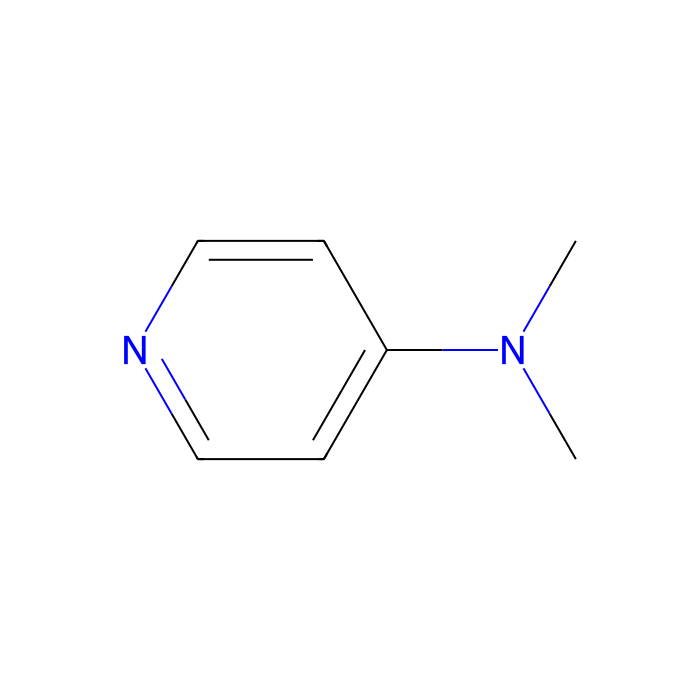
4-Dimethylaminopyridine - ≥99% , CAS No.1122-58-3

CAS: 1122-58-3 Cat. No.: D109207 Formula: C7H10N2 Molecular Weight: 122.17 Beilstein Registry Number: 3539759 EC Number: 214-353-5
AVAILABLE TO ORDER
GRADE & PURITY ≥99%
Synonyms
N,N-dimethyl 4-pyridinamine | p-dimethylamino pyridine | (4-DMAP);4-Dimethylaminopyridine | 4-di methylaminopyridine | 4-Dimethylaminepyridine | N,N-dimethyl-N-(4-pyridinyl)amine | dimethyl-pyridin-4-yl-amine | dimethyl-pyridin-4yl-amine | dimethylpyridin
Storage
Protected from light,Room temperature
Shipped In
Normal
★
Size
USA
Germany (EU)*
Price
Qty
25g
D109207-25g
9 In stock
—
$9.90
100g
D109207-100g
In stock ≥10
—
$15.90
500g
D109207-500g
1 In stock
—
$59.90
12×500g
D109207-12×500g
Made to order · 8–12 wks
$599.90
Enter a quantity for the sizes you want to add.
🧪
Why this grade

≥99% for sensitive chromatographic and analytical workflows requiring minimal baseline interference.

🌡

Storage & shipping

Protected from light,Room temperature Ships Normal Check lot-specific COA for exact specifications.

📋

Quality documents

SDS, COA, datasheet, and spec sheet available for download. Lot-specific COA accessible via lot number lookup.

📚

Literature proof

Cited in 1713 peer-reviewed publications across chromatography, organic synthesis, and cross-coupling reactions.

Overview

A highly efficient catalyst for acylation reactions

4-Dimethylaminopyridine (DMAP) is a versatile nucleophilic catalyst used in acylation and esterification reactions. It can also be used in various organic transformations such as Baylis-Hillman reaction, Dakin-West reaction, protection of amines, C-acylation, silylation, and applications in natural product chemistry.
Application
4-Dimethylaminopyridine can be used as a catalyst for the following reactions:
Synthesis of 3,5-substituted 2,6-dicyanoanilines by reaction with malononitrile, aldehydes and β-nitroolefins.
Acylation of alcohols with anhydrides to synthesize the corresponding esters in the absence of auxiliary bases and solvents.
Baylis-Hillman reaction to generate carbon-carbon bonds by coupling of activated alkenes with aldehydes or ketones.
Efficient catalyst for acylation reactions.

Specifications

Synonyms
N,N-dimethyl 4-pyridinamine | p-dimethylamino pyridine | (4-DMAP);4-Dimethylaminopyridine | 4-di methylaminopyridine | 4-Dimethylaminepyridine | N,N-dimethyl-N-(4-pyridinyl)amine | dimethyl-pyridin-4-yl-amine | dimethyl-pyridin-4yl-amine | dimethylpyridin
Specifications & Purity
≥99%
Storage
Protected from light,Room temperature
Shipped In
Normal
Purity
≥99%
Names and Identifiers
Pubchem Sid504752548
Pubchem Sid Urlhttps://pubchem.ncbi.nlm.nih.gov/substance/504752548
Canonical SmilesCN(C)C1=CC=NC=C1
IUPAC NameN,N-dimethylpyridin-4-amine
InChIKeyVHYFNPMBLIVWCW-UHFFFAOYSA-N
INCHI1S/C7H10N2/c1-9(2)7-3-5-8-6-4-7/h3-6H,1-2H3
Isomeric SMILES CN(C)C1=CC=NC=C1
WGK Germany 3
RTECS US9230000
UN Number 2811
Molecular Weight 122.17
Beilstein 3539759
Reaxy-Rn 110354
Reaxys-RN_link_address https://www.reaxys.com/reaxys/secured/hopinto.do?context=S&query=IDE.XRN=110354&ln=

Documentation

📋 Safety Data Sheet (SDS)

Comprehensive hazard, handling, storage, and regulatory compliance document.

Download SDS →

✅ Certificate of Analysis (COA)

Lot-specific quality data. Enter your lot number to retrieve the exact COA.

Look up COA →

📊 Datasheet

Quick-reference summary of product specifications and applications.

View datasheet →

🔬 Specification Sheet

Full quality attributes and acceptance criteria for this grade.

View spec sheet →

Advanced Data

Taxonomic Classification

Taxonomy Tree

KingdomOrganic compounds
SuperclassOrganic nitrogen compounds
ClassOrganonitrogen compounds
SubclassAmines
Intermediate Tree Nodes Tertiary amines - Tertiary alkylarylamines
Direct ParentDialkylarylamines
Alternative Parents Aminopyridines and derivatives  Heteroaromatic compounds  Azacyclic compounds  Organopnictogen compounds  Hydrocarbon derivatives  
Molecular FrameworkAromatic heteromonocyclic compounds
Substituents Dialkylarylamine - Aminopyridine - Pyridine - Heteroaromatic compound - Azacycle - Organoheterocyclic compound - Organopnictogen compound - Hydrocarbon derivative - Aromatic heteromonocyclic compound
DescriptionThis compound belongs to the class of organic compounds known as dialkylarylamines. These are aliphatic aromatic amines in which the amino group is linked to two aliphatic chains and one aromatic group.
External Descriptors Not available
3D Structure
Interactive Chemical Structure Model


Mechanisms of Action
Certificates(CoA,COO,BSE/TSE and Analysis Chart)
C of A & Other Certificates(BSE/TSE, COO):
Analytical Chart:

Find and download the COA for your product by matching the lot number on the packaging.

54 results found

Lot NumberCertificate TypeDateItem
H2619301Certificate of AnalysisJul 17, 2026 D109207
H2619299Certificate of AnalysisJul 17, 2026 D109207
H2619300Certificate of AnalysisJul 17, 2026 D109207
F2612584Certificate of AnalysisJun 09, 2026 D109207
F2612585Certificate of AnalysisJun 09, 2026 D109207
F2612583Certificate of AnalysisJun 09, 2026 D109207
A2615278Certificate of AnalysisDec 15, 2025 D109207
A2615291Certificate of AnalysisDec 15, 2025 D109207
A2615292Certificate of AnalysisDec 15, 2025 D109207
K2517533Certificate of AnalysisNov 11, 2025 D109207
C2631098Certificate of AnalysisNov 11, 2025 D109207
K2517530Certificate of AnalysisNov 11, 2025 D109207
K2517434Certificate of AnalysisNov 11, 2025 D109207
E2523268Certificate of AnalysisMay 17, 2025 D109207
E2523242Certificate of AnalysisMay 17, 2025 D109207
E2523218Certificate of AnalysisMay 17, 2025 D109207
D2511506Certificate of AnalysisApr 07, 2025 D109207
H2507051Certificate of AnalysisApr 07, 2025 D109207
D2511409Certificate of AnalysisApr 07, 2025 D109207
D2511408Certificate of AnalysisApr 07, 2025 D109207
A2507595Certificate of AnalysisDec 30, 2024 D109207
A2507546Certificate of AnalysisDec 30, 2024 D109207
A2507459Certificate of AnalysisDec 30, 2024 D109207
K2422295Certificate of AnalysisNov 15, 2024 D109207
K2422294Certificate of AnalysisNov 15, 2024 D109207
K2422443Certificate of AnalysisNov 15, 2024 D109207
J2409759Certificate of AnalysisSep 27, 2024 D109207
J2409757Certificate of AnalysisSep 27, 2024 D109207
H2419474Certificate of AnalysisAug 09, 2024 D109207
H2419475Certificate of AnalysisAug 09, 2024 D109207
H2419483Certificate of AnalysisAug 09, 2024 D109207
F2222066Certificate of AnalysisMar 21, 2024 D109207
F2222065Certificate of AnalysisMar 21, 2024 D109207
F2222049Certificate of AnalysisMar 21, 2024 D109207
L2103502Certificate of AnalysisSep 19, 2023 D109207
L2103504Certificate of AnalysisSep 19, 2023 D109207
L2103507Certificate of AnalysisSep 19, 2023 D109207
J2114361Certificate of AnalysisJul 11, 2023 D109207
F2130157Certificate of AnalysisApr 12, 2023 D109207
F2130154Certificate of AnalysisApr 12, 2023 D109207
L2306109Certificate of AnalysisApr 10, 2023 D109207
G2409023Certificate of AnalysisApr 10, 2023 D109207
E2308779Certificate of AnalysisApr 10, 2023 D109207
E2308695Certificate of AnalysisApr 10, 2023 D109207
E2308551Certificate of AnalysisApr 10, 2023 D109207
E2308541Certificate of AnalysisApr 10, 2023 D109207
E2308486Certificate of AnalysisApr 10, 2023 D109207
E2308464Certificate of AnalysisApr 10, 2023 D109207
A2419051Certificate of AnalysisApr 10, 2023 D109207
B2103158Certificate of AnalysisDec 12, 2022 D109207
B2103155Certificate of AnalysisDec 12, 2022 D109207
A2309307Certificate of AnalysisNov 29, 2022 D109207
F2222068Certificate of AnalysisMay 30, 2022 D109207
C23101285Certificate of AnalysisMay 30, 2022 D109207
Chemical and Physical Properties
SolubilitySoluble in methanol, benzene, ethyl acetate, chloroform, methylene chloride, acetone, and acetic acid. Slightly soluble in ether, diisopropyl ether, cyclohexane, hexane, and water.
Sensitivitylight sensitive
Flash Point(°F)230 °F
Flash Point(°C)110 ℃
Boil Point(°C)162°C
Melt Point(°C)110°C
Molecular Weight122.170 g/mol
XLogP31.300
Hydrogen Bond Donor Count0
Hydrogen Bond Acceptor Count2
Rotatable Bond Count1
Exact Mass122.084 Da
Monoisotopic Mass122.084 Da
Topological Polar Surface Area16.100 Ų
Heavy Atom Count9
Formal Charge0
Complexity75.000
Isotope Atom Count0
Defined Atom Stereocenter Count0
Undefined Atom Stereocenter Count0
Defined Bond Stereocenter Count0
Undefined Bond Stereocenter Count0
The total count of all stereochemical bonds0
Covalently-Bonded Unit Count1
Documents & Articles
Fluid chemistry: Lighting the fire of hope for the large-scale production of anticancer drugs
Tert-Butyl Nitrite (TBN)
A Practical Guide to Small-Molecule Chemical Probes: Concept Clarification, Causal Validation, and Experimental Selection (with Product Navigation and Tables A–D)
From Piperidine to Pyridine: The “Most Common N-Heterocycle” Shift in FDA Small-Molecule New Drugs (2013–2023) and a Selection Guide (Tables 1–4)
Salen-Catalyzed CO₂–Epoxide Ring-Opening Copolymerization (ROCOP) Guide: From Three-Way Chain-End Competition to Selective Control of Highly Alternating Polycarbonates and Reproducible Troubleshooting (Tables 1–4)
Pyridine Research Selection Roadmap: Structural Features, Reaction Logic, and a Classification Navigator for Reagents/Building Blocks/Reference Standards (Tables 1–6)
β-Acyloxy Alkenyl Amides (AAAs): A New Approach to Amide Bond and Peptide Bond Construction Worth Attention
Understanding ATD-DMAP: From Reagent Design to Esterification, Amidation, and Stereochemical Integrity
A New Balance in Coupling Reagents: How DMT-TU Balances Reactivity, Racemization Control, and Thermal Hazard
Reconsidering N-Acyl Amino Protecting Groups: Deprotection Differences, Strategic Roles, and Experimental Selection of Ac, Bz, and Tfa
The Methodological Value of Boc-Oxyma: Low-Racemization Coupling, Route Continuity, and Extended Applications
The Methodological Value of DSC: Building NHS-Type Activated Intermediates and Deciding When to Use Them
The Methodological Value of TPS-Cl: The Logic of Selective Activation and Representative Transformations in Nucleoside and Nucleotide Chemistry
Experimental Selection Logic for Carboxylic Acid Preactivation Pathways: Differences and Suitable Use Cases for Classical Mixed Anhydrides, CDI, Sulfonyl Chloride Systems, and the Yamaguchi System
Boc₂O Selection Cannot Be Judged by Protection Installation Alone: Experimental Decision-Making from Substrate Nucleophilicity and Medium Effects to Deprotection Pathways
DMAP Is More Than Just an Organic Base: Experimental Judgment from Nucleophilic Acyl Transfer to Esterification and Macrolactonization
Experimental Evaluation of Triphosgene in Organic Synthesis: Understanding Its Selection Logic Through Reaction Tasks
4-[(tert-Butyldimethylsilyl)oxy]butan-1-ol: Experimental Selection Logic as a Monoprotected 1,4-Butanediol Building Block and a Protected C4 Linker
Experimental Considerations for the Use of ADMP in the Conversion of Primary Amines to Organic Azides: Substrate Nucleophilicity, Base Matching, and Medium Selection
Experimental Judgment for CMPI in Carboxylic Acid Activation: Applicable Tasks, Base Matching, and Workup Burden
Reaction Selection in Small-Molecule Synthesis: From Transformation-Type Assessment to Experimental Route Screening
Why Small Molecules Can Also Serve as Catalysts: Judging Organocatalytic Systems from Reaction Objectives and Activatable Structural Sites
Selective Acylation of Less Reactive Amines in Complex Substrates: Strategies for N/O and N/N Selectivity Control This article draws on the work of Li et al. on the TCFH/catalytic Oxyma system and transient imine protection, and summarizes design strateg
Peptide Intermediates Difficult to Dissolve and Separate? Route Design and Workup Strategies for Tag-Assisted Liquid-Phase Peptide Synthesis (TAG-LPPS)
AITF-Mediated Carboxylic Acid Activation for the Synthesis of Amides, Peptides, and Esters: Activation Mechanism and Applicable Scenarios
Synthesis Strategy of Pentafluorothio Group - Synthesis of Aliphatic Compounds Containing SF₅
One-Pot Arylation of the Piperidine α-C–H Bond: From Directed Lithiation and Li→Zn Transmetalation to Negishi Coupling
Where Does the Selectivity in Piperidine C–H Functionalization Come From? — Nitrogen Effects, Chair Conformations, and Four Classes of Key Intermediates
Design Logic of Fluorinated 3,3-Disubstituted Oxetane Building Blocks: Structural Construction and Modulation of Amine Basicity, Lipophilicity, and Metabolic Stability
3,3-Spiro-α-Proline Building Blocks: Structural Features, Complementary Synthetic Routes, and Multigram-Scale Preparation
Activation of Carboxylic Acids by TFSP and Related Triflylpyridinium Reagents: Conversion to Aldehydes, Amides, Esters, and Oxazoles via Acylpyridinium Intermediates
Citations of This Product
Solution Calculators
Reviews

Customer Reviews

Frequently Asked Questions

What is the purity of this product?
This product is supplied at ≥99% purity (chemical assay). Lot-specific values are stated on the Certificate of Analysis.
How should this product be stored?
Store at room temperature, protected from light. The material is light-sensitive — keep it in its original opaque or amber container.
How is this product shipped?
This product ships under standard ambient conditions. No temperature-controlled packaging is required.
What are the CAS number, molecular formula and molecular weight?
The CAS Number is 1122-58-3, the molecular formula is C7H10N2, and the molecular weight is 122.17 g/mol. InChIKey VHYFNPMBLIVWCW-UHFFFAOYSA-N.
What documentation is provided?
Available product documentation, including Certificates of Analysis (COA), Safety Data Sheets (SDS), and specification sheets, is shown in the product document area. Document availability and access follow the current site policy.

Shall we send you a message when we have discounts available?

Remind me later

Thank you! Please check your email inbox to confirm.

Oops! Notifications are disabled.