
Determine the necessary mass, volume, or concentration for preparing a solution.
| Activity Type | Activity Value -log(M) | Mechanism of Action | Activity Reference | Publications (PubMed IDs) |
|---|
Moligand™, 10mM in DMSO Moligand™ for sensitive chromatographic and analytical workflows requiring minimal baseline interference.
Store at -80°C Ships Dry ice packs + Cold packs Check lot-specific COA for exact specifications.
SDS, COA, datasheet, and spec sheet available for download. Lot-specific COA accessible via lot number lookup.
Cited in 129 peer-reviewed publications across chromatography, organic synthesis, and cross-coupling reactions.
Information
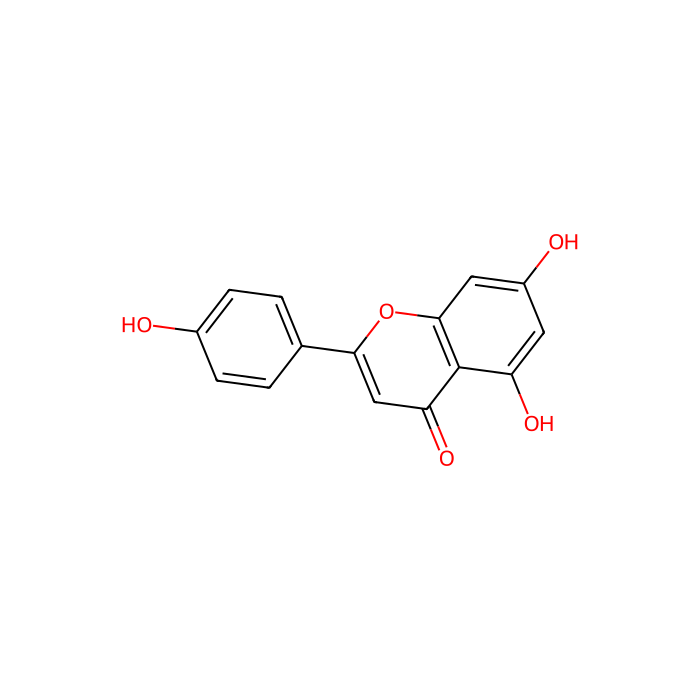
Apigenin (NSC 83244, LY 080400) is a potentP450inhibitor for CYP2C9 withKiof 2 μM.
In vitro
Apigenin inhibits PKC by competing with adenosine triphosphate (ATP). Apigenin also reduces the level of TPA-stimulated phosphorylation of cellular proteins and inhibits TPA-induced c-jun and c-fos expression. Apigenin exhibits the reverting effect on the transformed morphology of v-H-ras transformed NIH3T3 cells. Apigenin has been shown to possess anti-mutagenic properties in a setting of nitropyrene-induced genotoxicity in Chinese hamster ovary cells. Apigenin suppresses of LPS-induced cyclooxygenase-2 and nitric oxide synthase-2 activity and expression in mouse macrophages. Apigenin has been reported to inhibit protein kinase C activity, mitogen-activated protein kinase (MAPK), transformation of C3HI mouse embryonic fibroblasts and downstream oncogenes in v-Ha-ras-transformed NIH3T3 cells. Apigenin blocks peroxisome proliferation-regulated kinase (ERK), a MAPK in isolated hepatocytes. Apigenin has further been shown to down-regulate the expression of the Na+/Ca2+-exchanger, a protein important for calcium extrusion in neonatal rat cardiac myocytes. Apigenin induces a reversible G2/M and G0/G1 arrest by inhibiting p34 (cdc2) kinase activity, accompanied by increased p53 protein stability in epidermal cells and fibroblasts. Apigenin is also effective in inhibiting TNFα-induced intracellular adhesion molecule-1 upregulation in cultured human endothelial cells. Apigenin inhibits the expression of HIF-1α and VEGF via the PI3K/Akt/p70S6K1 and HDM2/p53 pathways in human ovarian cancer cells. Apigenin inhibits differentiation by suppressing MAPK signal transduction and reducing API transcription factor level in human keratinocytes. Apigenin also inhibits proliferating of human keratinocytes.
In vivo
Apigenin down-regulates production of IL-4 in ovalbumin-immunized BALB/C mice. Apigenin inhibits melanoma lung metastases by impairing interaction of tumor cells with endothelium. Apigenin is shown to cause a significant increase in uterine weight and overall uterine concentration of estrogen receptor (ER)-α in female mice (64) and also suppresses prostate and breast cancer cell growth through estrogen receptor β1. Apigenin suppresses the levels of IGF-I in prostate tumor xenografts and increases levels of IGFBP-3, a binding protein that sequesters IGF-I in vascular circulation. Apigenin (12.5 mg/kg) increases cell proliferation in the dentate gyrus of hippocampus of adult mice.
Cell Data
cell lines:
Concentrations:0, 1, 5, 10, 20, 30, 40, and 50 μg/ml
Incubation Time:24 h
Powder Purity:≥97%
| Isomeric SMILES | C1=CC(=CC=C1C2=CC(=O)C3=C(C=C(C=C3O2)O)O)O |
|---|---|
| WGK Germany | 3 |
| RTECS | LK9276000 |
| Molecular Weight | 270.24 |
| Beilstein | 262620 |
| Reaxy-Rn | 262620 |
| Reaxys-RN_link_address | https://www.reaxys.com/reaxys/secured/hopinto.do?context=S&query=IDE.XRN=262620&ln= |
Comprehensive hazard, handling, storage, and regulatory compliance document.
Download SDS →Lot-specific quality data. Enter your lot number to retrieve the exact COA.
Look up COA →Full quality attributes and acceptance criteria for this grade.
View spec sheet →| Activity Type | Activity Value -log(M) | Mechanism of Action | Activity Reference | Publications (PubMed IDs) |
|---|
| Activity Type | Activity Value -log(M) | Mechanism of Action | Activity Reference | Publications (PubMed IDs) |
|---|
| Activity Type | Activity Value -log(M) | Mechanism of Action | Activity Reference | Publications (PubMed IDs) |
|---|
| Activity Type | Activity Value -log(M) | Mechanism of Action | Activity Reference | Publications (PubMed IDs) |
|---|
| Activity Type | Activity Value -log(M) | Mechanism of Action | Activity Reference | Publications (PubMed IDs) |
|---|
| Activity Type | Activity Value -log(M) | Mechanism of Action | Activity Reference | Publications (PubMed IDs) |
|---|
| Activity Type | Activity Value -log(M) | Mechanism of Action | Activity Reference | Publications (PubMed IDs) |
|---|
| Activity Type | Activity Value -log(M) | Mechanism of Action | Activity Reference | Publications (PubMed IDs) |
|---|
| Activity Type | Activity Value -log(M) | Mechanism of Action | Activity Reference | Publications (PubMed IDs) |
|---|
| Activity Type | Activity Value -log(M) | Mechanism of Action | Activity Reference | Publications (PubMed IDs) |
|---|
| Activity Type | Activity Value -log(M) | Mechanism of Action | Activity Reference | Publications (PubMed IDs) |
|---|
| Activity Type | Activity Value -log(M) | Mechanism of Action | Activity Reference | Publications (PubMed IDs) |
|---|
| Solubility | Solubility (25°C) In vitro |
|---|---|
| Melt Point(°C) | 345-350°C |
Our grade selection guide covers purity, stabilizer status, and application suitability for all variants in our catalog.
View Moligand™ grade guide →