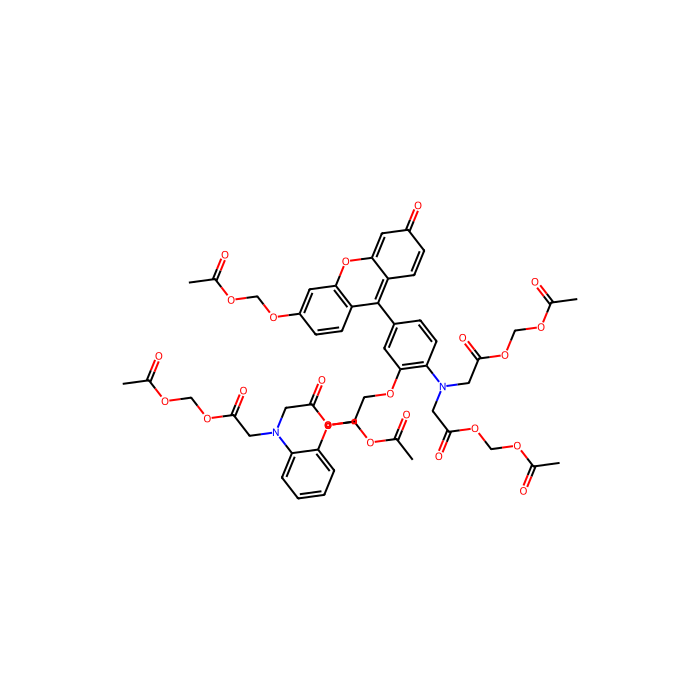
Calcium measurements are critical for numerous biological investigations. Fluorescent probes that show spectral responses upon binding Ca²⁺ have enabled researchers to investigate changes in intracellular free Ca²⁺ concentrations by using fluorescence microscopy, flow cytometry, fluorescence spectroscopy, and fluorescence microplate readers. Fluo-3 AM and Fluo-4 AM are most commonly used among the visible light-excitable calcium indicators for live-cell calcium imaging. However, Fluo-3 AM and Fluo-4 AM are only moderately fluorescent in live cells upon esterase hydrolysis and require harsh cell loading conditions to maximize their cellular calcium responses. Fluo-8 dyes are developed to improve cell loading and calcium response while maintaining the convenient Fluo-3 and Fluo-4 spectral wavelengths of Ex/Em = ∼490/∼520 nm. Fluo-8, AM can be loaded into cells at room temperature, while Fluo-3 AM and Fluo-4 AM require 37°C for cell loading. In addition, Fluo-8, AM is two times brighter than Fluo-4 AM and four times brighter than Fluo-3 AM.
KEY PARAMETERS
Fluorescence microscope
| Emission | FITC | | Excitation | FITC | | Recommended plate | Black wall/clear bottom |
|
Fluorescence microplate reader
| Cutoff | 515 | | Emission | 525 | | Excitation | 490 | | Recommended plate | Black wall/clear bottom | | Instrument specification(s) | Bottom read mode/Programmable liquid handling |
|
PREPARATION OF STOCK SOLUTIONS
Unless otherwise noted, all unused stock solutions should be divided into single-use aliquots and stored at -20 °C after preparation. Avoid repeated freeze-thaw cycles.
Fluo-8, AM Stock Solution
- Prepare a 2 to 5 mM stock solution of Fluo-8, AM in high-quality, anhydrous DMSO.
PREPARATION OF WORKING SOLUTION
Fluo-8, AM Working Solution
1. On the day of the experiment, either dissolve Fluo-8, AM in DMSO or thaw an aliquot of the indicator stock solution to room temperature.
2. Prepare a 2 to 20 µM Fluo-8, AM working solution in a buffer of your choice (e.g., Hanks and Hepes buffer) with 0.04% Pluronic® F-127. For most cell lines, Fluo-8, AM at a final concentration of 4-5 μM is recommended. The exact concentration of indicators required for cell loading must be determined empirically.
Note: The nonionic detergent Pluronic® F-127 is sometimes used to increase the aqueous solubility of Fluo-8, AM.
Note: If your cells contain organic anion-transporters, probenecid (1-2 mM) may be added to the dye working solution (final in well concentration will be 0.5-1 mM) to reduce leakage of the de-esterified indicators.
SAMPLE EXPERIMENTAL PROTOCOL
Following is our recommended protocol for loading AM esters into live cells. This protocol only provides a guideline and should be modified according to your specific needs.
1. Prepare cells in growth medium overnight.
2. On the next day, add 1×Fluo-8, AM working solution to your cell plate.
Note: If your compound(s) interfere with the serum, replace the growth medium with fresh HHBS buffer before dye-loading.
3. Incubate the dye-loaded plate in a cell incubator at 37 °C for 30 to 60 minutes.
Note: Incubating the dye for longer than 2 hours can improve signal intensities in certain cell lines.
4. Replace the dye working solution with HHBS or buffer of your choice (containing an anion transporter inhibitor, such as 1 mM probenecid, if applicable) to remove any excess probes.
5. Add the stimulant as desired and simultaneously measure fluorescence using either a fluorescence microscope equipped with a FITC filter set or a fluorescence plate reader containing a programmable liquid handling system such as an FDSS, FLIPR, or FlexStation, at 490/525 nm (cutoff 515 nm).
EXAMPLE DATA ANALYSIS AND FIGURES

Figure 1. U2OS cells were seeded overnight at 40,000 cells/100 µL/well in a 96-well black wall/clear bottom costar plate. The growth medium was removed, and the cells were incubated with, respectively, 100 µL of Fluo-3 AM, Fluo-4 AM and Fluo-8, AM in HHBS at a concentration of 4 μM in a 37 °C, 5% CO₂ incubator for 1 hour. The cells were washed twice with 200 µL HHBS, then imaged with a fluorescence microscope (Olympus IX71) using FITC channel.

 ZJ26F0232350