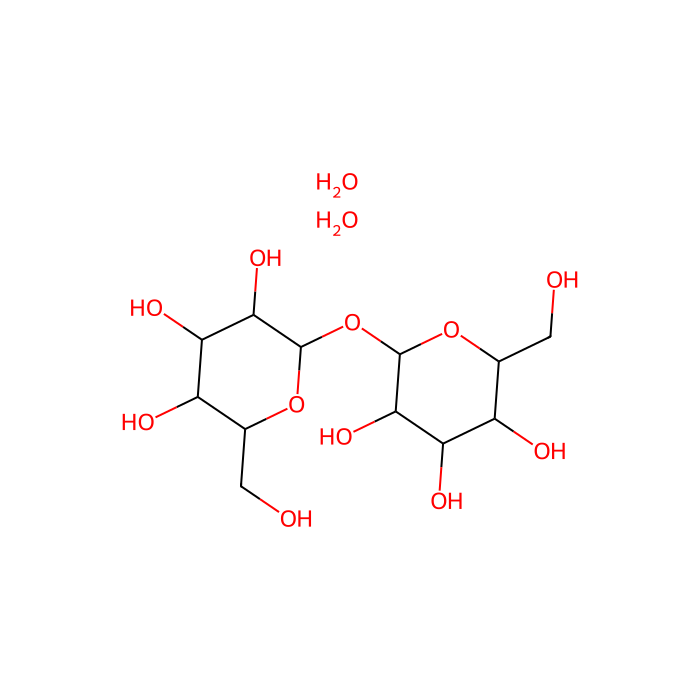
D-(+)-Trehalose dihydrate - suitable for plant cell culture, ≥99% , CAS No.6138-23-4

CAS: 6138-23-4 Cat. No.: T100013 Formula: C12H22O11·2H2O Molecular Weight: 378.33 Beilstein Registry Number: 5322018 EC Number: 612-140-5
AVAILABLE TO ORDER
GRADE & PURITY Suitable for plant cell culture ? Plant cell-culture grade — formulated for plant tissue and cell cultures. Use in plant biotechnology, callus, and suspension culture work. ≥99%
Synonyms
D-(+)-Trehalose dihydrate, for microbiology, >=99.0% | TREHALOSE, DIHYDRATE | (2R,3S,4S,5R,6R)-2-(hydroxymethyl)-6-[(2R,3R,4S,5S,6R)-3,4,5-trihydroxy-6-(hydroxymethyl)oxan-2-yl]oxyoxane-3,4,5-triol;dihydrate | a-d-glucopyranosyl-a-d-glucopyranoside | DPVH
Storage
Room temperature,Argon charged,Desiccated
Shipped In
Normal
★
Size
USA
Germany (EU)*
Price
Qty
25g
T100013-25g
7 In stock
—

$85.90

$128.90
Save $43.00 (33.36%)
100g
T100013-100g
2 In stock
—

$285.90

$428.90
Save $143.00 (33.34%)
Enter a quantity for the sizes you want to add.
🧪
Why this grade

suitable for plant cell culture, ≥99% Suitable for plant cell culture for sensitive chromatographic and analytical workflows requiring minimal baseline interference.

🌡

Storage & shipping

Room temperature,Argon charged,Desiccated Ships Normal Check lot-specific COA for exact specifications.

📋

Quality documents

SDS, COA, datasheet, and spec sheet available for download. Lot-specific COA accessible via lot number lookup.

📚

Literature proof

Cited in 25 peer-reviewed publications across chromatography, organic synthesis, and cross-coupling reactions.

Overview

Trehalose is a non-reducing disaccharide, ubiquitously present in nature. It is used as a food preservative and also to retain enzymes, vaccines, cells and many other molecules. Trehalose is present as hemolymph sugar among the invertebrates.
D-(+)-Trehalose dihydrate has been used in a slow-freezing method for freezing rabbit oocytes. It has also been used in solid-surface vitrification (SSV) of in vitro-matured oocytes. It is suitable for use as a cryoprotectant in a variety of cell freezing media.

Specifications

Synonyms
D-(+)-Trehalose dihydrate, for microbiology, >=99.0% | TREHALOSE, DIHYDRATE | (2R,3S,4S,5R,6R)-2-(hydroxymethyl)-6-[(2R,3R,4S,5S,6R)-3,4,5-trihydroxy-6-(hydroxymethyl)oxan-2-yl]oxyoxane-3,4,5-triol;dihydrate | a-d-glucopyranosyl-a-d-glucopyranoside | DPVH
Specifications & Purity
suitable for plant cell culture, ≥99%
Storage
Room temperature,Argon charged,Desiccated
Shipped In
Normal
Grade
Suitable for plant cell culture
Purity
≥99%
Names and Identifiers
Pubchem Sid
Pubchem Sid Url
https://pubchem.ncbi.nlm.nih.gov/substance/504757717
Canonical Smiles
[H]O[H].[H]O[H].OC[C@H]1O[C@H](O[C@H]2O[C@H](CO)[C@@H](O)[C@H](O)[C@H]2O)[C@H](O)[C@@H](O)[C@@H]1O
IUPAC Name
(2R,3S,4S,5R,6R)-2-(hydroxymethyl)-6-[(2R,3R,4S,5S,6R)-3,4,5-trihydroxy-6-(hydroxymethyl)oxan-2-yl]oxyoxane-3,4,5-triol;dihydrate
InChIKey
DPVHGFAJLZWDOC-PVXXTIHASA-N
INCHI
1S/C12H22O11.2H2O/c13-1-3-5(15)7(17)9(19)11(21-3)23-12-10(20)8(18)6(16)4(2-14)22-12;;/h3-20H,1-2H2;2*1H2/t3-,4-,5-,6-,7+,8+,9-,10-,11-,12-;;/m1../s1
Isomeric SMILES
C([C@@H]1[C@H]([C@@H]([C@H]([C@H](O1)O[C@@H]2[C@@H]([C@H]([C@@H]([C@H](O2)CO)O)O)O)O)O)O)O.O.O
WGK Germany
2
Molecular Weight
378.33
Beilstein
5322018
Reaxy-Rn
5322018
Reaxys-RN_link_address
https://www.reaxys.com/reaxys/secured/hopinto.do?context=S&query=IDE.XRN=5322018&ln=

Documentation

📋 Safety Data Sheet (SDS)

Comprehensive hazard, handling, storage, and regulatory compliance document.

Download SDS →

✅ Certificate of Analysis (COA)

Lot-specific quality data. Enter your lot number to retrieve the exact COA.

Look up COA →

📊 Datasheet

Quick-reference summary of product specifications and applications.

View datasheet →

🔬 Specification Sheet

Full quality attributes and acceptance criteria for this grade.

View spec sheet →

Advanced Data

Taxonomic Classification

Taxonomy Tree

KingdomOrganic compounds
SuperclassOrganic oxygen compounds
ClassOrganooxygen compounds
SubclassCarbohydrates and carbohydrate conjugates
Intermediate Tree Nodes Glycosyl compounds
Direct ParentO-glycosyl compounds
Alternative Parents Disaccharides  Oxanes  Secondary alcohols  Polyols  Oxacyclic compounds  Acetals  Primary alcohols  Organic oxides  Hydrocarbon derivatives  
Molecular FrameworkAliphatic heteromonocyclic compounds
Substituents O-glycosyl compound - Disaccharide - Oxane - Secondary alcohol - Oxacycle - Organoheterocyclic compound - Polyol - Acetal - Organic oxide - Hydrocarbon derivative - Primary alcohol - Alcohol - Aliphatic heteromonocyclic compound
DescriptionThis compound belongs to the class of organic compounds known as o-glycosyl compounds. These are glycoside in which a sugar group is bonded through one carbon to another group via a O-glycosidic bond.
External Descriptors Not available
3D Structure
Interactive Chemical Structure Model


Mechanisms of Action
Certificates(CoA,COO,BSE/TSE and Analysis Chart)
C of A & Other Certificates(BSE/TSE, COO):
Analytical Chart:

Find and download the COA for your product by matching the lot number on the packaging.

7 results found

Lot NumberCertificate TypeDateItem
I2102405Certificate of AnalysisJun 09, 2025 T100013
B2318726Certificate of AnalysisOct 17, 2022 T100013
B2318729Certificate of AnalysisOct 17, 2022 T100013
B2318736Certificate of AnalysisOct 17, 2022 T100013
B2318741Certificate of AnalysisOct 17, 2022 T100013
H2209643Certificate of AnalysisJul 19, 2022 T100013
C2203186Certificate of AnalysisFeb 16, 2022 T100013
Chemical and Physical Properties
SolubilitySoluble in water, insoluble in ether
SensitivityHygroscopic.
Specific Rotation[α]181 ° (C=7, H2O)
Melt Point(°C)97-99°C
Molecular Weight378.330 g/mol
XLogP3
Hydrogen Bond Donor Count10
Hydrogen Bond Acceptor Count13
Rotatable Bond Count4
Exact Mass378.137 Da
Monoisotopic Mass378.137 Da
Topological Polar Surface Area192.000 Ų
Heavy Atom Count25
Formal Charge0
Complexity348.000
Isotope Atom Count0
Defined Atom Stereocenter Count10
Undefined Atom Stereocenter Count0
Defined Bond Stereocenter Count0
Undefined Bond Stereocenter Count0
The total count of all stereochemical bonds0
Covalently-Bonded Unit Count3
Documents & Articles
Chelating Agents
For Cell Culture
Suitable for Plant Cell Culture
How should laboratory strains be preserved?
Glucose Oxidase: A Versatile Biocatalyst Across Multiple Fields
Trehalose: Physicochemical Characteristics, Manufacturing Processes, and Application Guidelines
Phycocyanin: A Review of Sources, Structural Features, Production Processes, Applications, and Claimed Benefits
dsDNase-Mediated Hydrolysis of Double-Stranded DNA: Enzymatic Characteristics, Methodological Strategies, and Bioanalytical Applications
Functional Properties, Application Scenarios, and Manufacturing Processes of Maltotetraose (G4): A Review
Effects of Cell Sample Preservation Systems on Morphological Integrity, Anticoagulant Stability, and Analytical Results
The Moisturizing and Low-Moisture Protective Mechanisms of Trehalose: From Its α,α-1,1 Structure and Hydration Dynamics to In Vitro Skin Barrier Research
Exosome-Related Ingredients in Skincare Products: Sources and Preparation, Quality Control, Evidence of Efficacy, and Safety Assessment
Citations of This Product
Solution Calculators
Reviews

Customer Reviews

Frequently Asked Questions

What is the purity of this product?
This product is supplied at ≥99% purity (chemical assay). Lot-specific values are stated on the Certificate of Analysis.
What does suitable for plant cell culture mean?
suitable for plant cell culture indicates that the product has been processed and tested for cell culture and tissue engineering. Specifications may include endotoxin limits, microbial controls, sterility, low DNase/RNase/protease activity, and verified biological activity where relevant.
How should this product be stored?
Store at room temperature, desiccated, under argon. It is supplied under an argon blanket; reseal under inert gas after each use.
How is this product shipped?
This product ships under standard ambient conditions. No temperature-controlled packaging is required.
What are the CAS number, molecular formula and molecular weight?
The CAS Number is 6138-23-4, the molecular formula is C12H22O11·2H2O, and the molecular weight is 378.33 g/mol. InChIKey DPVHGFAJLZWDOC-PVXXTIHASA-N.
What documentation is provided?
Available product documentation, including Certificates of Analysis (COA), Safety Data Sheets (SDS), and specification sheets, is shown in the product document area. Document availability and access follow the current site policy.

Shall we send you a message when we have discounts available?

Remind me later

Thank you! Please check your email inbox to confirm.

Oops! Notifications are disabled.