Application: For the R&D and large-scale preparation of β-hydroxybutyrate reagents.Enzymatic Properties
Enzymatic Properties
Source: Microorganism
Classification: EC 1.6.5.2
Molecular Weight: 28 kDa (SDS-PAGE)
Isoelectric Point (pI): 5.2
Km Value: 7.4 × 10⁻⁴ M (NADH), 6.0 × 10⁻² M (NADPH)
Inhibitors: Fe³⁺, Mn²⁺, Cu²⁺
Optimal pH: 7.5 Fig.1
Optimal Temperature: 45℃ Fig.2
pH Stability: 4.5-9.0 (25℃, 16 h) Fig.3
Thermal Stability: Stable below 50℃ (pH 7.5, 30 min) Fig.4
Storage Stability: ≥90% activity retained after 12 months of static storage at -25~-15℃ Fig.5
Protectants: FMN, NAD(P)H
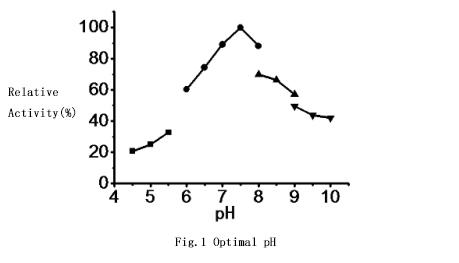
Buffer solution: pH 4.5-5.5, acetate buffer; pH 6.0-8.0,
Na-phosphate; pH 8.0-9.0, Tris-HCl; pH 9.0-10.0,
Glycine-NaOH.
.jpg)
Reaction in 200 mM Tris-HCl buffer pH 7.5.
Enzyme concentration: 1 mg/mL
.jpg)
25℃, 16 h-treatment with 50 mM buffer solution: pH 4.5-5.5, acetate buffer; pH 6.0-8.0; Na-phosphate; pH 8.0-9.0, Tris-HCl; pH 9.0-10.0, Glycine-NaOH. Enzyme concentration: 1 mg/mL
.jpg)
30 min-treatment with 200 mM Tris-HCl buffer, pH 7.5. Enzyme concentration: 1 mg/mL
.jpg)
Activity Assay Method
1. Principle
.png)
The concentration of DCPIP (2,6-dichlorophenolindophenol) can be determined by ultraviolet-visible spectrophotometry at 600 nm.
2. Definition of Enzyme Activity
One unit (U) of enzyme activity is defined as the amount of enzyme required to oxidize 1 μmol of DCPIP per minute under the specified reaction conditions.
3. Reagent Preparation
Reagent I: 200 mM Tris-HCl buffer (pH 7.0).
Reagent II: 36 mM NADH solution (dissolved in water, freshly prepared, stored on ice).
Reagent III: 2.4 mM DCPIP solution (dissolved in water, stored at room temperature, freshly prepared).
Reagent IV: 200 mM Tris-HCl buffer (pH 7.5) containing 0.5% Tween 20.
Test Sample: Dilute the enzyme solution to 0.1-0.25 U/mL with Reagent IV.
4. Procedure
4.1. Add 2.4 mL of water, 0.3 mL of Reagent I, and 0.1 mL of Reagent II to a 3 mL cuvette. Preincubate at 37℃ for 4 minutes.
4.2. Add 0.1 mL of the test sample and 0.1 mL of Reagent III, then mix rapidly.
4.3. Measure the rate of absorbance change (∆As) at 600 nm within 1 minute.
Blank Control: Replace the enzyme solution with enzyme dilution buffer (Reagent IV) and follow the same steps to obtain the blank absorbance change (∆Ab).
∆A = ∆As - ∆Ab
5. Activity Calculation
.png)
Vt: Total volume of the reaction mixture (3.0 mL).
Vs: Volume of the enzyme solution added (0.1 mL).
1.0: Light path length (cm).
df: Dilution factor of the enzyme solution.
C: Concentration of the enzyme solution (mg/mL).
20.9: Molar extinction coefficient of the chromophore (DCPIP) at 600 nm under standard conditions (cm²/μmol).


 ZJ26F0737272