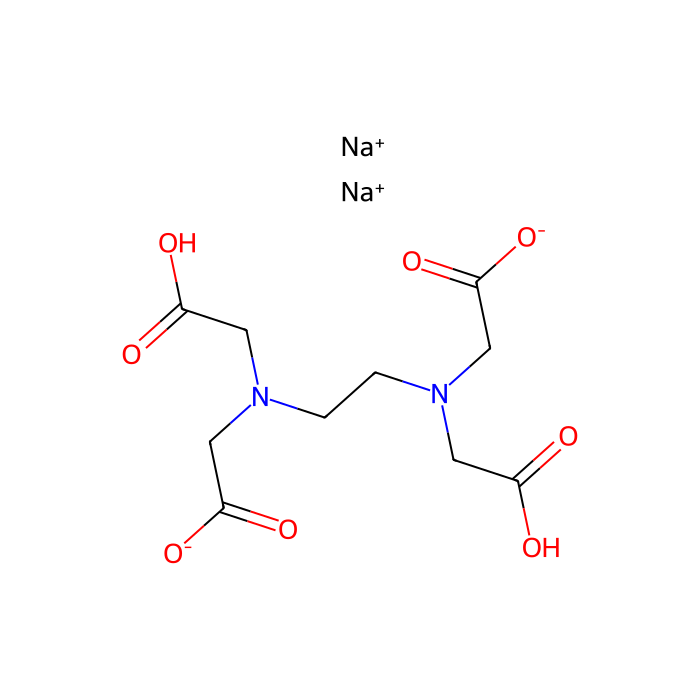
Edetate Disodium - 0.1% (w/v) in 5% (v/v) Alcohol , CAS No.139-33-3

CAS: 139-33-3 Cat. No.: E397526 Formula: C10H14N2Na2O8 Molecular Weight: 336.21 Beilstein Registry Number: 3822669 EC Number: 205-358-3
AVAILABLE TO ORDER
GRADE & PURITY 0.1% (w/v) in 5% (v/v) Alcohol
Synonyms
0.5M Sodium EDTA | Anhydrous disodium edetate | EN300-35828 | Mavacid ED 4 | MFCD00070672 | Zonon D | AKOS016370696 | Dotite 2NA | Endrate disodium | CBC 50152966 | Disodium (ethylenedinitrilo)tetraacetic acid | E386 | Sodium versenate | Disodium tetracem
Storage
Room temperature
Shipped In
Normal
★
Size
USA
Germany (EU)*
Price
Qty
500ml
E397526-500ml
7 In stock
1 In stock

$17.90

$20.90
Save $3.00 (14.35%)
Enter a quantity for the sizes you want to add.
🧪
Why this grade

0.1% (w/v) in 5% (v/v) Alcohol for sensitive chromatographic and analytical workflows requiring minimal baseline interference.

🌡

Storage & shipping

Room temperature Ships Normal Check lot-specific COA for exact specifications.

📋

Quality documents

SDS, COA, datasheet, and spec sheet available for download. Lot-specific COA accessible via lot number lookup.

📚

Literature proof

Cited in 159 peer-reviewed publications across chromatography, organic synthesis, and cross-coupling reactions.

Specifications

Synonyms
0.5M Sodium EDTA | Anhydrous disodium edetate | EN300-35828 | Mavacid ED 4 | MFCD00070672 | Zonon D | AKOS016370696 | Dotite 2NA | Endrate disodium | CBC 50152966 | Disodium (ethylenedinitrilo)tetraacetic acid | E386 | Sodium versenate | Disodium tetracem
Specifications & Purity
0.1% (w/v) in 5% (v/v) Alcohol
Storage
Room temperature
Shipped In
Normal
Names and Identifiers
Pubchem Sid
Canonical Smiles
C(CN(CC(=O)O)CC(=O)[O-])N(CC(=O)O)CC(=O)[O-].[Na+].[Na+]
IUPAC Name
disodium;2-[2-[carboxylatomethyl(carboxymethyl)amino]ethyl-(carboxymethyl)amino]acetate
InChIKey
ZGTMUACCHSMWAC-UHFFFAOYSA-L
INCHI
1S/C10H16N2O8.2Na/c13-7(14)3-11(4-8(15)16)1-2-12(5-9(17)18)6-10(19)20;;/h1-6H2,(H,13,14)(H,15,16)(H,17,18)(H,19,20);;/q;2*+1/p-2
Isomeric SMILES
C(CN(CC(=O)O)CC(=O)[O-])N(CC(=O)O)CC(=O)[O-].[Na+].[Na+]
WGK Germany
1
Alternate CAS
6381-92-6
Molecular Weight
336.21
Beilstein
3822669
Reaxy-Rn
3822669
Reaxys-RN_link_address
https://www.reaxys.com/reaxys/secured/hopinto.do?context=S&query=IDE.XRN=3822669&ln=

Documentation

📋 Safety Data Sheet (SDS)

Comprehensive hazard, handling, storage, and regulatory compliance document.

Download SDS →

✅ Certificate of Analysis (COA)

Lot-specific quality data. Enter your lot number to retrieve the exact COA.

Look up COA →

📊 Datasheet

Quick-reference summary of product specifications and applications.

View datasheet →

🔬 Specification Sheet

Full quality attributes and acceptance criteria for this grade.

View spec sheet →

Advanced Data

Taxonomic Classification

Taxonomy Tree

KingdomOrganic compounds
SuperclassOrganic acids and derivatives
ClassCarboxylic acids and derivatives
SubclassTetracarboxylic acids and derivatives
Intermediate Tree Nodes Not available
Direct ParentTetracarboxylic acids and derivatives
Alternative Parents Alpha amino acids  Trialkylamines  Carboxylic acid salts  Amino acids  Carboxylic acids  Organopnictogen compounds  Organic zwitterions  Organic sodium salts  Organic oxides  Hydrocarbon derivatives  Carbonyl compounds  
Molecular FrameworkAliphatic acyclic compounds
Substituents Tetracarboxylic acid or derivatives - Alpha-amino acid - Alpha-amino acid or derivatives - Amino acid or derivatives - Carboxylic acid salt - Amino acid - Tertiary amine - Tertiary aliphatic amine - Carboxylic acid - Organic alkali metal salt - Organic sodium salt - Organic nitrogen compound - Hydrocarbon derivative - Organooxygen compound - Organonitrogen compound - Organic oxide - Carbonyl group - Organopnictogen compound - Amine - Organic oxygen compound - Organic zwitterion - Organic salt - Aliphatic acyclic compound
DescriptionThis compound belongs to the class of organic compounds known as tetracarboxylic acids and derivatives. These are carboxylic acids containing exactly four carboxyl groups.
External Descriptors organic sodium salt
3D Structure
Interactive Chemical Structure Model


Mechanisms of Action
Certificates(CoA,COO,BSE/TSE and Analysis Chart)
C of A & Other Certificates(BSE/TSE, COO):
Analytical Chart:

Find and download the COA for your product by matching the lot number on the packaging.

7 results found

Lot NumberCertificate TypeDateItem
J2428001Certificate of AnalysisAug 14, 2026 E397526
H2415072Certificate of AnalysisMay 14, 2026 E397526
J2514007Certificate of AnalysisOct 22, 2025 E397526
J2514013Certificate of AnalysisOct 30, 2024 E397526
F2308927Certificate of AnalysisJul 11, 2023 E397526
D2323010Certificate of AnalysisMay 04, 2023 E397526
B2306110Certificate of AnalysisFeb 07, 2023 E397526
Chemical and Physical Properties
Molecular Weight336.210 g/mol
XLogP3
Hydrogen Bond Donor Count2
Hydrogen Bond Acceptor Count10
Rotatable Bond Count9
Exact Mass336.055 Da
Monoisotopic Mass336.055 Da
Topological Polar Surface Area161.000 Ų
Heavy Atom Count22
Formal Charge0
Complexity336.000
Isotope Atom Count0
Defined Atom Stereocenter Count0
Undefined Atom Stereocenter Count0
Defined Bond Stereocenter Count0
Undefined Bond Stereocenter Count0
The total count of all stereochemical bonds0
Covalently-Bonded Unit Count3
Documents & Articles
Why Is EDTA So Widely Used?
A Practical Guide to Fragrance Compositions: Turning a Black-Box Formula into an Engineerable System—Compatibility, Stability, Controlled Release, Traceability, and Selection
Practical Guide to Sodium Carboxymethyl Cellulose (CMC-Na): Thickening/Stabilizing Mechanisms, Key Controls for Solution Preparation, and Selection Navigation (including Table 1 and Tables A–C)
Why LABSA (Sulfonic Acid) Is Commonly Used in Household Cleaning Formulations: Neutralization Mechanism, Detergency Action, and Formulation Application Points
From Structure to Performance: Conditioning, Film-Forming, Thickening, and Chelating Applications of Functional Ingredients in Personal Care and Home Care
The Role, Selection, and Validation of Chelating Agents in Daily Chemical Formulations
Thickening, Suspension, Auxiliary Stabilization, and Agglomeration Mechanisms of Xanthan Gum in Personal Care Formulations: From Molecular Structure to Processing Applications
Why Daily Chemical Formulations Need Alkaline Ingredients: From pH Adjustment and Saponification to Detergency Boosting and Selection Logic
Why Limonene Can Soften Greasy Soils Yet Is Difficult to Dissolve in Water: Understanding the Cleaning Mechanism and Formulation Applications of Naturally Derived Solvents from Molecular Structure
How Can Sodium Tripolyphosphate (STPP) Be Replaced? From Detergency Mechanisms to Formulation Choices for Low-Phosphorus/Phosphorus-Free Builder Systems
Why Are Preservative Systems in Daily Chemical Products Effective? Common Types, Mechanisms of Action, and Factors Affecting Preservation Efficacy
Why Are Daily Chemical Products Prone to Viscosity Thinning in Summer? Core Mechanisms, Troubleshooting Methods, and Solutions
Mechanism of Kojic Acid in Reducing Hyperpigmentation: From Tyrosinase Inhibition to Melanin Production Regulation
Antioxidant Mechanisms of Ferulic Acid in Skincare, Vitamin C/E Synergy, and Stable Delivery Applications
Protective and Potential Reparative Mechanisms of Prinsepia utilis Seed Oil on the Skin Barrier: Fatty Acid Composition, Epidermal Lipid Metabolism, and Research Evidence
UVA Absorption Mechanism of Avobenzone: Keto–Enol Tautomerism, Photochemical Instability, and Formulation Photostabilization Strategies
How Coenzyme Q10 Acts on the Skin: Mitochondrial Electron Transfer, Antioxidant Protection of Membrane Lipids, and Lipid-Carrier Delivery
How Arbutin Regulates Melanin Production: α/β Anomeric Configuration and Tyrosinase Action
Citations of This Product
Solution Calculators
Reviews

Customer Reviews

Shall we send you a message when we have discounts available?

Remind me later

Thank you! Please check your email inbox to confirm.

Oops! Notifications are disabled.