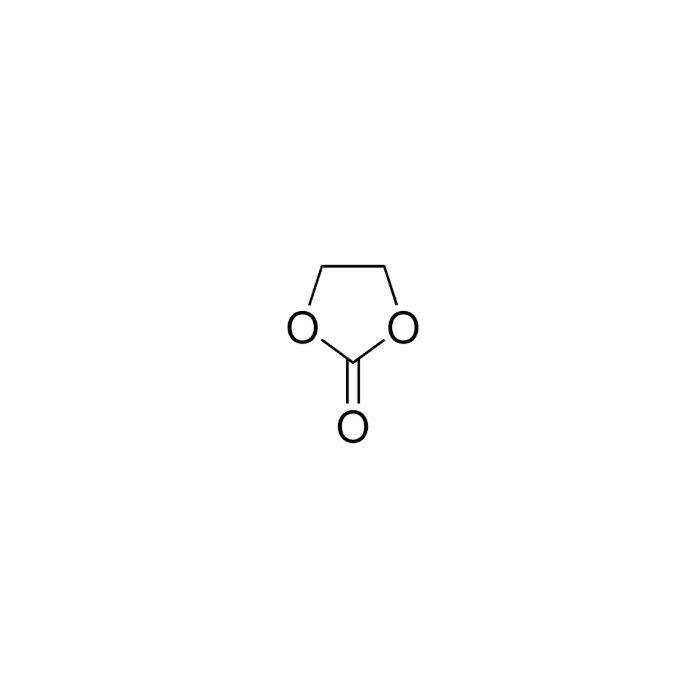
Ethylene carbonate - electronic grade, ≥99% , CAS No.96-49-1

CAS: 96-49-1 Cat. No.: E777011 Formula: C3H4O3 Molecular Weight: 88.06 Beilstein Registry Number: 106249 EC Number: 202-510-0
AVAILABLE TO ORDER
GRADE & PURITY Electronic grade ? Electronic grade — ultra-low metallic and particulate impurities for microelectronics. Use in semiconductor and electronics processes intolerant of contamination. ≥99%
Synonyms
1,3-Dioxolan-2-one, EC
Storage
Room temperature,Argon charged,Desiccated
Shipped In
Normal
★
Size
USA
Germany (EU)*
Price
Qty
25g
E777011-25g
Made to order · 8–12 wks
$69.90
100g
E777011-100g
Made to order · 8–12 wks
$179.90
500g
E777011-500g
Made to order · 8–12 wks
$566.90
Enter a quantity for the sizes you want to add.

Overview

Anhydrous ethylene carbonate is a cyclic ester and chemically related to ethylene glycol and dimethyl carbonate. It is a highly polar solvent and is a good solvent for many organic and inorganic compounds; however, at room temperature (25 °C) ethylene carbonate is a transparent crystalline solid, practically odorless and colorless, and somewhat soluble in water. In the liquid state (m.p. 35-37 °C) ethylene carbonate is a colorless, odorless liquid with a high boiling point (243 °C). Anhydrous ethylene carbonate is a solvent that is commonly used in the production of batteries, particularly lithium-ion batteries, and as a solvent in the pharmaceutical and chemical industries, in part because of its very high dielectric constant. Because of its high melting point and moderate viscosity, ethylene carbonate is often blended with other carbonates to yield a solution at room temperature with lower viscosity.

Specifications

Synonyms
1,3-Dioxolan-2-one, EC
Specifications & Purity
electronic grade, ≥99%
Application
Alkyl carbonates find applications as solvents for lithium ion battery electrolytes and the use of high quality battery grade electrolytes having extremely low water and acid contents are critical for achieving high electrochemical performance.
Legal Information
Storage
Room temperature,Argon charged,Desiccated
Shipped In
Normal
Grade
Electronic grade
Purity
≥99%
Names and Identifiers
SMILES
C1COC(=O)O1
IUPAC Name
1,3-dioxolan-2-one
InChIKey
KMTRUDSVKNLOMY-UHFFFAOYSA-N
InChI
1S/C3H4O3/c4-3-5-1-2-6-3/h1-2H2
Isomeric SMILES
C1COC(=O)O1
WGK Germany
1
RTECS
FF9550000
Molecular Weight
88.06
Beilstein
106249
Reaxys
106249
Reaxys-RN_link_address
https://www.reaxys.com/reaxys/secured/hopinto.do?context=S&query=IDE.XRN=106249&ln=

Advanced Data

Taxonomic Classification

Taxonomy Tree

KingdomOrganic compounds
SuperclassOrganic acids and derivatives
ClassOrganic carbonic acids and derivatives
SubclassCarbonic acid diesters
Intermediate Tree Nodes Not available
Direct ParentCarbonic acid diesters
Alternative Parents 1,3-dioxolanes  Oxacyclic compounds  Organic oxides  Hydrocarbon derivatives  Carbonyl compounds  
Molecular FrameworkAliphatic heteromonocyclic compounds
Substituents Carbonic acid diester - Meta-dioxolane - Oxacycle - Organoheterocyclic compound - Organic oxygen compound - Organic oxide - Hydrocarbon derivative - Organooxygen compound - Carbonyl group - Aliphatic heteromonocyclic compound
DescriptionThis compound belongs to the class of organic compounds known as carbonic acid diesters. These are compounds comprising the carbonic acid diester functional group.
External Descriptors Not available
3D Structure
Interactive Chemical Structure Model


Certificates (CoA,COO,BSE/TSE and Analysis Chart)
C of A & Other Certificates(BSE/TSE, COO):
Analytical Chart:

Find and download the COA for your product by matching the lot number on the packaging.

4 results found

Lot NumberCertificate TypeDateItem
K2512041K2512041Certificate of AnalysisNov 25, 2025 E777011
K2512073K2512073Certificate of AnalysisNov 25, 2025 E777011
K2512078K2512078Certificate of AnalysisNov 25, 2025 E777011
K2512077K2512077Certificate of AnalysisNov 22, 2025 E777011
Chemical and Physical Properties
SensitivityMoisture & heat sensitive
Flash Point58.5 °C
Boil Point243-244°C
Melt Point34-37°C
Molecular Weight88.06
XLogP30.300
Hydrogen Bond Donor Count0
Hydrogen Bond Acceptor Count3
Rotatable Bond Count0
Exact Mass88.016 Da
Monoisotopic Mass88.016 Da
Topological Polar Surface Area35.500 Ų
Heavy Atom Count6
Formal Charge0
Complexity60.400
Isotope Atom Count0
Defined Atom Stereocenter Count0
Undefined Atom Stereocenter Count0
Defined Bond Stereocenter Count0
Undefined Bond Stereocenter Count0
The total count of all stereochemical bonds0
Covalently-Bonded Unit Count1
Safety and Hazards(GHS)
Pictogram(s)
GHS07,   GHS08
Signal
Danger
Hazard Statements

H302:Harmful if swallowed

H315:Causes skin irritation

H318:Causes serious eye damage

H319:Causes serious eye irritation

H335:May cause respiratory irritation

H373:May causes damage to organs through prolonged or repeated exposure

Precautionary Statements

P260:Do not breathe dust/fume/gas/mist/vapors/spray.

P261:Avoid breathing dust/fume/gas/mist/vapors/spray.

P264:Wash hands [and …] thoroughly after handling.

P270:Do not eat, drink or smoke when using this product.

P271:Use only outdoors or in a well-ventilated area.

P280:Wear protective gloves/protective clothing/eye protection/face protection.

P321:Specific treatment (see ... on this label).

P330:Rinse mouth.

P302+P352:IF ON SKIN: wash with plenty of water.

P304+P340:IF INHALED: Remove person to fresh air and keep comfortable for breathing.

P305+P351+P338:IF IN EYES: Rinse cautiously with water for several minutes. Remove contact lenses if present and easy to do - continue rinsing.

P362+P364:Take off contaminated clothing and wash it before reuse.

P405:Store locked up.

P403+P233:Store in a well-ventilated place. Keep container tightly closed.

P501:Dispose of contents/container to an approved waste disposal plant.

P264+P265:Wash hands [and …] thoroughly after handling. Do not touch eyes.

P301+P317:IF SWALLOWED: Get medical help.

P305+P354+P338:IF IN EYES: Immediately rinse with water for several minutes. Remove contact lenses if present and easy to do. Continue rinsing.

P317:Get emergency medical help.

P337+P317:If eye irritation persists: Get medical help.

P332+P317:If skin irritation occurs: Get medical help.

P319:Get medical help if you feel unwell.

WGK Germany
1
RTECS
FF9550000
Reaxys
106249
Reaxys-RN_link_address
https://www.reaxys.com/reaxys/secured/hopinto.do?context=S&query=IDE.XRN=106249&ln=
Documents & Articles
Citations of This Product
Solution Calculators
Reviews

Customer Reviews

Frequently Asked Questions

What is the purity of this product?
This product is supplied at ≥99% purity (chemical assay). Lot-specific values are stated on the Certificate of Analysis.
What does electronic grade mean?
electronic grade indicates that the material has been processed and tested for semiconductor and electronics manufacturing. Specifications focus on the impurities that affect performance in that application — for example, metal content for electronics, particle size for batteries, refractive index for optics, or moisture content for moisture-sensitive processes.
How should this product be stored?
Store at room temperature, desiccated, under argon. It is supplied under an argon blanket; reseal under inert gas after each use.
How is this product shipped?
This product ships under standard ambient conditions. No temperature-controlled packaging is required.
What are the CAS number, molecular formula and molecular weight?
The CAS Number is 96-49-1, the molecular formula is C3H4O3, and the molecular weight is 88.06 g/mol. InChIKey KMTRUDSVKNLOMY-UHFFFAOYSA-N.
What documentation is provided?
Available product documentation, including Certificates of Analysis (COA), Safety Data Sheets (SDS), and specification sheets, is shown in the product document area. Document availability and access follow the current site policy.

Shall we send you a message when we have discounts available?

Remind me later

Thank you! Please check your email inbox to confirm.

Oops! Notifications are disabled.