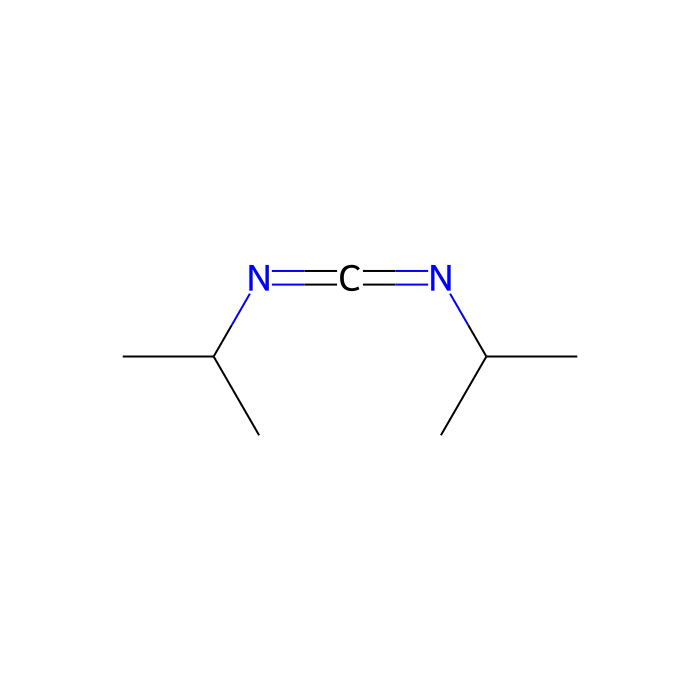
Diisopropylcarbodiimide solution - 1 M in dichloromethane , CAS No.693-13-0

CAS: 693-13-0 Cat. No.: D433331 Summenformel: C7H14N2 Molekulargewicht: 126.20 Beilstein Registry Number: 878281 EG-Nummer: 211-743-7
Zu bestellen verfügbar
GRADE & PURITY 1 M in dichloromethane
Synonyms
EINECS 211-743-7 | diisopropyl carbodiimide | N,N'-Diisopropyl carbodimide | dipropan-2-ylmethanediimine | N-((isopropylimino)methyl-ene)propan-2-amine | N-((isopropylimino)methylene)propan-2-amine | STR04127 | UNII-OQO20I6TWH | DIC, 99% | MFCD00065689 |
Storage
Room temperature
★
Size
Deutschland (EU)
USA*
Price
Qty
25ml
D433331-25ml
Auf Bestellung · 8–12 Wochen

202,96€

237,67€
Speichern 34,71 € (14.60%)
100ml
D433331-100ml
Auf Bestellung · 8–12 Wochen

586,50€

685,43€
Speichern 98,92 € (14.43%)
Enter a quantity for the sizes you want to add.
🧪
Why this grade

1 M in dichloromethane for sensitive chromatographic and analytical workflows requiring minimal baseline interference.

🌡

Storage & shipping

Room temperature Ships Check lot-specific COA for exact specifications.

📋

Quality documents

SDS, COA, datasheet, and spec sheet available for download. Lot-specific COA accessible via lot number lookup.

📚

Literature proof

Cited in 77 peer-reviewed publications across chromatography, organic synthesis, and cross-coupling reactions.

Übersicht

General Description

DIC is an abbreviated form of N , N ′-diisopropylcarbodiimide. It plays a role in the cyclization of N -(β-hydroxy)amides to form 2-oxazolines.


Application

Valuable reagent offered as a solution in dichloromethane for more convenient handling. Alternative to dicyclohexylcarbodiimide in peptide synthesis. Coupling reagent for peptide syntheses. DIC ( N , N′ -Diisopropylcarbodiimide) has been used in combination with 1-hydroxy-7-azabenzotriazole (HOAt) for the coupling of amino acid with N -allylglycine to form N -allylpeptide.

Specifications

Synonyme
EINECS 211-743-7 | diisopropyl carbodiimide | N,N'-Diisopropyl carbodimide | dipropan-2-ylmethanediimine | N-((isopropylimino)methyl-ene)propan-2-amine | N-((isopropylimino)methylene)propan-2-amine | STR04127 | UNII-OQO20I6TWH | DIC, 99% | MFCD00065689 |
Spezifikationen & Reinheit
1 M in dichloromethane
Storage
Room temperature
Namen und Kennungen
Kanonisches Lächeln
CC(C)N=C=NC(C)C
InChIKey
BDNKZNFMNDZQMI-UHFFFAOYSA-N
INCHI
1S/C7H14N2/c1-6(2)8-5-9-7(3)4/h6-7H,1-4H3
Isomere SMILES
CC(C)N=C=NC(C)C
WGK Deutschland
3
RTECS
FF2175000
UN-Nummer
2929
Molekulargewicht
126.20
Beilstein
878281
Reaxy-Rn
878281
Reaxys-RN_link_address
https://www.reaxys.com/reaxys/secured/hopinto.do?context=S&query=IDE.XRN=878281&ln=

Documentation

📋 Safety Data Sheet (SDS)

Comprehensive hazard, handling, storage, and regulatory compliance document.

Download SDS →

✅ Certificate of Analysis (COA)

Lot-specific quality data. Enter your lot number to retrieve the exact COA.

Look up COA →

📊 Datasheet

Quick-reference summary of product specifications and applications.

View datasheet →

🔬 Specification Sheet

Full quality attributes and acceptance criteria for this grade.

View spec sheet →

Advanced Data

3D-Struktur
Interaktives chemisches Strukturmodell


Zugehörige Ziele (menschlich)
KCNH2 Tclin HERG (29587 Activities)
Activity TypeRelationActivity valueUnitsAction TypeJournalPubMed IddoiAssay Aladdin ID
Wirkungsmechanismen
Zertifikate (CoA, COO, BSE/TSE und Analyse-Diagramm)
C of A & Other Certificates(BSE/TSE, COO):
Analytical Chart:
Chemische und physikalische Eigenschaften
Brechungsindex1.433
Flammpunkt (°F)91°F
Flammpunkt (°C)31°C
Siedepunkt (°C)145-148°C
Molekulargewicht126.200 g/mol
XLogP32.600
Hydrogen Bond Donor Count0
Hydrogen Bond Acceptor Count2
Rotatable Bond Count2
Exact Mass126.116 Da
Monoisotopic Mass126.116 Da
Topological Polar Surface Area24.700 Ų
Heavy Atom Count9
Formal Charge0
Complexity101.000
Isotope Atom Count0
Defined Atom Stereocenter Count0
Undefined Atom Stereocenter Count0
Defined Bond Stereocenter Count0
Undefined Bond Stereocenter Count0
The total count of all stereochemical bonds0
Covalently-Bonded Unit Count1
FAQs und Artikel
A Complete Guide to Choosing Resins for SPPS (Solid-Phase Peptide Synthesis): Fmoc/Boc Routes, C-Terminal Acid/Amide, and a Key-Parameter Navigator
β-Acyloxy Alkenyl Amides (AAAs): A New Approach to Amide Bond and Peptide Bond Construction Worth Attention
DAST-Mediated Amidation at Room Temperature: Method Features, Practical Value, and Scope of Applicability
From High Reactivity to Comprehensive Evaluation: Using CTSOAt as an Example to Understand the Design Logic of New Coupling Reagents
From Analytical Instrument to Synthetic Platform: A New Strategy for Reconstructing Automated Flow Solid-Phase Peptide Synthesis with Standard Analytical HPLC
New Progress in the Solid-Phase Synthesis of Sterically Hindered Peptides: Background, Core Breakthroughs, and Implications for Automation Compatibility of the RMMR Strategy
TCFH–NMI Amidation in Highly Aqueous Media: Research Value, Methodological Understanding, and Experimental Insights
A New Balance in Coupling Reagents: How DMT-TU Balances Reactivity, Racemization Control, and Thermal Hazard
The Positioning of TBTU in Practice: Racemization Risk, Extended Uses, and Selection Criteria
From “High Yield” to “Configuration Retention”: Activation-Stage Risks, Route Differences, and Selection Principles for Coupling Systems
The Methodological Value of HATU in Difficult Couplings: Reactivity Advantages, Stereochemical Retention, and Condition Management
The Methodological Value of Boc-Oxyma: Low-Racemization Coupling, Route Continuity, and Extended Applications
Low Racemization in Peptide Synthesis Is Not Just About Reagent Choice: Stereochemical Risk During the Activation Stage and Practical Strategies for Experimental Control
The Methodological Value of TCFH: Advantages in Challenging Amidation and the Switching Logic of Carboxylic Acid Activation Pathways
Ynamide Coupling Reagents: From Low-Epimerization Activation Pathways to More Practically Usable N→C Inverse Peptide Synthesis
Decision Logic for Peptide Synthesis Routes: Applicability and Criteria for Choosing among SPPS, LPPS, and Recombinant Expression
Decision Logic for Selecting Coupling Reagents in Amide Bond Formation: Activation Pathways, Side Reactions, Epimerization, Workup, and Safety
DMAP Is More Than Just an Organic Base: Experimental Judgment from Nucleophilic Acyl Transfer to Esterification and Macrolactonization
Experimental Assessment of HOPO in Carbodiimide-Mediated Amide Coupling: Low-Racemization Control, Application Scenarios, and Process Considerations
Experimental Selection Logic for Pentafluorophenyl-Based Systems: Practical Judgment from Active Esters and Pre-Activated Monomers to Downstream Transformations
Experimental Judgment in Oxyma Coupling Systems: Coupling Efficiency, Racemization Control, and the HCN Risk in DIC-Based Systems
Experimental Judgment for CMPI in Carboxylic Acid Activation: Applicable Tasks, Base Matching, and Workup Burden
Experimental Judgment for TFPN in Carboxylic Acid Activation: Suitable Scenarios, Intermediate Distribution, and Nucleophile Compatibility
Selective Acylation of Less Reactive Amines in Complex Substrates: Strategies for N/O and N/N Selectivity Control This article draws on the work of Li et al. on the TCFH/catalytic Oxyma system and transient imine protection, and summarizes design strateg
How to Troubleshoot Abnormal Impurities in Peptide Synthesis? Locating Process Issues Through Amino-Related Side Reactions
Peptide Intermediates Difficult to Dissolve and Separate? Route Design and Workup Strategies for Tag-Assisted Liquid-Phase Peptide Synthesis (TAG-LPPS)
AITF-Mediated Carboxylic Acid Activation for the Synthesis of Amides, Peptides, and Esters: Activation Mechanism and Applicable Scenarios
Formation and Control of Carboxyl- and Hydroxyl-Related Impurities in Peptide Synthesis — Using Asp/Glu and Ser/Thr Residue Side Reactions as Examples
Logic for Selecting Amidation Reagents in Aqueous Media: Competing Reactions, Activated Intermediates, and Substrate Effects
Where Does the Selectivity in Piperidine C–H Functionalization Come From? — Nitrogen Effects, Chair Conformations, and Four Classes of Key Intermediates
How Cyclization Changes Peptide Behavior: Conformational Preorganization, Skin Delivery, and Integrin Binding, Using Cyclopeptide-5 as an Example
The Combination Logic of Palmitoyl Tripeptide-1 and Palmitoyl Pentapeptide-4: Skin Delivery, Matrix Signaling, and Regulation of Collagen Homeostasis
Copper Tripeptide GHK-Cu and Skin Repair: From Copper Coordination Chemistry to Extracellular Matrix Remodeling
Citations of This Product
Lösungsrechner
Bewertungen

Kundenbewertungen

Shall we send you a message when we have discounts available?

Remind me later

Thank you! Please check your email inbox to confirm.

Oops! Notifications are disabled.