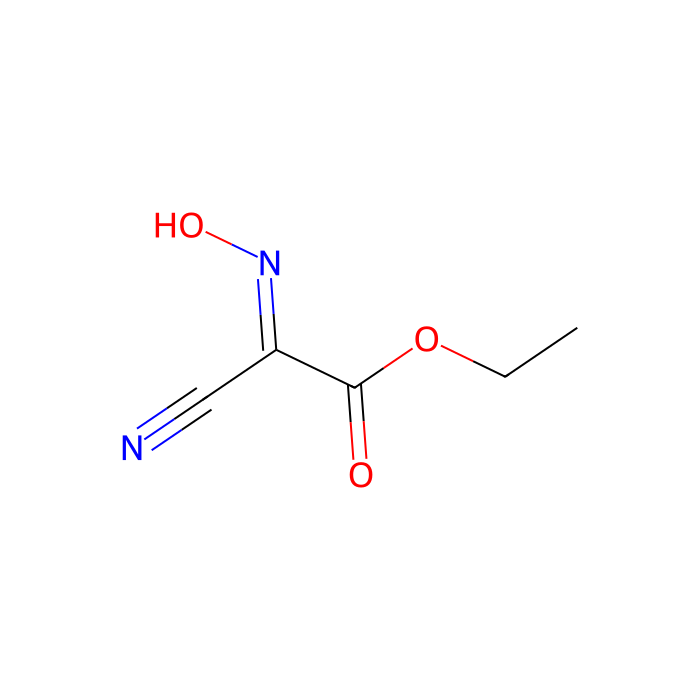
Ethyl (hydroxyimino)cyanoacetate - ≥98% , CAS No.3849-21-6

CAS: 3849-21-6 Cat. No.: E138773 Summenformel: NCC(=NOH)CO2C2H5 Molekulargewicht: 142.11 Beilstein Registry Number: 774783 EG-Nummer: 223-351-3
Zu bestellen verfügbar
QUALITÄT & REINHEIT ≥98%
Synonyms
Isothiocyanato-acetic acid ethyl ester|ethyl (2E)-2-cyano-2-hydroxyiminoacetate|CP-53619|(Z)-(ETHYL CYANO(HYDROXYIMINO)FORMATE)|2,4-dichloro-alpha-(1-imidazolylmethyl)-Benzyl alcohol
Storage
Room temperature,Desiccated
Shipped In
Normal
★
Größe
Deutschland (EU)
USA*
Preis
Menge
25g
E138773-25g
—
3 Auf Lager
12,06€
100g
E138773-100g
—
4 Auf Lager
32,02€
500g
E138773-500g
—
3 Auf Lager
124,00€
Enter a quantity for the sizes you want to add.

Übersicht

Ethyl (hydroxyimino)cyanoacetate is a non-explosive alternative to HOBt. It has been found to produce higher yields that HOBt in carbodiimide-mediated coupling reactions.
A non-explosive alternative to HOBt.

Spezifikationen

Synonyme
Isothiocyanato-acetic acid ethyl ester | ethyl (2E)-2-cyano-2-hydroxyiminoacetate | CP-53619 | (Z)-(ETHYL CYANO(HYDROXYIMINO)FORMATE) | 2,4-dichloro-alpha-(1-imidazolylmethyl)-Benzyl alcohol
Spezifikationen & Reinheit
≥98%
Storage
Room temperature,Desiccated
Verschickt in
Normal
Reinheit
≥98%
Namen und Kennungen
Pubchem Sid
Pubchem Sid Url
https://pubchem.ncbi.nlm.nih.gov/substance/488195735
SMILES
CCOC(=O)C(=NO)C#N
IUPAC Name
ethyl (2E)-2-cyano-2-hydroxyiminoacetate
InChIKey
LCFXLZAXGXOXAP-QPJJXVBHSA-N
InChI
1S/C5H6N2O3/c1-2-10-5(8)4(3-6)7-9/h9H,2H2,1H3/b7-4+
Isomere SMILES
CCOC(=O)/C(=N/O)/C#N
WGK Deutschland
3
Molekulargewicht
142.11
Beilstein
774783
Reaxys
774783
Reaxys-RN_link_address
https://www.reaxys.com/reaxys/secured/hopinto.do?context=S&query=IDE.XRN=774783&ln=

Erweiterte Daten

Taxonomic Classification

Taxonomy Tree

KingdomOrganic compounds
SuperclassOrganic nitrogen compounds
KlasseOrganonitrogen compounds
SubclassOximes
Intermediate Tree Nodes Not available
Direct ParentKetoximes
Alternative Parents Carboxylic acid esters  Nitriles  Monocarboxylic acids and derivatives  Organic oxides  Hydrocarbon derivatives  Carbonyl compounds  
Molecular FrameworkAliphatic acyclic compounds
Substituents Ketoxime - Carboxylic acid ester - Nitrile - Carbonitrile - Monocarboxylic acid or derivatives - Carboxylic acid derivative - Organic oxygen compound - Cyanide - Organic oxide - Hydrocarbon derivative - Organooxygen compound - Carbonyl group - Aliphatic acyclic compound
BeschreibungThis compound belongs to the class of organic compounds known as ketoximes. These are organic compounds with the general formula RC(R')=NOH (R,R' = organyl).
External Descriptors Not available
3D-Struktur
Interaktives chemisches Strukturmodell


Zertifikate (CoA, COO, BSE/TSE und Analyse-Diagramm)
C of A & Other Certificates(BSE/TSE, COO):
Analytical Chart:

Find and download the COA for your product by matching the lot number on the packaging.

28 results found

Lot NumberCertificate TypeDatumArtikel
B2308384B2308384Certificate of AnalysisAug 03, 2026 E138773
L2213344L2213344Certificate of AnalysisJun 09, 2026 E138773
L2213150L2213150Certificate of AnalysisJun 09, 2026 E138773
D2628306D2628306Certificate of AnalysisApr 18, 2026 E138773
D2628313D2628313Certificate of AnalysisApr 18, 2026 E138773
D2628317D2628317Certificate of AnalysisApr 18, 2026 E138773
D2628340D2628340Certificate of AnalysisApr 18, 2026 E138773
J2609046J2609046Certificate of AnalysisApr 18, 2026 E138773
H2205205H2205205Certificate of AnalysisFeb 04, 2026 E138773
E23301328E23301328Certificate of AnalysisMar 03, 2025 E138773
E23301344E23301344Certificate of AnalysisMar 03, 2025 E138773
E23301350E23301350Certificate of AnalysisMar 03, 2025 E138773
E23301351E23301351Certificate of AnalysisMar 03, 2025 E138773
L2405328L2405328Certificate of AnalysisNov 27, 2024 E138773
L2213170L2213170Certificate of AnalysisSep 12, 2024 E138773
L2213176L2213176Certificate of AnalysisSep 12, 2024 E138773
L2213346L2213346Certificate of AnalysisSep 12, 2024 E138773
H2205203H2205203Certificate of AnalysisMay 13, 2024 E138773
H2205204H2205204Certificate of AnalysisMay 13, 2024 E138773
D2411447D2411447Certificate of AnalysisMar 26, 2024 E138773
D2407207D2407207Certificate of AnalysisMar 20, 2024 E138773
J2116490J2116490Certificate of AnalysisAug 16, 2023 E138773
J2116491J2116491Certificate of AnalysisAug 16, 2023 E138773
B2308383B2308383Certificate of AnalysisFeb 16, 2023 E138773
E1703019E1703019Certificate of AnalysisDec 07, 2022 E138773
L2213375L2213375Certificate of AnalysisNov 18, 2022 E138773
K2025135K2025135Certificate of AnalysisSep 20, 2022 E138773
H2205202H2205202Certificate of AnalysisJul 21, 2022 E138773
Chemische und physikalische Eigenschaften
LöslichkeitSoluble in methanol
Schmelzpunkt (°C)131-135℃
Molekulargewicht142.11
XLogP31.300
Hydrogen Bond Donor Count1
Hydrogen Bond Acceptor Count5
Rotatable Bond Count3
Exact Mass142.038 Da
Monoisotopic Mass142.038 Da
Topological Polar Surface Area82.700 Ų
Heavy Atom Count10
Formal Charge0
Complexity200.000
Isotope Atom Count0
Defined Atom Stereocenter Count0
Undefined Atom Stereocenter Count0
Defined Bond Stereocenter Count1
Undefined Bond Stereocenter Count0
The total count of all stereochemical bonds1
Covalently-Bonded Unit Count1
Sicherheit und Gefahren (GHS)
Piktogramm(e)
Signal
Warning
Gefahrenhinweise

H302:Harmful if swallowed

H312:Harmful in contact with skin

H315:Causes skin irritation

H319:Causes serious eye irritation

H332:Harmful if inhaled

H335:May cause respiratory irritation

Sicherheitshinweise

P261:Avoid breathing dust/fume/gas/mist/vapors/spray.

P264:Wash hands [and …] thoroughly after handling.

P270:Do not eat, drink or smoke when using this product.

P271:Use only outdoors or in a well-ventilated area.

P280:Wear protective gloves/protective clothing/eye protection/face protection.

P321:Specific treatment (see ... on this label).

P330:Rinse mouth.

P302+P352:IF ON SKIN: wash with plenty of water.

P304+P340:IF INHALED: Remove person to fresh air and keep comfortable for breathing.

P305+P351+P338:IF IN EYES: Rinse cautiously with water for several minutes. Remove contact lenses if present and easy to do - continue rinsing.

P362+P364:Take off contaminated clothing and wash it before reuse.

P405:Store locked up.

P403+P233:Store in a well-ventilated place. Keep container tightly closed.

P501:Dispose of contents/container to an approved waste disposal plant.

P264+P265:Wash hands [and …] thoroughly after handling. Do not touch eyes.

P301+P317:IF SWALLOWED: Get medical help.

P317:Get emergency medical help.

P337+P317:If eye irritation persists: Get medical help.

P332+P317:If skin irritation occurs: Get medical help.

P319:Get medical help if you feel unwell.

WGK Deutschland
3
Reaxys
774783
Reaxys-RN_link_address
https://www.reaxys.com/reaxys/secured/hopinto.do?context=S&query=IDE.XRN=774783&ln=
FAQs und Artikel
A Complete Guide to Choosing Resins for SPPS (Solid-Phase Peptide Synthesis): Fmoc/Boc Routes, C-Terminal Acid/Amide, and a Key-Parameter Navigator
β-Acyloxy Alkenyl Amides (AAAs): A New Approach to Amide Bond and Peptide Bond Construction Worth Attention
From High Reactivity to Comprehensive Evaluation: Using CTSOAt as an Example to Understand the Design Logic of New Coupling Reagents
From Analytical Instrument to Synthetic Platform: A New Strategy for Reconstructing Automated Flow Solid-Phase Peptide Synthesis with Standard Analytical HPLC
New Progress in the Solid-Phase Synthesis of Sterically Hindered Peptides: Background, Core Breakthroughs, and Implications for Automation Compatibility of the RMMR Strategy
TCFH–NMI Amidation in Highly Aqueous Media: Research Value, Methodological Understanding, and Experimental Insights
A New Balance in Coupling Reagents: How DMT-TU Balances Reactivity, Racemization Control, and Thermal Hazard
The Positioning of TBTU in Practice: Racemization Risk, Extended Uses, and Selection Criteria
The Methodological Value of HATU in Difficult Couplings: Reactivity Advantages, Stereochemical Retention, and Condition Management
The Methodological Value of Boc-Oxyma: Low-Racemization Coupling, Route Continuity, and Extended Applications
Low Racemization in Peptide Synthesis Is Not Just About Reagent Choice: Stereochemical Risk During the Activation Stage and Practical Strategies for Experimental Control
The Methodological Value of TCFH: Advantages in Challenging Amidation and the Switching Logic of Carboxylic Acid Activation Pathways
Ynamide Coupling Reagents: From Low-Epimerization Activation Pathways to More Practically Usable N→C Inverse Peptide Synthesis
Decision Logic for Peptide Synthesis Routes: Applicability and Criteria for Choosing among SPPS, LPPS, and Recombinant Expression
Decision Logic for Selecting Coupling Reagents in Amide Bond Formation: Activation Pathways, Side Reactions, Epimerization, Workup, and Safety
Experimental Assessment of HOPO in Carbodiimide-Mediated Amide Coupling: Low-Racemization Control, Application Scenarios, and Process Considerations
Experimental Judgment in Oxyma Coupling Systems: Coupling Efficiency, Racemization Control, and the HCN Risk in DIC-Based Systems
Experimental Judgment for CMPI in Carboxylic Acid Activation: Applicable Tasks, Base Matching, and Workup Burden
Experimental Judgment for TFPN in Carboxylic Acid Activation: Suitable Scenarios, Intermediate Distribution, and Nucleophile Compatibility
Selective Acylation of Less Reactive Amines in Complex Substrates: Strategies for N/O and N/N Selectivity Control This article draws on the work of Li et al. on the TCFH/catalytic Oxyma system and transient imine protection, and summarizes design strateg
How to Troubleshoot Abnormal Impurities in Peptide Synthesis? Locating Process Issues Through Amino-Related Side Reactions
Peptide Intermediates Difficult to Dissolve and Separate? Route Design and Workup Strategies for Tag-Assisted Liquid-Phase Peptide Synthesis (TAG-LPPS)
AITF-Mediated Carboxylic Acid Activation for the Synthesis of Amides, Peptides, and Esters: Activation Mechanism and Applicable Scenarios
Formation and Control of Carboxyl- and Hydroxyl-Related Impurities in Peptide Synthesis — Using Asp/Glu and Ser/Thr Residue Side Reactions as Examples
CTSOBt Benzotriazole–Sulfonate Coupling Reagent: Carboxylic Acid Activation and Synthetic Application Value
Logic for Selecting Amidation Reagents in Aqueous Media: Competing Reactions, Activated Intermediates, and Substrate Effects
How Cyclization Changes Peptide Behavior: Conformational Preorganization, Skin Delivery, and Integrin Binding, Using Cyclopeptide-5 as an Example
Copper Tripeptide GHK-Cu and Skin Repair: From Copper Coordination Chemistry to Extracellular Matrix Remodeling
Citations of This Product
Lösungsrechner
Bewertungen

Kundenbewertungen

Häufig gestellte Fragen

What is the purity of this product?
This product is supplied at ≥98% purity (chemical assay). Lot-specific values are stated on the Certificate of Analysis.
How should this product be stored?
Store in a cool place, desiccated. Keep the container tightly closed with desiccant — the material is moisture-sensitive.
How is this product shipped?
This product ships under standard ambient conditions. No temperature-controlled packaging is required.
What are the CAS number, molecular formula and molecular weight?
The CAS Number is 3849-21-6, the molecular formula is C5H6N2O3, and the molecular weight is 142.11 g/mol. InChIKey LCFXLZAXGXOXAP-QPJJXVBHSA-N.
What documentation is provided?
Available product documentation, including Certificates of Analysis (COA), Safety Data Sheets (SDS), and specification sheets, is shown in the product document area. Document availability and access follow the current site policy.

Dürfen wir Sie über Rabattaktionen informieren?

Später erinnern

Vielen Dank! Bitte überprüfen Sie Ihren E-Mail-Posteingang, um zu bestätigen.

Hoppla! Benachrichtigungen sind deaktiviert.