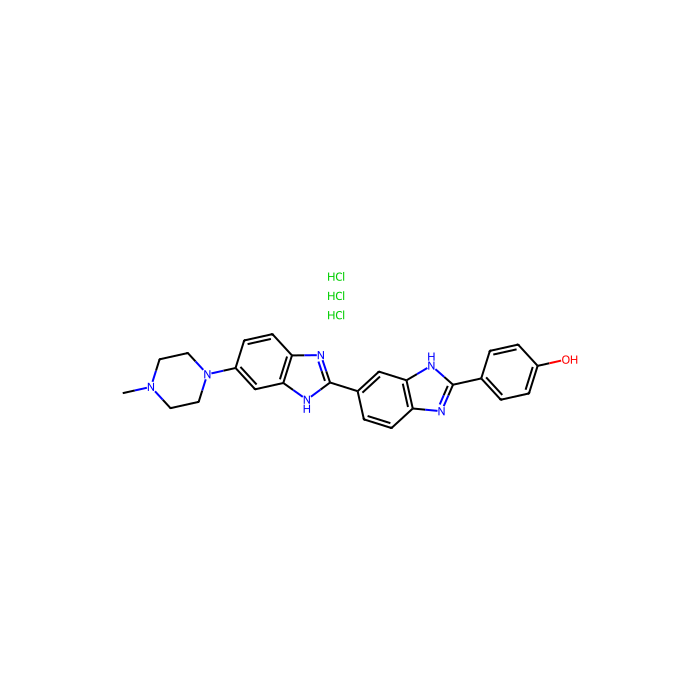
Hoechst 33258 UltraPure - ≥99%(HPLC) , CAS No.23491-45-4

CAS: 23491-45-4 Cat. No.: H266330 Summenformel: C25H24N6O·3HCl Molekulargewicht: 533.90 Beilstein Registry Number: 4088183 EG-Nummer: 245-690-6 PubChem CID: 31953
Zu bestellen verfügbar
QUALITÄT & REINHEIT ≥99%(HPLC)
Synonyms
HOE 33258|HOECHST 33258|BBIH|BXI-72|2′-(4-Hydroxyphenyl)-5-(4-methyl-1-piperazinyl)-2,5′-bi(1H-benzimidazole)|2-[2-(4-Hydroxyphenyl)-6-benzimidazoyl]-6-(1-methyl-4-piperazyl)benzimidazole
Storage
Protected from light,Store at -20°C,Desiccated
Shipped In
Ice chest + Ice pads
★
Größe
Deutschland (EU)
USA*
Preis
Menge
25mg
H266330-25mg
—
3 Auf Lager
95,36€
100mg
H266330-100mg
—
3 Auf Lager
268,04€
500mg
H266330-500mg
—
1 Auf Lager
714,93€
Enter a quantity for the sizes you want to add.

Übersicht

Hoechst 33258 is a nuclear staining reagent that can penetrate cell membranes and stain DNA. It releases strong blue fluorescence after intercalating double-stranded DNA. Hoechst 33258 is often used for cell apoptosis detection. After staining, observe with a fluorescence microscope or detect with a flow cytometer. The excitation and emission wavelengths of Hoechst 33258-DNA are 352 nm and 461 nm, respectively.

Instructions

1. For fixed cells or tissues

1) For cell or tissue samples, after fixation, wash them appropriately to remove fixative. Then, if immunofluorescence staining is required, perform immunofluorescence staining first, and then follow the subsequent steps for Hoechst 33258 staining after the staining is completed. If no other staining is required, the subsequent Hoechst 33258 staining is directly performed.

2) For adherent cells or tissue sections, add a small amount of Hoechst 33258 staining solution to cover the sample. For suspended cells, add at least 3 times the volume of the sample to be stained with staining solution and mix well. Leave at room temperature for 3-5 minutes.

3) Aspirate the Hoechst 33258 staining solution, wash 2-3 times with TBST, PBS or saline, 3-5 minutes each time.

4) Observe directly under a fluorescence microscope or after mounting the slide. When observing cell apoptosis, the nucleus of apoptotic cells will be densely stained, or fragmented and densely stained.

2. For living cells or tissues

5) Add an appropriate amount of Hoechst 33258 staining solution, which must fully cover the sample to be stained. Usually, 1ml staining solution is needed for one well of a six-well plate, and 100 microliters of staining solution is required for one well of a 96-well plate.

6) Incubate for 20-30 minutes at a temperature suitable for cell culture. Discard the staining solution, wash 2-3 times with PBS or culture solution to perform fluorescence detection.

Storage conditions: Store at -20°C and protected from light, valid for one year.

Precautions

1) Hoechst 33258 is irritating to the human body, please pay attention to proper protection.

2) Fluorescent dyes have the problem of quenching. It is recommended to complete the test on the same day after dyeing.

3) To slow down fluorescence quenching, anti-fluorescence quenching mounting solution can be used.

4) For your safety and health, please wear lab coats and disposable gloves for operation.

Spezifikationen

Synonyme
HOE 33258 | HOECHST 33258 | BBIH | BXI-72 | 2′-(4-Hydroxyphenyl)-5-(4-methyl-1-piperazinyl)-2,5′-bi(1H-benzimidazole) | 2-[2-(4-Hydroxyphenyl)-6-benzimidazoyl]-6-(1-methyl-4-piperazyl)benzimidazole
Spezifikationen & Reinheit
≥99%(HPLC)
Storage
Protected from light,Store at -20°C,Desiccated
Verschickt in
Ice chest + Ice pads
Dieses Produkt erfordert Kühlkettenversand. Grundversand und andere Economy-Optionen sind nicht verfügbar.
Reinheit
≥99%(HPLC)
Namen und Kennungen
Pubchem Sid
Pubchem Sid Url
https://pubchem.ncbi.nlm.nih.gov/substance/504753482
SMILES
CN1CCN(CC1)C2=CC3=C(C=C2)N=C(N3)C4=CC5=C(C=C4)N=C(N5)C6=CC=C(C=C6)O.Cl.Cl.Cl
IUPAC Name
4-[6-[6-(4-methylpiperazin-1-yl)-1H-benzimidazol-2-yl]-1H-benzimidazol-2-yl]phenol;trihydrochloride
InChIKey
SMNPLAKEGAEPJD-UHFFFAOYSA-N
InChI
1S/C25H24N6O.3ClH/c1-30-10-12-31(13-11-30)18-5-9-21-23(15-18)29-25(27-21)17-4-8-20-22(14-17)28-24(26-20)16-2-6-19(32)7-3-16;;;/h2-9,14-15,32H,10-13H2,1H3,(H,26,28)(H,27,29);3*1H
Isomere SMILES
CN1CCN(CC1)C2=CC3=C(C=C2)N=C(N3)C4=CC5=C(C=C4)N=C(N5)C6=CC=C(C=C6)O.Cl.Cl.Cl
WGK Deutschland
3
RTECS
SM1140500
PubChem CID
31953
Molekulargewicht
533.90
Beilstein
4088183

Erweiterte Daten

Taxonomic Classification

Taxonomy Tree

KingdomOrganic compounds
SuperclassOrganoheterocyclic compounds
KlasseBenzimidazoles
SubclassPhenylbenzimidazoles
Intermediate Tree Nodes Not available
Direct ParentPhenylbenzimidazoles
Alternative Parents N-arylpiperazines  Phenylimidazoles  Dialkylarylamines  N-methylpiperazines  1-hydroxy-2-unsubstituted benzenoids  Benzene and substituted derivatives  Heteroaromatic compounds  Trialkylamines  Azacyclic compounds  Organooxygen compounds  Hydrochlorides  Hydrocarbon derivatives  
Molecular FrameworkAromatic heteropolycyclic compounds
Substituents Phenylbenzimidazole - N-arylpiperazine - 2-phenylimidazole - Dialkylarylamine - Tertiary aliphatic/aromatic amine - 1-hydroxy-2-unsubstituted benzenoid - Phenol - N-alkylpiperazine - N-methylpiperazine - Monocyclic benzene moiety - 1,4-diazinane - Benzenoid - Piperazine - Azole - Heteroaromatic compound - Imidazole - Tertiary aliphatic amine - Tertiary amine - Azacycle - Hydrochloride - Organooxygen compound - Organonitrogen compound - Hydrocarbon derivative - Organic oxygen compound - Organic nitrogen compound - Amine - Aromatic heteropolycyclic compound
BeschreibungThis compound belongs to the class of organic compounds known as phenylbenzimidazoles. These are compounds containing a phenylbenzimidazole skeleton, which consists of a benzimidazole moiety where its imidazole ring is attached to a phenyl group.
External Descriptors Not available
3D-Struktur
Interaktives chemisches Strukturmodell


Zugehörige Ziele (menschlich)
TOP1 Tclin DNA topoisomerase I (7553 Activities)
Activity TypeRelationActivity valueUnitsAction TypeJournalPubMed IddoiAssay Aladdin ID
TOP2A Tclin DNA topoisomerase II alpha (6317 Activities)
Activity TypeRelationActivity valueUnitsAction TypeJournalPubMed IddoiAssay Aladdin ID
DU-145 (51482 Activities)
Activity TypeRelationActivity valueUnitsAction TypeJournalPubMed IddoiAssay Aladdin ID
MCF7 (126967 Activities)
Activity TypeRelationActivity valueUnitsAction TypeJournalPubMed IddoiAssay Aladdin ID
A549 (127892 Activities)
Activity TypeRelationActivity valueUnitsAction TypeJournalPubMed IddoiAssay Aladdin ID
KG-1 (867 Activities)
Activity TypeRelationActivity valueUnitsAction TypeJournalPubMed IddoiAssay Aladdin ID
HeLa (62764 Activities)
Activity TypeRelationActivity valueUnitsAction TypeJournalPubMed IddoiAssay Aladdin ID
Zugehörige Ziele (nicht menschlich)
Pseudomonas aeruginosa (123386 Activities)
Activity TypeRelationActivity valueUnitsAction TypeJournalPubMed IddoiAssay Aladdin ID
Enterobacter cloacae (7976 Activities)
Activity TypeRelationActivity valueUnitsAction TypeJournalPubMed IddoiAssay Aladdin ID
Klebsiella pneumoniae (43867 Activities)
Activity TypeRelationActivity valueUnitsAction TypeJournalPubMed IddoiAssay Aladdin ID
Shigella flexneri (1836 Activities)
Activity TypeRelationActivity valueUnitsAction TypeJournalPubMed IddoiAssay Aladdin ID
Staphylococcus aureus (210822 Activities)
Activity TypeRelationActivity valueUnitsAction TypeJournalPubMed IddoiAssay Aladdin ID
Staphylococcus epidermidis (22802 Activities)
Activity TypeRelationActivity valueUnitsAction TypeJournalPubMed IddoiAssay Aladdin ID
Acinetobacter baumannii (41033 Activities)
Activity TypeRelationActivity valueUnitsAction TypeJournalPubMed IddoiAssay Aladdin ID
Citrobacter freundii (1864 Activities)
Activity TypeRelationActivity valueUnitsAction TypeJournalPubMed IddoiAssay Aladdin ID
Escherichia coli (133304 Activities)
Activity TypeRelationActivity valueUnitsAction TypeJournalPubMed IddoiAssay Aladdin ID
Enterococcus faecium (13803 Activities)
Activity TypeRelationActivity valueUnitsAction TypeJournalPubMed IddoiAssay Aladdin ID
Enterococcus faecalis (29875 Activities)
Activity TypeRelationActivity valueUnitsAction TypeJournalPubMed IddoiAssay Aladdin ID
Calf thymus DNA (4845 Activities)
Activity TypeRelationActivity valueUnitsAction TypeJournalPubMed IddoiAssay Aladdin ID
Wirkungsmechanismen
Zertifikate (CoA, COO, BSE/TSE und Analyse-Diagramm)
C of A & Other Certificates(BSE/TSE, COO):
Analytical Chart:

Find and download the COA for your product by matching the lot number on the packaging.

6 results found

Lot NumberCertificate TypeDatumArtikel
G2410289G2410289Certificate of AnalysisOct 13, 2026 H266330
F2220538F2220538Certificate of AnalysisApr 03, 2026 H266330
F2220539F2220539Certificate of AnalysisApr 03, 2026 H266330
G2410283G2410283Certificate of AnalysisApr 02, 2026 H266330
D2419026D2419026Certificate of AnalysisFeb 06, 2025 H266330
F2220571F2220571Certificate of AnalysisJun 09, 2022 H266330
Chemische und physikalische Eigenschaften
EmpfindlichkeitLight & Heat sensitive
Schmelzpunkt (°C)314°C
Molekulargewicht533.9
XLogP3
Hydrogen Bond Donor Count6
Hydrogen Bond Acceptor Count5
Rotatable Bond Count3
Exact Mass532.131 Da
Monoisotopic Mass532.131 Da
Topological Polar Surface Area84.100 Ų
Heavy Atom Count35
Formal Charge0
Complexity634.000
Isotope Atom Count0
Defined Atom Stereocenter Count0
Undefined Atom Stereocenter Count0
Defined Bond Stereocenter Count0
Undefined Bond Stereocenter Count0
The total count of all stereochemical bonds0
Covalently-Bonded Unit Count4
Sicherheit und Gefahren (GHS)
Piktogramm(e)
Signal
Warning
Gefahrenhinweise

H302:Harmful if swallowed

H315:Causes skin irritation

H319:Causes serious eye irritation

Sicherheitshinweise

P264:Wash hands [and …] thoroughly after handling.

P270:Do not eat, drink or smoke when using this product.

P280:Wear protective gloves/protective clothing/eye protection/face protection.

P321:Specific treatment (see ... on this label).

P330:Rinse mouth.

P302+P352:IF ON SKIN: wash with plenty of water.

P305+P351+P338:IF IN EYES: Rinse cautiously with water for several minutes. Remove contact lenses if present and easy to do - continue rinsing.

P362+P364:Take off contaminated clothing and wash it before reuse.

P501:Dispose of contents/container to an approved waste disposal plant.

P264+P265:Wash hands [and …] thoroughly after handling. Do not touch eyes.

P301+P317:IF SWALLOWED: Get medical help.

P337+P317:If eye irritation persists: Get medical help.

P332+P317:If skin irritation occurs: Get medical help.

WGK Deutschland
3
RTECS
SM1140500
FAQs und Artikel
Hoechst Staining for Apoptosis Detection: Experimental Workflow
Cell Live/Dead Staining and Apoptosis Detection Techniques
Fluorescent Probes: A Complete Beginner’s Guide — Definitions & Emission Mechanisms, Signal Readouts, Classification Framework, Selection Roadmap, and Product Tables (Tables 1–4)
dsDNase-Mediated Hydrolysis of Double-Stranded DNA: Enzymatic Characteristics, Methodological Strategies, and Bioanalytical Applications
Physicochemical Properties of Diphenylamine, Analytical Applications, and a Review of Its DNA Colorimetric Reaction
Comparative Analysis and Selection Strategies for Mounting Media in Immunological Experiments
Cell Apoptosis Detection by TUNEL Labeling: Signal Interpretation and Result Evaluation
Fluorescent Dyes in Life Science Research: Classification, Labeling Principles, and Experimental Applications
Types, Binding Mechanisms, and Experimental Selection of Nuclear Dyes
Practical Guide to TSA Tyramide Signal Amplification: How to Select Reagents, Optimize the Workflow, and Reduce Background When Detection Signals Are Weak for Low-Abundance Targets
Applications of Cell Permeabilization Technology in Immunofluorescence and Flow Cytometry Detection
Summary of Cell Staining Methods
Citations of This Product
Lösungsrechner
Bewertungen

Kundenbewertungen

Application Protocols

Tested applications, recommended dilutions, and positive controls are not specified for this item; refer to CoA/Spec Sheet and SDS.

General guidance (literature/general; verify and optimize in your lab):

  • Stock solution: Prepare a concentrated stock in water or DMSO, protect from light, and aliquot to avoid freeze–thaw.
  • Working solution: Dilute into PBS or appropriate buffer/media immediately before use; filter if performing high-resolution imaging.
  • Controls: Include unstained cells/tissues and single-color controls when multiplexing; validate exposure and detector settings to avoid saturation.

Because this section requires product-specific validation, users should consult peer-reviewed protocols and adapt parameters to their model system and instrumentation.

Biological Roles

Hoechst 33258 is a synthetic fluorescent probe and does not have an endogenous biological role. However, its interaction with biomolecules is well characterized (literature/general):

  • Binding target: B-form double-stranded DNA, with pronounced preference for A/T-rich sequences in the minor groove. Binding is driven by hydrogen bonding, electrostatic interactions, and shape complementarity.
  • Consequences of binding: Fluorescence intensity increases markedly upon DNA association, with a hypsochromic shift relative to the free dye; lifetime and anisotropy also change, supporting quantitative assays.
  • Cellular distribution: In live cells, the cationic dye accumulates predominantly in the nucleus; permeability and accumulation are influenced by membrane transporters and dye formulation.
  • Selectivity vs RNA: Hoechst dyes bind DNA much more strongly than RNA; RNA-bound fluorescence is comparatively weak, enabling DNA-selective staining in mixed nucleic acid samples.
  • Environmental sensitivity: Emission intensity and maxima depend on local microenvironment (ionic strength, pH, viscosity) and binding site composition, which can be exploited in biophysical studies of chromatin.

Note: Because these dyes interact with genetic material, they should be handled with care to minimize exposure. No clinical or therapeutic roles are claimed; for research use only (per Product Data).

Buffer Applications

Hoechst 33258 is used in buffered aqueous media for nucleic acid staining rather than for pH buffering.

Practical buffer considerations (literature/general):

  • Common staining buffers: PBS, HBSS, or HEPES-buffered saline. Phenol red–free formulations are preferred for imaging to reduce background and spectral crosstalk.
  • Ionic strength: Moderate ionic strength (e.g., standard PBS) supports efficient minor-groove binding; very high salt can weaken electrostatic contributions.
  • pH: Near-neutral pH (≈7.2–7.6) maintains fluorescence and DNA affinity; extreme pH may alter protonation state and spectral properties.
  • Additives: 0.05–1% BSA can reduce nonspecific adsorption to plastics; 0.02–0.05% sodium azide may be used in fixed-cell solutions (not for live cells). Nonionic detergents (e.g., 0.05–0.1% Triton X-100) facilitate access in permeabilized fixed cells.
  • Filtration: Filter working solutions through 0.2 µm membranes to remove particulates prior to high-resolution imaging.

Recipes and exact concentrations for this item are not specified; refer to CoA/Spec Sheet and the primary literature for protocol-specific formulations appropriate to your assay and instrumentation.

Green Alternatives

While Hoechst 33258 is widely used and effective, sustainability and safety considerations may motivate alternatives that reduce hazard or improve waste profiles.

Comparison (literature/general):

  • Hoechst 33258

    • Pros: Bright DNA-bound fluorescence (Ex ~350–360 nm/Em ~460–465 nm), strong affinity for A/T-rich dsDNA, well-established protocols.
    • Cons: Requires UV/violet excitation (potential phototoxicity), DNA-binding raises mutagenicity concerns; not ideal for minimal-hazard labs.
  • DAPI (4′,6-diamidino-2-phenylindole)

    • Pros: Similar spectral properties; widely available; strong DNA binding.
    • Cons: UV excitation required; also a DNA binder with similar hazard profile.
  • SYBR Safe DNA Gel Stain / EvaGreen (solution assays and gels)

    • Pros: Engineered for lower mutagenic potential than ethidium bromide; visible-light excitation variants available; improved safety claims by manufacturers (evaluate critically).
    • Cons: Different spectra; may not substitute directly in fixed/live-cell nuclear staining.
  • NucBlue (Hoechst 33342 formulations) and other visible-excited nuclei stains

    • Pros: Formulated for live-cell convenience; sometimes excitable with 405 nm lasers.
    • Cons: Still DNA-binding dyes; hazard considerations remain.

Practical guidance:

  • Prefer 405 nm–excitable variants when available to avoid deep-UV sources.
  • Minimize dye concentration and exposure time; implement closed, small-volume staining to reduce waste.
  • Segregate and treat dye-containing waste per institutional green-chemistry policies.
Pharmaceutical Uses

This product is a laboratory fluorescent dye for research use only. No excipient role or pharmacopeial status is provided for this SKU.

  • Formulation/clinical use: Not applicable. No therapeutic or diagnostic claims are made.
  • Manufacturing context: Hoechst 33258 is not typically used in pharmaceutical formulation; its strong DNA-binding properties preclude routine excipient use.

Item-specific information:

  • Grade/purity: Not specified for this item; refer to CoA/Spec Sheet.

For regulated environments, consult your QA team and the product’s CoA/SDS to determine suitability for any non-research application.

Physical Properties

Item-specific physico-chemical specifications were not provided for this catalog entry; consult the CoA/SDS for authoritative values.

  • Appearance: Not specified for this item; refer to CoA/Spec Sheet.
  • Molecular weight: Not specified for this item; refer to CoA/Spec Sheet. (Varies with salt/hydrate form.)
  • Molecular formula: Not specified for this item; refer to CoA/Spec Sheet.

Fluorescence characteristics (literature/general for Hoechst 33258):

  • Excitation maximum: ~350–360 nm (UV)
  • Emission maximum (DNA-bound): ~460–465 nm (blue)
  • Strong fluorescence enhancement upon binding to dsDNA; weakly fluorescent free in solution.

Solubility (literature/general):

  • Readily soluble in water and polar organics (e.g., DMSO, methanol) when supplied as the hydrochloride salt; aqueous solubility improves with acidified media.
  • Working solutions are commonly prepared in water or buffer (e.g., PBS) at micromolar concentrations.

Other properties (literature/general):

  • Charge: cationic at physiological pH (salt form), promoting nuclear accumulation and DNA association.
  • LogP/logD: not routinely reported for the salt; effective partitioning favors aqueous environments yet permits cell permeability.

Note: Melting point, refractive index, density, pKa, and extinction coefficients are formulation- and salt-dependent; Not specified for this item; refer to CoA/Spec Sheet.

Quality and Grades
  • Listed grade/purity: Not specified for this item; refer to CoA/Spec Sheet.
  • Product designation: “UltraPure.”

What “UltraPure” generally implies (literature/general):

  • High chemical purity and low levels of fluorescent impurities that can elevate background.
  • Tight control of counter-ion and hydrate content for consistent performance in imaging/flow cytometry.
  • Reduced particulates and non-fluorescent residues to minimize nonspecific staining and optical artifacts.

Relevance for nucleic acid staining:

  • Background signal: UltraPure quality typically yields lower nonspecific background and higher signal-to-noise, especially critical for quantitative imaging, HCS, and flow applications.
  • Batch-to-batch consistency: Important for reproducible excitation/emission intensity, spectral alignment, and binding characteristics.

Documentation to consult for this specific SKU:

  • Certificate of Analysis (CoA): Lot-specific assay/purity, counter-ion content, residual solvents, spectral QC (if available). Not specified for this item; refer to CoA/Spec Sheet.
  • SDS: Comprehensive hazard and handling information.

Stabilizers/additives:

  • Not specified for this item; refer to CoA/Spec Sheet. If present, stabilizers can affect extinction/quantitation and should be considered when calculating dye concentrations by absorbance.
Reaction and Applications

This product is a fluorescent probe rather than a synthetic reagent; it is not typically used as a reactant in chemical synthesis.

Analytical/biological applications (literature/general for Hoechst 33258):

  • Nuclear/DNA staining: Robust blue-fluorescent stain for dsDNA in fixed and many live-cell preparations, with A/T-rich minor-groove preference.
  • Cell cycle/quantitation: DNA content analysis in flow cytometry for cell cycle profiling (requires appropriate excitation with UV/violet lasers and compensation strategies).
  • Apoptosis/viability assays: Used to visualize chromatin condensation/fragmentation; often combined with propidium iodide or annexin V (interpretation requires controls).
  • Microscopy modalities: Widefield, confocal, and high-content imaging; suitable as a nuclear counterstain alongside green/red probes.
  • Nucleic acid assays: Fluorescence enhancement upon DNA binding enables sensitive quantitation of DNA in solution.

Practical tips (literature/general):

  • Protect from light throughout preparation and incubation to preserve signal.
  • Filter working solutions (0.2 µm) for imaging to reduce particulate fluorescence.
  • Optimize concentration and incubation time empirically (cell type– and fixation-dependent) and include unstained/negative controls.
  • Rinse adequately after staining to lower background; brief postfixation can stabilize signal in some protocols.

Manufacturer Applications: Not specified in Product Data; see above general uses and consult primary literature for protocol-specific parameters.

Reaction Conditions

Not applicable as a synthetic reagent. Hoechst 33258 is employed under staining/assay conditions rather than reaction conditions.

Assay environment considerations (literature/general):

  • Temperature: Room temperature staining is common; live-cell protocols may use 37°C for brief incubations to maintain physiology.
  • Light exposure: Minimize during incubation to prevent photobleaching and phototoxicity.
  • Incubation time: Typically minutes to tens of minutes depending on cell type and permeability; optimize empirically.
  • Compatibility: Works with most standard aqueous buffers; avoid strong oxidants/reductants that can degrade the dye.

Exact conditions for this SKU are not specified; refer to CoA/Spec Sheet and peer-reviewed protocols aligned with your instrumentation (e.g., UV/405 nm excitation sources).

Safety and Handling

Hazard classification specifics for this item were not provided. Always review the product’s SDS for authoritative safety information.

  • GHS classification, signal word, pictograms, H-statements: Not specified for this item; refer to SDS.

General safety considerations for DNA-binding fluorescent dyes (literature/general):

  • Potential mutagenicity risk: DNA minor-groove binders can interact with genetic material. Handle with caution in a chemical fume hood, minimize aerosol formation, and avoid skin contact or inhalation.
  • PPE: lab coat, safety glasses or face shield, and suitable chemically resistant gloves (e.g., nitrile). Use secondary containment for stock solutions.
  • Light sensitivity: Protect from light during handling and storage to prevent photodegradation.
  • Incompatibilities: Avoid strong oxidizers and reducing agents that may degrade the dye; prevent contact with strong bases/acids that can alter fluorescence and stability outside recommended ranges.
  • Spill/accident response (general): Absorb small liquid spills with inert material, collect for disposal as hazardous chemical waste. For skin/eye contact, rinse with water for at least 15 minutes and seek medical evaluation per SDS guidance.
  • Waste: Collect all Hoechst-containing solutions and contaminated disposables as hazardous waste; do not discharge to drains.

Storage from Product Data:

  • Store at −20°C, desiccated, protected from light. Shipments are provided cold (ice chest + ice pads). Avoid repeated freeze–thaw of stock solutions by aliquoting.
Solvent Selection

Hoechst 33258 is typically supplied as a salt to enhance aqueous solubility and is used at micromolar concentrations in biological buffers.

  • Primary solvents (literature/general):

    • Water and biological buffers (PBS, HBSS, Tris, HEPES) for working solutions.
    • DMSO for concentrated stocks (e.g., mM range) with subsequent dilution into aqueous media; avoid high final DMSO in live-cell assays (>0.5–1%).
    • Methanol/ethanol can dissolve the dye but are less favored for live cells.
  • Polarity/miscibility:

    • Polar, cationic dye (salt form) is fully miscible with water; miscible with DMSO and alcohols.
  • Practical selection guidance (literature/general):

    • Fixed-cell staining: Use aqueous buffers; permeabilization (e.g., 0.1% Triton X-100) can be added if needed.
    • Live-cell staining: Use serum-containing or phenol red–free media/buffer; minimize organic co-solvent.
    • Flow cytometry: Buffer with protein (e.g., 0.1–1% BSA) can reduce nonspecific binding; filter solutions to remove particulates.
  • Comparison (literature/general):

    • Hoechst 33258 vs 33342: 33342 is often more cell-permeant; 33258 may show slightly lower live-cell uptake but similar fixed-cell performance. Choose 33258 when established protocols specify it or when spectral separation at ~460 nm emission is desired.
Storage and Reconstitution

Item-specific storage conditions (from Product Data):

  • Store at −20°C, desiccated, protected from light.
  • Shipped cold (ice chest + ice pads) to maintain stability.

Reconstitution guidance:

  • Solvent, concentration, and stabilizers: Not specified for this item; refer to CoA/Spec Sheet.

General best practices for this dye class (literature/general):

  • Use high-purity water or anhydrous DMSO to prepare concentrated stocks. If using DMSO, minimize hygroscopic uptake by handling quickly and under dry conditions.
  • Aliquot stock solutions into light-protective microtubes to avoid repeated freeze–thaw cycles. Store aliquots at −20°C, desiccated, and keep protected from light.
  • Thaw on ice and mix gently; avoid vigorous vortexing that can introduce air and accelerate photobleaching. Discard solutions that show precipitate, discoloration, or diminished fluorescence.
  • Working solutions should be prepared fresh on the day of use; prolonged storage at room temperature or in bright light can reduce activity.

Refer to the SDS for stability and compatibility information, and the CoA for any lot-specific guidance on solvent choice and concentration limits.

Structure and Identity

Hoechst 33258 is a bis-benzimidazole, blue-fluorescent DNA minor-groove binder widely used for nucleic acid staining in fixed and live cells.

  • Item-specific identifiers (from Product Data):

    • SKU: H266330 (Hoechst 33258 UltraPure)
    • CAS: 23491-45-4
    • PubChem CID: 31953
    • InChIKey: 339776 (provided as-is)
    • SMILES: Not specified for this item; refer to CoA/Spec Sheet.
  • Structural features (literature/general description):

    • Hoechst 33258 comprises two benzimidazole rings linked through a flexible bridge and appended with a piperazine moiety and a phenolic substituent. It is typically provided as a salt for aqueous solubility.
    • The dye binds the minor groove of B-form dsDNA with preference for A/T-rich sequences via hydrogen bonding and shape complementarity.
    • Functional groups: benzimidazole (heteroaromatic), tertiary amines (piperazine), phenol (in free base), and multiple ring systems.
  • Molecular formula and molecular weight: Not specified for this item; refer to CoA/Spec Sheet. (Note: values vary with salt/hydration state; consult the specific batch documentation.)

  • 2D structure in words (literature/general): two fused imidazole–benzene systems (benzimidazoles) arranged head-to-tail, connected by a methylene/aryl spacer; one terminus bears a 4-hydroxyphenyl, the other a 4-methylpiperazinyl substituent, creating a curved, cationic scaffold complementary to the DNA minor groove.

Synthetic Utility

Not typically applicable. Hoechst 33258 is a finished fluorescent probe used for staining and detection rather than a synthetic building block or reagent.

General chemistry context (literature/general):

  • The bis-benzimidazole core and tertiary amines confer high affinity for the DNA minor groove; these features are endpoints of synthesis rather than handles for routine downstream transformations.
  • Derivatization strategies have been explored in the literature (e.g., linker installation on the piperazine nitrogen or phenolic position) to create conjugates, sensors, or immobilized probes. Such transformations are specialized and beyond the scope of routine bench synthesis.

If your intent is to functionalize or immobilize Hoechst-like scaffolds, consult primary literature on benzimidazole coupling chemistry and amine acylation/alkylation, and consider starting from appropriate intermediates rather than the final dye.

Target Specificity

Item-specific immuno-target details are not applicable (this is not an antibody or affinity reagent with an epitope/clone).

Binding specificity (literature/general for Hoechst 33258):

  • Primary target: Double-stranded DNA minor groove with preference for A/T-rich sequences.
  • Nucleic acid selectivity: Strongly favors dsDNA over RNA; signal enhancement is pronounced upon DNA binding.
  • Cellular localization: Predominantly nuclear staining in eukaryotic cells; intensity correlates with DNA content and chromatin state.

No product-specific validation data are provided for this SKU; consult application notes and instrument vendor guides for spectral settings (UV/405 nm excitation; blue emission detection).

Häufig gestellte Fragen

What is the purity of this product, and how is it determined?
This product is supplied at ≥99% purity, determined by HPLC. Lot-specific values are stated on the Certificate of Analysis.
How should this product be stored?
Store at ?20 °C, protected from light, desiccated. Keep the container tightly closed with desiccant — the material is moisture-sensitive.
How is this product shipped?
This product ships in an insulated container with ice pads. Unpack on arrival and transfer it to the storage condition stated above.
What are the CAS number, molecular formula and molecular weight?
The CAS Number is 23491-45-4, the molecular formula is C25H27Cl3N6O, and the molecular weight is 533.90 g/mol. InChIKey SMNPLAKEGAEPJD-UHFFFAOYSA-N.
What documentation is provided?
Available product documentation, including Certificates of Analysis (COA), Safety Data Sheets (SDS), and specification sheets, is shown in the product document area. Document availability and access follow the current site policy.

Dürfen wir Sie über Rabattaktionen informieren?

Später erinnern

Vielen Dank! Bitte überprüfen Sie Ihren E-Mail-Posteingang, um zu bestätigen.

Hoppla! Benachrichtigungen sind deaktiviert.