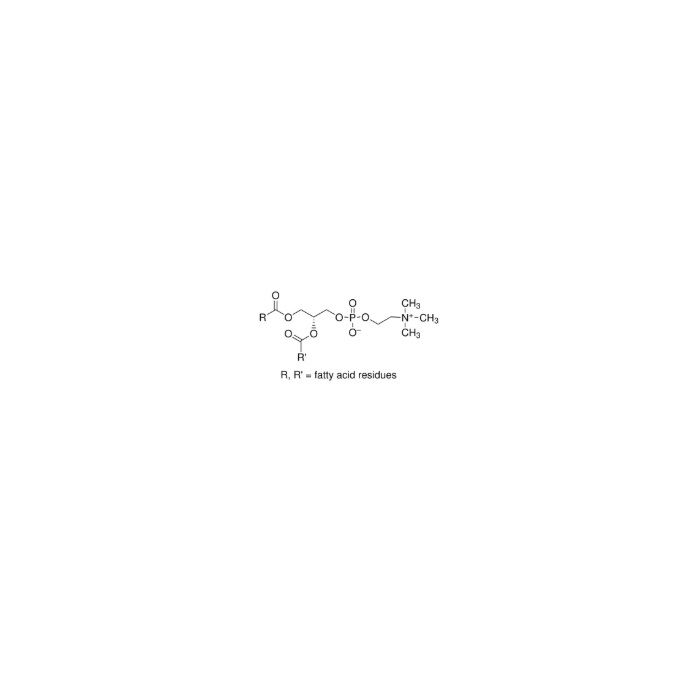
L-α-Phosphatidylcholine - ≥40%(enzymatic), from dried egg yolk, Type X-E , CAS No.8002-43-5

CAS: 8002-43-5 Cat. No.: L434223 Summenformel: C42H80NO8P Molekulargewicht: 758.06 Beilstein Registry Number: 5209585 EG-Nummer: 232-307-2
Zu bestellen verfügbar
GRADE & PURITY ≥40%(enzymatic) from dried egg yolk, Type X-E
Synonyms
PC | PC(16:0/18:2(9Z,12Z)) | [(2R)-3-hexadecanoyloxy-2-[(9Z,12Z)-octadeca-9,12-dienoyl]oxypropyl] 2-(trimethylazaniumyl)ethyl phosphate | 1-palmitoyl-2-linoleoyl-phosphatidylcholine | PALMITOYL-LINOLEOYL PHOSPHATIDYLCHOLINE | Soy PC, L-alpha-phosphatidylc
Storage
Store at -20°C
Shipped In
Ice chest + Ice pads
★
Size
Deutschland (EU)
USA*
Price
Qty
1g
L434223-1g
Auf Bestellung · 8–12 Wochen
69,33€
5g
L434223-5g
—
1 Auf Lager
156,11€
10g
L434223-10g
—
1 Auf Lager
253,29€
Enter a quantity for the sizes you want to add.
🧪
Why this grade

≥40%(enzymatic), from dried egg yolk, Type X-E for sensitive chromatographic and analytical workflows requiring minimal baseline interference.

🌡

Storage & shipping

Store at -20°C Ships Ice chest + Ice pads Check lot-specific COA for exact specifications.

📋

Quality documents

SDS, COA, datasheet, and spec sheet available for download. Lot-specific COA accessible via lot number lookup.

📚

Literature proof

Cited in 365 peer-reviewed publications across chromatography, organic synthesis, and cross-coupling reactions.

Specifications

Synonyme
PC | PC(16:0/18:2(9Z,12Z)) | [(2R)-3-hexadecanoyloxy-2-[(9Z,12Z)-octadeca-9,12-dienoyl]oxypropyl] 2-(trimethylazaniumyl)ethyl phosphate | 1-palmitoyl-2-linoleoyl-phosphatidylcholine | PALMITOYL-LINOLEOYL PHOSPHATIDYLCHOLINE | Soy PC, L-alpha-phosphatidylc
Spezifikationen & Reinheit
≥40%(enzymatic), from dried egg yolk, Type X-E
Biochemische und physiologische Mechanismen
A major structural phospholipid in brain, comprising approx. 15% of total lipid; primarily localized to gray matter.
Storage
Store at -20°C
Verschickt in
Ice chest + Ice pads
Dieses Produkt erfordert Kühlkettenversand. Grundversand und andere Economy-Optionen sind nicht verfügbar.
Reinheit
≥40%(enzymatic)
Namen und Kennungen
Pubchem Sid
Pubchem Sid Url
https://pubchem.ncbi.nlm.nih.gov/substance/504763513
Kanonisches Lächeln
[P](=O)([O-])(OC[C@H](OC(=O)CCCCCCC\C=C/C\C=C/CCCCC)COC(=O)CCCCCCCCCCCCCCC)OCC[N+](C)(C)C
IUPAC Name
[(2R)-3-hexadecanoyloxy-2-[(9Z,12Z)-octadeca-9,12-dienoyl]oxypropyl] 2-(trimethylazaniumyl)ethyl phosphate
InChIKey
JLPULHDHAOZNQI-ZTIMHPMXSA-N
INCHI
1S/C42H80NO8P/c1-6-8-10-12-14-16-18-20-21-23-25-27-29-31-33-35-42(45)51-40(39-50-52(46,47)49-37-36-43(3,4)5)38-48-41(44)34-32-30-28-26-24-22-19-17-15-13-11-9-7-2/h14,16,20-21,40H,6-13,15,17-19,22-39H2,1-5H3/b16-14-,21-20-/t40-/m1/s1
Isomere SMILES
CCCCCCCCCCCCCCCC(=O)OC[C@H](COP(=O)([O-])OCC[N+](C)(C)C)OC(=O)CCCCCCC/C=C\C/C=C\CCCCC
WGK Deutschland
1
RTECS
OG7565000
Alternative CAS-Nummer
55128-59-1
Molekulargewicht
758.06
Beilstein
5209585
Reaxy-Rn
11330961
Reaxys-RN_link_address
https://www.reaxys.com/reaxys/secured/hopinto.do?context=S&query=IDE.XRN=11330961&ln=

Documentation

📋 Safety Data Sheet (SDS)

Comprehensive hazard, handling, storage, and regulatory compliance document.

Download SDS →

✅ Certificate of Analysis (COA)

Lot-specific quality data. Enter your lot number to retrieve the exact COA.

Look up COA →

📊 Datasheet

Quick-reference summary of product specifications and applications.

View datasheet →

🔬 Specification Sheet

Full quality attributes and acceptance criteria for this grade.

View spec sheet →

Advanced Data

Taxonomic Classification

Taxonomy Tree

KingdomOrganic compounds
SuperclassLipids and lipid-like molecules
KlasseGlycerophospholipids
SubclassGlycerophosphocholines
Intermediate Tree Nodes Not available
Direct ParentPhosphatidylcholines
Alternative Parents Phosphocholines  Fatty acid esters  Dialkyl phosphates  Dicarboxylic acids and derivatives  Tetraalkylammonium salts  Carboxylic acid esters  Organopnictogen compounds  Organic salts  Organic oxides  Hydrocarbon derivatives  Carbonyl compounds  Amines  
Molecular FrameworkAliphatic acyclic compounds
Substituents Diacylglycero-3-phosphocholine - Phosphocholine - Fatty acid ester - Dialkyl phosphate - Dicarboxylic acid or derivatives - Organic phosphoric acid derivative - Phosphoric acid ester - Alkyl phosphate - Fatty acyl - Quaternary ammonium salt - Tetraalkylammonium salt - Carboxylic acid ester - Carboxylic acid derivative - Organic oxygen compound - Organic nitrogen compound - Carbonyl group - Organooxygen compound - Organonitrogen compound - Organic oxide - Organopnictogen compound - Amine - Organic salt - Hydrocarbon derivative - Aliphatic acyclic compound
BeschreibungThis compound belongs to the class of organic compounds known as phosphatidylcholines. These are glycerophosphocholines in which the two free -OH are attached to one fatty acid each through an ester linkage.
External Descriptors Diacylglycerophosphocholines
Zertifikate (CoA, COO, BSE/TSE und Analyse-Diagramm)
C of A & Other Certificates(BSE/TSE, COO):
Analytical Chart:

Find and download the COA for your product by matching the lot number on the packaging.

11 results found

Lot NumberCertificate TypeDatumArtikel
H2318514Certificate of AnalysisJun 08, 2026 L434223
H2318630Certificate of AnalysisJun 08, 2026 L434223
I2601751Certificate of AnalysisApr 03, 2026 L434223
B2605024Certificate of AnalysisJun 14, 2025 L434223
F2523433Certificate of AnalysisJun 14, 2025 L434223
F2523623Certificate of AnalysisJun 14, 2025 L434223
F2523624Certificate of AnalysisJun 14, 2025 L434223
H2318512Certificate of AnalysisAug 02, 2023 L434223
H2318513Certificate of AnalysisAug 02, 2023 L434223
H2318628Certificate of AnalysisAug 02, 2023 L434223
H2318629Certificate of AnalysisAug 02, 2023 L434223
Chemische und physikalische Eigenschaften
Molekulargewicht758.100 g/mol
XLogP312.900
Hydrogen Bond Donor Count0
Hydrogen Bond Acceptor Count8
Rotatable Bond Count40
Exact Mass757.562 Da
Monoisotopic Mass757.562 Da
Topological Polar Surface Area111.000 Ų
Heavy Atom Count52
Formal Charge0
Complexity940.000
Isotope Atom Count0
Defined Atom Stereocenter Count1
Undefined Atom Stereocenter Count0
Defined Bond Stereocenter Count2
Undefined Bond Stereocenter Count0
The total count of all stereochemical bonds2
Covalently-Bonded Unit Count1
FAQs und Artikel
Liposome Panorama Guide: Definition, Structural Mechanisms, Applications, and Selection Workflow (Including Products Table 1–Table 3)
Lecithin: Technical Characteristics, Preparation Processes, and Research Progress in Applications
Procyanidins: Structural Features and Key Points for Research and Application
Whey Protein: Composition Profile, Manufacturing Routes, and Key Product-Type Essentials
Functional Properties, Application Scenarios, and Manufacturing Processes of Maltotetraose (G4): A Review
Glutaraldehyde-mediated Microbial Inactivation: Chemical Mechanisms, Determinants, and Key Validation Considerations
Review of the Structural Characteristics, Biological Functions, and Application Advances of Lycopene
Functional Framework of Starch Metabolism-Related Enzymes in Food Science Research and Mechanistic Analysis of Quality Regulation
Mechanistic Analysis of Topical Glutathione in Skincare: Cellular Redox Regulation, Skin Delivery Challenges, and SLN-Based Delivery Strategies
Choline Metabolism and Detection Methods: Pathway Analysis of Choline, Phosphatidylcholine, Betaine, Acetylcholine, and TMAO
Antioxidant Mechanisms, Stability, and Delivery Strategies of Resveratrol in Skincare Research
Antioxidant Mechanisms of Ferulic Acid in Skincare, Vitamin C/E Synergy, and Stable Delivery Applications
Skin Anti-Aging Mechanisms of Carnosine and Decarboxy Carnosine: Active Carbonyl Scavenging, Oxidative-Stress Buffering, and Inhibition of Collagen Glycation Cross-Linking
The Moisturizing and Low-Moisture Protective Mechanisms of Trehalose: From Its α,α-1,1 Structure and Hydration Dynamics to In Vitro Skin Barrier Research
Protective and Potential Reparative Mechanisms of Prinsepia utilis Seed Oil on the Skin Barrier: Fatty Acid Composition, Epidermal Lipid Metabolism, and Research Evidence
UVA Absorption Mechanism of Avobenzone: Keto–Enol Tautomerism, Photochemical Instability, and Formulation Photostabilization Strategies
Mechanism of Action of Tranexamic Acid in Pigmentation Care: From the Plasmin System to Regulation of Inflammation-Driven Pro-Melanogenic Signaling
How Palmitoyl Pentapeptide-4 Acts on the Skin: From the KTTKS Sequence and Skin Delivery to Collagen Matrix Responses
How Cyclization Changes Peptide Behavior: Conformational Preorganization, Skin Delivery, and Integrin Binding, Using Cyclopeptide-5 as an Example
The Logic of Biomimetic Peptide Action in Skin: Sequence and Conformation, Skin Delivery, Stability, and Target Matching
How Does Collagen Tripeptide Act on the Skin: Stratum Corneum Delivery, Matrix Protection, and Regulation of Collagen Homeostasis
Potential Mechanisms of p-Cymene in Problem-Prone Skin: Membrane Perturbation, Inflammatory Signaling Modulation, and Localized Delivery
How Coenzyme Q10 Acts on the Skin: Mitochondrial Electron Transfer, Antioxidant Protection of Membrane Lipids, and Lipid-Carrier Delivery
The Combination Logic of Palmitoyl Tripeptide-1 and Palmitoyl Pentapeptide-4: Skin Delivery, Matrix Signaling, and Regulation of Collagen Homeostasis
How Arbutin Regulates Melanin Production: α/β Anomeric Configuration and Tyrosinase Action
Niacinamide Brightening Mechanisms and Formulation Design: Melanosome Transfer, pH Regulation, and Combination Strategies
Why Do Skincare Oligopeptides Have Different Effects? — Molecular Structure, Skin Delivery, and Mechanisms of Action
Citations of This Product
Lösungsrechner
Bewertungen

Kundenbewertungen

Häufig gestellte Fragen

What is the purity of this product, and how is it determined?
This product is supplied at ≥40% purity, determined by enzymatic assay. Lot-specific values are stated on the Certificate of Analysis.
How should this product be stored?
Store at ?20 °C. Freezer storage is required to maintain the specified shelf life.
How is this product shipped?
This product ships in an insulated container with ice pads. Unpack on arrival and transfer it to the storage condition stated above.
What are the CAS number, molecular formula and molecular weight?
The CAS Number is 8002-43-5, the molecular formula is C42H80NO8P, and the molecular weight is 758.06 g/mol. InChIKey JLPULHDHAOZNQI-ZTIMHPMXSA-N.
What documentation is provided?
Available product documentation, including Certificates of Analysis (COA), Safety Data Sheets (SDS), and specification sheets, is shown in the product document area. Document availability and access follow the current site policy.

Shall we send you a message when we have discounts available?

Remind me later

Thank you! Please check your email inbox to confirm.

Oops! Notifications are disabled.