GRADE & PURITYAnimal Free?Animal-free — produced without animal-derived components to reduce contamination risk. Use in biomanufacturing and culture avoiding animal-origin material.Carrier Free?Carrier-free — supplied without added carrier protein/stabilizer. Use when carriers (e.g. BSA) would interfere with conjugation or sensitive assays.Bioactive?Bioactive grade — verified to retain biological activity in functional assays. Use when the molecule must be functionally active, not just pure.ActiBioPure™?ActiBioPure™ — Aladdin's premier line for bioactive and recombinant products. Use when both high purity and preserved biological activity are required.Azide Free?Azide-free — without sodium azide preservative. Use in conjugations, cell work, or assays where azide is toxic or inhibitory.High Performance?High-performance grade with optimized purity and performance characteristics. Use for sensitive analyses where ordinary grades fall short.His Tag?His tag grade — recombinant protein bearing a His tag for affinity purification/detection. Use to purify, immobilize, or detect the tagged protein.PBS Only?PBS-only formulation — supplied in phosphate-buffered saline with no other additives. Use when you need a clean PBS buffer free of stabilizers/carriers.≥95%(SDS-PAGE)
Expression System
HEK293
Accession #
P01730
Protein Tag
C-His
Expression system
HEK293
Endotoxin Concentration
<1.0 EU/μg
Bioactivity
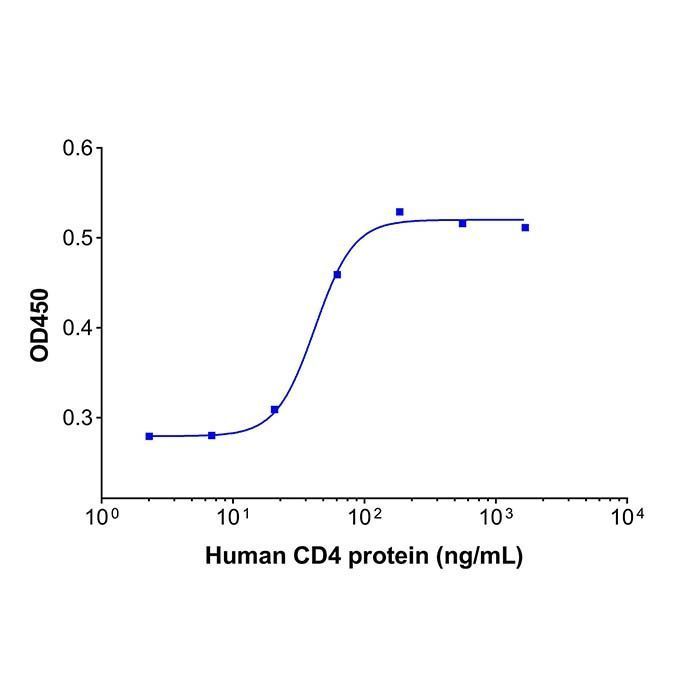
Measured by the ability of the immobilized protein to support the adhesion of HeLa human cervical epithelial carcinoma cells. The ED50 for this effect is 40.0 ng/mL. Measured by its binding ability in a functional ELISA. Immobilized Human CD4 protein (rp175911) at 1.0 μg/mL can bind Ibalizumab (anti-CD4) (Ab170728) with the EC50 of 52.66 ng/mL.
Animal Free,Carrier Free,Bioactive,ActiBioPure™,Azide Free,High Performance,His Tag,PBS Only,≥95%(SDS-PAGE) ActiBioPure™,Animal Free,Azide Free,Bioactive,Carrier Free,High Performance,His Tag,PBS Only for sensitive chromatographic and analytical workflows requiring minimal baseline interference.
🌡
Storage & shipping
Store at -20°C,Avoid repeated freezing and thawing Ships Ice chest + Ice pads Check lot-specific COA for exact specifications.
📋
Quality documents
SDS, COA, datasheet, and spec sheet available for download. Lot-specific COA accessible via lot number lookup.
📚
Literature proof
Cited in 0 peer-reviewed publications across chromatography, organic synthesis, and cross-coupling reactions.
Overview
Purity: >95%, by SDS-PAGE visualized with Coomassie® Blue Staining. Description: CD4, also known as L3T4, T4, and W3/25, is an approximately 55 kDa type I transmembrane glycoprotein that is expressed predominantly on thymocytes and a subset of mature T lymphocytes. It is a standard phenotype marker for the identification of T cell populations. Mature human CD4 consists of a 371 amino acid (aa) extracellular region containing four immunoglobulin-like domains, a 22 aa transmembrane segment, and a 40 aa cytoplasmic domain. Within the ECD, human CD4 shares approximately 52% aa sequence identity with mouse and rat CD4. CD4 is expressed along with CD8 on double positive T cells during their development in the thymus. Either CD4 or CD8 expression is then lost, giving rise to single positive (SP) CD4+ or CD8+ mature T cells. CD4+ SP cells, also known as T helper cells, further differentiate into multiple subsets of CD4+ cells including Th1, Th2, Th17, Tfh, and Treg cells which regulate humoral and cellular immunity. CD4 is reexpressed on circulating CD8+ T cells upon activation and contributes to their cytotoxic effector activity. In human, CD4 is additionally expressed on macrophages, neutrophils, monocytes, NK cells, and neurons and glial cells in the brain. Similar CD4 distribution between species cannot be assumed as demonstrated by its presence on macrophages in human and rat but not in mouse. CD4 binds directly to MHC class II molecules on antigen presenting cells. This interaction contributes to the formation of the immunological synapse which is focused around the TCR-MHC class II-antigenic peptide interaction. Palmitoylation of two cysteine residues in the cytoplasmic tail of CD4 promotes the localization of CD4 in lipid rafts and its ability to augment TCR signaling via activation of the tyrosine kinase Lck. CD4 also functions as a chemotactic receptor for IL-16 and, in human, as a co-receptor for the gp120 surface glycoprotein of HIV-1.
ActiBioPure™, Animal Free, Azide Free, Bioactive, Carrier Free, High Performance, His Tag, PBS Only
Specifications & Purity
Animal Free, Carrier Free, Bioactive, ActiBioPure™, Azide Free, High Performance, His Tag, PBS Only, ≥95%(SDS-PAGE)
Purity
>95% (SDS-PAGE)
Bioactivity
Measured by the ability of the immobilized protein to support the adhesion of HeLa human cervical epithelial carcinoma cells. The ED50 for this effect is 40.0 ng/mL. Measured by its binding ability in a functional ELISA. Immobilized Human CD4 protein (rp175911) at 1.0 μg/mL can bind Ibalizumab (anti-CD4) (Ab170728) with the EC50 of 52.66 ng/mL.
We recommend that this vial be briefly centrifuged prior to opening to bring the contents to the bottom. Reconstitute at 1.0 mg/mL in sterile distilled water. Stock solutions should be apportioned into working aliquots and stored at ≤ -20 °C. Further dilutions should be made in appropriate buffered solutions.
Storage
Store at -20°C,Avoid repeated freezing and thawing
Shipped In
Ice chest + Ice pads
Stability And Storage
Store at -20°C for 1 year. Avoid freeze / thaw cycle.
Images
Recombinant Human CD4 Protein (rp175911) - Protein Bioactivity Measured by the ability of the immobilized protein to support the adhesion of HeLa human cervical epithelial carcinoma cells. The ED₅₀ for this effect is 40.0 ng/mL.
Recombinant Human CD4 Protein (rp175911) - ELISA Measured by its binding ability in a functional ELISA. Immobilized Human CD4 protein (rp175911) at 1.0 μg/mL can bind Ibalizumab (anti-CD4) (Ab170728) with the EC₅₀ of 52.66 ng/mL.
Recombinant Human CD4 Protein (rp175911) - SDS-PAGE 3 μg/lane of Recombinant Human CD4 Protein was resolved with SDS-PAGE under reducing (R) and non-reducing (N) conditions and visualized by Coomassie® Blue staining, showing a band at 45.9-52.1 kDa under reducing conditions and 42.8-49.7 kDa under non-reducing conditions.
Documentation
📋 Safety Data Sheet (SDS)
Comprehensive hazard, handling, storage, and regulatory compliance document.
We use cookies to ensure the website functions properly and, where permitted, to improve your experience. You can manage your preferences at any time in Settings. Learn more in our Cookie Policy.
Shall we send you a message when we have discounts available?
Remind me later
Thank you! Please check your email inbox to confirm.
Products are supplied to verified businesses, institutions, and qualified professionals for research and development use only. Not for use in humans, animals, diagnosis, or therapy.

 ZJ24F0809662