GRADE & PURITYAnimal Free?Animal-free — produced without animal-derived components to reduce contamination risk. Use in biomanufacturing and culture avoiding animal-origin material.Carrier Free?Carrier-free — supplied without added carrier protein/stabilizer. Use when carriers (e.g. BSA) would interfere with conjugation or sensitive assays.Bioactive?Bioactive grade — verified to retain biological activity in functional assays. Use when the molecule must be functionally active, not just pure.ActiBioPure™?ActiBioPure™ — Aladdin's premier line for bioactive and recombinant products. Use when both high purity and preserved biological activity are required.Azide Free?Azide-free — without sodium azide preservative. Use in conjugations, cell work, or assays where azide is toxic or inhibitory.His Tag?His tag grade — recombinant protein bearing a His tag for affinity purification/detection. Use to purify, immobilize, or detect the tagged protein.≥95%(SDS-PAGE)
Expression System
HEK293
Accession #
Q60994
Protein Tag
C-His
Expression system
HEK293
Endotoxin Concentration
<0.1 EU/μg
Bioactivity
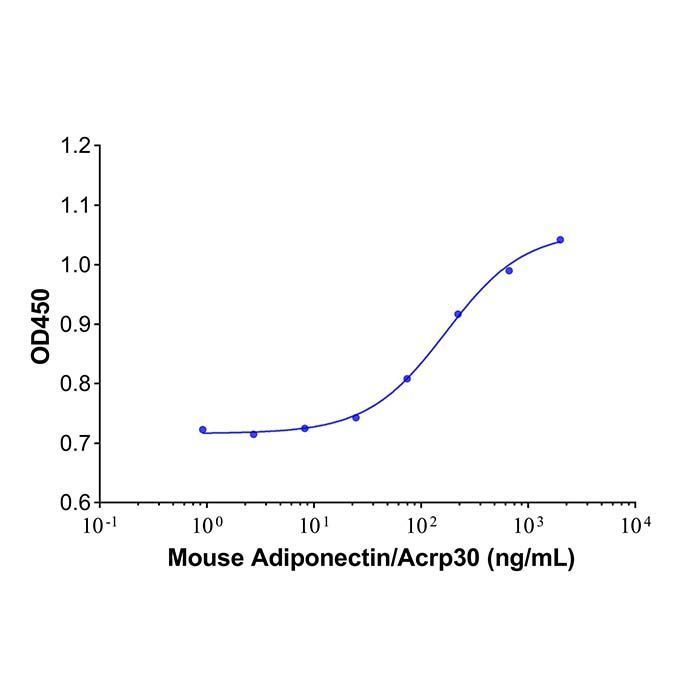
Measured by its ability to induce TIMP-1 secretion by mouse macrophages. Kumada. The ED₅₀ for this effect is 5-20 μg/mL.
Animal Free,Carrier Free,Bioactive,ActiBioPure™,Azide Free,His-Tag,≥95%(SDS-PAGE) ActiBioPure™,Animal Free,Azide Free,Bioactive,Carrier Free,His Tag for sensitive chromatographic and analytical workflows requiring minimal baseline interference.
🌡
Storage & shipping
Store at -20°C,Avoid repeated freezing and thawing Ships Ice chest + Ice pads Check lot-specific COA for exact specifications.
📋
Quality documents
SDS, COA, datasheet, and spec sheet available for download. Lot-specific COA accessible via lot number lookup.
📚
Literature proof
Cited in 0 peer-reviewed publications across chromatography, organic synthesis, and cross-coupling reactions.
Overview
Purity
>95% SDS-PAGE.
Function
Important adipokine involved in the control of fat metabolism and insulin sensitivity, with direct anti-diabetic, anti-atherogenic and anti-inflammatory activities. Stimulates AMPK phosphorylation and activation in the liver and the skeletal muscle, enhancing glucose utilization and fatty-acid combustion. Antagonizes TNF-alpha by negatively regulating its expression in various tissues such as liver and macrophages, and also by counteracting its effects. Inhibits endothelial NF-kappa-B signaling through a cAMP-dependent pathway. May play a role in cell growth, angiogenesis and tissue remodeling by binding and sequestering various growth factors with distinct binding affinities, depending on the type of complex, LMW, MMW or HMW.
Post-translational
Hydroxylated Lys-33 was not identified in PubMed:16497731, probably due to poor representation of the N-terminal peptide in mass fingerprinting. HMW complexes are more extensively glycosylated than smaller oligomers. Hydroxylation and glycosylation of the lysine residues within the collagene-like domain of adiponectin seem to be critically involved in regulating the formation and/or secretion of HMW complexes and consequently contribute to the insulin-sensitizing activity of adiponectin in hepatocytes. O-glycosylated. Not N-glycosylated. O-linked glycans on hydroxylysines consist of Glc-Gal disaccharides bound to the oxygen atom of post-translationally added hydroxyl groups. Sialylated to varying degrees depending on tissue. Thr-22 appears to be the major site of sialylation. Higher sialylation found in SGBS adipocytes than in HEK fibroblasts. Sialylation is not required neither for heterodimerization nor for secretion. Not sialylated on the glycosylated hydroxylysines. Desialylated forms are rapidly cleared from the circulation.
Reconstitute in water to a concentration of 0.1-1.0 mg/ml.
Storage
Store at -20°C,Avoid repeated freezing and thawing
Shipped In
Ice chest + Ice pads
Stability And Storage
Store at -20~-80℃ for more than 1 year
Images
Recombinant Mouse Adiponectin/Acrp30 Protein (rp153562) - Protein Bioactivity Fully biologically active determined by the dose dependent increase in MCF7 cell proliferation. The ED₅₀ for this effect is 0.17 μg/mL. Adiponectin induces a dichotomic effect on breast cancer growth. It stimulates growth in ERα+ MCF-7 cells while inhibiting proliferation of ERα- MDA-MB-231 cells.
Recombinant Mouse Adiponectin/Acrp30 Protein (rp153562) - Protein Bioactivity Measured by its ability to induce TIMP-1 secretion by mouse macrophages. The ED50 for this effect is 5-20 μg/mL.
Recombinant Mouse Adiponectin/Acrp30 Protein (rp153562) - SDS-PAGE 4 μg/lane of Recombinant Mouse Adiponectin/Acrp30 was resolved with SDS-PAGE under reducing (R) and non-reducing (N) conditions and visualized by Coomassie® Blue staining, showing a band at 31.4 kDa under reducing conditions and 30.2 & 54.1 kDa under non-reducing conditions.
Documentation
📋 Safety Data Sheet (SDS)
Comprehensive hazard, handling, storage, and regulatory compliance document.
We use cookies to ensure the website functions properly and, where permitted, to improve your experience. You can manage your preferences at any time in Settings. Learn more in our Cookie Policy.
Shall we send you a message when we have discounts available?
Remind me later
Thank you! Please check your email inbox to confirm.
Products are supplied to verified businesses, institutions, and qualified professionals for research and development use only. Not for use in humans, animals, diagnosis, or therapy.

 ZJ24F1215393