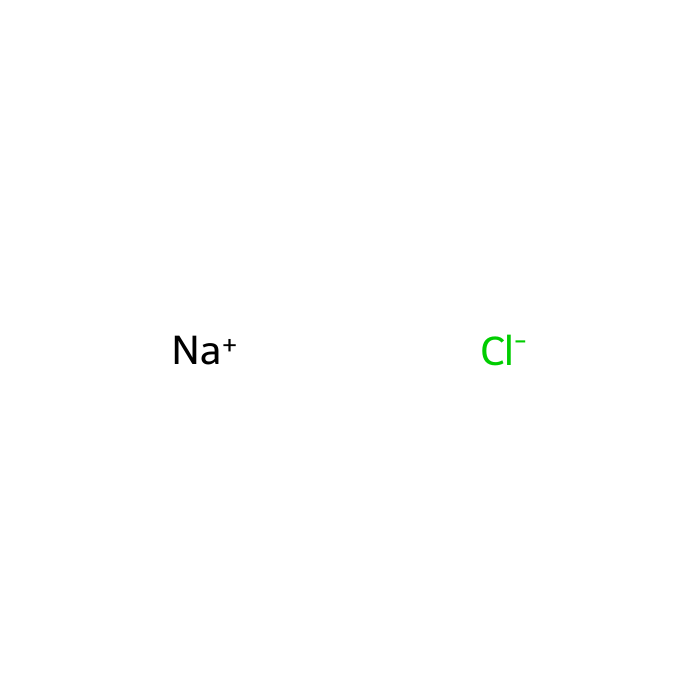
Sodium chloride - Anhydrous Grade, Reagent Grade, High-purity, ≥99% , CAS No.7647-14-5

CAS: 7647-14-5 Cat. No.: S433744 Summenformel: NaCl Molekulargewicht: 58.44 Beilstein Registry Number: 3534976 EG-Nummer: 231-598-3
Zu bestellen verfügbar
QUALITÄT & REINHEIT Anhydrous Grade ? Anhydrous grade — water removed and packaged dry for moisture-sensitive chemistry. Use in reactions where even trace water would interfere or quench. Reagent Grade ? General reagent-grade purity suitable for most laboratory work. Use as a dependable default when no specific higher grade is required. High-purity ? High-purity grade with substantially reduced impurity levels. Use when trace contaminants would interfere with your measurement or process. ≥99%
Synonyms
Sea water | Sodium chloride (NaCl) | Entsol | Natriumchlorid [German] | Cleanoz | Halite | Sodium chloric | Sodium chloride [USP:JAN] | Sodium-36 chloride | Saline Mist | Top flake | CCRIS 982 | Purex | Sodium chloride 0.9% in sterile plastic container |
Storage
Room temperature,Argon charged,Desiccated
Shipped In
Normal
★
Größe
Deutschland (EU)
USA*
Preis
Menge
500g
S433744-500g
1 Auf Lager
—

91,89€

108,38€
Speichern 16,49 € (15.21%)
Enter a quantity for the sizes you want to add.
🧪
Warum diese Qualität

Anhydrous Grade, Reagent Grade, High-purity, ≥99% Anhydrous Grade,High-purity,Reagent Grade für empfindliche chromatographische und analytische Workflows, die minimale Basislinieninterferenzen erfordern.

🌡

Lagerung & Versand

Room temperature,Argon charged,Desiccated Versand Normal. Genaue Spezifikationen finden Sie im chargenspezifischen COA.

📋

Qualitätsdokumente

SDS, COA, Datenblatt und Spezifikationsblatt stehen zum Download bereit. Chargenspezifische COA über Chargennummernsuche abrufbar.

📚

Literaturbeleg

In 6779 peer-reviewten Publikationen zu Chromatographie, organischer Synthese und Kreuzkupplungsreaktionen zitiert.

Spezifikationen

Synonyme
Sea water | Sodium chloride (NaCl) | Entsol | Natriumchlorid [German] | Cleanoz | Halite | Sodium chloric | Sodium chloride [USP:JAN] | Sodium-36 chloride | Saline Mist | Top flake | CCRIS 982 | Purex | Sodium chloride 0.9% in sterile plastic container |
Spezifikationen & Reinheit
Anhydrous Grade, Reagent Grade, High-purity, ≥99%
Storage
Room temperature,Argon charged,Desiccated
Verschickt in
Normal
Note
Anhydrous Grade, High-purity, Reagent Grade
Reinheit
≥99%
Namen und Kennungen
Kanonisches Lächeln
[Na+].[Cl-]
IUPAC Name
sodium;chloride
InChIKey
FAPWRFPIFSIZLT-UHFFFAOYSA-M
INCHI
1S/ClH.Na/h1H;/q;+1/p-1
Isomere SMILES
[Na+].[Cl-]
WGK Deutschland
1
RTECS
VZ4725000
Molekulargewicht
58.44
Beilstein
3534976

Dokumentation

📋 Sicherheitsdatenblatt (SDS)

Umfassendes Dokument zu Gefahren, Handhabung, Lagerung und Einhaltung regulatorischer Vorschriften.

<<<<<<< HEAD SDS herunterladen → ======= SDS herunterladen → >>>>>>> release248-p3

✅ Analysezertifikat (COA)

Chargenspezifische Qualitätsdaten. Geben Sie Ihre Chargennummer ein, um das genaue COA abzurufen.

COA nachschlagen →

📊 Datenblatt

Kurzübersicht über Produktspezifikationen und Anwendungen.

Datenblatt ansehen →

🔬 Spezifikationsblatt

Vollständige Qualitätsmerkmale und Akzeptanzkriterien für diese Qualität.

Spezifikationsblatt ansehen →

Erweiterte Daten

Taxonomic Classification

Taxonomy Tree

KingdomInorganic compounds
SuperclassMixed metal/non-metal compounds
KlasseAlkali metal salts
SubclassAlkali metal chlorides
Intermediate Tree Nodes Not available
Direct ParentAlkali metal chlorides
Alternative Parents Inorganic sodium salts  Inorganic chloride salts  
Molecular FrameworkNot available
Substituents Alkali metal chloride - Inorganic chloride salt - Inorganic sodium salt - Inorganic salt
BeschreibungThis compound belongs to the class of inorganic compounds known as alkali metal chlorides. These are inorganic compounds in which the largest halogen atom is Chlorine, and the heaviest metal atom is an alkali metal.
External Descriptors inorganic chloride - inorganic sodium salt
3D-Struktur
Interaktives chemisches Strukturmodell


Zugehörige Ziele (menschlich)
CA2 Tclin Carbonic anhydrase II (17698 Activities)
Activity TypeRelationActivity valueUnitsAction TypeJournalPubMed IddoiAssay Aladdin ID
CA1 Tclin Carbonic anhydrase I (13240 Activities)
Activity TypeRelationActivity valueUnitsAction TypeJournalPubMed IddoiAssay Aladdin ID
ST14 Tchem Matriptase (677 Activities)
Activity TypeRelationActivity valueUnitsAction TypeJournalPubMed IddoiAssay Aladdin ID
Zugehörige Ziele (nicht menschlich)
Carbonic anhydrase (69 Activities)
Activity TypeRelationActivity valueUnitsAction TypeJournalPubMed IddoiAssay Aladdin ID
Colletotrichum musae (107 Activities)
Activity TypeRelationActivity valueUnitsAction TypeJournalPubMed IddoiAssay Aladdin ID
Trypanosoma cruzi (99888 Activities)
Activity TypeRelationActivity valueUnitsAction TypeJournalPubMed IddoiAssay Aladdin ID
Mus musculus (284745 Activities)
Activity TypeRelationActivity valueUnitsAction TypeJournalPubMed IddoiAssay Aladdin ID
Fusarium verticillioides (912 Activities)
Activity TypeRelationActivity valueUnitsAction TypeJournalPubMed IddoiAssay Aladdin ID
Lasiodiplodia theobromae (193 Activities)
Activity TypeRelationActivity valueUnitsAction TypeJournalPubMed IddoiAssay Aladdin ID
Astrosclerin-3 (80 Activities)
Activity TypeRelationActivity valueUnitsAction TypeJournalPubMed IddoiAssay Aladdin ID
Musa acuminata AAA Group (20 Activities)
Activity TypeRelationActivity valueUnitsAction TypeJournalPubMed IddoiAssay Aladdin ID
Wirkungsmechanismen
Zertifikate (CoA, COO, BSE/TSE und Analyse-Diagramm)
C of A & Other Certificates(BSE/TSE, COO):
Analytical Chart:

Find and download the COA for your product by matching the lot number on the packaging.

12 results found

Lot NumberCertificate TypeDatumArtikel
G2608304G2608304Certificate of AnalysisJul 14, 2026 S433744
G2608305G2608305Certificate of AnalysisJul 14, 2026 S433744
G2608306G2608306Certificate of AnalysisJul 14, 2026 S433744
G2608591G2608591Certificate of AnalysisJul 14, 2026 S433744
G2608592G2608592Certificate of AnalysisJul 14, 2026 S433744
G2608593G2608593Certificate of AnalysisJul 14, 2026 S433744
G2608602G2608602Certificate of AnalysisJul 14, 2026 S433744
D2628049D2628049Certificate of AnalysisAug 16, 2023 S433744
H2314398H2314398Certificate of AnalysisAug 16, 2023 S433744
H2314399H2314399Certificate of AnalysisAug 16, 2023 S433744
H2314403H2314403Certificate of AnalysisAug 16, 2023 S433744
H2314404H2314404Certificate of AnalysisAug 16, 2023 S433744
Chemische und physikalische Eigenschaften
LöslichkeitSoluble in water (358 mg/ml at 20 °C), alcohol (very slightly), glycerol (100 mg/ml), and ammonia. Insoluble in hydrochloric acid.
EmpfindlichkeitHygroscopic
Schmelzpunkt (°C)800 °C
Molekulargewicht58.440 g/mol
XLogP3
Hydrogen Bond Donor Count0
Hydrogen Bond Acceptor Count1
Rotatable Bond Count0
Exact Mass57.9586 Da
Monoisotopic Mass57.9586 Da
Topological Polar Surface Area0.000 Ų
Heavy Atom Count2
Formal Charge0
Complexity2.000
Isotope Atom Count0
Defined Atom Stereocenter Count0
Undefined Atom Stereocenter Count0
Defined Bond Stereocenter Count0
Undefined Bond Stereocenter Count0
The total count of all stereochemical bonds0
Covalently-Bonded Unit Count2
FAQs und Artikel
Aladdin@Guidelines for the formulation of commonly used buffers for biological experiments
Competent E. coli Cell Preparation Using the Calcium Chloride Method
E. coli Competence Protocol for Plasmid Transformation
ADC Conjugation by DTT Reduction with Maleimide Drug Linker
The Guide to Anhydrous Grade for Reagents
Comparing Guanidine Hydrochloride and Urea for Inclusion-Body Solubilization
Buffer exchange of a sample using a dialysis bag
Professional Guide to Streptavidin-Modified Proteins
Common Types of Buffer Solutions
Buffer Additives to Prevent Protein Precipitation
Why Did My Ni-Agarose Beads Turn Black or Brown?
Why Does Protein A Keep Leaching?
How to Optimize Buffer Components for Ni-Agarose Beads
Stripping, Cleaning, and Metal Recharging Workflow for Ni²⁺–Agarose Resins
Salting-In and Salting-Out: “Salt” Strategies in Protein Purification
Differences Between Transformation and Transfection
Eight Common Lysis Buffers
How should laboratory strains be preserved?
How to Choose the Best Protein Purification Technique
FAQ on Molecular Interaction Assays
Differences Among Antibodies for WB/FC/IP/ChIP/IF/IHC
His-Tagged Protein Purification
GST-Tagged Protein Purification
High-Purity Reagents: Overview and Aladdin Product Selection Guide
7 Types of DNA Ligases: Functions and Features
What is Ion Exchange Chromatography Used For? 4 Important Applications for Protein Purification
Mag-Fluo-4 AM Magnesium/Calcium Ion Fluorescent Probe: Properties, Experimental Use, and Aladdin Metal Ion Fluorescent Probe Selection Guide
How to Choose Reagent Grades in Scientific Research? A Practical Guide to Reagent Grade
Fundamentals and Applications of Etching Solutions: Using Metallic Copper / PCB Etching as an Example
His-Tag Protein Purification: Common Troubleshooting Questions and Practical Solutions
RNA Pull-Down Standard Operating Procedure (SOP)
How to Purify Proteins by Ion-Exchange Chromatography Under Denaturing Condition
Electrophoretic Mobility Shift Assay (EMSA) Standard Operating Procedure (SOP)
Installing a Redox Switch on Biomolecules: Principles, Conjugation Essentials, and an Application Guide for ATTO MB2 NHS ester
Calcium Gluconate: Physicochemical Properties, Pharmacopoeial Quality Control, and Application Guidelines
Practical Guide to Sodium Carboxymethyl Cellulose (CMC-Na): Thickening/Stabilizing Mechanisms, Key Controls for Solution Preparation, and Selection Navigation (including Table 1 and Tables A–C)
A Review of Ten Commonly Used Techniques for Detection, Quantification, and Interaction Analysis in Nucleic Acid Research
Selection of Common Research Salts: A Task Map for Alkali Metal Salts & Alkaline Earth Metal Salts (with Product Tables 1–6)
Perovskite PV/PeLED Precursor Guide: Selecting Metal Halide Salts, Key Conditions, and Reproducible Performance (including Product Tables 1–4 and a Selection Navigation Guide)
Protein Tags Demystified: Classification, Properties, and Suitable Experimental Applications
Recent Progress in Types, Mechanisms, and Food Applications of In Vitro Digestion Models
Proteinase K: Frequently Asked Questions
Methodological essentials for mineralization visualization: Alizarin Red S staining vs. Von Kossa silver staining
Recent Advances in Methods for Measuring Plant Protein-Related Indices and Application-Oriented Selection
Phycocyanin: A Review of Sources, Structural Features, Production Processes, Applications, and Claimed Benefits
Acid Phosphatase: Dephosphorylation Reactions in Acidic Microenvironments and Their Research, Assay, and Detection Applications
Diaphorase: NAD(P)H-Dependent Electron-Transfer Activity and Its Applications in Detection and Research
Haptoglobin (Hp): A Key Carrier in the Free Hemoglobin Clearance–Detoxification Axis, with Assays and Applications
Angiotensin-Converting Enzyme (ACE): A Review of Molecular Features, Catalytic Functions, and Research and Translational Applications
Chymosin: A Review of Molecular Features, Coagulation Kinetics, and Activity Evaluation
Micrococcal Nuclease (MNase): A Technical Review of Enzymatic Properties, Reaction Control, and Research and Biomanufacturing Applications
Hemicellulases: A Review of Substrate Specificity, Catalytic Systems, and Research and Industrial Applications
Phytase: Enzymological Properties, Mechanism of Action, and Applications in Feed and Food
Chlorophyll: Structural Features, Physicochemical Properties, and Key Points for Research and Industrial Applications
Chitinases: Substrate-Specific Degradation Mechanisms, Enzymatic Properties, and Application Directions
Paeonol: Physicochemical Features, Uses, and Key Points for Research Applications
Research Value of Polyelectrolyte Multilayers: Layer-by-Layer Design of Interfacial Composition, Mass Transport, and Function
The Positioning of pNPP in ALP Testing: Quantitative Detection Logic, Application Scenarios, and Selection Criteria
Selection Strategy for PBS, TBS, PBST, and TBST Washing Systems in IHC
Why Fluorocarbon Resins Are Weatherable: Structural Stability, Low Surface Energy, and Coating Film Appearance Retention
Failure Mechanisms, Application Limitations, and Systematic Improvement Directions for Polyester Coatings
Capable of Swelling, Adsorption, and Cation Exchange: What Makes Montmorillonite Clay Different?
How Should Montmorillonite Be Rationally Modified? Organic Modification, Inorganic Modification, and Application-Oriented Selection and Validation
Selection and Formulation Design Guidelines for Phenolic Resins in Coatings: Applicable Scenarios, Application Limitations, and Performance Verification
Why LABSA (Sulfonic Acid) Is Commonly Used in Household Cleaning Formulations: Neutralization Mechanism, Detergency Action, and Formulation Application Points
Application of Fatty Acid Methyl Ester Sulfonate (MES) in Household Detergent and Cleaning Formulations: Detergency, Hard-Water Tolerance, and Selection Criteria
K12 (Sodium Lauryl Sulfate/SLS) Is More Than a Foaming Agent: Structure, Properties, and Applications in Personal Care and Household Care Formulations
From Structure to Rheology: How Carbomer Forms Gel Structures and Enables Thickening, Suspension, and Auxiliary Emulsion Stabilization
Thickening, Suspension, Auxiliary Stabilization, and Agglomeration Mechanisms of Xanthan Gum in Personal Care Formulations: From Molecular Structure to Processing Applications
Why Can 6501 (Cocamide DEA) Stabilize Foam and Build Viscosity? Structural Mechanism, 1:1/1:1.5 Differences, and Application Selection
Practical Guide to TSA Tyramide Signal Amplification: How to Select Reagents, Optimize the Workflow, and Reduce Background When Detection Signals Are Weak for Low-Abundance Targets
AES (Fatty Alcohol Polyoxyethylene Ether Sulfate) in Personal and Home-Care Cleansing Formulations: An Analysis of Structure, Performance, and Low-Temperature Flowability
Signal Transduction Mechanism of Graphene Biosensors: From Molecular Recognition to Electrical/Optical Signal Readout and Materials Selection
Understanding CAPB from Its Structure: How Cocamidopropyl Betaine Improves Foam, Enhances Mildness, and Supports Thickening
What Is Synthetic Biology? The Industrialization Pathway from Upstream Reagent Toolchains to Biomanufacturing Applications
What Are the Differences Among Sodium Dodecylbenzenesulfonate/SDBS, LAS, and Sodium α-Olefin Sulfonate/AOS: A Comparative Overview of Synthesis, Structure, Mechanism of Action, and Formulation Selection
Analysis of the Foaming Performance Differences Between K12 and AOS: Structure, Acid–Base Stability, and Formulation Selection
Mechanisms and Troubleshooting of Foam Reduction in Personal and Household Care Formulations: Film Rupture, Weak Interfacial Films, Insufficient Surfactant Supply, and Phase-State Disturbance
Why Are Daily Chemical Products Prone to Viscosity Thinning in Summer? Core Mechanisms, Troubleshooting Methods, and Solutions
Exosome-Related Ingredients in Skincare Products: Sources and Preparation, Quality Control, Evidence of Efficacy, and Safety Assessment
Discovery and Structural Optimization of the Noncovalent 3CL Protease Inhibitor S-217622
Moisturizing Mechanisms of Tremella fuciformis Polysaccharides: From Polysaccharide Structure and Hydration Rheology to Dynamic Film Formation on the Skin Surface
Multilevel Moisturizing Mechanisms of Sodium Hyaluronate and Its Derivatives: Molecular Weight Modulation, Crosslinking, Acetylation, and Major Sites of Action
Phase-Partitioning Principles, System Differences, and Application Selection in Phenol-Based DNA and RNA Extraction
Why Primary and Secondary Amines Have Difficulty Participating Directly in the Classical Mitsunobu Reaction: Mechanism, Inversion of Configuration, and Reaction Scope of BEHT-Mediated Alcohol Amination
Differences Between Animal-Derived Collagen and Recombinant Collagen in Skincare: Sequence and Structure, Safety, Skin Effects, and Evidence Evaluation
3,3-Spiro-α-Proline Building Blocks: Structural Features, Complementary Synthetic Routes, and Multigram-Scale Preparation
Citations of This Product
Lösungsrechner
Bewertungen

Kundenbewertungen

Benötigen Sie Hilfe bei der Auswahl der Qualität?

Unser Leitfaden zur Qualitätsauswahl behandelt Reinheit, Stabilisatorstatus und Anwendungseignung für alle Varianten in unserem Katalog.

Anhydrous Grade Qualitätsleitfaden ansehen → Reagent Grade Qualitätsleitfaden ansehen → High-purity Qualitätsleitfaden ansehen →

Dürfen wir Sie über Rabattaktionen informieren?

Später erinnern

Vielen Dank! Bitte überprüfen Sie Ihren E-Mail-Posteingang, um zu bestätigen.

Hoppla! Benachrichtigungen sind deaktiviert.