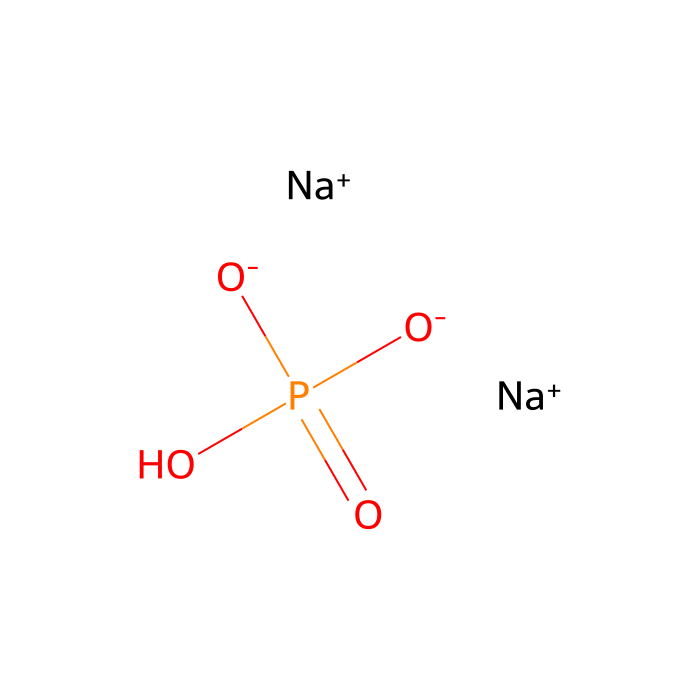
Sodium phosphate dibasic - Suitable for molecular biology, ≥99.5%(T) , CAS No.7558-79-4

CAS: 7558-79-4 Cat. No.: S118443 Summenformel: Na2HPO4 Molekulargewicht: 141.96 EG-Nummer: 231-448-7
Zu bestellen verfügbar
QUALITÄT & REINHEIT Suitable for molecular biology ? Molecular-biology grade — free of nucleases and contaminants that degrade DNA/RNA. Use in cloning, PCR, and nucleic-acid work needing clean reagents. ≥99.5%(T)
Synonyms
Disodium hydrogen orthophosphate | Disodium phosphoric acid | FEMA No. 2398 | OSMOPREP COMPONENT SODIUM PHOSPHATE, DIBASIC ANHYDROUS | Sodium phosphate, dibasic | AKOS015902440 | Disodium Hydrogen Phosphate Submicron | Fleet enema | DTXSID1026039 | Disodi
Storage
Room temperature
Shipped In
Normal
★
Größe
Deutschland (EU)
USA*
Preis
Menge
250g
S118443-250g
2 Auf Lager
6 Auf Lager
86,69€
Enter a quantity for the sizes you want to add.
🧪
Warum diese Qualität

Suitable for molecular biology, ≥99.5%(T) Suitable for molecular biology für empfindliche chromatographische und analytische Workflows, die minimale Basislinieninterferenzen erfordern.

🌡

Lagerung & Versand

Room temperature Versand Normal. Genaue Spezifikationen finden Sie im chargenspezifischen COA.

📋

Qualitätsdokumente

SDS, COA, Datenblatt und Spezifikationsblatt stehen zum Download bereit. Chargenspezifische COA über Chargennummernsuche abrufbar.

📚

Literaturbeleg

In 1212 peer-reviewten Publikationen zu Chromatographie, organischer Synthese und Kreuzkupplungsreaktionen zitiert.

Spezifikationen

Synonyme
Disodium hydrogen orthophosphate | Disodium phosphoric acid | FEMA No. 2398 | OSMOPREP COMPONENT SODIUM PHOSPHATE, DIBASIC ANHYDROUS | Sodium phosphate, dibasic | AKOS015902440 | Disodium Hydrogen Phosphate Submicron | Fleet enema | DTXSID1026039 | Disodi
Spezifikationen & Reinheit
Suitable for molecular biology, ≥99.5%(T)
Storage
Room temperature
Verschickt in
Normal
Note
Suitable for molecular biology
Reinheit
≥99.5%(T)
Namen und Kennungen
Pubchem Sid
Pubchem Sid Url
https://pubchem.ncbi.nlm.nih.gov/substance/488182863
Kanonisches Lächeln
OP(=O)([O-])[O-].[Na+].[Na+]
IUPAC Name
disodium;hydrogen phosphate
InChIKey
BNIILDVGGAEEIG-UHFFFAOYSA-L
INCHI
1S/2Na.H3O4P/c;;1-5(2,3)4/h;;(H3,1,2,3,4)/q2*+1;/p-2
Isomere SMILES
OP(=O)([O-])[O-].[Na+].[Na+]
Alternative CAS-Nummer
7778-77-0
Molekulargewicht
141.96
Reaxy-Rn
11343459
Reaxys-RN_link_address
https://www.reaxys.com/reaxys/secured/hopinto.do?context=S&query=IDE.XRN=11343459&ln=

Dokumentation

📋 Sicherheitsdatenblatt (SDS)

Umfassendes Dokument zu Gefahren, Handhabung, Lagerung und Einhaltung regulatorischer Vorschriften.

<<<<<<< HEAD SDS herunterladen → ======= SDS herunterladen → >>>>>>> release248-p3

✅ Analysezertifikat (COA)

Chargenspezifische Qualitätsdaten. Geben Sie Ihre Chargennummer ein, um das genaue COA abzurufen.

COA nachschlagen →

📊 Datenblatt

Kurzübersicht über Produktspezifikationen und Anwendungen.

Datenblatt ansehen →

🔬 Spezifikationsblatt

Vollständige Qualitätsmerkmale und Akzeptanzkriterien für diese Qualität.

Spezifikationsblatt ansehen →

Erweiterte Daten

Taxonomic Classification

Taxonomy Tree

KingdomInorganic compounds
SuperclassMixed metal/non-metal compounds
KlasseAlkali metal oxoanionic compounds
SubclassAlkali metal phosphates
Intermediate Tree Nodes Not available
Direct ParentAlkali metal phosphates
Alternative Parents Inorganic sodium salts  Inorganic oxides  
Molecular FrameworkNot available
Substituents Alkali metal phosphate - Inorganic sodium salt - Inorganic oxide - Inorganic salt
BeschreibungThis compound belongs to the class of inorganic compounds known as alkali metal phosphates. These are inorganic compounds in which the largest oxoanion is phosphate, and in which the heaviest atom not in an oxoanion is an alkali metal.
External Descriptors sodium phosphate
3D-Struktur
Interaktives chemisches Strukturmodell


Zertifikate (CoA, COO, BSE/TSE und Analyse-Diagramm)
C of A & Other Certificates(BSE/TSE, COO):
Analytical Chart:

Find and download the COA for your product by matching the lot number on the packaging.

11 results found

Lot NumberCertificate TypeDatumArtikel
E23101077E23101077Certificate of AnalysisOct 09, 2026 S118443
J2613282J2613282Certificate of AnalysisApr 21, 2026 S118443
I2504446I2504446Certificate of AnalysisAug 15, 2025 S118443
I2504705I2504705Certificate of AnalysisAug 15, 2025 S118443
E23101086E23101086Certificate of AnalysisApr 18, 2025 S118443
E23101067E23101067Certificate of AnalysisFeb 07, 2025 S118443
F2207271F2207271Certificate of AnalysisMar 20, 2024 S118443
F2207273F2207273Certificate of AnalysisMar 20, 2024 S118443
J2417316J2417316Certificate of AnalysisDec 10, 2022 S118443
A2119354A2119354Certificate of AnalysisNov 15, 2022 S118443
I2322094I2322094Certificate of AnalysisNov 15, 2022 S118443
Chemische und physikalische Eigenschaften
EmpfindlichkeitMoisture sensitive.
Molekulargewicht141.959 g/mol
XLogP3
Hydrogen Bond Donor Count1
Hydrogen Bond Acceptor Count4
Rotatable Bond Count0
Exact Mass141.941 Da
Monoisotopic Mass141.941 Da
Topological Polar Surface Area83.400 Ų
Heavy Atom Count7
Formal Charge0
Complexity46.500
Isotope Atom Count0
Defined Atom Stereocenter Count0
Undefined Atom Stereocenter Count0
Defined Bond Stereocenter Count0
Undefined Bond Stereocenter Count0
The total count of all stereochemical bonds0
Covalently-Bonded Unit Count3
FAQs und Artikel
Aladdin@Guidelines for the formulation of commonly used buffers for biological experiments
Molecular Biology Grade
Common Types of Buffer Solutions
Differences Between Transformation and Transfection
How to Choose a Hydrogen Evolution (HER) Catalyst: Kinetic Barriers in Water Electrolysis, AWE/PEM/AEM Pathways, and a Materials-Family Roadmap (with a Product Map)
TEMPO-Catalyzed Oxidation Quick Reference (Alcohol Oxidation Focus): Three Regeneration Routes (NaOCl / Cu–O₂ / PIDA) + Selection & Troubleshooting
Installing a Redox Switch on Biomolecules: Principles, Conjugation Essentials, and an Application Guide for ATTO MB2 NHS ester
A Review of Ten Commonly Used Techniques for Detection, Quantification, and Interaction Analysis in Nucleic Acid Research
Selection of Common Research Salts: A Task Map for Alkali Metal Salts & Alkaline Earth Metal Salts (with Product Tables 1–6)
Methodological essentials for mineralization visualization: Alizarin Red S staining vs. Von Kossa silver staining
Recent Advances in Methods for Measuring Starch-Related Indices in Plants and Their Application-Oriented Selection
Phycocyanin: A Review of Sources, Structural Features, Production Processes, Applications, and Claimed Benefits
Amino Acid Oxidases: Oxygen-Dependent Oxidative Deamination Systems and Their Analytical and Applied Uses
Diaphorase: NAD(P)H-Dependent Electron-Transfer Activity and Its Applications in Detection and Research
Glutathione (GSH) Quantification: Method Systems, Experimental Workflows, and Key Quality-Control Considerations
Haptoglobin (Hp): A Key Carrier in the Free Hemoglobin Clearance–Detoxification Axis, with Assays and Applications
Lipase (Triacylglycerol Hydrolase): Interfacial Catalysis, Selectivity Classes, and Assay/Application Systems
Glucose Content Determination: A Systematic Review of Detection Principles, Method Validation, and Research Application Frameworks
Bromelain: Enzymological Properties and Key Points for Food, Pharmaceutical, and Industrial Applications
Chlorophyll: Structural Features, Physicochemical Properties, and Key Points for Research and Industrial Applications
AmpC β-Lactamases (Cephalosporinases): Mechanisms of Production, Diagnostic Pathways, and Research and Clinical Applications
Chitinases: Substrate-Specific Degradation Mechanisms, Enzymatic Properties, and Application Directions
Whey Protein: Composition Profile, Manufacturing Routes, and Key Product-Type Essentials
From Sucrose to Monosaccharides: Key Enzymatic Nodes and Regulatory Logic in Sugar Conversion
Acetyl-Group Metabolic Enzyme Network and In Vitro Enzymology Analysis
Structural Characteristics, Operational Methods, and Separation Applications of Dextran Gels
Selection Strategy for PBS, TBS, PBST, and TBST Washing Systems in IHC
Preparation Methods and Precautions for Silane Coupling Agent Primer Solutions
From Functional Groups to Experimental Decision-Making: Protein Crosslinker Selection and Experimental Essentials
The Chemical Basis of Natural Lacquer Durability: Urushiol Structure, Oxidative Polymerization Film Formation, and Coating Film Properties
Practical Guide to TSA Tyramide Signal Amplification: How to Select Reagents, Optimize the Workflow, and Reduce Background When Detection Signals Are Weak for Low-Abundance Targets
Signal Transduction Mechanism of Graphene Biosensors: From Molecular Recognition to Electrical/Optical Signal Readout and Materials Selection
Comparison of Bilirubin Detection Methods: Application Selection of the Diazo Method, Vanadate Oxidation Method, Bilirubin Oxidase Method, and HPLC
Plant Tissue and Cell Wall Staining Methods: Selection of Light Green, Safranin, Fast Green, and Composite Staining Systems
1,8-Naphthyridine-Based Aldose Reductase Inhibitors: Scaffold Construction, In Vitro Inhibitory Activity, and Directions for Structural Optimization
Citations of This Product
Lösungsrechner
Bewertungen

Kundenbewertungen

Häufig gestellte Fragen

What does Suitable for molecular biology mean?
Suitable for molecular biology indicates that the product has been processed and tested for molecular biology and proteomics. Typical specifications include low or undetectable nuclease/protease activity, low endotoxin, controlled microbial limits and high lot-to-lot reproducibility.
How should this product be stored?
Store at room temperature.
How is this product shipped?
This product ships under standard ambient conditions. No temperature-controlled packaging is required.
What are the CAS number, molecular formula and molecular weight?
The CAS Number is 7558-79-4, the molecular formula is HNa2O4P, and the molecular weight is 141.96 g/mol. InChIKey BNIILDVGGAEEIG-UHFFFAOYSA-L.
What documentation is provided?
Available product documentation, including Certificates of Analysis (COA), Safety Data Sheets (SDS), and specification sheets, is shown in the product document area. Document availability and access follow the current site policy.

Benötigen Sie Hilfe bei der Auswahl der Qualität?

Unser Leitfaden zur Qualitätsauswahl behandelt Reinheit, Stabilisatorstatus und Anwendungseignung für alle Varianten in unserem Katalog.

Suitable for molecular biology Qualitätsleitfaden ansehen →

Dürfen wir Sie über Rabattaktionen informieren?

Später erinnern

Vielen Dank! Bitte überprüfen Sie Ihren E-Mail-Posteingang, um zu bestätigen.

Hoppla! Benachrichtigungen sind deaktiviert.