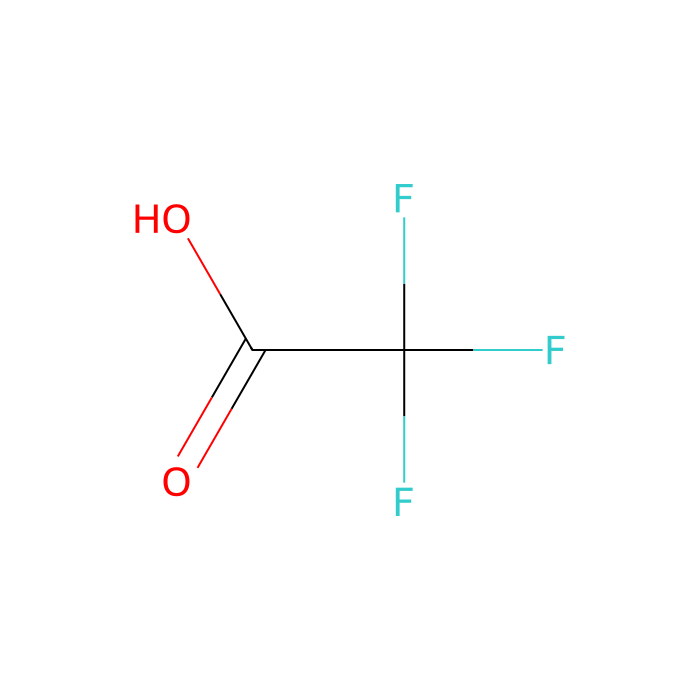
Trifluoressigsäure(TFA) - UltraPureChrom™, für LC-MS, ≥99,5% , CAS No.76-05-1

CAS: 76-05-1 Cat. No.: T103297 Summenformel: CF3COOH Molekulargewicht: 114.02 Beilstein Registry Number: 742035 EG-Nummer: 200-929-3
Zu bestellen verfügbar
GRADE & PURITY UltraPureChrom™ ? UltraPureChrom™ — Aladdin's ultra-pure line for chromatography and spectroscopy. Use as a premium solvent/reagent where the lowest impurity background is required. for LC-MS ? LC-MS grade — very low metal/ion and non-volatile residues to protect mass-spec signal. Use for LC-MS where ion suppression and background must be minimal. ≥99.5%
Synonyms
TFA | EN300-19296 | Flurtamon TP1 | Perfluoressigsäure | BP-20560 | Trifluoracetat | Trifluoressigsäure, >=99,995% Spurenmetalle | Essigsäure, Trifluor- | EC 200-929-3 | Trifluoressigsäure | Trifluoressigsäure, Handelsqualität | UNII-E5R8
Storage
Argon charged,Desiccated,Room temperature
Shipped In
FedEx DG Service
★
Size
Deutschland (EU)
USA*
Price
Qty
10ml
T103297-10ml
—
2 Auf Lager
301,89€
Enter a quantity for the sizes you want to add.
🧪
Why this grade

UltraPureChrom™, für LC-MS, ≥99,5% for LC-MS,UltraPureChrom™ for sensitive chromatographic and analytical workflows requiring minimal baseline interference.

🌡

Storage & shipping

Argon charged,Desiccated,Room temperature Ships FedEx DG Service Check lot-specific COA for exact specifications.

📋

Quality documents

SDS, COA, datasheet, and spec sheet available for download. Lot-specific COA accessible via lot number lookup.

📚

Literature proof

Cited in 1129 peer-reviewed publications across chromatography, organic synthesis, and cross-coupling reactions.

Specifications

Synonyme
TFA | EN300-19296 | Flurtamon TP1 | Perfluoressigsäure | BP-20560 | Trifluoracetat | Trifluoressigsäure, >=99,995% Spurenmetalle | Essigsäure, Trifluor- | EC 200-929-3 | Trifluoressigsäure | Trifluoressigsäure, Handelsqualität | UNII-E5R8
Spezifikationen & Reinheit
UltraPureChrom™, für LC-MS, ≥99,5%
Storage
Argon charged,Desiccated,Room temperature
Verschickt in
FedEx DG Service
Note
for LC-MS, UltraPureChrom™
Reinheit
≥99.5%
Namen und Kennungen
Pubchem Sid
Kanonisches Lächeln
C(=O)(C(F)(F)F)O
IUPAC Name
2,2,2-trifluoroacetic acid
InChIKey
DTQVDTLACAAQTR-UHFFFAOYSA-N
INCHI
1S/C2HF3O2/c3-2(4,5)1(6)7/h(H,6,7)
Isomere SMILES
C(=O)(C(F)(F)F)O
WGK Deutschland
2
RTECS
AJ9625000
UN-Nummer
2699
Verpackungsgruppe
I
Molekulargewicht
114.02
Beilstein
742035
Reaxy-Rn
742035
Reaxys-RN_link_address
https://www.reaxys.com/reaxys/secured/hopinto.do?context=S&query=IDE.XRN=742035&ln=

Documentation

📋 Safety Data Sheet (SDS)

Comprehensive hazard, handling, storage, and regulatory compliance document.

Download SDS →

✅ Certificate of Analysis (COA)

Lot-specific quality data. Enter your lot number to retrieve the exact COA.

Look up COA →

📊 Datasheet

Quick-reference summary of product specifications and applications.

View datasheet →

🔬 Specification Sheet

Full quality attributes and acceptance criteria for this grade.

View spec sheet →

Advanced Data

Taxonomic Classification

Taxonomy Tree

KingdomOrganic compounds
SuperclassOrganic acids and derivatives
KlasseCarboxylic acids and derivatives
SubclassAlpha-halocarboxylic acids and derivatives
Intermediate Tree Nodes Not available
Direct ParentAlpha-halocarboxylic acids
Alternative Parents Monocarboxylic acids and derivatives  Carboxylic acids  Organofluorides  Organic oxides  Hydrocarbon derivatives  Carbonyl compounds  Alkyl fluorides  
Molecular FrameworkAliphatic acyclic compounds
Substituents Alpha-halocarboxylic acid - Monocarboxylic acid or derivatives - Carboxylic acid - Organic oxygen compound - Organic oxide - Hydrocarbon derivative - Organooxygen compound - Organofluoride - Organohalogen compound - Carbonyl group - Alkyl halide - Alkyl fluoride - Aliphatic acyclic compound
BeschreibungThis compound belongs to the class of organic compounds known as alpha-halocarboxylic acids. These are carboxylic acids containing a halogen atom bonded to the alpha carbon atom.
External Descriptors organofluorine compound - monocarboxylic acid
3D-Struktur
Interaktives chemisches Strukturmodell


Wirkungsmechanismen
Zertifikate (CoA, COO, BSE/TSE und Analyse-Diagramm)
C of A & Other Certificates(BSE/TSE, COO):
Analytical Chart:

Find and download the COA for your product by matching the lot number on the packaging.

9 results found

Lot NumberCertificate TypeDatumArtikel
C2626578Certificate of AnalysisMar 14, 2026 T103297
K2518759Certificate of AnalysisNov 11, 2025 T103297
K2514773Certificate of AnalysisNov 10, 2025 T103297
E2529589Certificate of AnalysisMay 26, 2025 T103297
E2529647Certificate of AnalysisMay 26, 2025 T103297
L2402606Certificate of AnalysisNov 25, 2024 T103297
E23161050Certificate of AnalysisMay 04, 2023 T103297
I2220601Certificate of AnalysisSep 26, 2022 T103297
J2218177Certificate of AnalysisSep 13, 2022 T103297
Chemische und physikalische Eigenschaften
EmpfindlichkeitHygroscopic
Brechungsindexn20/D 1.3 (lit.)
Flammpunkt (°C)>100°C
Siedepunkt (°C)72-73°
Schmelzpunkt (°C)-15°
Molekulargewicht114.020 g/mol
XLogP30.900
Hydrogen Bond Donor Count1
Hydrogen Bond Acceptor Count5
Rotatable Bond Count0
Exact Mass113.993 Da
Monoisotopic Mass113.993 Da
Topological Polar Surface Area37.300 Ų
Heavy Atom Count7
Formal Charge0
Complexity83.400
Isotope Atom Count0
Defined Atom Stereocenter Count0
Undefined Atom Stereocenter Count0
Defined Bond Stereocenter Count0
Undefined Bond Stereocenter Count0
The total count of all stereochemical bonds0
Covalently-Bonded Unit Count1
FAQs und Artikel
UltraPureChrom™: The Pinnacle of Purity for Chromatography
LC-MS Grade Solvents and Reagents
Peptide Mapping for Protein Structure Identification
Minute-Scale Construction of Fluorinated Nitrogen-Bridged Bicycles: Pd(II)/Pd(IV) Cascade Chemistry and a Pd(IV) “Dyotropic (Paired-Migration)” Rearrangement Driving Strain-Release Ring Expansion
A Complete Guide to Ion-Pair Reversed-Phase Chromatography (IPC / IP-RP): Mechanisms, Four Tuning Knobs, Troubleshooting, and Ion-Pair Reagent Families (Tables 1–4)
A Complete Guide to Choosing Resins for SPPS (Solid-Phase Peptide Synthesis): Fmoc/Boc Routes, C-Terminal Acid/Amide, and a Key-Parameter Navigator
Installing a Redox Switch on Biomolecules: Principles, Conjugation Essentials, and an Application Guide for ATTO MB2 NHS ester
A Practical Guide to Small-Molecule Chemical Probes: Concept Clarification, Causal Validation, and Experimental Selection (with Product Navigation and Tables A–D)
Endoproteinase Lys-C: Mechanism, Applications, and Method-Control Considerations for Lysine-Specific Digestion
Secondary Effects Behind Chromatographic Peak Tailing and Unstable Peak Shapes: How Residual Silanols (Si–OH) Affect Basic Compounds, and the Shortest Troubleshooting/Remediation Path (with Product Navigation and Tables 1–3)
2-Methylpyridine–Borane (2-Picoline·BH₃) Reductive Amination Guide: Process Drivers for Replacing NaBH₃CN, the Practical Operating Window, and Scale-Up/Quench Close-Out Essentials (Including Product Tables 1–3)
How Organic Acids “Stabilize a System”: Selection Logic via the pH Window, Salt Forms, and Metal-Ion Management (with a navigation guide to Tables A–E)
Angiotensin-Converting Enzyme (ACE): A Review of Molecular Features, Catalytic Functions, and Research and Translational Applications
Chymosin: A Review of Molecular Features, Coagulation Kinetics, and Activity Evaluation
Review of Chymotrypsin: Enzymological Properties, Catalytic Mechanism, and Research Applications
β-Acyloxy Alkenyl Amides (AAAs): A New Approach to Amide Bond and Peptide Bond Construction Worth Attention
DAST-Mediated Amidation at Room Temperature: Method Features, Practical Value, and Scope of Applicability
Methodological Studies on Glycoprotein Structural Characterization and Quality Attribute Analysis
From Analytical Instrument to Synthetic Platform: A New Strategy for Reconstructing Automated Flow Solid-Phase Peptide Synthesis with Standard Analytical HPLC
New Progress in the Solid-Phase Synthesis of Sterically Hindered Peptides: Background, Core Breakthroughs, and Implications for Automation Compatibility of the RMMR Strategy
Understanding Cbz (Benzyloxycarbonyl): Selection Logic and Practical Value of a Classical Amino Protecting Group
From the Logic of Deprotection to Protecting Group Choice: Differences Among Bn, PMB, and Dmb in Experimental Design
The Core Value of the Trityl Family of Protecting Groups: Acid-Deprotection Hierarchies and Selective Route Design
Reassessing Trimethylaluminum: Method Design and Experimental Value of One-Pot Peptide Elongation from Unprotected Amino Acids
Reconsidering N-Acyl Amino Protecting Groups: Deprotection Differences, Strategic Roles, and Experimental Selection of Ac, Bz, and Tfa
Selective Deprotection and Sulfonyl Group Migration of N-Aryl Sulfonamides Mediated by TfOH (Trifluoromethanesulfonic Acid): Reaction Patterns and Synthetic Implications
Low Racemization in Peptide Synthesis Is Not Just About Reagent Choice: Stereochemical Risk During the Activation Stage and Practical Strategies for Experimental Control
Unstabilized Azomethine Ylide Chemistry from a Single Precursor: Acceptor-Controlled Divergence and Patterns of Scaffold Outcomes
Technical Comparison and Method Selection for Hydroxyproline Determination
Decision Logic for Peptide Synthesis Routes: Applicability and Criteria for Choosing among SPPS, LPPS, and Recombinant Expression
Selection Logic for the Teoc Amino Protecting Group: From Fluoride-Triggered Deprotection to Orthogonal Protecting-Group Design
Boc₂O Selection Cannot Be Judged by Protection Installation Alone: Experimental Decision-Making from Substrate Nucleophilicity and Medium Effects to Deprotection Pathways
Experimental Judgment for Differential Deprotection of Double Boc and Related N-Boc Systems: Substrate Type, Site-Response Differences, and Initial Condition Selection
Experimental Selection of SEM-Cl: From O/N-SEM Protection and Directed Functionalization of N-Heterocycles to the Introduction of Protected C1 Fragments
Reaction Selection in Small-Molecule Synthesis: From Transformation-Type Assessment to Experimental Route Screening
How to Troubleshoot Abnormal Impurities in Peptide Synthesis? Locating Process Issues Through Amino-Related Side Reactions
Peptide Intermediates Difficult to Dissolve and Separate? Route Design and Workup Strategies for Tag-Assisted Liquid-Phase Peptide Synthesis (TAG-LPPS)
Porous Graphitic Carbon (PGC) Chromatography Columns: Creating New Selectivity for Challenging Separations through Molecular Shape and the π-Electron Cloud on the Graphitic Surface
Formation and Control of Carboxyl- and Hydroxyl-Related Impurities in Peptide Synthesis — Using Asp/Glu and Ser/Thr Residue Side Reactions as Examples
Discovery and Structural Optimization of the Noncovalent 3CL Protease Inhibitor S-217622
Moisturizing Mechanisms of Tremella fuciformis Polysaccharides: From Polysaccharide Structure and Hydration Rheology to Dynamic Film Formation on the Skin Surface
How Palmitoyl Pentapeptide-4 Acts on the Skin: From the KTTKS Sequence and Skin Delivery to Collagen Matrix Responses
How Cyclization Changes Peptide Behavior: Conformational Preorganization, Skin Delivery, and Integrin Binding, Using Cyclopeptide-5 as an Example
The Logic of Biomimetic Peptide Action in Skin: Sequence and Conformation, Skin Delivery, Stability, and Target Matching
Design Logic of Fluorinated 3,3-Disubstituted Oxetane Building Blocks: Structural Construction and Modulation of Amine Basicity, Lipophilicity, and Metabolic Stability
The Combination Logic of Palmitoyl Tripeptide-1 and Palmitoyl Pentapeptide-4: Skin Delivery, Matrix Signaling, and Regulation of Collagen Homeostasis
Mechanistic Basis of Acetyl Hexapeptide-8 in the Management of Expression Lines: SNARE Complex Interference, Constraints on Percutaneous Delivery, and Combination Strategies
The Piperidine Bioisosteric Potential of 4-Azaspiro[2.3]hexane: Geometry, Physicochemical Properties, and Synthetic Accessibility
Copper Tripeptide GHK-Cu and Skin Repair: From Copper Coordination Chemistry to Extracellular Matrix Remodeling
Supramolecular Materials: From Molecular Recognition and Self-Assembly to Dynamic Function
Construction of the Key α-Bromoketone Intermediate for LY3509754: A β-Keto Ester Strategy and Concomitant Decarboxylation Following Enzymatic Ester Hydrolysis
Regioselectivity of Pyridine-Diimine (PDI)–Cobalt-Catalyzed Simmons–Smith-Type Cyclopropanation: Alkene Substitution Patterns and the Methylene-Transfer Mechanism
Desaturative Amination for the Synthesis of Amino Heteroarenes: Carbonyl-Site Predefinition of the C–N Bond-Forming Position and Subsequent Desaturative Aromatization
ACT-1014-6470 Kilogram-Scale Synthesis: N7-Selective Reductive Amination of an Unprotected Pyrazole, Subsequent N2 Alkylation, and Intramolecular Urea Formation
MTAD-Mediated Oxidative Dearomatization of Pyridines: Transient para-Cycloaddition, Alkene Oxidation, and Heteroatom Functionalization
Citations of This Product
Lösungsrechner
Bewertungen

Kundenbewertungen

Need help choosing the grade?

Our grade selection guide covers purity, stabilizer status, and application suitability for all variants in our catalog.

View UltraPureChrom™ grade guide → View for LC-MS grade guide →

Shall we send you a message when we have discounts available?

Remind me later

Thank you! Please check your email inbox to confirm.

Oops! Notifications are disabled.