
Determine the necessary mass, volume, or concentration for preparing a solution.
| Activity Type | Activity Value -log(M) | Mechanism of Action | Activity Reference | Publications (PubMed IDs) |
|---|
Moligand™, 10mM in DMSO Moligand™ for sensitive chromatographic and analytical workflows requiring minimal baseline interference.
Store at -80°C Ships Dry ice packs + Cold packs Check lot-specific COA for exact specifications.
SDS, COA, datasheet, and spec sheet available for download. Lot-specific COA accessible via lot number lookup.
Cited in 1 peer-reviewed publications across chromatography, organic synthesis, and cross-coupling reactions.
Information
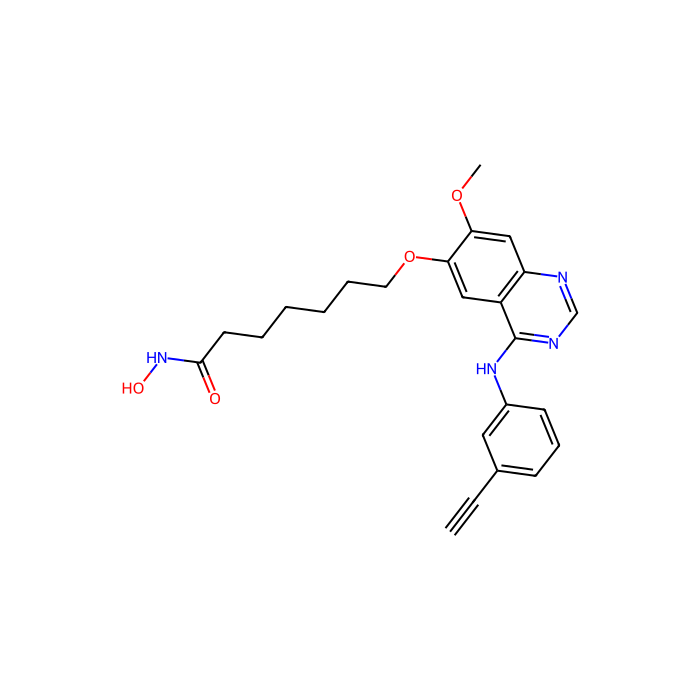
CUDC-101 is a potent multi-targeted inhibitor againstHDAC,EGFRand HER2 withIC50of 4.4 nM, 2.4 nM, and 15.7 nM, and inhibits class I/II HDACs, but not class III, Sir-type HDACs. Phase 1.
In vitro
Specific for class I and class II HDACs, CUDC-101 does not inhibit class III Sir-type HDACs. CUDC-101 displays weak activity against other protein kinases including KDR/VEGFR2, Lyn, Lck, Abl-1, FGFR-2, Flt-3, and Ret with IC50 of 0.85 μM, 0.84 μM, 5.91 μM, 2.89 μM, 3.43 μM, 1.5 μM, abd 3.2 μM, respectively. CUDC-101 displays broad antiproliferative activity in many human cancer cell types with IC50 of 0.04-0.80 μM, exhibiting a higher potency than erlotinib, lapatinib, and combinations of vorinostat with either erlotinib or lapatinib in most cases. CUDC-101 potently inhibits lapatinib- and erlotinib-resistant cancer cell lines. CUDC-101 inhibits the erlotinib-resistant EGFR mutant T790M although its effects are incomplete with an Amax of ~60% of peak enzyme activity after inhibition. CUDC-101 treatment increases the acetylation of histone H3 and H4, as well as the acetylation of non-histone substrates of HDAC such as p53 and α-tubulin, in a dose-dependant manner in various cancer cell lines. CUDC-101 also suppresses HER3 expression, Met amplification, and AKT reactivation in tumor cells.
In vivo
Administration of CUDC-101 at 120 mg/kg/day induces tumor regression in the Hep-G2 liver cancer model, which is more efficacious than that of erlotinib at its maximum tolerated dose (25 mg/kg/day) and vorinostat at an equimolar concentration dose (72 mg/kg/day). CUDC-101 inhibits the growth of erlotinib-sensitive H358 NSCLC xenografts in a dose-dependent manner. CUDC-101 also shows potent inhibition of tumor growth in the erlotinib-resistant A549 NSCLC xenograft model. CUDC-101 produces significant tumor regression in the lapatinib-resistant, HER2-negative, EGFR-overexpressing MDA-MB-468 breast cancer model and the EGFR-overexpressing CAL-27 head and neck squamous cell carcinoma (HNSCC) model. Additionally, CUDC-101 inhibits tumor growth in the K-ras mutant HCT116 colorectal and EGFR/HER2 (neu)-expressing HPAC pancreatic cancer models.
Cell Data
cell lines:
Concentrations:Dissolved in DMSO, final concentrations ~10 μM
Incubation Time:72 hours
Powder Purity:≥99%
| ALogP | 4 |
|---|
| Isomeric SMILES | COC1=C(C=C2C(=C1)N=CN=C2NC3=CC=CC(=C3)C#C)OCCCCCCC(=O)NO |
|---|---|
| Molecular Weight | 434.49 |
| Reaxy-Rn | 13122626 |
| Reaxys-RN_link_address | https://www.reaxys.com/reaxys/secured/hopinto.do?context=S&query=IDE.XRN=13122626&ln= |
Comprehensive hazard, handling, storage, and regulatory compliance document.
Download SDS →Lot-specific quality data. Enter your lot number to retrieve the exact COA.
Look up COA →Full quality attributes and acceptance criteria for this grade.
View spec sheet →| Activity Type | Activity Value -log(M) | Mechanism of Action | Activity Reference | Publications (PubMed IDs) |
|---|
| Activity Type | Activity Value -log(M) | Mechanism of Action | Activity Reference | Publications (PubMed IDs) |
|---|
| Activity Type | Activity Value -log(M) | Mechanism of Action | Activity Reference | Publications (PubMed IDs) |
|---|
| Activity Type | Activity Value -log(M) | Mechanism of Action | Activity Reference | Publications (PubMed IDs) |
|---|
| Activity Type | Activity Value -log(M) | Mechanism of Action | Activity Reference | Publications (PubMed IDs) |
|---|
| Activity Type | Activity Value -log(M) | Mechanism of Action | Activity Reference | Publications (PubMed IDs) |
|---|
| Activity Type | Activity Value -log(M) | Mechanism of Action | Activity Reference | Publications (PubMed IDs) |
|---|
| Activity Type | Activity Value -log(M) | Mechanism of Action | Activity Reference | Publications (PubMed IDs) |
|---|
| Activity Type | Activity Value -log(M) | Mechanism of Action | Activity Reference | Publications (PubMed IDs) |
|---|
| Activity Type | Activity Value -log(M) | Mechanism of Action | Activity Reference | Publications (PubMed IDs) |
|---|
| Activity Type | Activity Value -log(M) | Mechanism of Action | Activity Reference | Publications (PubMed IDs) |
|---|
| Activity Type | Activity Value -log(M) | Mechanism of Action | Activity Reference | Publications (PubMed IDs) |
|---|
| Solubility | Solubility (25°C) In vitro DMSO: 38 mg/mL (195.6 mM); Ethanol: 38 mg/mL (195.6 mM); Water: Insoluble; |
|---|
| 1. Jinzhao Liu, Meicen Wu, Qingyang Lyu, Chang Yang, Ni Fan, Kang Chen, Weiping Wang. (2025) IR783-Stabilized Nanodrugs Enhance Anticancer Immune Response by Synergizing Oxidation Therapy and Epigenetic Modulation. Advanced Science, [PMID:40150864] [10.1002/advs.202415684] |
Our grade selection guide covers purity, stabilizer status, and application suitability for all variants in our catalog.
View Moligand™ grade guide →