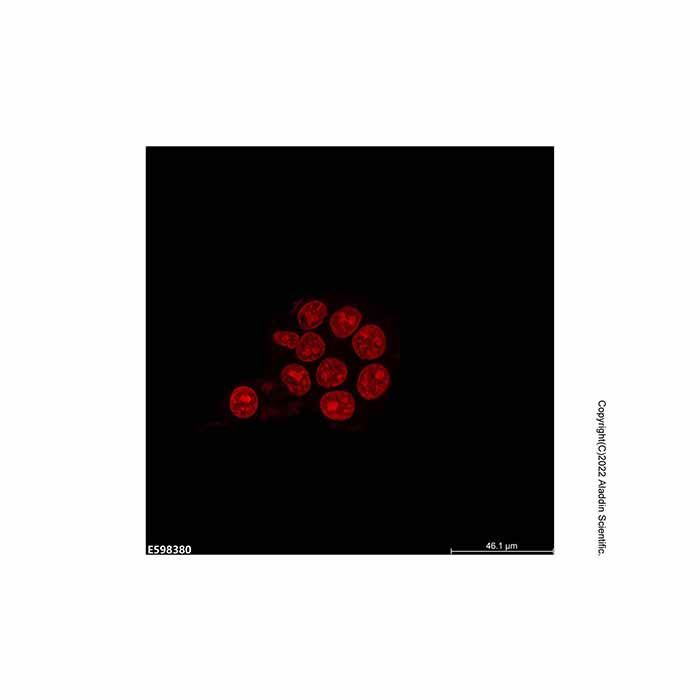
Ethidium Homodimer-I (EthD-I) is a high-affinity fluorescent nucleic acid dye. Upon binding to DNA or RNA, its fluorescence is enhanced more than 30‑fold. It is used for staining mammalian cells, bacteria, yeast and fungi. EthD-I carries strong positive charge, so it cannot cross the cell membrane to stain live cells. However, it can penetrate the disordered regions of dead cell membranes to reach the cell nucleus and intercalate into double‑stranded DNA, thereby producing red fluorescence. Therefore, EthD-I can accurately detect nucleic acids in solution or in lysed cells, making it a sensitive nucleic acid stain.
Application
Nucleic acid staining
Product Features
1. Fluorescence performance: long‑lasting luminescence and low quenching tendency;
2. Flexible and convenient use: compatible with other reagents from our company for flexible applications.
Product Parameters
1. Appearance: red solid, soluble in DMSO and MeOH
2. Ex/Em: 528/617 nm (when bound to DNA)
3. CAS No.: 61926-22-5
4. Formula: C₄₆H₅₀Cl₄N₈
5. Molecular weight: 856.75
Protocol
Note: This protocol is suitable for most cells. However, different cell types, cell densities, culture media and other factors may affect staining results. This protocol is for reference only.
1. Preparation of stock solution: Add an appropriate amount of DMSO to EthD-I to prepare a 2 mM stock solution. This stock solution can be stably stored at −20 °C for one year.
2. Add 20 μL of 2 mM stock solution to 10 mL of sterile tissue‑culture‑grade D‑PBS, and mix thoroughly by vortexing to a final concentration of 4 μM (recommended range: 0.1–10 μM; gradient optimization is recommended for different cell lines to determine optimal staining concentration).
3. Pipette 100–150 μL of the prepared working solution onto the cell coverslip to ensure full coverage. Incubation is preferably performed in a covered dish to prevent evaporation of the staining solution.
4. Incubate at room temperature for 30–45 minutes in the dark. Incubation time may be shortened appropriately if the staining concentration is too high or the temperature is too low.
5. Add 10 μL of D‑PBS onto a new microscope slide.
6. Using fine tweezers, carefully and quickly invert the cell‑bearing coverslip onto the slide with D‑PBS. To prevent evaporation, seal the edges of the coverslip with clear, transparent nail polish.
7. Observe cell staining under a fluorescence microscope.
Precautions
1. Briefly centrifuge the product to the bottom of the tube before use prior to subsequent experiments.
2. All fluorescent dyes are subject to photobleaching; protect from light as much as possible to slow fluorescence quenching.
3. This product is for research use only. It is not intended for clinical diagnosis or therapy, or for use in food or pharmaceutical products, and shall not be stored in ordinary residential premises.
4. For your safety and health, please wear a lab coat and disposable gloves during operation.
FAQ
1. Q: How to prepare dead cell controls for staining with this reagent?
A: Two simple methods are available. One is heat inactivation of cells by incubation at 60 °C for 20 minutes. The second is fixation of cells in 70% ethanol. Ethanol‑fixed cells can be stored long‑term at 4 °C until use, for up to several years.
2. Q: Can it stain single‑stranded DNA?
A: Yes. In addition to single‑stranded DNA, it can also be used for staining dsDNA, RNA, oligonucleotides and triple‑stranded DNA.

 ZJ26F0434841