
Indazole (Indazole) Scaffold Explained: How Adjacent Nitrogens, Tautomerism, and Substitution Sites Make H-Bonding and Acid–Base Behavior Tunable
Indazole (Indazole) Scaffold Explained: How Adjacent Nitrogens, Tautomerism, and Substitution Sites Make H-Bonding and Acid–Base Behavior Tunable
1.A practical question: why does a “small scaffold” keep showing up?
In drug and functional-molecule R&D, recurring bottlenecks usually concentrate on three things: whether a molecule can bind its target stably, whether it can dissolve/form salts, and whether it can maintain controllable stability and metabolism in vivo or under process conditions. Often, the solution cannot be achieved by merely “swapping a functional group”. Instead, you need a scaffold that simultaneously offers more suitable interaction sites and a tunable microstate space (acid–base behavior / tautomerism).
Indazole is repeatedly used because its two adjacent nitrogens plus tautomerism enable systematic, apples-to-apples comparisons across H-bonding patterns, acid–base/charge states, and substitution/position expansion. This turns optimization from trial-and-error into iterative tuning of controllable variables.
2.Definition and essentials: what is indazole?
Indazole is a fused aromatic nitrogen heterocycle: a benzene ring fused with a pyrazole ring. It is also commonly written as benzopyrazole (benzopyrazole, or benzo[d]pyrazole / 1,2-benzopyrazole).
Using the most common parent 1H-indazole as a representative:
(1). Molecular formula: C₇H₆N₂
(2). CAS: 271-44-3
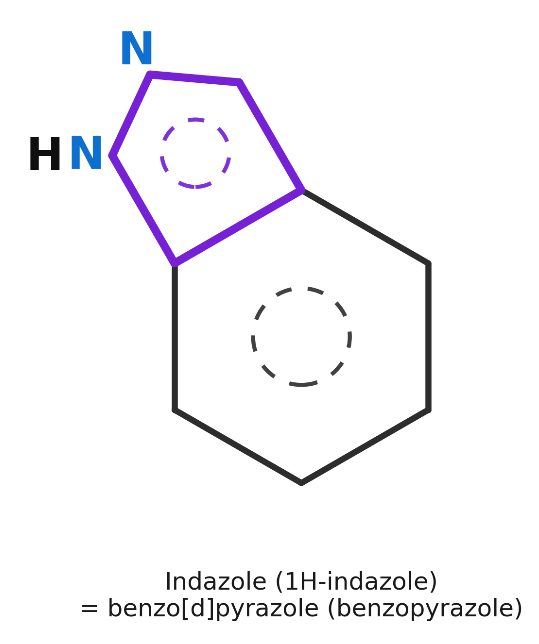
3.Structural features: how two “adjacent nitrogens” determine properties
Structural feature | Corresponding property changes | Common usage |
Tautomerism (mainly 1H ↔ 2H; literature may also mention 3H as a potential form) | The position of the N–H shifts; the H-bond donor/acceptor map changes accordingly; reactions may proceed via different pathways | N-substitution (alkylation/acylation) often discusses N1/N2 regioisomers; in scaffold comparisons, used to rationalize differences in activity/selectivity |
Switchable acid–base and charge states (neutral indazole ⇄ indazolate anion; neutral indazole ⇄ indazolium cation) | Changing charge state can strongly affect solubility, coordination ability, and H-bonding/polarity | Salt formation / solubility window, coordination/metal systems, and reaction design under strong base or strong acid conditions |
Stackable interactions (two nitrogens + fused aromatic π surface) | More likely to provide both directional H-bonding and aromatic contact surfaces; under suitable conditions, can also serve as an N-donor coordination site | Multipoint interactions in drug binding sites; as a nitrogen-containing ligand fragment in materials/coordination systems |
Multiple substitution sites (N sites + positions adjacent on the five-membered ring + multiple benzene-ring sites) | Large SAR space: electronics/hydrophobicity/sterics can be tuned systematically to manage selectivity, exposure, and metabolically sensitive sites | “Position scanning” and series optimization in drugs/functional molecules; also used as an intermediate platform for further diversification |
Notes:
① 1H is the dominant (most common/more stable) tautomer; 2H interconverts but is usually a smaller fraction; 3H can typically be treated as a rarely used potential form. In unsubstituted parent/simple derivatives, discussions often default to 1H. However, for N-substituted derivatives (especially in drug IUPAC naming), 1H/2H labels are frequently used for naming and site identification and should not be directly equated to tautomer populations in solution.
② The indazole ring is a very weak base: under neutral conditions it is mainly neutral; it is more readily protonated only under strongly acidic conditions and deprotonated only under strongly basic conditions.
③ N-site substitution should consider N¹/N² regioisomerism; tautomerism and conditions can affect regioselectivity.
4.Classification: first identify the “molecular state”, then identify “which position is modified”
4.1 Classification by “molecular state” (clarify neutral/tautomeric/charged first)
Molecular state | How to recognize | When you typically encounter it |
Neutral 1H-indazole (most common default form) | The structure is usually drawn with one N bearing H (N–H) and no overall charge | Most drug-scaffold discussions; routine neutral molecule design |
Tautomerism-related systems (mainly 1H ↔ 2H) | Within the same scaffold, H can transfer between the two nitrogens (tautomerism) | Discussions of N-substitution (alkylation/acylation), regioselectivity, and regioisomer ratios |
Indazolate (anion after deprotonation) | N–H is absent and there is an overall negative charge (often as a salt) | Strong base conditions; when stronger N-donor/coordination ability is desired; certain reaction designs |
Indazolium (cation after protonation) | An additional proton and an overall positive charge (often as a salt) | Strong acid / salt form conditions; discussions of charge state in acidic media |
4.2 Classification by “modification site” (“modify N / modify the five-membered ring / modify the benzene ring”)
Modification site | What you are typically trying to solve | Common directions of change |
N-site substitution (N1/N2) | Lock/remove N–H, adjust polarity and binding mode, or build an N-substituted derivative library | Presence/absence of H-bond donor changes; tautomer behavior may be “locked”; N1/N2 regioisomers may appear |
Substitution/side chains near the five-membered ring | Tune key interaction geometry and spatial orientation, or address metabolically sensitive sites | More directly affects docking pose, local electronics, and reaction/metabolism sensitivity points |
Benzene-ring substitution | Fine-tune hydrophobic volume, π-surface contacts, and electronic effects to improve selectivity and exposure windows | Often used for “fine adjustment”: stepwise alignment of lipophilicity, selectivity, and stability windows |
5.Applications: Turning “Structure Determines Properties” into Three High-Frequency Workstreams
High-frequency application workstream | What indazole does (linked to structural features) | Checkable representative examples | Notes |
Drug discovery: a commonly used heteroaromatic scaffold | Two nitrogens provide a designable H-bond map + a fused aromatic π surface; positions can be expanded for series-based SAR (same-scaffold controls are easier) | Pazopanib: studies have directly performed structure optimization by modifying the indazole ring in pazopanib; Niraparib: metabolism/stability evaluations explicitly treat the indazole moiety as one tunable fragment; Benzydamine: an indazole derivative used for local anti-inflammatory/analgesic effects (often grouped under NSAIDs; commonly formulated as the hydrochloride salt) | Do not expect a dramatic solubility increase by relying only on “protonation of the indazole ring itself”: a review summary reports an indazolium/indazole pKₐ ~ 1.04, indicating indazole is a very weak base; real drugs more often rely on an appended protonatable side chain, plus salt/co-crystal strategies, and substitution-driven tuning of hydrophobicity and H-bond networks to reach the desired property window. |
Synthesis & fine chemicals: an agrochemicals/dyes/intermediate platform | The indazole scaffold is planar and multi-position functionalizable, enabling you to first build a “further-expandable” intermediate, then rapidly diversify in parallel (coupling, amidation, N-substitution, etc.) | Review statements: the indazole core is an important component in agrochemicals, dyes, and key pharmaceutical intermediates; a checkable “dye example”: patents and application descriptions exist for indazole azo dyes | The most common practical issue when using it as an intermediate: N-substitution frequently encounters N1/N2 regioisomerism and strong condition dependence (you should plan for this in route design and purification early). |
Coordination & materials: an N-donor ligand unit (coordination polymers / MOFs) | The two nitrogens can serve as N-donor sites; introducing a “linker handle” such as carboxylic acid makes coordination networks easier to form, extending toward luminescence and porous adsorption | Checkable literature reports include coordination polymers built from 1H-indazole-4-carboxylic acid; Zn-MOFs based on 1H-indazole-5-carboxylic acid; and metal coordination polymers using 1H-indazole-3-carboxylic acid | “Two nitrogens coordinate; the carboxylate connects/creates the network.” Dimensionality (1D/2D/3D) and function (emission/adsorption) depend more on the metal node and auxiliary ligands. |
6.Five Most Common Modification Entry Points for Indazole
Structural variable to modify | Property variable most often “tuned” (main impact) | Where it lands in use | Notes (reminders) |
Tautomerism / molecular state (mainly 1H ↔ 2H) | H-bond donor/acceptor positions and local polarity | Use same-scaffold controls to explain differences in activity/selectivity; understand/predict pathway differences during N-substitution | 3H is usually not treated as a common dominant form; discussions mainly focus on 1H/2H |
N site: keep NH vs N-substitution (N1/N2) | Presence/absence of an H-bond donor; overall polarity/coordination mode; may introduce regioisomers | Solubility/salt strategy; fine-tuning binding mode; building an N-substituted derivative library | N1/N2 regioisomerism is a common real-world issue—plan ahead in route design and purification |
Benzene-ring substitution (electronic / hydrophobic) | Lipophilicity and hydrophobic contact surface; selectivity/exposure window | “Position-scanning” SAR: fine-tune selectivity, exposure, and stability | Often used for “fine adjustments”; small-step, controlled comparisons are usually better than one big change |
Substitution/side chains near the five-membered ring | Spatial vectoring and key interaction geometry; metabolically sensitive sites | Improve docking pose and potency (IC₅₀/selectivity, etc.); manage metabolic hotspots | Changes near the di-nitrogen region tend to be more “sensitive”; systematic controls are recommended |
Introduce linking/coordination handles (e.g., carboxylic acid) | Increased polarity and connectivity; stronger ability to build coordination networks | Coordination polymers/MOFs/functional materials; or treat it as an “expandable intermediate” for further derivatization | The stronger the “handle,” the more performance depends on specific metal nodes/conditions; use often shifts from drug-like to materials or intermediate-platform contexts |
7.Product Navigation Table: Locate Indazole Chemicals by Research Task (Tables 1–4)
Research task / experimental need | Which table to check first | Why start with this table | Typical next step (common handoff) |
Need approved/clinical drugs for activity benchmarking, method validation, impurity/degradation studies | Table 1: Drug APIs / reference standards | Provides checkable marketed drugs/tool compounds directly—best for controls and analytical work; avoids time/cost of resynthesis from intermediates | For structure expansion/metabolite analogs: then check Table 3 (functional handles / boronation handles) or Table 4 (position-scanning substitutions) |
For target validation/cell assays, need a pharmacological indazole representative as a positive control | Table 1: Drug APIs / reference standards | Table 1 contains real drug-context representatives—fastest way to establish a baseline “effect vs no effect” | If the positive control is clear and you want SAR: move to Table 4 (position scanning) or Table 3 (rapid coupling-based expansion) |
Build an indazole fragment library / scaffold starting point (beginning from the parent core) | Table 2: Parent cores & basic N-substituted building blocks | First decide whether you need N–H and confirm core availability—prevents repeated rework on N1 strategy later | If you need fast series at 3/5/6/7 positions: move to Table 4 (halogen/CF₃ etc. scanning) or Table 3 (boronic acid/Bpin for coupling) |
Test whether N1 must be N–H or build N-substituted controls (microstate/H-bond-donor differences) | Table 2: Parent cores & basic N-substituted building blocks | N-substitution directly changes H-bond donor/acceptor patterns, pKₐ, and coordination behavior—one of the first variables to lock down in indazole SAR | If N1 can be locked: then go to Table 4 for position scanning, or Table 3 for coupling/linker-based expansion |
Need a transformable handle to attach side chains/linkers (amidation, esterification, reductive amination, oxidation, etc.) | Table 3: Functional handles & boronation/coupling intermediates | Table 3 concentrates the most-used synthetic “handles” (acids/esters/aldehydes/nitriles/alcohols/amides), enabling rapid attachment of the indazole core to your desired modules | If you need diverse aryl/heteroaryl: prioritize Suzuki using Table 3 boronic acids/Bpin; for position scanning switch to Table 4 |
Goal is the fastest 10–50 derivative set for SAR (library/parallel synthesis) | Table 3: Functional handles & boronation/coupling intermediates | Boronic acids/Bpin (incl. preinstalled Bpin) are ideal for parallel Suzuki expansion; acids/aldehydes/alcohols also enable multiple parallel derivatization paths | Use Table 4 to pick halogenated positions → combine with Table 3 boron blocks for coupling; or directly assemble from Table 3 Bpin series |
Doing Suzuki–Miyaura (or related) cross-coupling and need boronic acid/boronate ester/Bpin coupling blocks | Table 3: Functional handles & boronation/coupling intermediates | Table 3 groups boronic acids and Bpin together—easy to choose by position (3/5/6) and by stability/handling | If you have halo-indazoles: go to Table 4 to pick the matching halogenated site; if you want position-migration comparisons: Table 4 same-position halogen controls are more direct |
Run position scanning / halogen scanning (3/4/5/6/7; Cl/Br/I/F) to optimize activity, selectivity, or ADME | Table 4: Position-substitution scanning | Table 4 is organized by position and substitution type (halogens, CF₃, amino/nitro/hydroxy, etc.)—best for grouped “same-position, different substituent” comparisons | To expand into larger substituents: couple Table 4 halogenated intermediates with Table 3 boronic acid/Bpin blocks |
Tune solubility/salt/H-bonding via a polarity knob (amino, hydroxy, amide/acid) | Table 4 (check position amino/hydroxy/nitro first) + Table 3 (then acids/amides/alcohols/esters) | Table 4 provides position-level polar substituent controls; Table 3 provides stronger transformable polar handles (acid/amide/alcohol/aldehyde). Together they enable systematic property tuning | First use Table 4 to quickly compare “position effects,” then use Table 3 for deeper “handle derivatization/salt forms/linkers” |
Need electronic-effect controls (nitro/nitrile/halogens/CF₃) to infer binding-site preference or metabolic stability trends | Table 4 (nitro/halogens/CF₃) + Table 3 (nitrile/amide) | Electronics are commonly scanned quickly via nitro, halogens, CF₃; nitrile/amide offer finer electronic + polarity tuning | If a position proves sensitive: return to Table 3 for coupling or handle derivatization to broaden structure space |
Need scaffold hopping / topology controls (e.g., introduce related carbonyl-containing scaffolds) | Table 4: Position-substitution scanning (scaffold variants) | Table 4 includes variants such as “3-indazolinone,” suitable for topology/polarity controls within the same scaffold family | If a variant works, go back to Table 3 to add linkers/coupling expansion, or back to Table 2 to re-check the N1 strategy |
Table 1|Drug APIs / Reference Standards (Marketed Drugs / Tool Compounds)
Category | CAS No. | Aladdin Cat. No. | Name | Specification / Purity | Key Features & Applications |
Drug API / Reference Standard | Targeted anti-tumor (kinase inhibitor) | 444731-52-6 | Pazopanib | Moligand™, ≥99% | A representative multi-target TKI containing an indazole core; used for API research, quality/impurity and degradation studies, method development, and activity benchmarking. | |
Drug API / Reference Standard | Targeted anti-tumor (kinase inhibitor) | 319460-85-0 | Axitinib | Moligand™, ≥99% | A representative indazole-scaffold VEGFR inhibitor; used for drug research, analytical reference, impurity profiling/stability, and process evaluation. | |
Drug API / Reference Standard | Anti-tumor (PARP inhibitor) | 1038915-60-4 | MK-4827 (Niraparib) | Moligand™, ≥98% | A representative PARP inhibitor containing an indazole core; used for pharmacology studies, analytical reference, and impurity/metabolite and degradation-pathway research. | |
Drug API / Reference Standard | Anti-inflammatory analgesic / topical use | 132-69-4 | Benzydamine Hydrochloride | ≥97% | A representative indazole-class NSAID (commonly as the hydrochloride salt); used for drug research, analytical reference, impurity/degradation studies, and method validation. |
Table 2|Indazole Parent Core & Basic N-Substituted Building Blocks (Fragment Library / Scaffold Starting Points)
Category | CAS No. | Aladdin Cat. No. | Name | Specification / Purity | Key Features & Applications |
Parent core / basic scaffold | General heterocycle building block | 271-44-3 | I473130 | Indazole | 98% | Core indazole scaffold (N-heteroaromatic fused ring) building block; commonly used for medicinal-chemistry scaffold construction, fragment libraries, and SAR starting points. |
Parent core / N-substitution | N1 property tuning | 13436-48-1 | 1-Methyl-1H-indazole | ≥97% | N-methylation changes N–H acid–base/coordination behavior and H-bond donor properties; commonly used as a control to probe whether an N–H is required in structure–activity relationships. |
Table 3|Functional Handles (Carboxylic Acid / Ester / Aldehyde / Amide / Nitrile / Alcohol) & Boronation Coupling Intermediates (Boronic Acid / Bpin)
Category | CAS No. | Aladdin Cat. No. | Name | Specification / Purity | Key Features & Applications |
Functional handle | Carboxylic acid (salt formation / amidation / linker) | 4498-67-3 | Indazole-3-carboxylic acid | ≥98% (HPLC) | A 3-position carboxylic-acid “coupling handle”: facilitates salt formation and amidation for linker/side-chain extension, enabling iterative structure–property optimization. | |
Functional handle | Amide (polarity / H-bonding / metabolic-stability tuning) | 90004-04-9 | 1H-Indazole-3-carboxamide | ≥98% | The amide provides H-bonding and polarity; commonly used in lead optimization to tune solubility/exposure and as a control for receptor binding-mode comparisons. | |
Functional handle | Nitrile (further transformable / electronic-effect control) | 50264-88-5 | 1H-Indazole-3-carbonitrile | ≥98% | The nitrile is both small and electron-withdrawing; often used as an intermediate (further transformable) or to tune electronics and metabolic stability. | |
Functional handle | Aldehyde (reductive amination / condensation / ring-fusion entry) | 5235-10-9 | 3-Formylindazole | ≥98% | An aldehyde is an efficient “joining point”: commonly used for reductive amination, condensations, and ring-fusion construction to rapidly generate series of derivatives. | |
Functional handle | Alcohol (oxidizable / esterifiable / linker) | 64132-13-4 | 1H-Indazole-3-methanol | ≥97% | The hydroxymethyl group can be oxidized to an aldehyde/acid or esterified into a prodrug/linker; used to tune polarity and steric occupancy. | |
Functional handle | Ester (subsequent hydrolysis / amidation) | 43120-28-1 | Methyl 1H-indazole-3-carboxylate | ≥97% | An ester is a “transformable handle”: readily hydrolyzed to the acid or converted to an amide/other derivatives for synthetic route handoffs. | |
Functional handle | Carboxylic acid (salt formation / amidation / linker) | 61700-61-6 | 1H-Indazole-5-carboxylic acid | ≥97% | A 5-position carboxylic acid suitable for amide/ester/salt-form controls; often used to build derivatives with improved solubility or connectivity. | |
Functional handle | Carboxylic acid (salt formation / amidation / linker) | 704-91-6 | 1H-Indazole-6-carboxylic acid | ≥97% | A 6-position carboxylic acid for salt formation and amidation expansion; often used to compare how an “acid handle” at different positions affects properties. | |
Functional handle | Alcohol (oxidizable / esterifiable / linker) | 916902-55-1 | (1H-Indazol-6-yl)methanol | ≥97% | A 6-position hydroxymethyl is a common “connection point”: can be oxidized/esterified/etherified to introduce side chains, tuning sterics and polarity. | |
Boronic acid | Suzuki coupling handle | 1310383-95-9 | 1H-Indazole-3-boronic acid | ≥97% | A classic 3-position Suzuki entry point: enables rapid installation of aryl/heteroaryl groups, suitable for fragment growth and library synthesis. | |
Boronic acid | Suzuki coupling handle | 338454-14-1 | 1H-Indazole-5-boronic acid | ≥95% | Used in Suzuki–Miyaura to rapidly introduce aryl/heteroaryl groups; a key building block for 5-position substitution series. | |
Boronate ester | Bpin (Suzuki-friendly, stable and easy to handle) | 862723-42-0 | 1H-Indazole-5-boronic acid pinacol ester | ≥97% | The Bpin form is typically more stable and easier to weigh and scale in couplings; used for rapid construction of 5-substitution patterns. | |
Boronate ester | Bpin (Suzuki-friendly, stable and easy to handle) | 937049-58-6 | 1H-Indazole-6-boronic acid pinacol ester | ≥97% | A 6-position Bpin that supports rapid construction of diverse 6-substituted series; used for SAR expansion and lead optimization. | |
Boronated intermediate | Bpin (preinstalled coupling site) | 1627722-97-7 | 1-Methyl-3-(4,4,5,5-tetramethyl-1,3,2-dioxaborolan-2-yl)-1H-indazole | ≥98% | A Bpin-preinstalled “couplable site” on indazole: used for fast Suzuki–Miyaura installation of aryl/heteroaryl groups for SAR expansion and library synthesis. |
Table 4|Position Substitution (Amino / Nitro / Hydroxy / Alkyl / Trifluoromethyl / Halogenation / Scaffold Variants)
Category | CAS No. | Aladdin Cat. No. | Name | Specification / Purity | Key Features & Applications |
Scaffold variant | Carbonyl-containing scaffold (property control) | 7364-25-2 | 3-Indazolinone | ≥97% | An indazole-related scaffold featuring a lactam: provides stronger H-bond acceptor/polar features; used for scaffold hopping and property controls. | |
Polar substitution | Amino (derivatization & salt-form window) | 874-05-5 | 3-Aminoindazole | ≥97% | A 3-position amino enables rapid installation of acyl/sulfonyl groups; used to tune H-bonding and solubility and to build bioactive derivatives. | |
Polar substitution | Amino (derivatization & salt-form window) | 19335-11-6 | 5-Aminoindazole | ≥98% | Enables fast diversification via acylation/sulfonylation/urea formation; also commonly used to tune salt forms/solubility and H-bond networks. | |
Polar substitution | Amino (derivatization & salt-form window) | 6967-12-0 | 6-Aminoindazole | ≥98% | A 6-position amino supports building diverse amides/ureas/sulfonamides; used to compare activity and ADME changes across substitution sites. | |
Polar substitution | Nitro (electronic tuning / reducible to amino) | 5401-94-5 | 5-Nitroindazole | ≥98% | Strongly electron-withdrawing; a reducible precursor to 5-amino series; used for electronic and polarity controls. | |
Polar substitution | Nitro (electronic tuning / reducible to amino) | 7597-18-4 | 6-Nitroindazole | ≥98% | Used for electronic-effect controls or as an intermediate en route to 6-amino series via reduction. | |
Polar substitution | Hydroxy (H-bonding / solubility tuning) | 15579-15-4 | 5-Hydroxy-1H-indazole | ≥97% | Hydroxy increases polarity and provides H-bonding; can be further etherified/esterified as a prodrug or for side-chain introduction, expanding property space. | |
Hydrophobic tuning | Methyl (size / conformation / hydrophobicity) | 3176-62-3 | 3-Methyl-1H-indazole | ≥97% | Methyl is a common “fine steric knob”: used for conformation/hydrophobic-pocket occupancy controls to assess benefits of small substituents. | |
Hydrophobic tuning | Trifluoromethyl (lipophilicity / stability) | 57631-05-7 | 3-(Trifluoromethyl)-1H-indazole | ≥98% | CF₃ is often used to raise lipophilicity and metabolic stability and to alter conformation/pocket occupancy; used as an SAR “hydrophobic knob” control. | |
Hydrophobic tuning | Trifluoromethyl (lipophilicity / stability) | 954239-22-6 | 6-(Trifluoromethyl)-1H-indazole | ≥97% | 6-position CF₃ is often used to enhance lipophilicity and metabolic stability and strengthen hydrophobic-pocket interactions; used for key-site hydrophobic scanning. | |
Halogenation | Chloro (coupling / position scanning) | 29110-74-5 | 3-Chloroindazole | ≥97% | A 3-position chloro serves as a cross-coupling substrate or a downstream functionalization entry point; commonly used in substitution-pattern scanning for SAR. | |
Halogenation | Bromo (coupling / position scanning) | 40598-94-5 | 3-Bromo-1H-indazole | ≥95% | A high-frequency coupling intermediate at C-3: used to rapidly build 3-substituted indazole derivatives for SAR and library synthesis. | |
Halogenation | Iodo (high-reactivity coupling site) | 66607-27-0 | 3-Iodo-1H-indazole | ≥97% | Iodo substitution is often chosen for more facile couplings (e.g., Suzuki); suitable for rapid installation of complex aryl/heteroaryl groups to build series. | |
Halogenation | Chloro (coupling / position scanning) | 13096-96-3 | 4-Chloro-1H-indazole | ≥97% | Used to build control series with different substitution topologies; often serves as a cross-coupling entry point for position scanning. | |
Halogenation | Bromo (coupling / position scanning) | 186407-74-9 | 4-Bromoindazole | ≥97% | A common coupling handle to build 4-substituted indazole series for lead optimization and library synthesis. | |
Halogenation | Fluoro (electronic / metabolic & conformational fine-tuning) | 348-26-5 | 5-Fluoro-1H-indazole | ≥97% | Fluorine is often used for subtle tuning of electronics, metabolic stability, and conformational preference; used for fine SAR and property optimization. | |
Halogenation | Chloro (coupling / position scanning) | 698-26-0 | 5-Chloro-1H-indazole | ≥97% | A 5-position chloro can be diversified by coupling; also commonly used to compare structure–activity/ADME differences among halogens at the same position. | |
Halogenation | Bromo (coupling / position scanning) | 53857-57-1 | 5-Bromo-1H-indazole | ≥97% | A standard intermediate for building diverse 5-substituted series; suitable for Suzuki/Buchwald expansions. | |
Halogenation | Iodo (high-reactivity coupling site) | 55919-82-9 | 5-Iodo-1H-indazole | ≥97% | Enables higher-reactivity coupling at C-5; used to rapidly install larger/more complex substituents to probe hydrophobic pockets and selectivity. | |
Halogenation | Chloro (coupling / position scanning) | 698-25-9 | 6-Chloro-1H-indazole | ≥97% | A general derivatization entry point at C-6; used in cross-couplings to build 6-substituted series and evaluate position effects. | |
Halogenation | Bromo (coupling / position scanning) | 79762-54-2 | 6-Bromoindazole | ≥98% | A common cross-coupling site: used in Suzuki / Buchwald–Hartwig to introduce substituents for SAR expansion. | |
Halogenation | Bromo (coupling / position scanning) | 53857-58-2 | 7-Bromo-1H-indazole | ≥97% | Used to explore less common substitution sites; suitable for “position migration” controls and conformation/selectivity comparisons. |
Note: The above are representative Aladdin products. For additional specifications, please refer to the full product list at the end of the article or search the Aladdin website using “product name / CAS / catalog number.”
For more related articles, please see below:
Applications of imidazole and its derivatives
Innovations in the design of stereospecific drug molecular structures: Spirocyclic Scaffolds