
Pyrrolidine and Its Derivative Systems: How a Five-Membered N-Heterocycle Tunes Properties and Use Cases via “Charge State–Conformation–Functional-Group Switching” (with Tables 1–4 for Selection Navigation)
Pyrrolidine and Its Derivative Systems: How a Five-Membered N-Heterocycle Tunes Properties and Use Cases via “Charge State–Conformation–Functional-Group Switching” (with Tables 1–4 for Selection Navigation)
1.Definitions: Pyrrolidine vs. “Pyrrolidine-Type” Compounds
1.1 What is Pyrrolidine?
Pyrrolidine is a five-membered saturated nitrogen heterocycle: the ring contains 4 carbons + 1 nitrogen, with the molecular formula C₄H₉N. From a functional-group perspective, it is a cyclic secondary amine: the nitrogen is bonded to two ring carbons and carries one N–H, matching the general secondary-amine motif R₂NH.
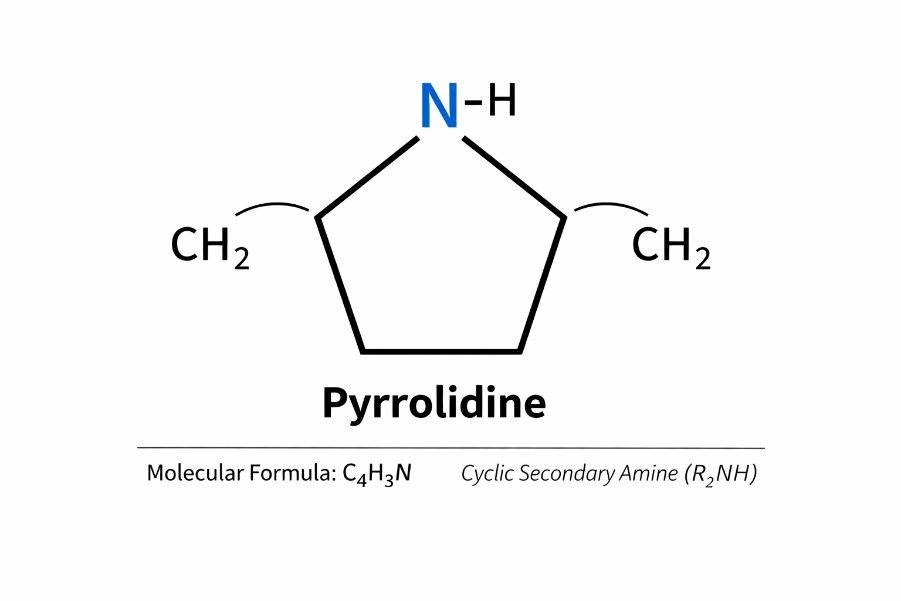
In practical research, pyrrolidine is also often treated as a strongly basic, readily salt-forming five-membered N-heterocyclic module. Its conjugate acid (pyrrolidinium) has an aqueous pKₐ ≈ 11.3, so under acidic or near-neutral conditions it more readily exists in a protonated / salt form—which directly affects solubility, extraction partitioning, reactivity, and purification strategy.
1.2 What Are “Pyrrolidine-Type Compounds”?
“Pyrrolidine-type compounds” do not refer to a single molecule, but rather a family of compounds related to the pyrrolidine ring.
①. Definition (strict structural sense): Compounds whose structures explicitly contain a pyrrolidine ring (a saturated five-membered N-heterocycle)—including diverse derivatives formed by N-substitution, ring substitution, chiral substitution, and other “functionalization built around a pyrrolidine ring.”
②. Expanded usage in reviews / medicinal chemistry: Beyond “containing a pyrrolidine ring,” discussions often include ring systems that derive directly from pyrrolidine, such as fused systems, and carbonyl variants like pyrrolidones (pyrrolidinone) formed by oxidation to a lactam. A key reminder: these variants have functionally shifted from an amine to an amide/lactam, so their basicity, hydrogen-bonding behavior, and polarity window can differ substantially and should not be analogized as if they behaved like an amine.
Take-home: Pyrrolidine is the parent core; “pyrrolidine-type compounds” are the broad family of functionalized derivatives built around that core (or directly derived ring systems).
2.Research Background: Four High-Frequency R&D Problems
In drug discovery, catalysis, and materials/process R&D, researchers repeatedly face a familiar set of needs: tuning property windows, achieving more 3D shape, and enabling systematic iteration and controllable scale-up. Pyrrolidine (and its “pyrrolidone” derivative systems) appears so frequently because they are practically useful as, respectively, a small, salt-forming amine module and a high-polarity, high-solvating solvent module.
Real-world R&D problem | Why it gets stuck (core trade-off) | Typical value pyrrolidine (Pyrrolidine; cyclic secondary amine) brings | What is commonly checked in experiments/selection |
1) Hard to reconcile the property window (solubility / salt formation / lipophilicity / H-bonding) | Want “soluble / salt-formable” but don’t want polarity so high that permeability/distribution is limited; also need controllable H-bonding and charge state | Pyrrolidine is one of the compact, strongly basic, readily protonated N-heterocycle modules: it can markedly shift charge state and solubility and provides clear H-bond donor/acceptor features (depending on protonation and N-substitution) | Salt-formation feasibility (salt/counter-salt choice), aqueous solubility and partitioning (logD), pH–solubility profile, polymorphism/hygroscopicity, controllability of purification |
2) Need a more three-dimensional (3D) shape (avoid relying on flat aromatics) | Planar aromatic fragments have similar spatial profiles (“shape homogenization”); aromaticity also often increases hydrophobicity and π-stacking | A saturated five-membered ring provides sp³ / non-planar conformations, making molecules more “3D,” while staying small and offering different orientations and volume-filling modes (a common strategy, not a universal rule) | Conformation and steric fit (crystal/compute/SAR trends), selectivity shifts, non-specific binding/aggregation tendency, changes in the balance of solubility vs. membrane permeability |
3) Need a systematically iterable “modifiable scaffold” (to advance SAR efficiently) | Must be small and robust, yet allow “add substituents / add chirality / lock conformation” at key sites for series comparisons | Pyrrolidine is readily diversified via N-substitution, α-(2-position) substitution, and fused/bridged conformation locking; it can carry chirality/substituent variation within a small footprint, supporting rapid matched-set construction | SAR interpretability (clear trends from single-site edits), enantiomer/configuration effects, metabolic soft-spot drift, chemical accessibility and route robustness at scale |
4) Materials/process needs for a “high-polarity, high-solvating” environment | Processes often need to dissolve polymers/binders and deliver stable slurries and coating windows, but may face EHS/compliance pressure and substitution needs | Here, pyrrolidones (pyrrolidone; lactam) are more common—typified by NMP: high polarity and strong solvating power (especially for certain polymers), hence widely used as process solvents; this also drives solvent-replacement research | Solvating power (for polymers/binders), viscosity vs. solids-loading window, drying and residuals, process consistency, EHS/compliance and feasibility of replacement routes |
3.Structural Features: What “Structural Information” Matters in Pyrrolidine?
Key structural information | Immediate “controllable variables” it introduces | Typical observable outcomes |
① Cyclic secondary amine N (R₂NH) + lone pair + protonatable | Charge state switches between neutral amine ↔ ammonium salt; H-bonding role and ionic interactions shift accordingly | Solubility/salt-formation window, pH-dependent partitioning (logD), strength of ionic interactions with receptors/interfaces, changes in purification and crystallization/salt screening feasibility |
② Five-membered saturated ring conformations (envelope/twist) + pseudorotation interconversion | Spatial “direction / shielding / distance” of the same functional group can vary; conformer populations affect binding and material packing | Same formula / same functional groups yet clear differences in activity/selectivity/physical properties; after conformational locking, trends often become more stable and reproducible |
③ Substitution and fusion readily “encode stereochemical information” (commonly 2-substitution; fused rings for locking) | Stereocenters form easily, yielding enantiomer/diastereomer differences; fused rings can fix conformations | Activity/selectivity/ADME differences among stereoisomers; after locking, binding modes can be more singular and property drift more controllable (but synthesis and steric effects can also alter reactivity) |
4.How to Classify: Grouping by N State, Ring Framework, Carbonylation, and Stereochemical Substitution
The table below organizes “pyrrolidine-type compounds” by the most commonly used structural dimensions that best predict property differences. Practical usage suggestions:
①. If you care about solubility / salt formation / charge, first look at N substitution level + charge state/salt form.
②. If you care about selectivity / conformational stability / 3D shape, first look at the ring framework (rigidity; fused/bridged/spiro) + stereochemistry.
③. If you care about a sharp drop in basicity or a shift toward solvent-like behavior, first look at carbonylation (lactam/imide).
Classification dimension (what to inspect) | Typical structural forms | Direct meaning for property shifts | Representative examples |
Degree of N substitution (structure) | N–H: cyclic secondary amine (R₂NH) / N-substituted: cyclic tertiary amine (R₃N) / Quaternization: tetra-substituted ammonium (R₄N⁺) | Determines whether N–H exists (H-bond donor), the amine site’s protonation/salt-forming behavior, and how sterics/solvation influence real behavior; quaternization introduces a permanent positive charge (a hard structural branch point) | Pyrrolidine (N–H); N-alkyl pyrrolidines; quaternized pyrrolidinium salts |
Charge state / salt form (state) | Free base (neutral) ↔ protonated salt (ammonium) (reversible) | Different existence forms of the same structure: can strongly change water solubility, partitioning, ionic interaction strength, and separation/purification strategy; not equivalent to quaternary ammonium (which is a structural change with permanent charge) | Pyrrolidine free base vs. pyrrolidinium salts |
N functionalization / protection (structure) | N-acylation / sulfonylation / carbamate protection, etc. | Converting an “amine” into an amide/sulfonamide/carbamate markedly alters basicity and H-bonding; frequently used in medicinal chemistry to weaken/neutralize a strong base to tune permeability, selectivity, or metabolic liabilities | Boc-pyrrolidine; pyrrolidine sulfonamides, etc. |
Ring framework rigidity / shape | Monocycle (more flexible) / fused, bridged, spiro systems (more rigid/locked) | Whether conformations interconvert easily; whether the 3D shape is locked; increased rigidity often yields a more singular conformational presentation and more predictable spatial placement (sometimes at the cost of synthetic difficulty and steric burden) | Pyrrolizidine and other fused systems |
Carbonylation (turning N into an amide-type) | Pyrrolidone (lactam / 2-pyrrolidone) / imides (e.g., diones) | After amine N → amide/lactam/imide: basicity drops sharply and interaction modes change; may also exhibit “high polarity / strong solvating” solvent-like behavior (typical for pyrrolidones). NMP belongs to the 5-membered lactam (pyrrolidone) family | 2-pyrrolidone; NMP; succinimide/maleimide, etc. |
Substitution sites and stereochemistry | 2/3/4-substitution; single enantiomer vs. racemate; conformation-locking substituents | Affects 3D contour, binding geometry, and selectivity; also impacts metabolic stability and physical properties. Note: unsubstituted pyrrolidine itself is achiral—chirality typically arises from substitution or fusion that creates stereocenters | Proline and other chiral pyrrolidine systems and derivatives |
5.Typical Applications: Mapping “Structure → Properties → Use Cases”
Typical application | The corresponding “structural handle” | Direct property leverage (why it works) | When you would use it |
A. Drug discovery / lead optimization: high-frequency saturated N-containing scaffolds | Pyrrolidine as a cyclic secondary amine (R₂NH) + five-membered folded ring conformations + amenable to substitution/chirality introduction | Switchable charge state (free base ↔ salt) enables tunable solubility/partitioning; 3D shape and conformational differences provide room to tune binding geometry and selectivity | When you need to: (1) add a salt-formable / tunable pKₐ site; (2) replace a planar fragment with a more 3D, compact scaffold; (3) carry chirality and substituent series within a small footprint to build SAR sets |
B. Asymmetric / organocatalysis: “pyrrolidine secondary-amine catalysis” represented by proline | A secondary amine site on pyrrolidine + (in proline) intramolecular acidic / H-bonding elements that help positioning | The most classic proline mode is enamine activation; iminium activation is also common in pyrrolidine secondary-amine catalysis, but is more typically emphasized in proline-derived secondary-amine catalyst systems; both can leverage intramolecular positioning and a chiral environment to deliver enantioselectivity | When running amine-catalyzed reactions such as aldol / Mannich / Michael, and you want a mature, interpretable chiral template to quickly benchmark ee/selectivity trends |
C. Materials / process solvents: pyrrolidone (lactam) systems represented by NMP | “Amine → lactam/pyrrolidone” (functional-group switching) | After converting an amine to a lactam: basicity drops sharply and polarity increases; it behaves as a high-polarity, strongly solvating polar aprotic solvent, enabling a stable processing window | When dissolving polymers/binders and running film-forming/coating processes (e.g., electrode slurries) that demand strong solvating power and controllable rheology; also used as a benchmark reference when evaluating replacement routes |
6.Pyrrolidine-Related Chemicals by Research Task|Product Navigation Table (linked to Tables 1–4)
Research task / experimental scenario | Which table to check first | Why this table first (selection logic / key points) |
Hydrophilic polymers / hydrogels / coatings / binder systems: need PVP or its monomer/crosslinker for materials and formulations | Table 1 | Table 1 places NVP → PVP → PVP-P → PVP-I on one continuous “chain”: you can select directly from monomer polymerization, to finished excipient polymer, to crosslinked form, to iodine-complex functionalization—best for fast formulation/material-route positioning. |
Pharmaceutical excipients / formulation processes: screening disintegrants, solubilization/dispersion stabilization, drug loading, and controlled-release iodine carriers | Table 1 | PVP/PVP-P are classic excipients (solubilization/binding/disintegration), and PVP-I is a common iodine carrier; Table 1 matches the screening logic of excipient function → formulation performance. |
Need a strongly polar, high-boiling solvent for polymer dissolution, film/coating, battery slurries, or reaction-solvent screening (NMP family) | Table 2 | Table 2 focuses on the pyrrolidone solvent family (NMP, NEP, 2-pyrrolidone, 3-methyl-2-pyrrolidone), suitable for solvent comparisons by solvency / viscosity / volatility and safety window. |
Building ionic-liquid/electrolyte systems, or needing ionic-liquid dissolution/extraction window benchmarks | Table 2 | Table 2 includes BMIMCl (pyrrolidinium-type ionic liquid salt form), making it more suitable for screening conductivity, viscosity, solvency, and electrochemical window. |
Rapid entry into pyrrolidine scaffolds via the chiral pool: drug building blocks, chiral controls, peptide/amino-acid derivative synthesis | Table 3 | Table 3 is a chiral platform set of proline/hydroxyproline/prolinamide/pyroglutamic acid—ideal for matched comparisons from configuration (L/D) and substitution (4-OH cis/trans) to properties/conformation. |
Organocatalysis (proline-type) or needing a “proline platform” as a reaction starting point (enamine/iminium pathways are common) | Table 3 | Table 3 directly covers L/D-proline and hydroxyproline isomers, enabling fast side-by-side checks of configuration and substitution for catalysts/additives. |
Bioconjugation / surface modification / protein labeling: need NHS / water-soluble NHS / DSC “activation reagents” to build amide or carbonate linkages | Table 4 | Table 4 groups NHS, sulfo-NHS sodium salt, DSC, and the succinimide platform together, enabling rapid reagent selection by aqueous vs. organic compatibility and activation mode (NHS ester vs. carbonate). |
Selective halogenation (allylic/benzylic) or route scouting with mild N-halogenating reagents | Table 4 | Table 4 concentrates NCS/NBS/NIS—common mild halogen sources for screening halogenation entry points and downstream coupling/functionalization nodes. |
Building a “five-membered N-heterocycle” side-chain/fragment library: need pyrrolidine, aminopyrrolidines, Boc-protected forms, etc. for rapid derivatization | Table 4 | Table 4 covers pyrrolidine (and salts), 3-aminopyrrolidine (incl. chiral forms), Boc-protected forms, and 2-chloroethyl intermediates—best aligned with selecting salt-formable / derivatizable sites → rapid SAR series generation. |
Constructing and expanding a “lactam (pyrrolidone) platform”: entering substituted pyrrolidones via reductions/additions/substitutions | Table 4 | Table 4 includes 3-pyrrolidone·HCl and 4-aminopyrrolidin-2-one·HCl, which are among the most common “functionalized lactam building-block entries” for scaffold expansion and multi-step routes. |
Salt-form / solubility window / process operability benchmarks: free amine vs. HCl salt; chiral vs. racemic baseline comparisons | Table 4 (and Table 3 if needed) | Table 4 provides multiple HCl salts/protected forms/racemates for process comparisons of form changes → solubility/weighing/stability; if the chiral pool is involved, Table 3 is the more direct companion. |
Table 1|PVP Materials System (Monomer → Polymer / Crosslinked Form / Iodine Complex)
Category | CAS No. | Aladdin Cat. No. | Name | Spec / Purity | Product features & applications |
Monomer / polymer feedstock|NVP | 88-12-0 | N-Vinylpyrrolidone | ≥99%, with 100 ppm NaOH stabilizer | Key monomer for PVP/copolymers: used to prepare hydrophilic polymers, gels, coatings, and binder systems; widely used in water-soluble materials, pharmaceutical excipients, and functional-film polymer screening. | |
Polymer / pharmaceutical excipient|PVP series | 9003-39-8 | Polyvinylpyrrolidone (PVP) | For plant cell culture, average mol wt 10,000 | Water-soluble polymer additive: commonly used as a solubilizer/dispersion stabilizer and binder (formulations, nano-dispersions, polymorph/crystallization control); in cell culture it is often used as a protective colloid and system-stabilizing component. | |
Polymer / pharmaceutical excipient|PVP series | 25249-54-1 | Crosslinked polyvinylpyrrolidone (PVP-P) | USP grade, cross-linked, powder | Crosslinked PVP (Crospovidone) excipient: widely used as a tablet disintegrant; also used as an adsorption/clarifying aid and as a “solid-phase adsorption control” in formulations (impurity removal, dissolution tuning). | |
Polymer / pharmaceutical excipient|PVP series | 25655-41-8 | Povidone–iodine complex | Reagent grade | PVP–iodine complex: commonly used as a controlled-release iodine carrier in formulation/antimicrobial materials studies; in synthesis it may also serve as a relatively mild iodine source for oxidative iodination condition scouting and benchmarking. |
Table 2|Strongly Polar Pyrrolidone Solvents and Ionic Liquids (Process Solvency / Electrochemical Window)
Category | CAS No. | Aladdin Cat. No. | Name | Spec / Purity | Product features & applications |
Strong polar solvent|Pyrrolidone system | 872-50-4 | N-Methyl-2-pyrrolidone (NMP) | Anhydrous, ≥99.5% | A classic high-polarity, high-boiling polar aprotic solvent: used for polymer dissolution and film formation (coating/fibers/resins), as a reaction solvent (substitutions/couplings/polymerizations, etc.), and in electrochemistry/battery slurry systems. | |
Strong polar solvent|Pyrrolidone system | 2687-91-4 | 1-Ethyl-2-pyrrolidone | ≥99% | N-alkylated pyrrolidone solvent: used for resin/polymer dissolution, as a reaction solvent, and for formulation solvency benchmarking; serves as a “structure–property” screening point within the NMP-like solvent family. | |
Strong polar solvent|Pyrrolidone system | 616-45-5 | 2-Pyrrolidone | ≥99% | Parent pyrrolidone: can be used as a solvent/additive and also as a synthetic building block to access N-substituted pyrrolidones, pyrrolidines, and more complex lactam scaffolds; suitable as a starting point for “lactam platform” routes. | |
Strong polar solvent|Pyrrolidone system | 2555-05-7 | 3-Methyl-2-pyrrolidone | ≥95% | Member of the NMP-like high-polarity solvent family: used for solvency screening, reaction-solvent benchmarking, and formulation comparisons; suitable for evaluating “small structural changes → shifts in solvency/viscosity/volatility window.” | |
Ionic liquid / electrolyte|Pyrrolidinium salt | 479500-35-1 | 1-Butyl-1-methylpyrrolidinium chloride | ≥99% | A pyrrolidinium-salt ionic liquid: used in ionic-liquid solvent systems, dissolution/extraction studies, and electrochemical electrolyte research (benchmarking the viscosity–conductivity–solvency window). |
Table 3|Amino Acids / Chiral Pool: Proline and Related Derivatives (Chiral Building Blocks / Peptide & Biochemical References)
Category | CAS No. | Aladdin Cat. No. | Name | Spec / Purity | Product features & applications |
Chiral amino-acid platform|Proline / derivatives | 147-85-3 | L-Proline | Non-animal origin, USP, Ph.Eur, for cell culture, ≥99% | Classic “proline platform” chiral building block: used in the synthesis of many pyrrolidine-containing drugs/fragments; also a common starting point for organocatalysis (e.g., enamine/iminium pathways) and for peptide / modified amino-acid synthesis. | |
Chiral amino-acid platform|Proline / derivatives | 344-25-2 | D-Proline | Moligand™, ≥99% | D-configured proline: used for enantiomeric controls, chiral resolution / chiral-pool synthesis, and peptide sequence construction; a key reference in organocatalysis and in screening drug stereochemical configurations. | |
Chiral amino-acid platform|Proline / derivatives | 51-35-4 | trans-4-Hydroxy-L-proline | Moligand™, for cell culture, ≥98.5% | Hydroxyproline (trans) chiral building block: widely used in collagen-related peptide motifs and conformational-stability studies, and in medicinal-chemistry optimization of hydroxyl-substituted pyrrolidine scaffolds; serves as an entry point for introducing an “added polarity / H-bonding site” as a matched comparison. | |
Chiral amino-acid platform|Proline / derivatives | 618-27-9 | cis-4-Hydroxy-L-proline | ≥98% | Hydroxyproline (cis) isomer: used for “configuration / conformation difference” benchmarking and fine-tuning of hydroxyl-pyrrolidine scaffolds; commonly employed in peptide conformation, H-bond network, and polarity-window optimization. | |
Chiral amino-acid platform|Proline / derivatives | 7531-52-4 | L-Prolinamide | ≥98% | Amide derivative of proline: used as a chiral building block and for tuning “H-bond donor/acceptor combinations” as matched controls; useful in organocatalysis and fragment optimization to probe polarity/conformation changes. | |
Chiral amino-acid platform|Proline / derivatives | 98-79-3 | L-Pyroglutamic acid | UltraBio™, ultrahigh purity | Cyclic lactam-type amino-acid (pyroglutamic acid) platform: used in peptide/protein modifications and metabolic/biochemical reference studies; also serves as a chiral lactam building block enabling routes into pyrrolidone/pyrrolidine-type derivatives. |
Table 4|Synthetic Reagents and Building Blocks: Succinimide Platform (Halogenation / Coupling Activation) + Pyrrolidine / Pyrrolidone Building-Block Library
Category | CAS No. | Aladdin Cat. No. | Name | Spec / Purity | Product features & applications |
Coupling / activation platform|Succinimide system | 123-56-8 | Succinimide | ≥99% | Parent “succinimide platform”: structural core and reference for synthesizing activation reagents such as NHS / sulfonated NHS; also used as an imide-containing intermediate and functional-group transformation node in materials and medicinal chemistry. | |
Halogenation reagent|N-halosuccinimide | 128-09-6 | N431696 | N-Chlorosuccinimide (NCS) | Reagent grade | Selective chlorination reagent: commonly used for allylic/benzylic chlorination, chloride introduction, and downstream functional-group transformations; also used for screening mild chlorine sources / activated-chlorine conditions. |
Halogenation reagent|N-halosuccinimide | 128-08-5 | N-Bromosuccinimide (NBS) | Chemical pure (CP), ≥98% (T) | Classic bromination/bromination reagent: widely used for allylic/benzylic bromination (radical conditions) and electrophilic bromination; suitable for selective bromination entry points and route benchmarking. | |
Halogenation reagent|N-halosuccinimide | 516-12-1 | N-Iodosuccinimide (NIS) | ≥97% | Mild electrophilic iodination reagent: used for arene/alkene iodination and condition exploration for iodolactonization / iodamination; often a key reagent for installing “I” as a handle for subsequent coupling. | |
Bioconjugation / acylation activation reagent|NHS | 6066-82-6 | N-Hydroxysuccinimide (NHS) | ≥98% | Classic carboxylic-acid activation / coupling auxiliary: used to form NHS esters for mild amide bond formation; broadly used in protein/peptide labeling, linker coupling, and material surface functionalization. | |
Bioconjugation / acylation activation reagent|Water-soluble NHS | 106627-54-7 | N-Hydroxysulfosuccinimide sodium salt (Sulfo-NHS sodium salt) | ≥98% | Water-soluble NHS-type activation system: suited to aqueous/buffer coupling and biolabeling (improved water solubility and handling window); commonly used for surface modification and bioconjugation benchmarking. | |
Bioconjugation / carbonate activation | 74124-79-1 | N,N′-Disuccinimidyl carbonate (DSC) | ≥98% | Common activator for hydroxyl/amine linkages: activates alcohols to NHS carbonates to form carbamate bonds; widely used in bioconjugation, materials grafting, and PEG/linker construction. | |
Basic amine / heterocycle feedstock|Pyrrolidine | 123-75-1 | Pyrrolidine | ≥99% | Common secondary-amine feedstock: used in substitution reactions, salt formation/quaternization, and enamine-related chemistry (e.g., scouting conditions for carbonyl activation); a foundational ring amine for building many drug side chains and ligand fragments. | |
Basic amine / heterocycle feedstock|Pyrrolidine (salt) | 25150-61-2 | Pyrrolidine hydrochloride | ≥98% (T) | Stable salt form of pyrrolidine: convenient for weighing and storage; commonly used to release the free amine in situ for amidation/alkylation, etc.; also used as a benchmark for salt form / solubility-window comparisons. | |
Basic amine / heterocycle feedstock|Tertiary amine | 120-94-5 | 1-Methylpyrrolidine | ≥98% | Common tertiary-amine scaffold: can serve as a structural control in base / nucleophilic-catalysis systems; also used for quaternization to prepare ionic liquids / phase-transfer-type salts and for drug side-chain construction. | |
Alkylation intermediate|2-Chloroethyl side-chain installation | 7250-67-1 | N-(2-Chloroethyl)pyrrolidine hydrochloride | ≥98% | 2-Chloroethylation intermediate: used to introduce a reactive handle for further substitution/quaternization to build pyrrolidine-side-chain drug or functional-material fragments; often used as a route node for downstream amination, thio/oxo substitution, etc. | |
Protected cyclic amine|N-Boc-pyrrolidine (protected form / derivatization entry) | 86953-79-9 | 1-Boc-tetrahydropyrrole | ≥98% | Boc-protected five-membered N-heterocycle intermediate: used for subsequent selective functionalization and reductions/additions, enabling rapid access to diverse pyrrolidine / N-heterocycle derivative libraries. | |
Aminopyrrolidine|Protected form (Boc) | 147081-49-0 | (R)-(+)-N-tert-Butoxycarbonyl-3-aminopyrrolidine | ≥97% | Chiral Boc-protected aminopyrrolidine: enables selective coupling and multi-step synthesis (protect first, functionalize later); commonly used in medicinal chemistry to rapidly build “chiral cyclic-amine side chains” while keeping routes controllable. | |
Aminopyrrolidine|Amine salt / building block | 79286-79-6 | 3-Aminopyrrolidine | ≥98% (GC) | Typical “ring amine + amino group” side-chain building block: used in medicinal chemistry and fragment-library construction (higher 3D character and tunable basicity); well suited for rapid derivatization into amides/ureas/sulfonamides, etc. | |
Aminopyrrolidine|Amine salt / building block | 116183-82-5 | (R)-3-Aminopyrrolidine | ≥98% | Chiral 3-aminopyrrolidine: used to build enantiopure chemical space and SAR matched sets; common in nitrogen side-chain designs that need “conformational definition + salt-forming capability.” | |
Aminopyrrolidine|Amine salt / building block | 103831-11-4 | 3-Aminopyrrolidine dihydrochloride | ≥98% | Dihydrochloride form of aminopyrrolidine: improved handling and storage for aqueous/coupling workflows; commonly used to rapidly generate amide/urea/sulfonamide derivatives and to benchmark salt-form windows. | |
Hydroxypyrrolidine|Chiral / racemic alcohol | 2799-21-5 | (R)-3-Pyrrolidinol | ≥99% | Chiral hydroxypyrrolidine building block: used to assemble “3D cyclic amine + hydroxyl” fragments in drug design (tuning polarity/salt-form window/conformation); also a general entry for further esterification/sulfonation/halogenation. | |
Hydroxypyrrolidine|Chiral / racemic alcohol | 40499-83-0 | DL-3-Pyrrolidinol | ≥97% | Racemic 3-pyrrolidinol: used for route scouting and structural controls (without introducing a chirality variable), and as a process starting point prior to resolution/chiral scale-up; commonly used as a functionalization entry (esters/halides/sulfonates). | |
Functionalized lactam building block|Pyrrolidone salt | 3760-52-9 | 3-Pyrrolidone hydrochloride | ≥97% | A pyrrolidone platform with a derivatizable C-3 position: used to build substituted pyrrolidones (high-frequency drug scaffolds) and expand via reductions/additions/alkylations, etc.; the HCl salt improves storage and handling. | |
Functionalized lactam building block|Aminopyrrolidone salt | 167465-93-2 | 4-Aminopyrrolidin-2-one hydrochloride | ≥97% | A dual-functional building block (“amino + lactam”): enables rapid construction of urea/amide/sulfonamide derivatives while maintaining a rigid core; commonly used to diversify medicinal-chemistry side chains and fragment libraries. |
Note: The above are representative Aladdin products. For more specifications, please refer to the product list at the end of the article, or search the Aladdin website using the product name / CAS / catalog number.
For more related articles, please see below:
Stimulus-responsive materials for intelligent drug delivery systems
Innovations in the design of stereospecific drug molecular structures: Spirocyclic Scaffolds