
Determine the necessary mass, volume, or concentration for preparing a solution.
| Activity Type | Activity Value -log(M) | Mechanism of Action | Activity Reference | Publications (PubMed IDs) |
|---|
Moligand™, ≥98% Moligand™ for sensitive chromatographic and analytical workflows requiring minimal baseline interference.
Store at -20°C Ships Ice chest + Ice pads Check lot-specific COA for exact specifications.
SDS, COA, datasheet, and spec sheet available for download. Lot-specific COA accessible via lot number lookup.
Cited in 0 peer-reviewed publications across chromatography, organic synthesis, and cross-coupling reactions.
Information
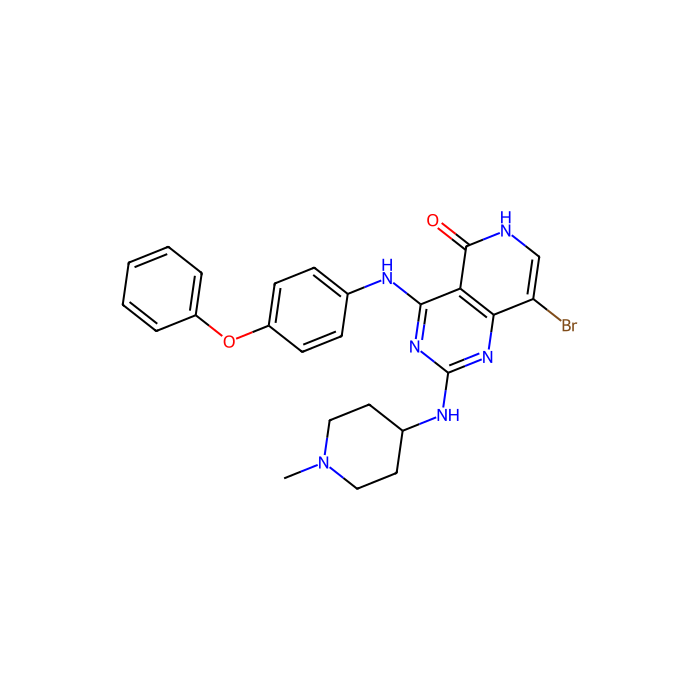
G-749 G-749 is a novel and potent FLT3 inhibitor with IC50 of 0.4 nM, 0.6 nM and 1 nM for FLT3 (WT), FLT3 (D835Y), and Mer, respectively, showing lower potency against other tyrosine kinases.
Targets
FLT3 (Cell-free assay); FLT3 (D835Y) (Cell-free assay); Mer (Cell-free assay); Aurora B (Cell-free assay); RET (Cell-free assay) 15501,0.4 nM; 0.6 nM; 1 nM; 6 nM; 9 nM
In vitro
In FLT3-WT-bearing RS4-11 cells and FLT3-ITD-harboring MV4-11 and Molm-14 cells, G-749 potently inhibits autophosphorylation of FLT3 with IC50 of ≤8 nM. In leukemia cells, G-749 shows antiproliferative activity by inducing apoptosis. In BaF3 cell lines that stably express FLT3-ITD/N676D, FLT3-ITD/F691L, FLT3-D835Y, or FLT3-D835Y/N676D, G-749 shows strong inhibitory activity with IC50 of <10 nM, and thus overcomes drug resistance. In blasts of AML patients, G-749 also exhibits potent antileukemia activity.
In vivo
In MV4-11 xenograft mice, G-749 (30 mg/kg p.o.) effectively inhibits the FLT3 pathway and significant inhibits tumor growth. In an orthogonal model of bone marrow engraftment using Molm-14 cells, G-749 (20 mg/kg p.o.) also inhibits tumor growth and increases survival.
Cell Research(from reference)
Cell lines:MV4-11, RS4-11, K562, HEL, and Molm-14 cells
Concentrations:~1 μM
Incubation Time:72 hours
| Pubchem Sid | 504772431 |
|---|---|
| Pubchem Sid Url | https://pubchem.ncbi.nlm.nih.gov/substance/504772431 |
| Canonical Smiles | CN1CCC(CC1)NC2=NC3=C(C(=O)NC=C3Br)C(=N2)NC4=CC=C(C=C4)OC5=CC=CC=C5 |
| IUPAC Name | 8-bromo-2-[(1-methylpiperidin-4-yl)amino]-4-(4-phenoxyanilino)-6H-pyrido[4,3-d]pyrimidin-5-one |
| InChIKey | SXWMIXPJPNCXQQ-UHFFFAOYSA-N |
| INCHI | 1S/C25H25BrN6O2/c1-32-13-11-17(12-14-32)29-25-30-22-20(26)15-27-24(33)21(22)23(31-25)28-16-7-9-19(10-8-16)34-18-5-3-2-4-6-18/h2-10,15,17H,11-14H2,1H3,(H,27,33)(H2,28,29,30,31) |
| Isomeric SMILES | CN1CCC(CC1)NC2=NC3=C(C(=O)NC=C3Br)C(=N2)NC4=CC=C(C=C4)OC5=CC=CC=C5 |
| Alternate CAS | 1457983-33-3 |
| Molecular Weight | 521.41 |
| Reaxy-Rn | 24014667 |
| Reaxys-RN_link_address | https://www.reaxys.com/reaxys/secured/hopinto.do?context=S&query=IDE.XRN=24014667&ln= |
Comprehensive hazard, handling, storage, and regulatory compliance document.
Download SDS →Lot-specific quality data. Enter your lot number to retrieve the exact COA.
Look up COA →Full quality attributes and acceptance criteria for this grade.
View spec sheet →Taxonomy Tree
| Kingdom | Organic compounds |
|---|---|
| Superclass | Benzenoids |
| Class | Benzene and substituted derivatives |
| Subclass | Diphenylethers |
| Intermediate Tree Nodes | Not available |
| Direct Parent | Diphenylethers |
| Alternative Parents | Diarylethers Pyridopyrimidines Aniline and substituted anilines Phenoxy compounds Phenol ethers Aminopyrimidines and derivatives Pyridinones Aryl bromides Piperidines Imidolactams Vinylogous amides Heteroaromatic compounds Trialkylamines Lactams Azacyclic compounds Hydrocarbon derivatives Organic oxides Organobromides |
| Molecular Framework | Aromatic heteropolycyclic compounds |
| Substituents | Diphenylether - Diaryl ether - Pyridopyrimidine - Phenol ether - Aniline or substituted anilines - Phenoxy compound - Aminopyrimidine - Pyridinone - Pyridine - Piperidine - Imidolactam - Pyrimidine - Aryl bromide - Aryl halide - Heteroaromatic compound - Vinylogous amide - Lactam - Tertiary aliphatic amine - Tertiary amine - Ether - Azacycle - Organoheterocyclic compound - Organobromide - Organohalogen compound - Organic nitrogen compound - Amine - Hydrocarbon derivative - Organic oxide - Organic oxygen compound - Organonitrogen compound - Organooxygen compound - Aromatic heteropolycyclic compound |
| Description | This compound belongs to the class of organic compounds known as diphenylethers. These are aromatic compounds containing two benzene rings linked to each other through an ether group. |
| External Descriptors | Not available |
| Activity Type | Activity Value -log(M) | Mechanism of Action | Activity Reference | Publications (PubMed IDs) |
|---|
| Activity Type | Activity Value -log(M) | Mechanism of Action | Activity Reference | Publications (PubMed IDs) |
|---|
| Activity Type | Relation | Activity value | Units | Action Type | Journal | PubMed Id | doi | Assay Aladdin ID |
|---|
| Activity Type | Relation | Activity value | Units | Action Type | Journal | PubMed Id | doi | Assay Aladdin ID |
|---|
| Activity Type | Relation | Activity value | Units | Action Type | Journal | PubMed Id | doi | Assay Aladdin ID |
|---|
| Activity Type | Relation | Activity value | Units | Action Type | Journal | PubMed Id | doi | Assay Aladdin ID |
|---|
| Activity Type | Relation | Activity value | Units | Action Type | Journal | PubMed Id | doi | Assay Aladdin ID |
|---|
| Activity Type | Relation | Activity value | Units | Action Type | Journal | PubMed Id | doi | Assay Aladdin ID |
|---|
Find and download the COA for your product by matching the lot number on the packaging.
| Lot Number | Certificate Type | Date | Item |
|---|---|---|---|
 H2508438 H2508438 | Certificate of Analysis | Jul 21, 2025 | G413776 |
| H2508572 | Certificate of Analysis | Jul 21, 2025 | G413776 |
| K2218427 | Certificate of Analysis | Aug 25, 2022 | G413776 |
| K2218428 | Certificate of Analysis | Aug 25, 2022 | G413776 |
| K2218429 | Certificate of Analysis | Aug 25, 2022 | G413776 |
| K2218439 | Certificate of Analysis | Aug 25, 2022 | G413776 |
| K2218589 | Certificate of Analysis | Aug 25, 2022 | G413776 |
| Solubility | Solubility (25°C) In vitro DMSO: 24 mg/mL warmed with 50ºC Water: bath (46.02 mM); Water: Insoluble; Ethanol: Insoluble; |
|---|---|
| Molecular Weight | 521.400 g/mol |
| XLogP3 | 4.900 |
| Hydrogen Bond Donor Count | 3 |
| Hydrogen Bond Acceptor Count | 7 |
| Rotatable Bond Count | 6 |
| Exact Mass | 520.122 Da |
| Monoisotopic Mass | 520.122 Da |
| Topological Polar Surface Area | 91.400 Ų |
| Heavy Atom Count | 34 |
| Formal Charge | 0 |
| Complexity | 716.000 |
| Isotope Atom Count | 0 |
| Defined Atom Stereocenter Count | 0 |
| Undefined Atom Stereocenter Count | 0 |
| Defined Bond Stereocenter Count | 0 |
| Undefined Bond Stereocenter Count | 0 |
| The total count of all stereochemical bonds | 0 |
| Covalently-Bonded Unit Count | 1 |
No tested applications or protocols are provided in the listing for this SKU.
General guidance (for small-molecule ligands):
For research use only.
The product is designated for research use as a small-molecule ligand (Moligand™). The listing provides no target, pathway, or mode-of-action details for this SKU.
General notes for small-molecule ligands (no therapeutic claims):
Item-specific biological role or target: Not specified for this item; refer to CoA/Spec Sheet and any associated application notes. Any statements of specificity or selectivity should be substantiated by your in-house data or peer-reviewed literature tied unambiguously to the CAS/CID and batch identity.
Not typically applicable. This SKU is a small-molecule ligand and not a buffering agent. It does not constitute a defined buffer system, and no pH range or buffering capacity is provided.
Practical notes for use in buffered assays (general):
Item-specific buffer guidance: Not specified for this item; refer to CoA/Spec Sheet.
This SKU is a discrete small-molecule screening ligand, not a process solvent or commodity reagent. Therefore, the concept of “green alternatives” (e.g., swapping to a greener solvent) is not typically applicable.
Nevertheless, greener handling practices can still apply:
If you are seeking greener substitutes for solvents used with this compound:
Item-specific greener alternatives: Not applicable; no alternative compound delivering the same biological profile is defined in the product data.
No pharmaceutical excipient role or pharmacopeial status is provided for this SKU. The product is labeled for research use only and is not intended for clinical or diagnostic applications.
General context (for discovery-stage compounds only):
Item-specific excipient uses or regulatory listings: Not specified for this item; refer to CoA/Spec Sheet.
Item-specific physical constants are not included in the provided listing.
Practical guidance (general, literature/common practice for screening compounds):
Grade/Purity: Moligand™ (as provided).
What this typically implies:
How to interpret grade for use:
Batch-to-batch considerations:
This product is positioned as a Moligand™ screening compound rather than a general-purpose synthetic reagent. Consequently, classical synthetic reaction applications (e.g., as a solvent, catalyst, or coupling partner) are not typically applicable.
Research applications (general for screening ligands):
Practical considerations:
Item-specific application notes: Not provided in the listing; refer to CoA/Spec Sheet and internal validation data if available.
Classical synthetic reaction conditions are not generally applicable because this product is supplied as a ready-made small-molecule ligand rather than a reagent or substrate for standard transformations.
If you plan to perform chemical transformations on this molecule (general advice):
Item-specific reaction media, temperature ranges, catalysts, and yields: Not specified for this item; refer to CoA/Spec Sheet.
Hazard information is not included in the supplied data for this SKU. Always consult the SDS supplied with the product for authoritative safety and first-aid measures.
General laboratory precautions (good practice):
Note: For research use only; not for human or veterinary use.
No item-specific solubility data are supplied. Selection should follow general best practices for small-molecule screening compounds while verifying against the CoA/SDS.
General guidance (common for discovery ligands):
Small comparison (general):
Practical tips:
Item-specific solubility and stability: Not specified for this item; refer to CoA/Spec Sheet.
From product data:
Additional handling guidance (general best practice for screening compounds; verify against CoA/SDS for this specific item):
Note: For research use only.
Brief overview: G-749 (SKU G413776) is provided as a Moligand™ screening compound. The supplier listing does not include a structure or elemental composition for this specific catalog entry.
Structural features (general notes):
2D structure description (general):
Not a general synthetic building block. This SKU is offered as a discrete screening ligand rather than a reagent for bond-forming chemistry.
Guidance if derivatization is contemplated (general):
Item-specific synthetic roles, named-reaction participation, or retrons: Not specified for this item; refer to CoA/Spec Sheet.
No target, selectivity profile, or mechanism-of-action information is provided in the product data for this SKU.
Notes:
Our grade selection guide covers purity, stabilizer status, and application suitability for all variants in our catalog.
View Moligand™ grade guide →