≥98% for sensitive chromatographic and analytical workflows requiring minimal baseline interference.
🌡
Storage & shipping
Room temperature Ships Normal Check lot-specific COA for exact specifications.
📋
Quality documents
SDS, COA, datasheet, and spec sheet available for download. Lot-specific COA accessible via lot number lookup.
📚
Literature proof
Cited in 0 peer-reviewed publications across chromatography, organic synthesis, and cross-coupling reactions.
Overview
A selective 5-HT3 receptor agonist
Specifications
Synonyms
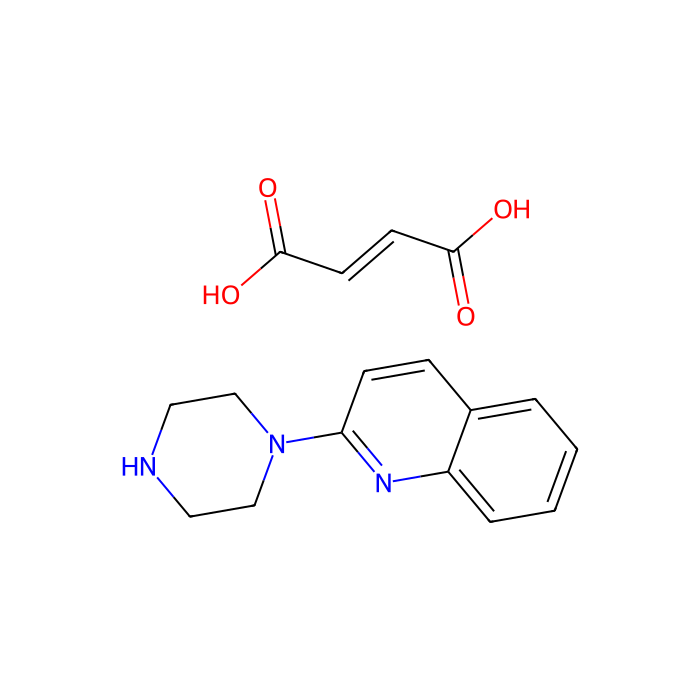
SCHEMBL124520 | AKOS027327559 | Ext D and C Red No. 15 | Pharmakon1600-01503420 | 2-(1-Piperazinyl)quinoline (Z)-2-butenedioate (1:1) | CAS-5786-68-5 | MFCD00133796 | Quipazine maleate salt | 2-[1-PIPERAZINYL]QUINOLINE MALEATE SALT | NSC 758469 | Tox21_11
Specifications & Purity
≥98%
Biochemical and Physiological Mechanisms
Quipazine dimaleate is a selective agonist of 5-HT3 receptors (SR-3, HTR3). 5-HT3 receptors (SR-3, HTR3) are neuronal ligand-gated ion channels that produce excitatory responses in neurons when activated by seratonin or other agonists for the receptor. Qu
This compound belongs to the class of organic compounds known as pyridinylpiperazines. These are compounds containing a pyridinylpiperazine skeleton, which consists of a pyridine linked (not fused) to a piperazine by a bond by a single bond that is not part of a ring.
External Descriptors
Not available
1. Djoumbou Feunang Y, Eisner R, Knox C, Chepelev L, Hastings J, Owen G, Fahy E, Steinbeck C, Subramanian S, Bolton E, Greiner R, and Wishart DS. ClassyFire: Automated Chemical Classification With A Comprehensive, Computable Taxonomy. Journal of Cheminformatics, 2016, 8:61.
We use cookies to ensure the website functions properly and, where permitted, to improve your experience. You can manage your preferences at any time in Settings. Learn more in our Cookie Policy.
Shall we send you a message when we have discounts available?
Remind me later
Thank you! Please check your email inbox to confirm.
Products are supplied to verified businesses, institutions, and qualified professionals for research and development use only. Not for use in humans, animals, diagnosis, or therapy.

 E1719029