
Sulfo Cyanine3 Maleimide Labeling Protocol and Instructions for Use
Sulfo Cyanine3 Maleimide Labeling Protocol and Instructions for Use
Product Overview
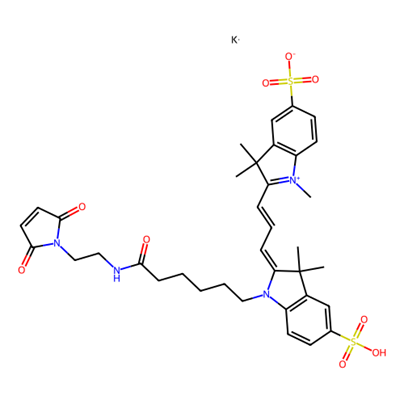
Sulfo-Cyanine3 Maleimide (Aladdin Catalog No.: S276245 ≥95%; S595919 ≥96%) is a thiol-reactive dye used for labeling sulfhydryl groups. It is commonly used for labeling biomolecules, fluorescence imaging, and other fluorescence-based biological analyses. When Cy3 dye binds to proteins or other biomolecules (such as peptides or nucleic acids), it significantly enhances their fluorescence intensity, enabling high-sensitivity detection and labeling.
- English Name: Sulfo-Cyanine3 Maleimide
- CAS Number: 1656990-68-9
- Molecular Formula: C36H41KN4O9S2
- Molecular Weight: 776.96
- Excitation (Ex) (nm): 555
- Emission (Em) (nm): 569
- Purity: ≥95%
- Available Sizes: 1 mg, 5 mg, 10 mg, 25 mg
- Storage Conditions: Store at -20°C, dry, protected from light. Avoid repeated freezing and thawing. It is recommended to prepare and use the solution fresh.
Chemical Structure:
Product Advantages
- Excellent water solubility
- High extinction coefficient
- Large molar absorptivity
- High specificity and sensitivity
Experimental Protocol
1. Solution Preparation
(1) Protein Stock Solution (Solution A)
Mix 100 µL of reaction buffer (e.g., 100 mM MES buffer, pH ~6.0) with 900 µL of protein solution (e.g., antibody, protein concentration >2 mg/mL) to prepare 1 mL of protein labeling stock solution.
- Note: The pH of the protein solution (Solution A) should be maintained at 6.5 ± 0.5.
- Note: Impure antibodies, or antibodies stabilized with bovine serum albumin (BSA) or other stabilizing proteins, may not label efficiently.
- Note: If the protein concentration is below 2 mg/mL, the coupling efficiency will significantly decrease. For optimal labeling efficiency, it is recommended to use a final protein concentration in the range of 2-10 mg/mL.
(2) Dye Stock Solution (Solution B)
Add anhydrous DMSO to the Cy3 Maleimide vial to prepare a 10 mM stock solution. Mix thoroughly by pipetting or vortexing.
- Note: Prepare the dye stock solution (Solution B) just before the coupling reaction and use it promptly. Long-term storage of the dye stock solution may reduce its activity. Solution B can be stored in the refrigerator, protected from light and moisture, for up to 4 weeks. Avoid repeated freezing and thawing.
(3) Optional Step
If your protein does not contain free cysteine, it must be treated with DTT or TCEP to generate thiol groups. DTT or TCEP reduces disulfide bonds into two free thiol groups. If using DTT, it must be removed by dialysis or gel filtration before the maleimide dye reacts with the protein. Below is an example protocol for generating free thiol groups:
- Prepare a fresh 1 M DTT solution (15.4 mg/100 µL) in distilled water.
- Prepare an IgG solution in 20 mM DTT: add 20 µL of DTT stock solution per mL of IgG solution. Incubate at room temperature for 30 minutes without additional mixing (to minimize re-oxidation of cysteine to cystine).
- Pass the reduced IgG through a gel filtration column pre-equilibrated with "exchange buffer." Collect the eluate (0.25 mL fraction).
- Determine the protein concentration and pool the major IgG fractions. This can be done by spectrophotometry or colorimetric methods.
Note: For optimal results, the IgG concentration should be >4 mg/mL. If the antibody concentration is below 2 mg/mL, it should be concentrated. Additionally, add 10% to compensate for losses during buffer exchange.
Note: The reduction reaction can be performed in any buffer with a pH of 7-7.5, such as MES, phosphate, or TRIS buffers.
Note: Steps 3 and 4 can be replaced with dialysis.
2. Sample Experimental Protocol
(This protocol is suitable for labeling Goat Anti-Mouse IgG with Cy3 Maleimide conjugate.)
Note: Each protein requires a different dye-to-protein ratio, which also depends on the nature of the dye. Excessive labeling of the protein may negatively affect its binding affinity, while a low dye-to-protein ratio may reduce the sensitivity of the protein conjugate.
(1) Coupling Reaction
(2) Purification of the Conjugate
(The following protocol demonstrates using a Sephadex G-25 column to purify the dye-protein conjugate.)
1. Prepare the Sephadex G-25 column according to the product instructions.
2. Load the reaction mixture from the “Coupling Reaction” step onto the top of the Sephadex G-25 column.
3. Once the sample is just below the surface of the column resin, immediately add PBS (pH 7.2-7.4).
4. Add more PBS (pH 7.2-7.4) to complete the column purification. Pool the fractions containing the target dye-protein conjugate.
- Note: If the conjugate is required immediately, dilute the dye-protein conjugate with labeling buffer and aliquot as needed.
- Note: For long-term storage, the dye-protein conjugate solution should be concentrated or lyophilized.
Aladdin product List
Product Name | CAS Number | Aladdin Catalog No. | Grade and Purity | Remarks |
Cy3 Maleimide | 1656990-68-9 | ≥96% | Used for labeling proteins, peptides, and nucleic acids; exhibits good water solubility and fluorescence properties | |
DTT (Dithiothreitol) | 3483-12-3 | UltraBio™ Molecular Biology Grade ≥99.5% (RT) | Used for reducing disulfide bonds in proteins, generating free thiol groups | |
DTT (Dithiothreitol) | 3483-12-3 | UltraBio™ Molecular Biology Grade ~1 M in H2O | Same as above | |
DTT (Dithiothreitol) | 3483-12-3 | Molecular Biology Grade ≥99% | Same as above | |
TCEP (Tris(2-carboxyethyl)phosphine) | 51805-45-9 | UltraBio™ ≥98% (NMR) | Alternative to DTT for reducing disulfide bonds and generating free thiol groups | |
Sephadex G-25 | 9041-35-4 | BioReagent, Coarse Particles | Used for separating and purifying dye-labeled protein conjugates | |
Sephadex G-25 | 9041-35-4 | BioReagent, Medium Particles | Same as above | |
Sephadex G-25 | 9041-35-4 | BioReagent, Fine Particles | Same as above | |
Anhydrous DMSO (Dimethyl Sulfoxide) | 67-68-5 | Anhydrous ≥99.9% | Used to dissolve Cy3 Maleimide and prepare dye stock solutions |
Aladdin: https://www.aladdinsci.com/