
 L2417371
Determine the necessary mass, volume, or concentration for preparing a solution.
| Activity Type | Relation | Activity value | Units | Action Type | Journal | PubMed Id | doi | Assay Aladdin ID |
|---|
analytical standard Analytical standard for sensitive chromatographic and analytical workflows requiring minimal baseline interference.
Store at 2-8°C,Protected from light,Desiccated Ships Wet ice Check lot-specific COA for exact specifications.
SDS, COA, datasheet, and spec sheet available for download. Lot-specific COA accessible via lot number lookup.
Cited in 0 peer-reviewed publications across chromatography, organic synthesis, and cross-coupling reactions.
| Pubchem Sid | 504756334 |
|---|---|
| Pubchem Sid Url | https://pubchem.ncbi.nlm.nih.gov/substance/504756334 |
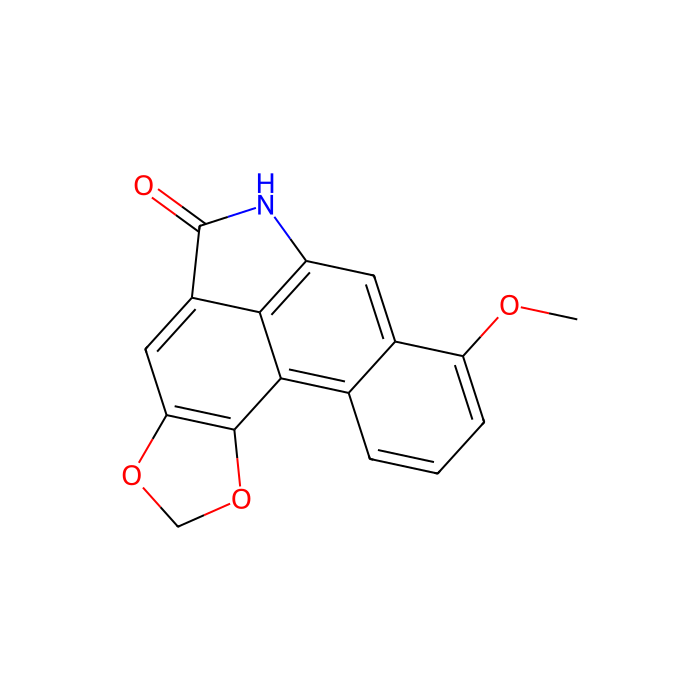
| Canonical Smiles | COC1=CC=CC2=C3C4=C(C=C21)NC(=O)C4=CC5=C3OCO5 |
| IUPAC Name | 14-methoxy-3,5-dioxa-10-azapentacyclo[9.7.1.02,6.08,19.013,18]nonadeca-1(18),2(6),7,11(19),12,14,16-heptaen-9-one |
| InChIKey | MXOKGWUJNGEKBH-UHFFFAOYSA-N |
| INCHI | 1S/C17H11NO4/c1-20-12-4-2-3-8-9(12)5-11-14-10(17(19)18-11)6-13-16(15(8)14)22-7-21-13/h2-6H,7H2,1H3,(H,18,19) |
| Isomeric SMILES | COC1=CC=CC2=C3C4=C(C=C21)NC(=O)C4=CC5=C3OCO5 |
| Molecular Weight | 293.27 |
| Reaxy-Rn | 307971 |
| Reaxys-RN_link_address | https://www.reaxys.com/reaxys/secured/hopinto.do?context=S&query=IDE.XRN=307971&ln= |
Comprehensive hazard, handling, storage, and regulatory compliance document.
Download SDS →Lot-specific quality data. Enter your lot number to retrieve the exact COA.
Look up COA →Full quality attributes and acceptance criteria for this grade.
View spec sheet →Taxonomy Tree
| Kingdom | Organic compounds |
|---|---|
| Superclass | Alkaloids and derivatives |
| Class | Aristolactams |
| Subclass | Not available |
| Intermediate Tree Nodes | Not available |
| Direct Parent | Aristolactams |
| Alternative Parents | Phenanthrenes and derivatives Isoindolones Naphthalenes Benzodioxoles Indoles Isoindoles Anisoles Alkyl aryl ethers Pyrroles Heteroaromatic compounds Lactams Oxacyclic compounds Acetals Azacyclic compounds Hydrocarbon derivatives Organic oxides Organonitrogen compounds Organopnictogen compounds |
| Molecular Framework | Aromatic heteropolycyclic compounds |
| Substituents | Aristolactam - Phenanthrene - Isoindolone - Naphthalene - Benzodioxole - Indole - Indole or derivatives - Isoindole - Isoindole or derivatives - Anisole - Alkyl aryl ether - Benzenoid - Heteroaromatic compound - Pyrrole - Lactam - Acetal - Ether - Oxacycle - Azacycle - Organoheterocyclic compound - Hydrocarbon derivative - Organic nitrogen compound - Organic oxide - Organic oxygen compound - Organopnictogen compound - Organooxygen compound - Organonitrogen compound - Aromatic heteropolycyclic compound |
| Description | This compound belongs to the class of organic compounds known as aristolactams. These are phenanthrenic compounds containing a five-membered lactam ring and a 1,3-dioxolane ring fused to the phenanthrene ring system. |
| External Descriptors | Not available |
| Activity Type | Relation | Activity value | Units | Action Type | Journal | PubMed Id | doi | Assay Aladdin ID |
|---|
| Activity Type | Relation | Activity value | Units | Action Type | Journal | PubMed Id | doi | Assay Aladdin ID |
|---|
| Flash Point(°C) | 234.4±25.7 °C |
|---|---|
| Boil Point(°C) | 463.9±34.0 °C(Predicted) |
| Melt Point(°C) | 319 °C |
| Molecular Weight | 293.270 g/mol |
| XLogP3 | 3.100 |
| Hydrogen Bond Donor Count | 1 |
| Hydrogen Bond Acceptor Count | 4 |
| Rotatable Bond Count | 1 |
| Exact Mass | 293.069 Da |
| Monoisotopic Mass | 293.069 Da |
| Topological Polar Surface Area | 56.800 Ų |
| Heavy Atom Count | 22 |
| Formal Charge | 0 |
| Complexity | 483.000 |
| Isotope Atom Count | 0 |
| Defined Atom Stereocenter Count | 0 |
| Undefined Atom Stereocenter Count | 0 |
| Defined Bond Stereocenter Count | 0 |
| Undefined Bond Stereocenter Count | 0 |
| The total count of all stereochemical bonds | 0 |
| Covalently-Bonded Unit Count | 1 |
Our grade selection guide covers purity, stabilizer status, and application suitability for all variants in our catalog.
View Analytical standard grade guide →