
Understanding Indoline: Analysis of the Structural Features, Properties, and Applications of the 2,3-Dihydroindole Scaffold
Understanding Indoline: Analysis of the Structural Features, Properties, and Applications of the 2,3-Dihydroindole Scaffold
1 What Is Indoline?
1.1 Basic Structural Identity
Indoline, also known as 2,3-dihydro-1H-indole and in Chinese as 2,3-dihydroindole, has the CAS number 496-15-1, the molecular formula C₈H₉N, and a relative molecular mass of approximately 119.16.
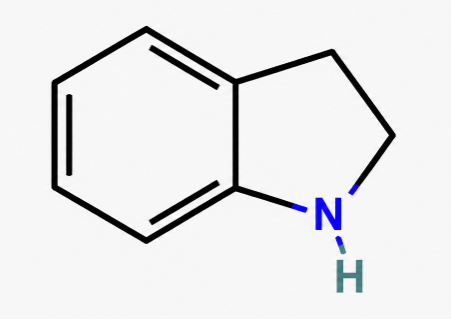
From the perspective of molecular framework, indoline is composed of a benzene ring fused with a nitrogen-containing saturated five-membered ring. Indoline can be regarded as the structure obtained after hydrogenation at the 2- and 3-positions of indole. Hydrogenation at these two positions changes the aromaticity of the five-membered ring, the electronic state of the nitrogen atom, the spatial geometry of the molecule, and its subsequent reaction pathways. The structural characteristics of indoline can be summarized in the following four aspects:
Structural Element | Influence | Significance for Properties |
Benzene ring | Provides an aromatic π system and a hydrophobic surface | Favors aromatic interactions, electron transfer, and structural rigidity |
Secondary amine nitrogen | Provides N–H, a lone pair of electrons, and an N-substitution site | Determines nucleophilicity, hydrogen bonding, basicity, and derivatization potential |
C2/C3 saturated segment | Introduces sp³ carbons and a non-fully planar structure | Provides three-dimensionality and creates possibilities for constructing chiral centers, quaternary carbon centers, and spiro/fused ring structures |
Fused bicyclic framework | Restricts conformational freedom | Contributes to conformational preorganization and stereoselective control |
1.2 Key Differences Between Indoline and Indole: 2,3-Dihydrogenation Changes the Nature of the Nitrogen Atom and the Five-Membered Ring
Indole is a fully aromatic fused heterocycle. The nitrogen atom in its five-membered ring is a pyrrole-type nitrogen, and its lone pair participates in the aromatic system. In other words, the lone pair on the indole nitrogen is used to maintain the aromatic stability of the five-membered ring. Therefore, the nitrogen atom in indole does not readily exhibit the pronounced basicity and nucleophilicity typical of ordinary amine nitrogens.
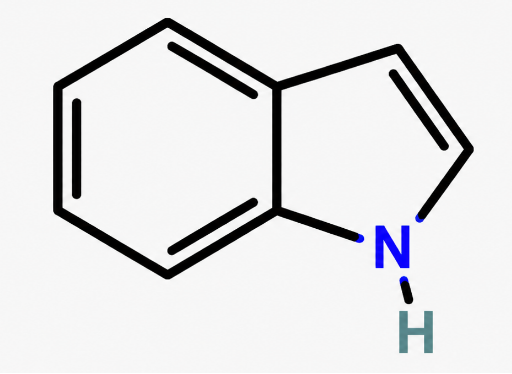
1.3 Differences Among Indoline, Indole, Oxindole, and Isatin
Indoline, indole, oxindole, and isatin all belong to indole-related structures, but their electronic properties and experimental uses differ significantly. The table below distinguishes their functional roles from the perspective of structure.
Structural Type | Core Structural Difference | Nitrogen Atom State | Main Reaction Characteristics | Suitable Research Needs |
Indoline | Hydrogenation at the 2- and 3-positions of indole; the five-membered ring is a saturated nitrogen-containing ring | Cyclic secondary amine, capable of N-substitution | N-site modification, oxidative dehydrogenation, construction of chiral or spirocyclic structures | Systems requiring amine reactivity, three-dimensionality, and transformability |
Indole | Fully aromatic fused heterocycle | Nitrogen lone pair participates in the aromatic system | Prominent C3 reactivity; suitable for functionalization of aromatic heterocycles | Systems requiring a planar aromatic heterocycle and continuous conjugation |
Oxindole / Indolin-2-one | The five-membered ring contains a lactam carbonyl group | Nitrogen is affected by the amide carbonyl, and amine-like character is weakened | C3 position can form chiral centers, quaternary carbon centers, and alkenylated structures | Systems requiring carbonyl participation in reactions and drug-like scaffold design |
Isatin / Indoline-2,3-dione | The five-membered ring contains two carbonyl groups | Nitrogen is strongly affected by the dicarbonyl system, and nucleophilic amine character is markedly reduced | Strong carbonyl electrophilicity; suitable for condensation, nucleophilic addition, and heterocycle construction | Systems requiring a carbonyl-active platform rather than an amine-type indoline scaffold |
2 Structural Features of Indoline
2.1 Secondary Amine Nitrogen: Not an Ordinary Amino Group, but a Reactive Center Constrained by a Fused Framework
The nitrogen atom in indoline is a secondary amine nitrogen. Unsubstituted indoline contains an N–H group, which can act as a hydrogen-bond donor. When it is not protonated, acylated, or substituted with a strongly electron-withdrawing group, the lone pair on the nitrogen atom can exhibit nucleophilicity and participate in N-substitution reactions.
The nitrogen atom in indoline is not completely equivalent to that in an ordinary aliphatic amine. It is located within a fused five-membered ring and connected to a benzene ring. Its lone pair is jointly influenced by the electronic effects of the aromatic ring and the conformational constraints of the fused scaffold. Therefore, indoline nitrogen has the characteristics of a cyclic secondary amine influenced by an aromatic ring. Compared with indole nitrogen, it more readily exhibits amine-type nucleophilicity and N-site derivatization capability. However, compared with a fully flexible aliphatic amine, its basicity, nucleophilicity, and conformational freedom are still subject to certain limitations.
This property is highly important for experimental design. Through N-alkylation, N-acylation, N-sulfonylation, or N-protection, the basicity, polarity, lipophilicity, steric bulk, and hydrogen-bonding pattern of indoline derivatives can be altered. In medicinal chemistry, the N-position can be used to modulate interactions between the molecule and its target. In organic synthesis, the N-position may serve as a reaction site, but it may also need to be controlled with protecting groups to achieve reaction selectivity.
2.2 C2/C3 Saturated Segment: From a Planar Aromatic System to a Three-Dimensional Scaffold
The most intuitive difference between indoline and indole is that the C2/C3 positions change from aromatic carbons to saturated carbons. In indole, the five-membered ring and the benzene ring together form a highly planar aromatic system. A planar structure favors conjugation and π interactions, but it may also make the molecule excessively planar and leave little room for conformational variation. After 2,3-dihydrogenation, the pyrrole-type aromaticity of the five-membered ring in indole is disrupted. The benzene ring retains its aromaticity, but the overall fused system no longer forms a continuous planar conjugated structure as indole does. As a result, the molecule is no longer fully planar and shows more pronounced sp³ carbon character.
After substitution, functionalization, or cyclization, these sp³ carbon sites can support chiral centers, quaternary carbon centers, spirocyclic junctions, or fused ring structures. For complex molecule synthesis, this provides a spatial basis for constructing natural-product-like three-dimensional scaffolds. For drug design, it helps break excessive planarity and increases the possibility of spatial matching between the molecule and biological targets.
2.3 Fused Bicyclic Framework: Rigidity Is Not a Limitation, but an Advantage for Conformational Preorganization
Indoline is neither an open-chain amine nor an ordinary phenethylamine. Its nitrogen-containing five-membered ring is fused with a benzene ring, forming a conformationally constrained bicyclic system. This structure limits free rotation around single bonds, keeping the benzene ring, nitrogen atom, and C2/C3 positions in a relatively fixed spatial relationship.
In molecular design, conformational restriction can sometimes be more important than an individual functional group. Although open-chain amines are easy to modify, they have high conformational freedom, and the molecule often needs to pay a greater conformational adjustment cost when binding to a target or participating in a reaction. Indoline fixes the amine nitrogen and aromatic surface within the same scaffold, allowing hydrogen bonding, hydrophobic interactions, and spatial arrangement to be presented simultaneously and more stably.
This is one of the reasons indoline is often regarded as a valuable scaffold in medicinal chemistry. It does not simply provide an N–H group or a benzene ring; rather, it preorganizes N–H, an aromatic surface, and a three-dimensional shape within a relatively small structure. For molecules that require controlled binding conformations, improved fragment directionality, or limited three-dimensionality, indoline offers greater structural integration advantages than open-chain aromatic amines.
2.4 Coupling Between the Benzene Ring and Amine Nitrogen: Electron Enrichment Brings Reactivity and Electron-Donating Ability
Indoline retains a benzene ring and therefore still possesses an aromatic π system. However, this benzene ring does not exist in isolation. It is fused with a nitrogen-containing five-membered ring and is influenced by the electron-donating effect of the amine nitrogen. Compared with indole, the five-membered ring in indoline is no longer fully aromatic, so the electronic effect of the nitrogen atom can more directly influence the adjacent aromatic system and the overall reactivity of the molecule. This leads to two types of properties.
① In organic synthesis, indoline may exhibit aromatic ring reactivity and regioselectivity different from those of indole. Researchers can use this electronic difference to design functionalization routes and then convert the product into indole derivatives through oxidative dehydrogenation.
② In organic dyes and optoelectronic materials, indoline derivatives can serve as electron-donating structural units. The amine nitrogen and fused aromatic system together enhance electron-donating ability. Through N-substitution, ring fusion, and π-bridge regulation, the highest occupied molecular orbital (HOMO), lowest unoccupied molecular orbital (LUMO), and light absorption behavior of the molecule can be influenced.
3 How Structure Determines Properties
3.1 Electronic Level: Indoline Has Greater Amine-Type Modifiability Than Indole
The electronic characteristics of indoline are first reflected in its nitrogen atom. The lone pair on indole nitrogen participates in the aromatic system, which limits reactivity at the nitrogen position. In contrast, indoline nitrogen no longer bears the same responsibility for maintaining the aromaticity of the five-membered ring, so it more readily exhibits amine-type reactivity. Indoline is therefore more suitable as a modifiable nitrogen-containing building block. N-substitution can be used to regulate molecular properties, for example:
N-Site Modification | Possible Property Changes |
N-alkylation | Reduces N–H hydrogen-bond donor ability and increases hydrophobicity and steric bulk |
N-acylation | Reduces the basicity and nucleophilicity of the nitrogen atom and introduces a carbonyl interaction site |
N-sulfonylation | Enhances electron-withdrawing effects and changes acid–base properties and reaction selectivity |
N-Boc protection | Temporarily reduces nitrogen-site reactivity, facilitating functionalization at other positions |
3.2 Spatial Level: Indoline Is Better Suited Than Indole for Providing Three-Dimensional Recognition Ability
Indole has strong aromaticity and planarity, which is very useful in certain conjugated systems. However, in drug design and complex molecule construction, excessive planarity is not always an advantage. Overly planar molecules may lack sufficient spatial differentiation, making it difficult to achieve specific three-dimensional recognition.
The C2/C3 saturated segment of indoline disrupts the fully planar structure and gives the molecule more pronounced spatial directionality. The benzene ring provides a relatively stable aromatic surface, the amine nitrogen provides a polar interaction site, and the C2/C3 positions provide space for three-dimensional extension and subsequent construction of chiral structures. When combined, these three features allow indoline to simultaneously present a hydrophobic surface, hydrogen-bonding sites, and a non-planar shape within a relatively small scaffold.
3.3 Synthetic Level: Indoline Can Change the Construction Route of Indole Derivatives
The ability of indoline to undergo oxidative dehydrogenation gives it special value in synthetic strategy. Many indole derivatives can be synthesized directly from indole. However, when the target structure involves regioselectivity challenges, direct use of indole is not always the optimal route.
Indoline offers a different approach: key functionalization can first be completed at the indoline stage by taking advantage of its amine-like electronic structure and different reactive sites, followed by oxidative dehydrogenation to enter the indole system. A Pd-catalyzed oxidative dehydrogenation and C2-selective arylation tandem reaction reported in 2025 demonstrated the one-step synthesis of 2-arylindoles from indolines by combining Pd-catalyzed oxidative dehydrogenation with C2-selective arylation, using oxygen as the sole oxidant. This type of research shows that the structural state of a molecule can change its reaction pathway. The differences between indoline and indole allow researchers to redesign synthetic routes to target molecules based on a strategy of “first using the dihydro scaffold, then aromatizing it.”
3.4 Materials Level: The Electron-Donating Ability of Indoline Comes from the Synergy Between the Amine Nitrogen and Aromatic System
In organic dyes, indoline derivatives after N-substitution, extended conjugation, and acceptor connection are often used as electron-donor units. This is because the amine nitrogen has electron-donating ability, the fused benzene ring can participate in π-electron transfer, and N-substitution and ring fusion can further alter molecular energy levels and conformation.
In typical D–π–A dyes, D–π–A refers to a donor–π bridge–acceptor structure. Indoline can serve as the D component, pushing electrons through the π bridge toward the acceptor or anchoring group. D149 is a representative metal-free indoline dye and has shown relatively high photoelectric conversion efficiency (PCE) in studies of dye-sensitized solar cells (DSSCs).
A 2021 study on D–A–π–A organic sensitizers further showed that N-substituted indoline donors and their ring-fusion modes affect ultraviolet–visible absorption (UV-vis), HOMO, LUMO, and device efficiency. This indicates that the role of indoline in materials arises from its tunable electron-donor structure.
4 Recent Research Progress
4.1 Selective Conversion of Indoline to Indole
Research on the conversion of indoline to indole reflects the synthetic value of indoline as a precursor structure. In 2025, RSC Advances reported a one-step method for synthesizing 2-arylindoles from indolines. This method combines palladium-catalyzed oxidative dehydrogenation with C2-selective Heck-type arylation and uses oxygen as the sole oxidant.
Researchers no longer treat indoline merely as a simple starting material. Instead, they exploit the electronic structural differences between indoline and indole to change the synthetic route. For indole target molecules that are difficult to functionalize directly with good regioselectivity, this strategy is instructive.
4.2 Asymmetric Dearomatization and Construction of Three-Dimensional Scaffolds
Asymmetric dearomatization is an important direction for constructing indoline-related three-dimensional structures. By disrupting the aromatic system, it converts relatively planar indole structures into non-planar structures containing chiral centers, fused rings, or spirocycles.
A chiral phosphoric acid-catalyzed reaction reported in 2024 demonstrated the possibility of generating chiral indolenines and fused indolines from 2,3-disubstituted indoles through asymmetric dearomatization. In 2025, visible-light-promoted [2 + 2] cycloaddition/dearomatization research enabled the synthesis of cyclobutane-fused indolines, highlighting the potential of photochemical methods to rapidly increase scaffold complexity.
4.3 Biocatalytic and Electrochemical Methods
Synthetic methods for indoline-related scaffolds are also moving toward milder and more selective approaches. In 2023, ACS Central Science reported the use of engineered cytochrome P411 for intramolecular C(sp³)–H amination, constructing chiral pyrrolidines and indolines from aryl azide substrates. This study demonstrates that biocatalysis can be used to construct chiral nitrogen-containing rings that are difficult to obtain with high selectivity using traditional chemical methods.
Electrochemical dearomatization is another important direction. A 2024 review on the electrochemical dearomatization synthesis of 3,3-spiroindolines pointed out that electrochemical methods can construct diverse spiroindoline structures through anodic oxidation and radical processes. Such methods reduce dependence on traditional chemical oxidants while providing new synthetic entry points to complex indoline-related scaffolds.
5 Implications for Experiments and Product Selection
5.1 When Indoline Is Worth Prioritizing
The choice of indoline should depend on whether the target system requires its structural capabilities. In the following situations, indoline is usually worth prioritizing:
Research or Application Need | Structural Advantage Provided by Indoline |
Need stronger three-dimensionality than indole | The C2/C3 saturated segment provides sp³ character and a non-fully planar geometry |
Need a modifiable nitrogen-containing site | The secondary amine nitrogen can undergo N-substitution, protection, or functionalization |
Need to control molecular conformation | The fused bicyclic framework restricts free rotation and improves conformational preorganization |
Need to construct chiral or spirocyclic structures | Saturated carbon sites and dearomatization reactions provide stereochemical complexity |
Need to bypass challenges in direct indole functionalization | Electronic differences at the indoline stage can be used before oxidation to indole |
Need an electron donor for organic dyes | The amine nitrogen and aromatic system synergistically provide electron-donating ability |
5.2 When Indoline Is Not Recommended
Indoline is not suitable for all indole-related research. If the target requires a fully planar, strongly conjugated system, indole may be more direct. If the target requires a carbonyl-active platform, oxindole or isatin is more appropriate. If the goal is simply to introduce an ordinary basic amine, an open-chain amine or simple cyclic amine may be more economical.
In addition, the free amine nitrogen of indoline may also cause side reactions. If the reaction system contains acid chlorides, isocyanates, strong electrophiles, or acid-sensitive conditions, the N-position may need to be protected. If researchers overlook this point, the high modifiability of indoline may instead become a challenge for selectivity control.
6 Classification Tables of Representative Indoline-Related Products
Table 1 Representative Products for Core Parent Scaffolds and Structural Comparisons
Category | CAS No. | Aladdin Cat. No. | Name | Specification or Purity | Product Features and Applications |
Indoline parent scaffold | 496-15-1 | Indoline | ≥99% | Parent indoline structure, featuring an aromatic ring, secondary amine nitrogen, saturated five-membered ring, and fused-ring rigidity. It can be used for the synthesis of indoline derivatives, N-position modification, oxidative dehydrogenation transformations, and structure–property comparative studies. | |
Aromatized structural reference | 120-72-9 | Indole | ≥99% | Fully aromatized indole skeleton, used for comparison with indoline in terms of the electronic state of the nitrogen atom, planar conjugated structure, electrophilic aromatic reactions, and differences in the synthesis of indole derivatives. | |
Lactam-type oxidized scaffold | 59-48-3 | 2-Oxindole | ≥98% (GC) | Indoline-related lactam scaffold. The carbonyl group alters the nature of the nitrogen atom and the electronic distribution within the ring. It can be used for drug-like scaffold development, C3 functionalization, and construction of chiral quaternary carbon structures. | |
Dicarbonyl oxidized scaffold | 91-56-5 | Isatin (NSC 9262) | Moligand™, ≥98% | Indoline-related dicarbonyl scaffold with pronounced carbonyl electrophilicity. It can be used for condensation reactions, nucleophilic addition, heterocycle construction, and structural comparison of oxidized indoline derivatives. | |
Chloro-substituted dicarbonyl oxidized scaffold | 17630-76-1 | 5-Chloroisatin | ≥98% | Halogenated isatin derivative combining dicarbonyl reactivity with aromatic chlorine substitution. It can be used for the synthesis of chlorine-containing indole-related heterocycles, condensation reactions, and structure–activity relationship studies. | |
Bromo-substituted lactam oxidized scaffold | 20870-78-4 | 5-Bromo-2-oxindole | ≥97% | Brominated oxindole scaffold featuring both a lactam carbonyl group and an aromatic bromine substitution site. It can be used for cross-coupling, C3 functionalization, and construction of drug-like nitrogen-containing fused-ring structures. |
Table 2 Indoline-Substituted Building Block Products
Category | CAS No. | Aladdin Cat. No. | Name | Specification or Purity | Product Features and Applications |
C2-substituted indoline | 6872-06-6 | 2-Methylindoline | ≥99% | C2-methyl-substituted indoline, demonstrating the influence of substitution at the saturated five-membered ring position on spatial conformation and substituent effects. It can be used for chiral center construction, drug-fragment design, and structural comparison of 2-substituted analogues. | |
N-substituted indoline | 824-21-5 | 1-Methylindoline | ≥97% | N-methylated indoline, used to compare changes in hydrogen-bonding capacity, basicity, hydrophobicity, and N-position reactivity between free N–H and N-alkyl-substituted structures. | |
N-acyl indoline | 16078-30-1 | N-Acetylindoline | ≥98% | N-acetylated indoline. Amidation reduces the nucleophilicity of the nitrogen atom and introduces a carbonyl interaction site. It can be used for N-position protection, synthesis of amide-type derivatives, and modulation of drug-fragment properties. | |
Aromatic-ring alkyl-substituted indoline | 65826-95-1 | 5-Methylindoline | ≥98% | 5-methyl-substituted indoline. Electron-donating substitution on the aromatic ring helps regulate hydrophobicity and aromatic-ring electron density. It can be used for substituent-effect studies, aromatic-ring functionalization, and structure–activity relationship research. | |
Aromatic-ring methoxy-substituted indoline | 21857-45-4 | 5-Methoxyindoline | ≥95% | 5-methoxy-substituted indoline. The methoxy group possesses electron-donating and hydrogen-bond-acceptor characteristics. It can be used for electronic-effect regulation, drug-fragment synthesis, and studies of precursors for organic functional molecules. | |
Aromatic-ring fluoroindoline | 2343-22-8 | 5-Fluoroindoline | ≥97% | 5-fluoro-substituted indoline. The fluorine atom can modulate the electronic effect of the aromatic ring, lipophilicity, and metabolic stability. It can be used as a medicinal chemistry building block, for the synthesis of fluorinated indoline derivatives, and for structural comparison. | |
Aromatic-ring fluoroindoline | 2343-23-9 | 6-Fluoroindoline | ≥97% | 6-fluoro-substituted indoline, used to investigate the influence of fluorine substitution position on aromatic-ring electronic distribution, molecular interactions, and derivative performance. It is suitable for the synthesis of fluorinated drug fragments. | |
Aromatic-ring chloroindoline | 25658-80-4 | 5-Chloroindoline | ≥95% | 5-chloro-substituted indoline. Chlorine substitution can regulate hydrophobicity and the electronic properties of the aromatic ring. It can be used for the synthesis of halogenated indoline derivatives, as a cross-coupling precursor, and for drug-fragment screening. | |
Aromatic-ring chloroindoline | 52537-00-5 | 6-Chloroindoline | ≥95% | 6-chloro-substituted indoline, used to compare the effects of halogen substitution at different aromatic-ring positions on reaction selectivity, hydrophobic interactions, and subsequent functionalization pathways. | |
Aromatic-ring bromoindoline | 86626-38-2 | 4-Bromo-2,3-dihydro-1H-indole | ≥97% | 4-bromo-substituted indoline, providing an aromatic halogen reaction site. It can be used for cross-coupling, expansion of aromatic-ring substituted structures, and studies of indoline regioselectivity. | |
Aromatic-ring bromoindoline | 22190-33-6 | 5-Bromoindoline | ≥98% | 5-bromo-substituted indoline, commonly used for cross-coupling and aromatic-ring functionalization. It enables the construction of aryl-, heteroaryl-, or alkenyl-substituted indoline derivatives. | |
Aromatic-ring bromoindoline | 63839-24-7 | 6-Bromoindoline | ≥98% | 6-bromo-substituted indoline, suitable for aromatic-site-selective derivatization, preparation of coupling-reaction precursors, and comparison of structure–activity relationships across different substitution positions. |
Table 3 Carboxylic Acid, Protecting Group, and Chiral Indoline Building Block Products
Category | CAS No. | Aladdin Cat. No. | Name | Specification or Purity | Product Features and Applications |
Indoline carboxylic acid building block | 78348-24-0 | (RS)-1H-Indoline-2-carboxylic acid | ≥97% | 2-carboxylic acid-functionalized indoline-related building block, combining a secondary amine framework with a carboxylic acid linkage site. It can be used for amide coupling, chiral resolution, pharmaceutical intermediates, and studies of nitrogen-containing carboxylic acid fragments. | |
Indoline carboxylic acid building block | 15861-30-0 | 5-Carboxyisoindoline | ≥97% | 5-carboxylic acid-substituted indoline. The aromatic-ring carboxylic acid provides sites for salt formation, amide coupling, and linker extension. It can be used for drug fragments, material intermediates, and structure–activity relationship studies. | |
N-Boc-protected indoline | 143262-10-6 | tert-Butyl indoline-1-carboxylate | ≥98% | N-Boc-protected indoline, which reduces side reactions at the nitrogen position while retaining the fused bicyclic framework. It can be used for multistep synthesis, selective aromatic-ring functionalization, and preparation of amine-type derivatives after deprotection. | |
N-Boc-protected carboxylic acid building block | 339007-88-4 | 1-[(tert-Butoxy)carbonyl]-2,3-dihydro-1H-indole-5-carboxylic acid | ≥95% | N-Boc-protected 5-carboxylic acid indoline, featuring both a protected amine nitrogen and a carboxylic acid linkage site. It can be used for amide coupling, multistep synthesis of drug fragments, and structural extension. | |
N-Boc-protected carboxylic acid building block | 143262-20-8 | N-Boc-indoline-7-carboxylic acid | ≥98% | N-Boc-protected 7-carboxylic acid indoline, suitable for carboxylic acid coupling under N-protected conditions, regioisomer comparison, and construction of nitrogen-containing fused-ring fragments. | |
Chiral indoline carboxylate | 141410-06-2 | (S)-(+)-Methyl indoline-2-carboxylate | ≥97% (HPLC) | Chiral 2-carboxylate-substituted indoline, highlighting the structural value of chirality introduced by the saturated C2 carbon. It can be used for chiral pharmaceutical intermediates, asymmetric synthesis, and stereochemical structure–activity relationship studies. |
Table 4 Indoline Optoelectronic Dye Products
Category | CAS No. | Aladdin Cat. No. | Name | Specification or Purity | Product Features and Applications |
Indoline optoelectronic dye | 652145-29-4 | D 131 | ≥98% | Indoline-based organic dye that utilizes the electron-donating indoline structure to participate in intramolecular charge transfer. It can be used for dye-sensitized solar cells, light-absorption performance studies, and energy-level regulation research. | |
Indoline optoelectronic dye | 786643-20-7 | D149 Dye | ≥98% (HPLC) | Representative indoline-based organic dye. The indoline electron-donating unit works synergistically with the acceptor structure to promote charge transfer. It can be used for dye-sensitized solar cells, photoelectric conversion, and interfacial electron-injection studies. | |
Indoline optoelectronic dye | 936336-21-9 | D205 Dye | ≥97% (HPLC) | Indoline-based organic sensitizing dye, suitable for investigating the influence of the indoline electron-donating structure, conjugated bridge, and acceptor group on absorption properties, energy-level distribution, and device performance. |
Note: The above products are representative Aladdin products related to scientific research and formulation studies. For more product specifications, grades, and COA information, please search by “product name/CAS/catalog number” on the Aladdin official website.
References
[1] NIST Chemistry WebBook. 1H-Indole, 2,3-dihydro-. NIST Standard Reference Database 69. Formula: C₈H₉N; Molecular weight: 119.1638; CAS Registry Number: 496-15-1.
[2] Yang Y.-S., Yoo J., Jeon J., Bak J. H., Shin J.-W., Won H.-J., Hwang H. S., Kim J. H., Sim J., Kim N.-J. One-step synthesis of 2-arylindoles from indolines via Pd-catalyzed oxidative dehydrogenation and C2-selective arylation. RSC Advances, 2025, 15, 28131–28135. DOI: 10.1039/D5RA04628A.
[3] Liu T., Wang J., Xiao R., Zhao J. Switchable divergent synthesis of chiral indole derivatives via catalytic asymmetric dearomatization of 2,3-disubstituted indoles. RSC Advances, 2024, 14, 15591–15596. DOI: 10.1039/D4RA03231D.
[4] Dolas A. J., Patel A., Shah I. A., Yadav J., Iype E., Kumar I. Recent developments in the catalytic asymmetric synthesis of indolin-3-one derivatives. Organic & Biomolecular Chemistry, 2025, 23, 2523–2538. DOI: 10.1039/D4OB02028F.
[5] El-Zohry A., Orthaber A., Zietz B. Isomerization and Aggregation of the Solar Cell Dye D149. The Journal of Physical Chemistry C, 2012, 116, 26144–26153. DOI: 10.1021/jp306636w.
[6] Tanaka E., Mikhailov M. S., Gudim N. S., Knyazeva E. A., Mikhalchenko L. V., Robertson N., Rakitin O. A. Structural features of indoline donors in D–A–π–A type organic sensitizers for dye-sensitized solar cells. Molecular Systems Design & Engineering, 2021, 6, 730–738. DOI: 10.1039/D1ME00054C.
[7] Han Z., Wang L., Luo Y., Cui X. Photocatalytic intermolecular [2 + 2] cycloaddition/dearomatization of indoles: easy access to cyclobutane-fused indolines. Organic Chemistry Frontiers, 2025, 12, 3177–3183. DOI: 10.1039/D4QO02302A.
[8] Qin Z.-Y., Gao S., Zou Y., Liu Z., Wang J. B., Houk K. N., Arnold F. H. Biocatalytic Construction of Chiral Pyrrolidines and Indolines via Intramolecular C(sp³)–H Amination. ACS Central Science, 2023, 9, 2333–2338. DOI: 10.1021/acscentsci.3c00516.
[9] Wang J., Zhu R., Zhao Y., Wu J. Electrochemical Dearomatization of Indoles: Access to Diversified Functionalized Spirocyclic Indolines. Topics in Heterocyclic Chemistry, 2024, 61, 91–112. DOI: 10.1007/7081_2024_81.
For more related articles, please see below:
D-DTTA Salts of Azaindole Chiral Amines: New Options for Chemical Splitting
The process path of EBL-3183: from indole to preclinical inhibitor
Efficient synthesis of Fluorinated Azaindoles