GRADE & PURITYAnimal Free?Animal-free — produced without animal-derived components to reduce contamination risk. Use in biomanufacturing and culture avoiding animal-origin material.Carrier Free?Carrier-free — supplied without added carrier protein/stabilizer. Use when carriers (e.g. BSA) would interfere with conjugation or sensitive assays.Bioactive?Bioactive grade — verified to retain biological activity in functional assays. Use when the molecule must be functionally active, not just pure.ActiBioPure™?ActiBioPure™ — Aladdin's premier line for bioactive and recombinant products. Use when both high purity and preserved biological activity are required.Azide Free?Azide-free — without sodium azide preservative. Use in conjugations, cell work, or assays where azide is toxic or inhibitory.High Performance?High-performance grade with optimized purity and performance characteristics. Use for sensitive analyses where ordinary grades fall short.PBS Only?PBS-only formulation — supplied in phosphate-buffered saline with no other additives. Use when you need a clean PBS buffer free of stabilizers/carriers.≥97%(SDS-PAGE&HPLC)
Expression System
E.coli
Accession #
P55773
Protein Tag
No tag
Expression system
E. coli
Endotoxin Concentration
<1.0 EU/μg
Bioactivity
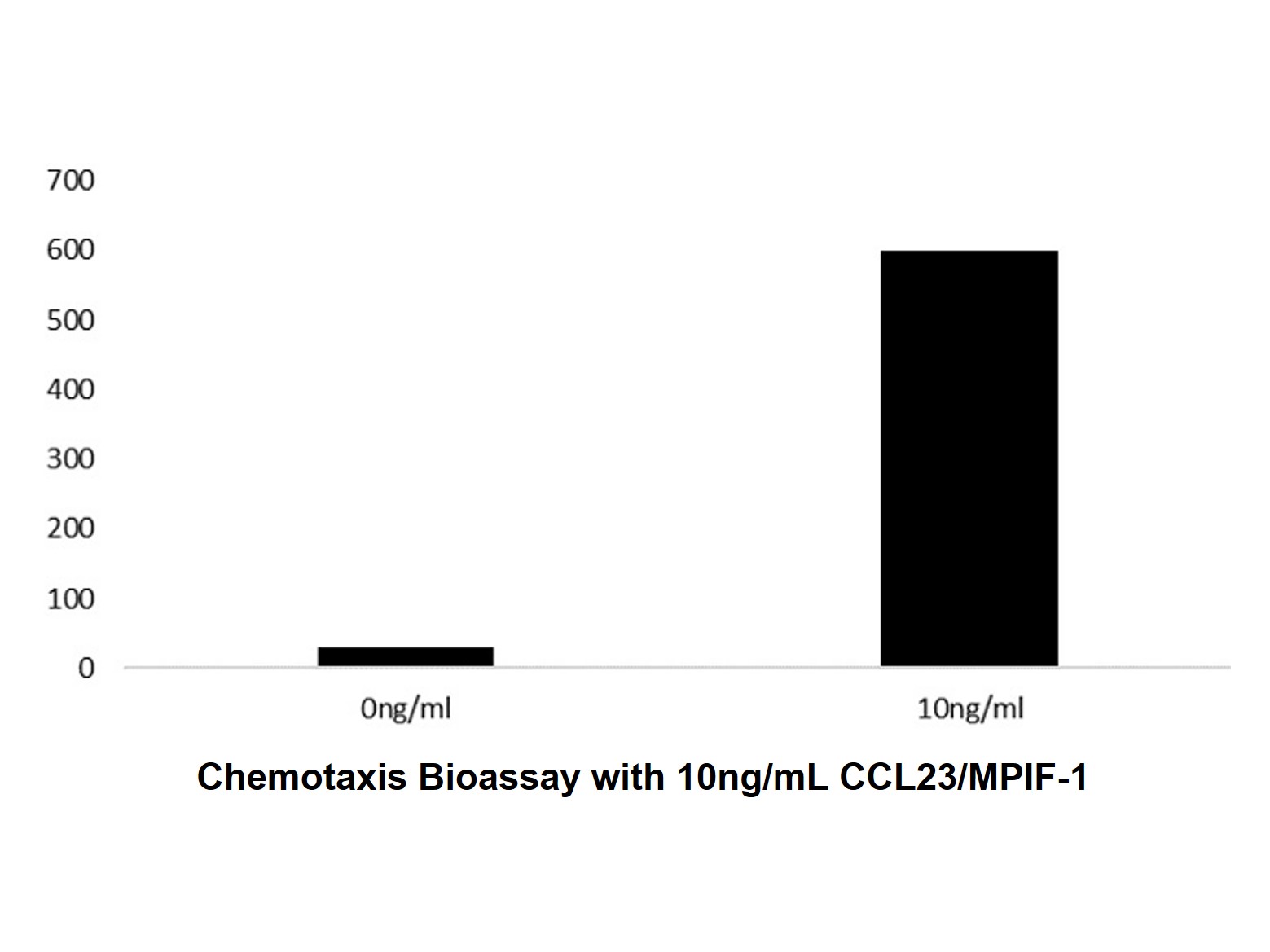
Fully biologically active when compared to standard. The biological activity determined by a chemotaxis bioassay using human T-lymphocytes is in a concentration of 10-50 ng/ml.
Animal Free,Carrier Free,Bioactive,ActiBioPure™,Azide Free,High Performance,PBS Only,≥97%(SDS-PAGE&HPLC) ActiBioPure™,Animal Free,Azide Free,Bioactive,Carrier Free,High Performance,PBS Only for sensitive chromatographic and analytical workflows requiring minimal baseline interference.
🌡
Storage & shipping
Store at -20°C,Avoid repeated freezing and thawing Ships Ice chest + Ice pads Check lot-specific COA for exact specifications.
📋
Quality documents
SDS, COA, datasheet, and spec sheet available for download. Lot-specific COA accessible via lot number lookup.
📚
Literature proof
Cited in 0 peer-reviewed publications across chromatography, organic synthesis, and cross-coupling reactions.
Overview
Purity >97% by SDS-PAGE and HPLC analyses.
Function Shows chemotactic activity for monocytes, resting T-lymphocytes, and neutrophils, but not for activated lymphocytes. Inhibits proliferation of myeloid progenitor cells in colony formation assays. This protein can bind heparin. Binds CCR1. CCL23(19-99), CCL23(22-99), CCL23(27-99), CCL23(30-99) are more potent chemoattractants than the small-inducible cytokine A23.
Myeloid progenitor inhibitory factor (MPIF-1), also known as CK beta 8 and MIP-3, is a member of the CC chemokine subfamily that is designated CCL23. Alternative splicing of the MPIF-1 gene results in two mRNAs that encode a short (CK beta 8) and a long (CK beta 8-1) isoform of the chemokine. CK beta 8 cDNA encodes a 120 amino acid (aa) residue precursor protein with a putative 21 aa residue signal peptide that is cleaved to generate a 99 aa residue mature CK beta 8 (aa 22 - 120). Additional N-terminal processing of the 99 aa residue variant can generate a 75 aa residue CK beta 8 (aa 46 - 120) that is significantly more active than the 99 aa residue variant. Similarly, CK beta 8-1 encodes a 137 aa residue precursor protein that can give rise to a 116 and a 92 aa residue chemokine. Among CC chemokine members, MPIF-1 is most closely related to MIP-5/CCL15 (67% sequence identity) and MIP-1 alpha /CCL3 (51%). MPIF-1 mRNA is most abundant in the adult lung and liver, but is also present in bone marrow, placenta, and various myelomonocytic cell lines. MPIF-1 has been shown to suppress the low proliferative potential colony-forming cells that give rise to granulocyte and monocyte lineages. MPIF-1 binds to CCR1 with high affinity and has been shown to be a potent chemoattractant and activator of monocytes, dendritic cells, and osteoclast precursors.
Specifications
Product Name
Recombinant Human CCL23/MPIF-1 Protein, >97%(SDS-PAGE and HPLC)
Fully biologically active when compared to standard. The biological activity determined by a chemotaxis bioassay using human T-lymphocytes is in a concentration of 10-50 ng/ml.
Reconstitute in sterile distilled water or aqueous buffer containing 0.1 % BSA to a concentration of 0.1-1.0 mg/mL. Stock solutions should be apportioned into working aliquots and stored at ≤ -20 °C. Further dilutions should be made in appropriate buffered solutions.
Storage
Store at -20°C,Avoid repeated freezing and thawing
Shipped In
Ice chest + Ice pads
Stability And Storage
Use a manual defrost freezer and avoid repeated freeze-thaw cycles. 12 months from date of receipt, -20 to -70 °C as supplied. 1 month, 2 to 8 °C under sterile conditions after reconstitution. 3 months, -20 to -70 °C under sterile conditions after reconst
Images
Recombinant Human CCL23/MPIF-1 Protein (rp143739)-Protein Bioactivity Fully biologically active when compared to standard. The biological activity determined by a chemotaxis bioassay using human T-lymphocytes is in a concentration of 10-50 ng/mL.
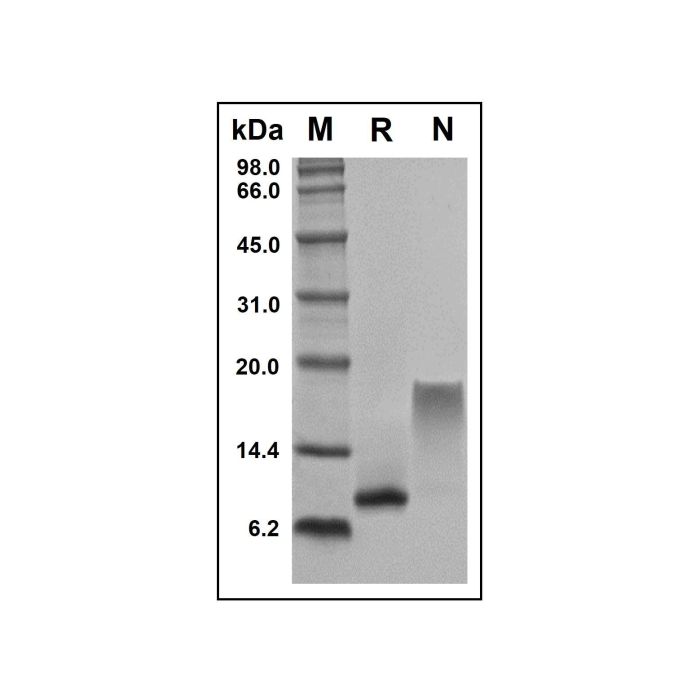
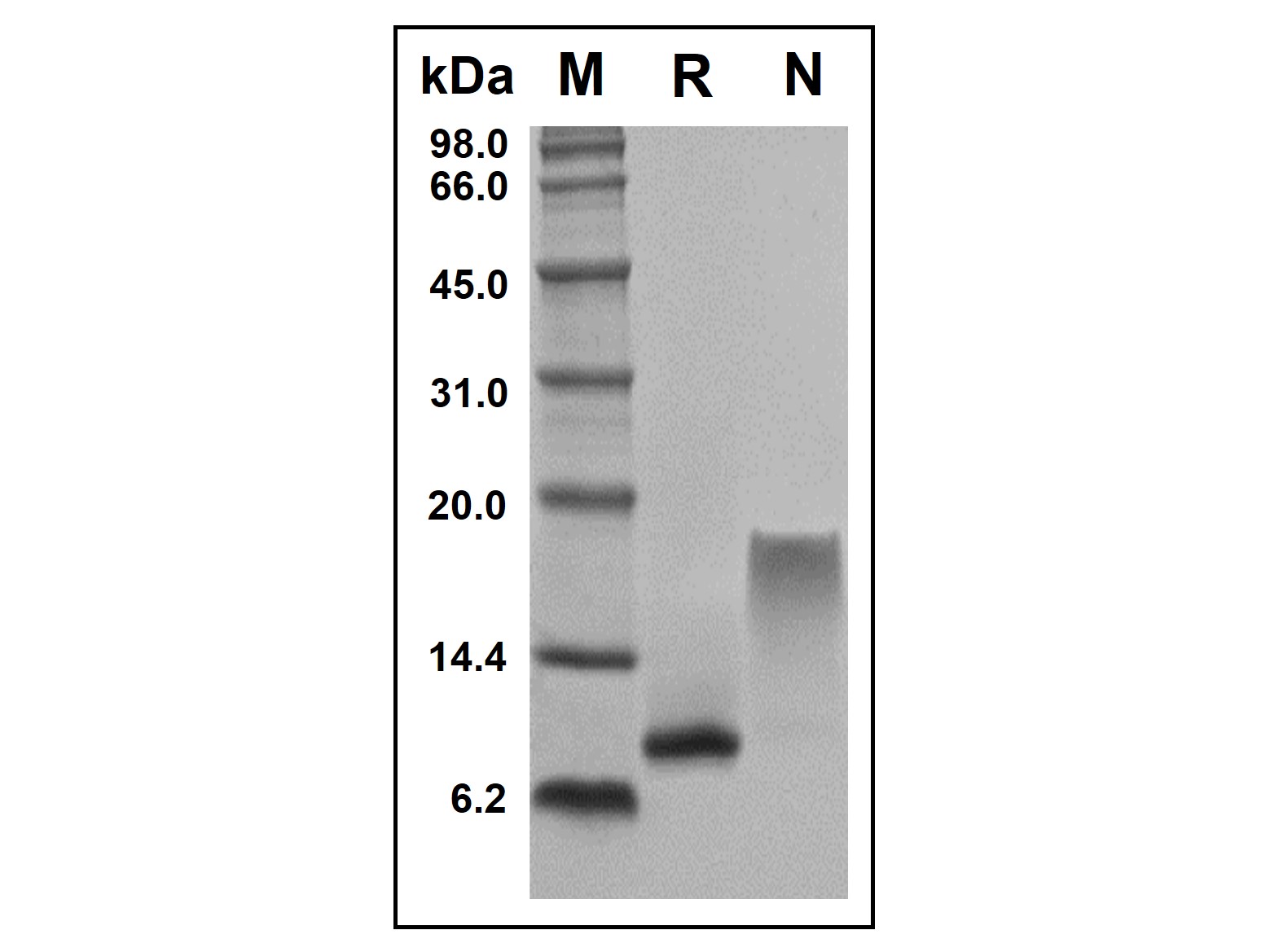
Recombinant Human CCL23/MPIF-1 Protein (rp143739)-SDS-PAGE Recombinant Human CCL23/MPIF-1 Protein was resolved with SDS-PAGE under reducing (R) and non-reducing (N) conditions and visualized by Coomassie® Blue staining, showing a band at 10.4 kDa under reducing conditions and 16.0-18.5 kDa under non-reducing conditions.
Documentation
📋 Safety Data Sheet (SDS)
Comprehensive hazard, handling, storage, and regulatory compliance document.
We use cookies to ensure the website functions properly and, where permitted, to improve your experience. You can manage your preferences at any time in Settings. Learn more in our Cookie Policy.
Shall we send you a message when we have discounts available?
Remind me later
Thank you! Please check your email inbox to confirm.
Products are supplied to verified businesses, institutions, and qualified professionals for research and development use only. Not for use in humans, animals, diagnosis, or therapy.

 ZJ23F0600373