
Determine the necessary mass, volume, or concentration for preparing a solution.
| Activity Type | Activity Value -log(M) | Mechanism of Action | Activity Reference | Publications (PubMed IDs) |
|---|
10mM in DMSO for sensitive chromatographic and analytical workflows requiring minimal baseline interference.
Store at -80°C Ships Dry ice packs + Cold packs Check lot-specific COA for exact specifications.
SDS, COA, datasheet, and spec sheet available for download. Lot-specific COA accessible via lot number lookup.
Cited in 2 peer-reviewed publications across chromatography, organic synthesis, and cross-coupling reactions.
Information
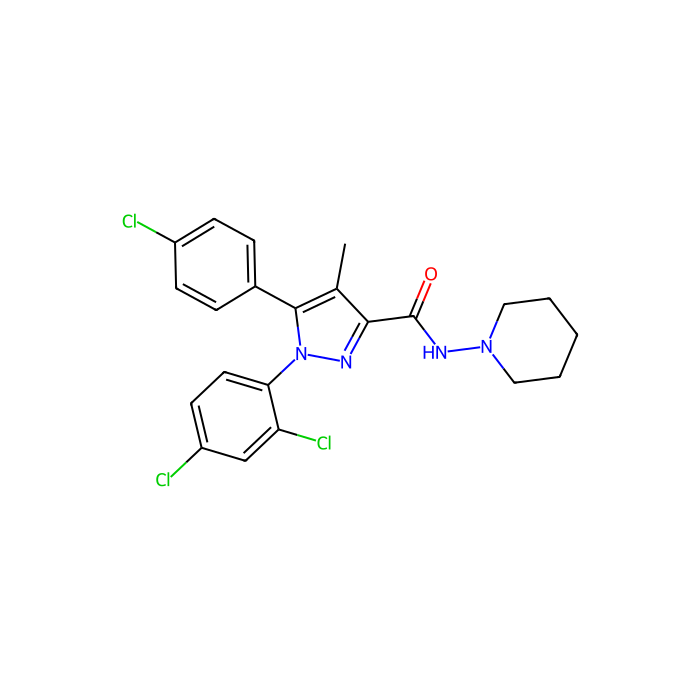
Rimonabant (SR141716) is a selective antagonist ofCB1withIC50of 13.6 nM andEC50of 17.3 nM in hCB1 transfected HEK 293 membrane. Rimonabant is also a dual inhibitor ofacyl CoA:cholesterol acyltransferases(ACAT) 1 and 2and inhibits mycobacterial MmpL3.
In vitro
Rimonabant dose-dependently reduces ACAT activity in Raw264.7macrophages with IC50 of 2.9 μM and isolated peritoneal macrophages. Rimonabant inhibits ACATactivity in intact CHO-ACAT1 and CHO-ACAT2 cells and in cell-free assays with approximately equal efficiency with IC50 of 1.5 μM and 2.2 μM for CHO-ACAT1 and CHO-ACAT2, respectively. Consistent with ACAT inhibition, Rimonabant treatment blocks ACAT dependent processes in macrophages, oxysterol-induced apoptosis and acetylated-LDL induced foam cell formation. Rimonabant antagonizes the inhibitory effects of cannabinoid receptor agonists on both mouse vas deferens contractions and adenylyl cyclase activity in rat brain membranes in a concentration-dependent manner. Rimonabant significantly reduces cell growth and induces cell death of human colorectal cancer cells (DLD-1, CaCo-2 and SW620). Rimonabant is able to alter cell cycle distribution in all the cell lines tested. Particularly, Rimonabant produces a G2/M cell cycle arrest in DLD-1 cells without inducing apoptosis or necrosis.
In vivo
Rimonabant is administered intraperitoneally or orally potently and dose-dependently antagonize classical pharmacological and behavioural effectos of cannabinoid receptor agonists. In the mouse model of azoxymethane-induced colon carcinogenesis, Rimonabant significantly decreased aberrant crypt foci (ACF) formation, which precedes colorectal cancer. Rimonabant (10 mg/kg by gavage) is fed for 2 weeks to 3-month-old male obese Zucker rats as an impaired glucose tolerance model and for 10 weeks to 6-month-old male obese Zucker rats as a model of the metabolic syndrome. RANTES (Regulated upon Activation, Normal T cell Expressed, and Secreted) and MCP-1 (monocyte chemotactic protein-1) serum levels are increased in obese vs lean Zucker rats and significantly reduced by long-term treatment with Rimonabant, which slowes weight gain in rats with the metabolic syndrome. Neutrophils and monocytes are significantly increased in young and old obese vs lean Zucker rats and lowered by Rimonabant. Platelet-bound fibrinogen is significantly enhanced in obese vs lean Zucker rats of both age, and is reduced by Rimonabant. Platelets from obese rats are more sensitive to thrombin-induced aggregation and adhesion to fibrinogen, which are both attenuated by Rimonabant therapy.
Cell Data
cell lines:
Concentrations:0,1,4 μM
Incubation Time:17 hours
Powder Purity:≥99%
| ALogP | 6.5 |
|---|
| Isomeric SMILES | CC1=C(N(N=C1C(=O)NN2CCCCC2)C3=C(C=C(C=C3)Cl)Cl)C4=CC=C(C=C4)Cl |
|---|---|
| PubChem CID | 104850 |
| Molecular Weight | 463.79 |
Comprehensive hazard, handling, storage, and regulatory compliance document.
Download SDS →Lot-specific quality data. Enter your lot number to retrieve the exact COA.
Look up COA →Full quality attributes and acceptance criteria for this grade.
View spec sheet →| Activity Type | Activity Value -log(M) | Mechanism of Action | Activity Reference | Publications (PubMed IDs) |
|---|
| Activity Type | Activity Value -log(M) | Mechanism of Action | Activity Reference | Publications (PubMed IDs) |
|---|
| Activity Type | Activity Value -log(M) | Mechanism of Action | Activity Reference | Publications (PubMed IDs) |
|---|
| Activity Type | Activity Value -log(M) | Mechanism of Action | Activity Reference | Publications (PubMed IDs) |
|---|
| Solubility | Solubility (25°C) In vitro DMSO: 69 mg/mL (199.13 mM); |
|---|
| 1. Yuhang Li, Yitian Li, Sennan Xu, Yue Chen, Pan Zhou, Ting Hu, Hua Li, Ying Liu, Yaping Xu, Jie Ren, Yan Qiu, Canzhong Lu. (2022) N-Acylethanolamine acid amidase (NAAA) exacerbates psoriasis inflammation by enhancing dendritic cell (DCs) maturation. PHARMACOLOGICAL RESEARCH, [PMID:36244543] [10.1016/j.phrs.2022.106491] |
| 2. Jia-Rui Bi, Hai-Wei Zha, Qing-Lin Gao, Hui Wu, Zhen-Jiang Liu, Dong Sun. (2024) Pleasant Odor Decreases Mouse Anxiety-like Behaviors by Regulating Hippocampal Endocannabinoid Signaling. INTERNATIONAL JOURNAL OF MOLECULAR SCIENCES, 25 (19): (10699). [PMID:39409026] [10.3390/ijms251910699] |