
Determine the necessary mass, volume, or concentration for preparing a solution.
| Activity Type | Activity Value -log(M) | Mechanism of Action | Activity Reference | Publications (PubMed IDs) |
|---|
10mM in DMSO for sensitive chromatographic and analytical workflows requiring minimal baseline interference.
Store at -80°C Ships Dry ice packs + Cold packs Check lot-specific COA for exact specifications.
SDS, COA, datasheet, and spec sheet available for download. Lot-specific COA accessible via lot number lookup.
Cited in 4 peer-reviewed publications across chromatography, organic synthesis, and cross-coupling reactions.
Information
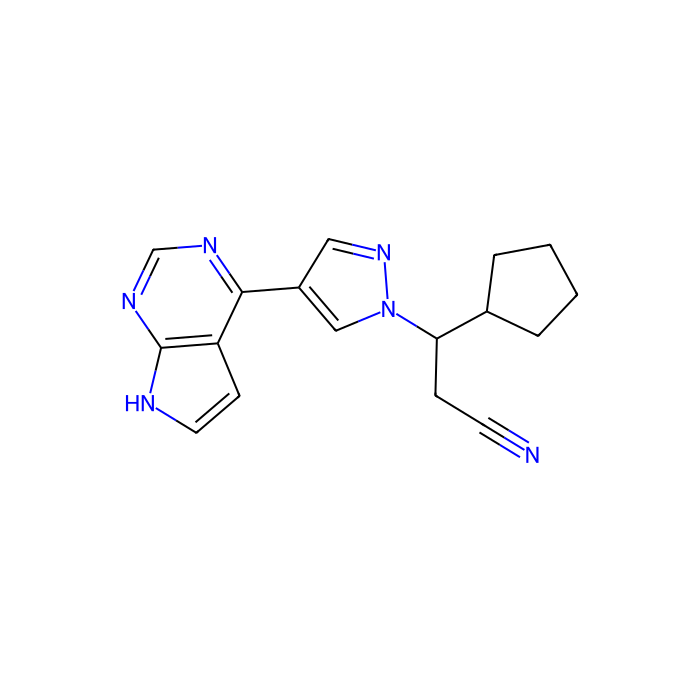
Ruxolitinib (INCB018424) is the first potent, selective,JAK1/2inhibitor to enter the clinic withIC50of 3.3 nM/2.8 nM in cell-free assays, >130-fold selectivity for JAK1/2 versus JAK3. Ruxolitinib kills tumor cells through toxic mitophagy. Ruxolitinib indu
In vitro
INCB018424 potently and selectively inhibits JAK2V617F-mediated signaling and proliferation in Ba/F3 cells and HEL cells. INCB018424 markedly increases apoptosis in a dose dependent manner in Ba/F3 cells. INCB018424 (64 nM) results in a doubling of cells with depolarized mitochondria in Ba/F3 cells. INCB018424 inhibits proliferating of erythroid progenitors from normal donors and polycythemia vera patients with IC50 of 407 nM and 223 nM, respectively. INCB018424 demonstrates remarkable potency against erythroid colony formation with IC50 of 67nM.
In vivo
INCB018424 (180 mg/kg, orally, twice a day) results in survive rate of greater than 90% by day 22 in a JAK2V617F-driven mouse model. INCB018424 (180 mg/kg, orally, twice a day) markedly reduces splenomegaly and circulating levels of inflammatory cytokines, and preferentially eliminated neoplastic cells, resulting in significantly prolonged survival without myelosuppressive or immunosuppressive effects in a JAK2V617F-driven mouse model. The primary end point is reached in 41.9% of patients in the Ruxolitinib group as compared with 0.7% in the placebo group in the double-blind trial of myelofibrosis. Ruxolitinib results in maintaining of reduction in spleen volume and improvement of 50% or more in the total symptom score. A total of 28% of the patients in the Ruxolitinib (15 mg twice daily) group has at least a 35% reduction in spleen volume at week 48 in patients with myelofibrosis, as compared with 0% in the group receiving the best available therapy. The mean palpable spleen length has decreased by 56% with Ruxolitinib but has increased by 4% with the best available therapy at week 48. Patients in the ruxolitinib group has an improvement in overall quality-of-life measures and a reduction in symptoms associated with myelofibrosis.
Cell Data
cell lines:NSCLC and Ba/F3 cells
Concentrations:3 μM
Incubation Time:48 hours
Powder Purity:≥98%
| Isomeric SMILES | C1CCC(C1)[C@@H](CC#N)N2C=C(C=N2)C3=C4C=CNC4=NC=N3 |
|---|---|
| PubChem CID | 25126798 |
| Molecular Weight | 306.37 |
Comprehensive hazard, handling, storage, and regulatory compliance document.
Download SDS →Lot-specific quality data. Enter your lot number to retrieve the exact COA.
Look up COA →Full quality attributes and acceptance criteria for this grade.
View spec sheet →| Activity Type | Activity Value -log(M) | Mechanism of Action | Activity Reference | Publications (PubMed IDs) |
|---|
| Activity Type | Activity Value -log(M) | Mechanism of Action | Activity Reference | Publications (PubMed IDs) |
|---|
| Activity Type | Activity Value -log(M) | Mechanism of Action | Activity Reference | Publications (PubMed IDs) |
|---|
| Activity Type | Activity Value -log(M) | Mechanism of Action | Activity Reference | Publications (PubMed IDs) |
|---|
| Activity Type | Activity Value -log(M) | Mechanism of Action | Activity Reference | Publications (PubMed IDs) |
|---|
| Activity Type | Activity Value -log(M) | Mechanism of Action | Activity Reference | Publications (PubMed IDs) |
|---|
| Solubility | Solubility (25°C) In vitro DMSO: 45 mg/mL (201.54 mM); Ethanol: 45 mg/mL (201.54 mM); Water: Insoluble; |
|---|
| 1. Shi Liu, Xinlin Jia, Jina Hao, Dapeng Zhang, Shengchao Yang, Bin Dai, Yuanqing Mao, Yongsheng Li. (2023) Tissue Engineering of Jak Inhibitor-Loaded Hierarchically Biomimetic Nanostructural Scaffold Targeting Cellular Senescence for Aged Bone Defect Repair and Bone Remolding. Advanced Healthcare Materials, [PMID:37667873] [10.1002/adhm.202301798] |
| 2. Yao Liu, Zhichao He, Heng Liang, Minzhen Han, Jinxingyi Wang, Qian Liu, Yanping Guan. (2023) A high-throughput UHPLC-MS/MS method for the determination of eight anti-tumor drugs in plasma. ANALYTICAL BIOCHEMISTRY, [PMID:37429484] [10.1016/j.ab.2023.115230] |
| 3. Li Li, Xingfeng He, Xingtong Wang, Yu Sun, Guosheng Wu, He Fang, Chen Wang, Pengfei Luo, Zhaofan Xia. (2020) Ruxolitinib protects lipopolysaccharide (LPS)-induced sepsis through inhibition of nitric oxide production in mice. Annals of Translational Medicine, [PMID:32411769] [10.21037/atm-20-2972] |
| 4. Qi Chen, Yue Zhou, Xudong Zhu, Lei Xu, Ge Bai, Yaru Zhou, Nannan Zhang, Hongwen Liu, Yani Pan, Yu Liu, Lishan Wang, Xueni Fu, Jingjing Wei, Lina Zhou, Lu Xu, Yuxiang Sun, Zhangding Wang, Shanshan Shen, Yun Zhu, Lei Wang. (2025) Enhancing PD-1 Inhibitor Efficacy in Cholangiocarcinoma by Reprogramming Tumor-Associated Neutrophils With CAF-Derived Extracellular Vesicles Loaded with Ruxolitinib. ADVANCED FUNCTIONAL MATERIALS, [PMID:] [10.1002/adfm.202423217] |