
Determine the necessary mass, volume, or concentration for preparing a solution.
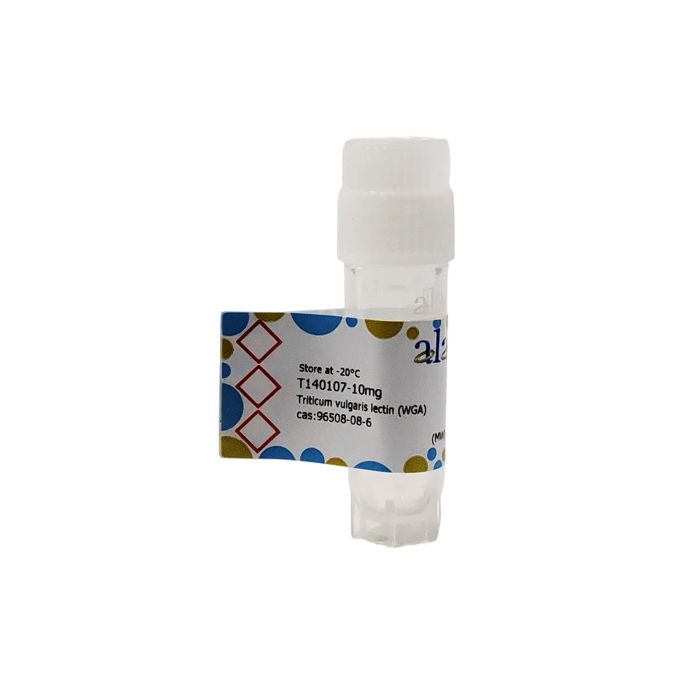
Triticum vulgaris lectin (WGA) , CAS No.96508-08-6
AVAILABLE TO ORDER
Storage
Store at -20°C
Shipped In
Ice chest + Ice pads
for sensitive chromatographic and analytical workflows requiring minimal baseline interference.
Store at -20°C Ships Ice chest + Ice pads Check lot-specific COA for exact specifications.
SDS, COA, datasheet, and spec sheet available for download. Lot-specific COA accessible via lot number lookup.
Cited in 2 peer-reviewed publications across chromatography, organic synthesis, and cross-coupling reactions.
Triticum vulgaris lectin or Weat germ agglutinin (WGA) is isolated from Triticum vulgaris (Weat germ) and purified by affinity chromatography. The lectin has two subunits and a molecular weight of 36 kDa. WGA selectively binds to N-Acetyl glucosamine (GlcNAc) and to N-acetylneuraminic acid (sialic acid) residues of glycoproteins and glycolipids. The WGA lectin agglutinates erythrocytes and most types of malignant cells. It agglutinates rabbit erythrocytes at < 0.1 μg/ml following trypsin treatment of the cells. Adding 300 mM N-Acetyle-D-Glucosamine gives an inhibition with a titer that is at least 8-fold lower than the control. Wheat germ agglutinin inhibits the C5a receptor interaction, which has implications in studies of receptor micro-heterogeneity and ligand binding sites. WGA together with Con A is the lectin most widely used as an analytical and preparative agent when studying glycoproteins and cell surface proteins. The immobilized lectin can be used for affinity chromatography of cells and sub-cellular particles. WGA is supplied as a white to pale yellow lyophilized powder from a buffer containing 10 mM CH3COONH4. No preservatives are added. The purity of WGA is determined by SDS- electrophoresis which generates three bands, corresponding to the three isolectins of WGA. Protein content is verified in spectrophotmetry.
● Ultrapure quality
● Sugar specificity: N-acetylglucosamine and N-acetylneuraminic acid residues
● Agglutinates erythrocytes and most types of malignant cells
● Agglutinates rabbit erythrocytes at ≤0.1 μg/ml after treating the cells with trypsin
● Not blood group specific
Studies of glycoproteins and glycolipids; Purification of membrane proteins; Affinity chromatography of cells and sub-cellular particles; Agglutination studies
Comprehensive hazard, handling, storage, and regulatory compliance document.
Download SDS →Lot-specific quality data. Enter your lot number to retrieve the exact COA.
Look up COA →Full quality attributes and acceptance criteria for this grade.
View spec sheet →Find and download the COA for your product by matching the lot number on the packaging.
| Lot Number | Certificate Type | Date | Item |
|---|---|---|---|
 D2627379 D2627379 | Certificate of Analysis | Apr 17, 2026 | T140107 |
| K2510638 | Certificate of Analysis | Oct 22, 2025 | T140107 |
| K22301359 | Certificate of Analysis | Sep 09, 2025 | T140107 |
| I2126505 | Certificate of Analysis | Jul 03, 2024 | T140107 |
| G2528017 | Certificate of Analysis | Oct 26, 2022 | T140107 |
| K22301362 | Certificate of Analysis | Oct 26, 2022 | T140107 |
| B2519088 | Certificate of Analysis | Jun 22, 2022 | T140107 |
| G2214588 | Certificate of Analysis | Jun 22, 2022 | T140107 |
| 1. Qian Wang, Zichao Peng, Bin Gui, Yongming Li, Lanjie Liao, Zuoyan Zhu, Yaping Wang, Libo He. (2025) Sialic acid serves as a functional receptor for grass carp reovirus. PLoS Pathogens, 21 (9): (e1013481). [PMID:40911632] [10.1371/journal.ppat.1013481] |
| 2. Donghua Su, Xiaolong Zhang, Tianwu An, Xi Wang, Yaqiu Lin, Haibo Wang, Peiqiang Yu, Haitao Shi. (2025) Astral-DIA proteomics and 4D label-free N-glycoproteomics of milk fat globule membrane proteins reveal distinct profiles between yak colostrum and mature milk. Food Chemistry-X, [PMID:41378274] [10.1016/j.fochx.2025.103302] |