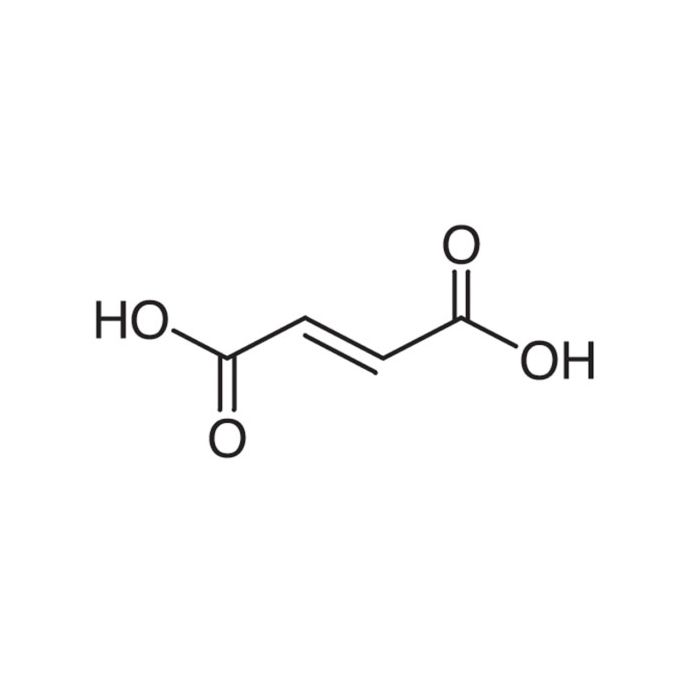
Fumaric acid - for cell culture, ≥99% , CAS No.110-17-8

CAS: 110-17-8 Cat. No.: F118459 Formula: C4H4O4 Molecular Weight: 116.07 Beilstein Registry Number: 605763 EC Number: 203-743-0
AVAILABLE TO ORDER
GRADE & PURITY for Cell culture ? Cell-culture grade — low endotoxin and contaminants to support viable cell growth. Use in mammalian/other cell culture media and supplements. ≥99%
Synonyms
Butenedioic acid, (E)- | CAS-110-17-8 | HSDB 710 | trans-but-2-enedioic acid | FUMARIC ACID (USP IMPURITY) | trans-2-Butendisaure | 2(TRANS)-BUTENEDIOIC ACID | Allomaleic acid | fumarate, 10 | FUMARIC ACID [MART.] | MFCD00002700 | U-1149 | Boletic acid |
Storage
Room temperature
Shipped In
Normal
★
Size
USA
Germany (EU)*
Price
Qty
100g
F118459-100g
Made to order · 8–12 wks

$88.90

$103.90
Save $15.00 (14.44%)
500g
F118459-500g
3 In stock
—

$294.90

$343.90
Save $49.00 (14.25%)
Enter a quantity for the sizes you want to add.

Overview

application:

Fumaric acid is used as a food additive and acid regulator. It is used in the production of polyester resins and polyhydric alcohols. It is also used as a mordant for dyes, paint additives, coating additives, plasticizers, processing aids and specific to petroleum production. Further, it is used in dentifrices as a stain remover and to make other chemicals. In addition to this, it is used in rosin esters, drying oils, printing inks and flavoring agent.


product description:

Fumaric acid can be prepared by fermentation by employing Rhizopus species. Recently, industrial-scale synthesis of fumaric acid from renewable feedstocks and lignocellulosic biomass has been proposed.Fumaric acid has been used as a standard for the quantitative determination of phenolic compounds in nettle samples by HPLC.Fumaric acid may be used in the preparation of L-Lysine-fumaric acid crystals. It may also be employed for the industrial manufacture of synthetic resins and eco-friendly/biodegradable polymers.

Specifications

Synonyms
Butenedioic acid, (E)- | CAS-110-17-8 | HSDB 710 | trans-but-2-enedioic acid | FUMARIC ACID (USP IMPURITY) | trans-2-Butendisaure | 2(TRANS)-BUTENEDIOIC ACID | Allomaleic acid | fumarate, 10 | FUMARIC ACID [MART.] | MFCD00002700 | U-1149 | Boletic acid |
Specifications & Purity
for cell culture, ≥99%
Storage
Room temperature
Shipped In
Normal
Grade
for Cell culture
Purity
≥99%
Names and Identifiers
Pubchem Sid
Pubchem Sid Url
https://pubchem.ncbi.nlm.nih.gov/substance/504758834
Canonical Smiles
C(=CC(=O)O)C(=O)O
IUPAC Name
(E)-but-2-enedioic acid
InChIKey
VZCYOOQTPOCHFL-OWOJBTEDSA-N
INCHI
1S/C4H4O4/c5-3(6)1-2-4(7)8/h1-2H,(H,5,6)(H,7,8)/b2-1+
Isomeric SMILES
C(=C/C(=O)O)\C(=O)O
WGK Germany
1
RTECS
LS9625000
Molecular Weight
116.07
Beilstein
605763
Reaxy-Rn
8132074
Reaxys-RN_link_address
https://www.reaxys.com/reaxys/secured/hopinto.do?context=S&query=IDE.XRN=8132074&ln=

Advanced Data

Taxonomic Classification

Taxonomy Tree

KingdomOrganic compounds
SuperclassOrganic acids and derivatives
ClassCarboxylic acids and derivatives
SubclassDicarboxylic acids and derivatives
Intermediate Tree Nodes Not available
Direct ParentDicarboxylic acids and derivatives
Alternative Parents Unsaturated fatty acids  Carboxylic acids  Organic oxides  Hydrocarbon derivatives  Carbonyl compounds  
Molecular FrameworkAliphatic acyclic compounds
Substituents Fatty acyl - Fatty acid - Unsaturated fatty acid - Dicarboxylic acid or derivatives - Carboxylic acid - Organic oxygen compound - Organic oxide - Hydrocarbon derivative - Organooxygen compound - Carbonyl group - Aliphatic acyclic compound
DescriptionThis compound belongs to the class of organic compounds known as dicarboxylic acids and derivatives. These are organic compounds containing exactly two carboxylic acid groups.
External Descriptors butenedioic acid
3D Structure
Interactive Chemical Structure Model


Associated Targets(Human)
EGFR Tclin Epidermal growth factor receptor erbB1 (33727 Activities)
Activity TypeRelationActivity valueUnitsAction TypeJournalPubMed IddoiAssay Aladdin ID
CA2 Tclin Carbonic anhydrase II (17698 Activities)
Activity TypeRelationActivity valueUnitsAction TypeJournalPubMed IddoiAssay Aladdin ID
ESR1 Tclin Estrogen receptor alpha (17718 Activities)
Activity TypeRelationActivity valueUnitsAction TypeJournalPubMed IddoiAssay Aladdin ID
NR3C1 Tclin Glucocorticoid receptor (14987 Activities)
Activity TypeRelationActivity valueUnitsAction TypeJournalPubMed IddoiAssay Aladdin ID
PGR Tclin Progesterone receptor (8562 Activities)
Activity TypeRelationActivity valueUnitsAction TypeJournalPubMed IddoiAssay Aladdin ID
ADRB2 Tclin Beta-2 adrenergic receptor (11824 Activities)
Activity TypeRelationActivity valueUnitsAction TypeJournalPubMed IddoiAssay Aladdin ID
CHRM2 Tclin Muscarinic acetylcholine receptor M2 (10671 Activities)
Activity TypeRelationActivity valueUnitsAction TypeJournalPubMed IddoiAssay Aladdin ID
ADRB1 Tclin Beta-1 adrenergic receptor (6630 Activities)
Activity TypeRelationActivity valueUnitsAction TypeJournalPubMed IddoiAssay Aladdin ID
HTR1A Tclin Serotonin 1a (5-HT1a) receptor (14969 Activities)
Activity TypeRelationActivity valueUnitsAction TypeJournalPubMed IddoiAssay Aladdin ID
ADRA2A Tclin Alpha-2a adrenergic receptor (9450 Activities)
Activity TypeRelationActivity valueUnitsAction TypeJournalPubMed IddoiAssay Aladdin ID
AR Tclin Androgen Receptor (11781 Activities)
Activity TypeRelationActivity valueUnitsAction TypeJournalPubMed IddoiAssay Aladdin ID
CHRM1 Tclin Muscarinic acetylcholine receptor M1 (12690 Activities)
Activity TypeRelationActivity valueUnitsAction TypeJournalPubMed IddoiAssay Aladdin ID
DRD2 Tclin Dopamine D2 receptor (23596 Activities)
Activity TypeRelationActivity valueUnitsAction TypeJournalPubMed IddoiAssay Aladdin ID
GABRA1 Tclin GABA receptor alpha-1 subunit (399 Activities)
Activity TypeRelationActivity valueUnitsAction TypeJournalPubMed IddoiAssay Aladdin ID
TSHR Tclin Thyroid stimulating hormone receptor (29986 Activities)
Activity TypeRelationActivity valueUnitsAction TypeJournalPubMed IddoiAssay Aladdin ID
MAOA Tclin Monoamine oxidase A (11911 Activities)
Activity TypeRelationActivity valueUnitsAction TypeJournalPubMed IddoiAssay Aladdin ID
CNR1 Tclin Cannabinoid CB1 receptor (20913 Activities)
Activity TypeRelationActivity valueUnitsAction TypeJournalPubMed IddoiAssay Aladdin ID
DRD1 Tclin Dopamine D1 receptor (9720 Activities)
Activity TypeRelationActivity valueUnitsAction TypeJournalPubMed IddoiAssay Aladdin ID
ACHE Tclin Acetylcholinesterase (18204 Activities)
Activity TypeRelationActivity valueUnitsAction TypeJournalPubMed IddoiAssay Aladdin ID
PTGS1 Tclin Cyclooxygenase-1 (9233 Activities)
Activity TypeRelationActivity valueUnitsAction TypeJournalPubMed IddoiAssay Aladdin ID
SLC6A2 Tclin Norepinephrine transporter (10102 Activities)
Activity TypeRelationActivity valueUnitsAction TypeJournalPubMed IddoiAssay Aladdin ID
HTR2A Tclin Serotonin 2a (5-HT2a) receptor (14758 Activities)
Activity TypeRelationActivity valueUnitsAction TypeJournalPubMed IddoiAssay Aladdin ID
HTR2C Tclin Serotonin 2c (5-HT2c) receptor (11471 Activities)
Activity TypeRelationActivity valueUnitsAction TypeJournalPubMed IddoiAssay Aladdin ID
ADORA1 Tclin Adenosine A1 receptor (17603 Activities)
Activity TypeRelationActivity valueUnitsAction TypeJournalPubMed IddoiAssay Aladdin ID
AGTR1 Tclin Type-1 angiotensin II receptor (5176 Activities)
Activity TypeRelationActivity valueUnitsAction TypeJournalPubMed IddoiAssay Aladdin ID
SLC6A4 Tclin Serotonin transporter (12625 Activities)
Activity TypeRelationActivity valueUnitsAction TypeJournalPubMed IddoiAssay Aladdin ID
ADRA1A Tclin Alpha-1a adrenergic receptor (8359 Activities)
Activity TypeRelationActivity valueUnitsAction TypeJournalPubMed IddoiAssay Aladdin ID
PTGS2 Tclin Cyclooxygenase-2 (13999 Activities)
Activity TypeRelationActivity valueUnitsAction TypeJournalPubMed IddoiAssay Aladdin ID
HRH1 Tclin Histamine H1 receptor (7573 Activities)
Activity TypeRelationActivity valueUnitsAction TypeJournalPubMed IddoiAssay Aladdin ID
OPRM1 Tclin Mu opioid receptor (19785 Activities)
Activity TypeRelationActivity valueUnitsAction TypeJournalPubMed IddoiAssay Aladdin ID
DRD3 Tclin Dopamine D3 receptor (14368 Activities)
Activity TypeRelationActivity valueUnitsAction TypeJournalPubMed IddoiAssay Aladdin ID
PPARG Tclin Peroxisome proliferator-activated receptor gamma (15191 Activities)
Activity TypeRelationActivity valueUnitsAction TypeJournalPubMed IddoiAssay Aladdin ID
AVPR1A Tclin Vasopressin V1a receptor (5412 Activities)
Activity TypeRelationActivity valueUnitsAction TypeJournalPubMed IddoiAssay Aladdin ID
OPRD1 Tclin Delta opioid receptor (15096 Activities)
Activity TypeRelationActivity valueUnitsAction TypeJournalPubMed IddoiAssay Aladdin ID
HTR3A Tclin Serotonin 3a (5-HT3a) receptor (3366 Activities)
Activity TypeRelationActivity valueUnitsAction TypeJournalPubMed IddoiAssay Aladdin ID
SLC6A3 Tclin Dopamine transporter (10535 Activities)
Activity TypeRelationActivity valueUnitsAction TypeJournalPubMed IddoiAssay Aladdin ID
PDE3A Tclin Phosphodiesterase 3A (3309 Activities)
Activity TypeRelationActivity valueUnitsAction TypeJournalPubMed IddoiAssay Aladdin ID
SLC29A1 Tclin Equilibrative nucleoside transporter 1 (1711 Activities)
Activity TypeRelationActivity valueUnitsAction TypeJournalPubMed IddoiAssay Aladdin ID
ERBB2 Tclin Receptor protein-tyrosine kinase erbB-2 (7851 Activities)
Activity TypeRelationActivity valueUnitsAction TypeJournalPubMed IddoiAssay Aladdin ID
ADRA2B Tclin Alpha-2b adrenergic receptor (4412 Activities)
Activity TypeRelationActivity valueUnitsAction TypeJournalPubMed IddoiAssay Aladdin ID
ADRA2C Tclin Alpha-2c adrenergic receptor (4876 Activities)
Activity TypeRelationActivity valueUnitsAction TypeJournalPubMed IddoiAssay Aladdin ID
CHRM3 Tclin Muscarinic acetylcholine receptor M3 (7750 Activities)
Activity TypeRelationActivity valueUnitsAction TypeJournalPubMed IddoiAssay Aladdin ID
HTR2B Tclin Serotonin 2b (5-HT2b) receptor (10323 Activities)
Activity TypeRelationActivity valueUnitsAction TypeJournalPubMed IddoiAssay Aladdin ID
EDNRA Tclin Endothelin receptor ET-A (5008 Activities)
Activity TypeRelationActivity valueUnitsAction TypeJournalPubMed IddoiAssay Aladdin ID
ADORA2A Tclin Adenosine A2a receptor (16305 Activities)
Activity TypeRelationActivity valueUnitsAction TypeJournalPubMed IddoiAssay Aladdin ID
ADORA3 Tchem Adenosine A3 receptor (15931 Activities)
Activity TypeRelationActivity valueUnitsAction TypeJournalPubMed IddoiAssay Aladdin ID
CA1 Tclin Carbonic anhydrase I (13240 Activities)
Activity TypeRelationActivity valueUnitsAction TypeJournalPubMed IddoiAssay Aladdin ID
HRH3 Tclin Histamine H3 receptor (10389 Activities)
Activity TypeRelationActivity valueUnitsAction TypeJournalPubMed IddoiAssay Aladdin ID
CHRNA4 Tclin Neuronal acetylcholine receptor protein alpha-4 subunit (1265 Activities)
Activity TypeRelationActivity valueUnitsAction TypeJournalPubMed IddoiAssay Aladdin ID
EGLN2 Tclin Hypoxia-inducible factor prolyl hydroxylase 1 (404 Activities)
Activity TypeRelationActivity valueUnitsAction TypeJournalPubMed IddoiAssay Aladdin ID
Associated Targets(non-human)
Papain (844 Activities)
Activity TypeRelationActivity valueUnitsAction TypeJournalPubMed IddoiAssay Aladdin ID
Cckar Cholecystokinin A receptor (90 Activities)
Activity TypeRelationActivity valueUnitsAction TypeJournalPubMed IddoiAssay Aladdin ID
Pde4d Phosphodiesterase 4D (4 Activities)
Activity TypeRelationActivity valueUnitsAction TypeJournalPubMed IddoiAssay Aladdin ID
Hcar2 Hydroxycarboxylic acid receptor 2 (55 Activities)
Activity TypeRelationActivity valueUnitsAction TypeJournalPubMed IddoiAssay Aladdin ID
BALB/3T3 (534 Activities)
Activity TypeRelationActivity valueUnitsAction TypeJournalPubMed IddoiAssay Aladdin ID
Slc22a20 Solute carrier family 22 member 20 (86 Activities)
Activity TypeRelationActivity valueUnitsAction TypeJournalPubMed IddoiAssay Aladdin ID
Slc22a6 Solute carrier family 22 member 6 (141 Activities)
Activity TypeRelationActivity valueUnitsAction TypeJournalPubMed IddoiAssay Aladdin ID
GAPDH Glyceraldehyde-3-phosphate dehydrogenase (59 Activities)
Activity TypeRelationActivity valueUnitsAction TypeJournalPubMed IddoiAssay Aladdin ID
Nfe2l2 Nuclear factor erythroid 2-related factor 2 (214 Activities)
Activity TypeRelationActivity valueUnitsAction TypeJournalPubMed IddoiAssay Aladdin ID
A085R Prolyl 4-hydroxylase (72 Activities)
Activity TypeRelationActivity valueUnitsAction TypeJournalPubMed IddoiAssay Aladdin ID
Mechanisms of Action
Certificates (CoA,COO,BSE/TSE and Analysis Chart)
C of A & Other Certificates(BSE/TSE, COO):
Analytical Chart:

Find and download the COA for your product by matching the lot number on the packaging.

4 results found

Lot NumberCertificate TypeDateItem
F2511008F2511008Certificate of AnalysisJun 18, 2025 F118459
I2110248I2110248Certificate of AnalysisMar 03, 2025 F118459
I2110249I2110249Certificate of AnalysisMar 03, 2025 F118459
B2301567B2301567Certificate of AnalysisAug 19, 2021 F118459
Chemical and Physical Properties
SolubilitySoluble in water, slightly soluble in cold water, ether, benzene, easily soluble in hot water, soluble in ethanol.
SensitivityMoisture sensitive.
Flash Point(°F)523°F
Flash Point(°C)273 °C
Melt Point(°C)287°C
Molecular Weight116.070 g/mol
XLogP3-0.300
Hydrogen Bond Donor Count2
Hydrogen Bond Acceptor Count4
Rotatable Bond Count2
Exact Mass116.011 Da
Monoisotopic Mass116.011 Da
Topological Polar Surface Area74.600 Ų
Heavy Atom Count8
Formal Charge0
Complexity119.000
Isotope Atom Count0
Defined Atom Stereocenter Count0
Undefined Atom Stereocenter Count0
Defined Bond Stereocenter Count1
Undefined Bond Stereocenter Count0
The total count of all stereochemical bonds1
Covalently-Bonded Unit Count1
Documents & Articles
For Cell Culture
How Organic Acids “Stabilize a System”: Selection Logic via the pH Window, Salt Forms, and Metal-Ion Management (with a navigation guide to Tables A–E)
Bacterial Sodium Ion-Driven Energy Metabolism and Mechanisms of Transmembrane Coupled Transport
Noncanonical Functions of Epigenetic Enzymes and Regulation of Mitochondrial Metabolism
Understanding Polyester Resins for Coatings: Structure Design, Key Indicators, and Coating Film Performance
Porous Graphitic Carbon (PGC) Chromatography Columns: Creating New Selectivity for Challenging Separations through Molecular Shape and the π-Electron Cloud on the Graphitic Surface
Applications of Rosin and Modified Rosin Resins in Coatings and Inks: Structure–Property Relationships, Modification Pathways, and Usage Guidelines
TCA Cycle Metabolite Detection Methods and Result Interpretation
Discovery and Structural Optimization of the Noncovalent 3CL Protease Inhibitor S-217622
Citations of This Product
Solution Calculators
Reviews

Customer Reviews

Application Protocols

No assay-specific protocols are provided for this item. For general guidance:

  • Preparing a sterile fumarate solution for cell culture (general workflow):
    • Calculate desired concentration and pH (e.g., 50–100 mM sodium fumarate, pH 4.0–5.0).
    • Suspend fumaric acid in ~80% of final volume of water for injection (WFI) or cell-culture grade water, stir vigorously.
    • Titrate with sterile NaOH to target pH to increase solubility; bring to volume.
    • Sterile-filter through 0.22 µm; store at 2–8 °C for short term.

Item-specific validated applications/dilutions: Not specified for this item; refer to CoA/Spec Sheet and SDS.

Biological Roles

General biochemistry context (literature; not item-specific):

  • Central metabolism:
    • Fumarate is an intermediate of the tricarboxylic acid (TCA) cycle, formed by oxidation of succinate and converted to malate by fumarase. The fumarate/malate pair participates in cellular redox balance.
  • Anaplerotic and shuttle functions:
    • Fumarate participates in the urea cycle and the aspartate–argininosuccinate shunt, linking nitrogen metabolism with the TCA cycle.
  • Post-translational modifications:
    • Elevated fumarate can lead to cysteine succination (via fumarate addition to protein thiols) in certain stressed cells, a topic of chemical biology interest.
  • Cell culture relevance (general):
    • Fumarate/fumaric acid may be used in media or buffer systems as a pH adjuster or as a defined dicarboxylate source in metabolic studies once neutralized to physiologically compatible salts.

Note: The above roles are provided for biochemical context only. This product is for research use only (from Product Data) and is not intended for diagnostic or clinical applications.

Buffer Applications

Practical buffer use (general; literature values):

  • Acid–base characteristics:
    • Diprotic acid with pKa1 ≈ 3.0 and pKa2 ≈ 4.4 (25 °C), enabling buffers in the ~2.5–5.0 range when paired with appropriate bases.
  • Solubility strategy:
    • Because the free acid is sparingly soluble in water, prepare buffers by partial or full neutralization (e.g., with NaOH or KOH) to the desired pH, forming mono- or di-fumarate. Use gentle heating and stirring to aid dissolution.
  • Example workflow (guideline):
    • Target 100 mM sodium fumarate, pH 4.0: suspend fumaric acid in ~80% of final water volume, add 1.0–1.2 equivalents of NaOH incrementally while monitoring pH; adjust to final pH and volume, then sterile-filter (0.22 µm) for cell culture compatibility.
  • Compatibility:
    • Fumarate buffers exhibit low metal chelation relative to citrate; they can be preferable in studies involving metal-dependent enzymes. Ionic strength and osmolarity should be calculated for cell culture applications.

Item-specific specifications for buffer preparation (endotoxin, bioburden, exact pH windows): Not specified for this item; refer to CoA/Spec Sheet and SDS for detailed guidance.

Green Alternatives

As a bio-based dicarboxylic acid that can be produced by fermentation, fumaric acid is often considered a relatively benign reagent. Selection among organic acids should balance pH range, solubility, and downstream processing.

Comparison (literature; general guidance):

  • Fumaric acid vs citric acid:
    • Citric acid offers broader buffering (pH ~2–7) and higher water solubility; however, it introduces a tricarboxylate that can chelate metals strongly, which may be undesirable in some catalytic or cell culture contexts.
  • Fumaric acid vs succinic acid:
    • Succinic acid (saturated) lacks the unsaturation needed for further polymer crosslinking chemistry; it is more water-soluble and can be a greener choice where unsaturation is unnecessary.
  • Fumaric acid vs maleic acid:
    • Maleic acid is more water-soluble and stronger (first pKa) but can display higher corrosivity; fumaric acid is more thermally stable and less hygroscopic.

Sustainability considerations:

  • Feedstock: fumaric acid can be sourced from renewable carbon via fermentation followed by crystallization.
  • Process advantages: solid handling at ambient temperature, minimal volatile organic emissions, and compatibility with aqueous processing after neutralization reduce solvent burdens.

Trade-offs:

  • Limited aqueous solubility of the free acid may necessitate bases or polar aprotic solvents (e.g., DMSO/DMF). When possible, use aqueous neutralization to form fumarate solutions and avoid aprotic dipolar solvents.
Pharmaceutical Uses

Formulation and manufacturing context (general; no therapeutic claims):

  • Counterion and salt formation:
    • Fumaric acid is commonly used to form fumarate salts of basic active pharmaceutical ingredients (APIs), improving stability, crystallinity, or bioavailability. Selection is based on solid-state form, hygroscopicity, and dissolution behavior.
  • Excipients/processing aids:
    • Can function as an acidulant in oral solid dosage development and as a co-former in cocrystals or eutectic systems to tailor melting and compaction properties.
  • Solid-state considerations:
    • The trans geometry favors strong intermolecular interactions and robust crystals, aiding flowability and tableting in some salt forms.
  • Regulatory status (general):
    • Fumaric acid and many fumarate salts appear in major pharmacopeias; specific monographs, impurity limits, and tests depend on the pharmacopeia and salt selected. Item-specific compliance: Not specified for this item; refer to CoA/Spec Sheet.

Note: This product is supplied for research use only (from Product Data). Suitability for GMP or clinical manufacturing requires separate qualification and documentation.

Physical Properties
  • Item-specific specs: Not specified for this item; refer to CoA/Spec Sheet.

Literature/general reference values (not item specifications):

  • Appearance: white crystalline solid (literature)
  • Melting point: ~287 °C with decomposition (literature)
  • Boiling point: not observed (decomposes before boiling at ambient pressure) (literature)
  • Density (solid): ~1.63 g/cm³ at 20–25 °C (literature)
  • Acidity (pKa): pKa1 ≈ 3.0; pKa2 ≈ 4.4 (aqueous, 25 °C) (literature)
  • Solubility: sparingly soluble in water at room temperature; solubility increases with temperature and upon neutralization to fumarate salts; more soluble in polar aprotic solvents (e.g., DMSO, DMF) (literature)
  • LogP (octanol/water): negative; high hydrophilicity in ionized forms (literature)

Practical notes (general):

  • Due to limited aqueous solubility of the free acid, dissolve by partial neutralization (e.g., with NaOH) to prepare fumarate buffers or media components.
  • Heating and vigorous stirring aid dissolution; avoid prolonged heating near decomposition temperature.
Quality & Grades
  • Item-specific grade: for Cell culture (from Product Data).

What “for Cell culture” typically implies (general guidance):

  • Manufactured and packaged to support use in cell biology workflows (e.g., media supplementation, pH adjustment), with emphasis on low bioburden and low levels of common cytotoxic impurities and particulates.
  • May include enhanced documentation or testing relevant to cell culture (e.g., endotoxin/bioburden limits), though specific numerical limits are not provided here.

Important note:

  • Any specific acceptance criteria (e.g., assay %, metals, endotoxin, UV profile) are Not specified for this item; refer to CoA/Spec Sheet for this lot.

Stabilizers/antioxidants:

  • None stated in Product Data. If present, would be listed on the CoA; otherwise, fumaric acid is generally supplied neat.

Use implications:

  • Suitable for preparing fumarate-containing media components or for controlled acidification steps in culture workflows after appropriate sterile handling/filtration.
  • For research use only (from Product Data); not for human or veterinary use.
Reaction & Applications

General chemistry applications of fumaric acid (literature; expand as needed for your workflow):

  • Polymer/intermediate chemistry:
    • Precursor to unsaturated polyester resins via esterification with glycols (formation of fumarate diesters), enabling subsequent crosslinking through the C=C bond.
  • Esterification and salt formation:
    • Fischer esterification to dimethyl/diethyl fumarate (acid catalysis, Dean–Stark or azeotropic removal of water). Fumarate salts (e.g., disodium fumarate) prepared by controlled neutralization.
  • Michael-type and Diels–Alder reactivity:
    • The electron-poor C=C conjugated to two carbonyls serves as a dienophile in Diels–Alder reactions (often using activated esters/anhydrides for enhanced reactivity). Michael additions typically proceed on fumarate esters rather than the free acid.
  • Isomer/photochemistry:
    • Interconversion with maleic acid under UV or radical conditions (maleate → fumarate favored thermodynamically). Useful in studying cis/trans isomerization thermodynamics.
  • Biochemical/analytical uses:
    • Standard for assays involving TCA-cycle fumarase activity or fumarate quantification (after neutralization/appropriate buffer preparation).

Practical tips:

  • Drying: as a crystalline solid, typically used as received; if needed, dry under vacuum at ambient-to-mild temperatures to avoid decomposition.
  • For solution-phase reactions, convert to esters/anhydrides or use coupling agents (e.g., SOCl2/oxalyl chloride to acid chloride, or carbodiimides) to enhance reactivity of the carboxyl groups.
Reaction Conditions

Typical literature conditions (general guidance; not item-specific):

  • Fischer esterification to dimethyl fumarate:
    • Solvent: methanol (neat or with toluene for azeotrope); Catalyst: catalytic H2SO4 or p-TsOH; Temperature: reflux (65–80 °C depending on solvent mix); Time: 4–24 h; Water removal accelerates conversion; Typical isolated yields: 70–90%.
  • Formation of fumaroyl chloride:
    • Reagent: SOCl2 (2–4 equiv) with catalytic DMF; Solvent: neat SOCl2 or inert solvent (CH2Cl2); Temperature: 0 °C to reflux; Time: 2–6 h; Quench cautiously; Store acid chloride cold/dry.
  • Diels–Alder as dienophile (using diesters):
    • Solvent: toluene, chlorobenzene, or acetonitrile; Temperature: 80–150 °C (thermal) or room temp with Lewis acids (e.g., AlCl3, BF3·OEt2) depending on partner; Time: hours to overnight; Endo/exo selectivity governed by conditions and substituents.
  • Hydrogenation to succinic acid (derivatives):
    • Catalyst: Pd/C or Raney Ni; Solvent: water/ethanol; H2 pressure: 1–10 bar; Temperature: RT–60 °C; Time: 1–6 h; Gives high yields to saturated diacids/esters.

Operational notes:

  • For aqueous work, pre-neutralize to fumarate to enhance solubility and control pH.
  • Avoid prolonged heating of the free acid near its decomposition temperature; use derivatives (esters/anhydrides) when higher reactivity or solubility is required.
Safety & Handling
  • Item-specific hazard and GHS data: Not specified for this item; consult the product SDS for authoritative information.

Typical safety profile (literature; not item-specific):

  • Generally regarded as a low-hazard organic acid; may cause eye, skin, and respiratory irritation. Dust may cause mechanical irritation.
  • GHS classification varies by supplier; many list no classified hazards or Eye Irrit. 2/Skin Irrit. 2. Always defer to the SDS supplied with this lot.

Handling recommendations (general lab practice):

  • Use in a chemical fume hood when weighing or preparing solutions to minimize dust exposure.
  • PPE: lab coat, safety glasses, and appropriate disposable gloves (e.g., nitrile). Avoid generating dust; use anti-static measures if necessary.
  • Incompatibilities: strong bases (vigorous neutralization), strong oxidizers, and carbonates (CO2 evolution upon neutralization). Avoid contact with reactive metals in the presence of acids.
  • First aid (overview; see SDS):
    • Inhalation of dust: move to fresh air; seek medical advice if symptoms persist.
    • Skin/eye contact: rinse with water for several minutes; remove contaminated clothing; seek medical attention for persistent irritation.
    • Ingestion: rinse mouth; do not induce vomiting; seek medical attention as appropriate.
  • Spill/cleanup: avoid dry sweeping that raises dust; carefully collect with minimal dust generation or wet-wipe. Dispose according to local regulations.
Solvent Selection

Fumaric acid is a polar, hydrogen-bonding solid with limited solubility in neutral water.

  • Aqueous systems:
    • Water: sparingly soluble at neutral pH; solubility increases markedly upon neutralization to mono/di-fumarate salts (literature).
    • Practical tip: dissolve by titration with NaOH/KOH/NH4OH to target pH 2.8–5.0 to form a clear fumarate buffer.
  • Organic solvents (literature):
    • Good: DMSO, DMF; moderate: hot ethanol, methanol, acetone; poor: nonpolar solvents (hexanes, toluene, ethers).
  • Polarity/dielectric considerations:
    • Choose high-dielectric, hydrogen-bond accepting solvents to disrupt crystal lattice; aprotic polar media (DMSO/DMF) perform best for stock solutions.
  • When to choose alternatives:
    • If aqueous solubility at neutral pH is required without base addition, consider using the disodium fumarate salt directly.

Comparison (general):

  • Fumaric acid vs maleic acid: fumaric acid (E) is less water-soluble but more thermally stable; maleic acid (Z) is more soluble and stronger in first dissociation (pKa1 lower). Selection depends on desired pH range and solubility behavior.
Storage & Reconstitution
  • Item-specific storage and shipping:
    • Storage Conditions: Room temperature (from Product Data).
    • Shipped In: Normal (from Product Data).

General storage guidance:

  • Keep tightly closed in a dry, well-ventilated area to prevent moisture uptake and caking. Store away from strong bases and oxidizers.
  • If long-term storage is planned, protect from excessive humidity; use desiccant in secondary containment.

Reconstitution/preparation notes (general):

  • Aqueous solutions: increase solubility by partial or full neutralization to fumarate with NaOH/KOH; gentle heating (≤50 °C) and stirring can assist dissolution.
  • Organic stock solutions: dissolve in DMSO or DMF for high-concentration stocks; filter if particulates remain.
  • Sterilization: for cell culture applications, prepare solutions using sterile technique and 0.22 µm filtration. Avoid heat sterilization of concentrated acidic solutions unless required and compatible with your application.

Stability of solutions:

  • Acidic/neutral aqueous fumarate solutions are generally stable for days to weeks at 2–8 °C; prepare fresh if precipitation or pH drift is observed. Exact shelf life: Not specified for this item; refer to CoA/Spec Sheet.

Research Use Note: For research use only (from Product Data).

Structure & Identity

A trans-alkene dicarboxylic acid widely used as a biochemical building block and acidulant.

  • Item-specific (from Product Data):
    • SKU: F118459
    • Product Name: Fumaric acid
    • CAS: 110-17-8
    • CID: 444972
    • InChIKey: 392213 (as provided)
    • Grade/Purity: for Cell culture
  • Literature identifiers (for reference; not item specifications):
    • Molecular formula: C4H4O4 (literature)
    • Molecular weight: 116.07 g/mol (literature)
    • Preferred IUPAC name: (E)-but-2-enedioic acid (literature)
    • SMILES: O=C(O)/C=C\C(=O)O (literature)
    • InChIKey: VZCYOOQTPOCHFL-UHFFFAOYSA-N (literature)

Structural features (general chemistry):

  • Contains a planar trans (E) C=C double bond flanked by two carboxylic acids (–CO2H), giving a symmetrical, unsaturated dicarboxylic acid.
  • Each carboxyl group can ionize, yielding mono- and di-fumarate anions; conjugation with the C=C influences acidity and reactivity.
  • 2D description: HOOC–CH=CH–COOH with the two carboxyls anti across the double bond (E configuration), enabling intermolecular H-bonding and tight crystal packing.
Synthetic Utility

Functional group reactivity (literature; general guidance):

  • Carboxylic acids (×2):
    • Amenable to coupling (amide formation with amines via carbodiimides or acid chloride/anhydride activation). Useful for di-functionalization to symmetrical di-amides/esters.
    • Esterification (Fischer or Steglich) affords dialkyl fumarates—key intermediates in polymer chemistry and conjugate additions.
  • Conjugated C=C:
    • Acts as a dienophile in Diels–Alder cycloadditions (rate enhanced in derivatives like diesters or anhydrides). Hydrogenation affords succinic acid derivatives.
    • Under basic or radical conditions, can undergo addition across the double bond, especially in activated derivatives (fumarates, fumaroyl halides).
  • Derivative interconversions:
    • Conversion to fumaroyl chloride with thionyl chloride or oxalyl chloride enables acylation strategies; formation of fumaric anhydride provides a versatile acylating reagent.
  • Stereochemical handle:
    • Thermodynamically more stable than maleic acid; controlled isomerization strategies allow access to the trans isomer from maleic precursors.

Retrosynthetic value:

  • As a cheap, symmetric C4 synthon bearing two masked carbonyl equivalents and an activated alkene, fumaric acid underpins concise routes to cyclic anhydrides, diesters, and succinate frameworks after reduction/addition.
Target Specificity

Not applicable. This product is a small-molecule chemical reagent (fumaric acid), not a biological targeting reagent (e.g., antibody, ligand with defined biological target). For biochemical context, see the Biological Roles section.

Frequently Asked Questions

What is the purity of this product?
This product is supplied at ≥99% purity (chemical assay). Lot-specific values are stated on the Certificate of Analysis.
What does for cell culture mean?
for cell culture indicates that the product has been processed and tested for cell culture and tissue engineering. Specifications may include endotoxin limits, microbial controls, sterility, low DNase/RNase/protease activity, and verified biological activity where relevant.
How should this product be stored?
Store at room temperature.
How is this product shipped?
This product ships under standard ambient conditions. No temperature-controlled packaging is required.
What are the CAS number, molecular formula and molecular weight?
The CAS Number is 110-17-8, the molecular formula is C4H4O4, and the molecular weight is 116.07 g/mol. InChIKey VZCYOOQTPOCHFL-OWOJBTEDSA-N.
What documentation is provided?
Available product documentation, including Certificates of Analysis (COA), Safety Data Sheets (SDS), and specification sheets, is shown in the product document area. Document availability and access follow the current site policy.

Shall we send you a message when we have discounts available?

Remind me later

Thank you! Please check your email inbox to confirm.

Oops! Notifications are disabled.