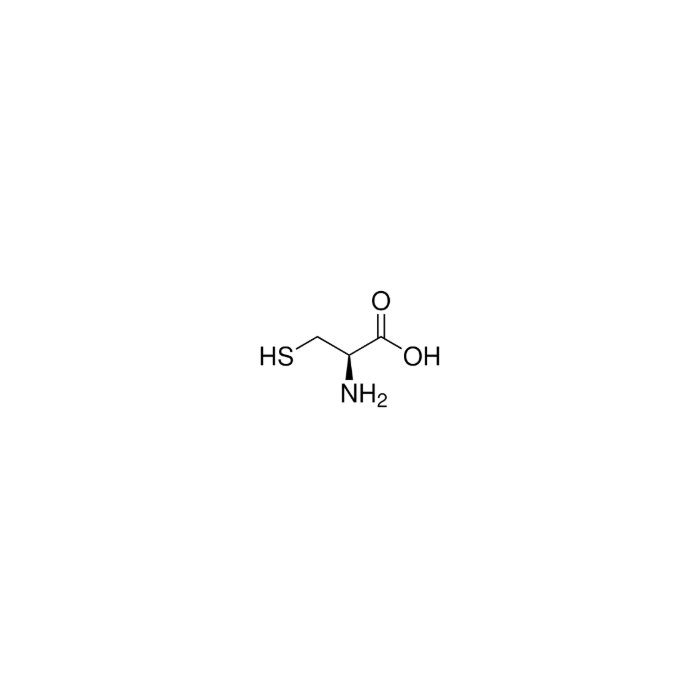
L-Cysteine - UltraBio™, ≥98.5%(RT) , CAS No.52-90-4

CAS: 52-90-4 Cat. No.: L755721 Formula: C3H7NO2S Molecular Weight: 121.16 Beilstein Registry Number: 4506 EC Number: 200-158-2
AVAILABLE TO ORDER
GRADE & PURITY UltraBio™ ? UltraBio™ — Aladdin's line for molecular-biology applications. Use for nuclease-free, high-consistency reagents across molecular workflows. ≥98.5%(RT)
Storage
Protected from light,Room temperature,Argon charged
Shipped In
Normal
★
Size
USA
Germany (EU)*
Price
Qty
25g
L755721-25g
Made to order · 8–12 wks
$203.90
100g
L755721-100g
Made to order · 8–12 wks
$616.90
500g
L755721-500g
Made to order · 8–12 wks
$2,290.90
Enter a quantity for the sizes you want to add.
🧪
Why this grade

UltraBio™, ≥98.5%(RT) UltraBio™ for sensitive chromatographic and analytical workflows requiring minimal baseline interference.

🌡

Storage & shipping

Protected from light,Room temperature,Argon charged Ships Normal Check lot-specific COA for exact specifications.

📋

Quality documents

SDS, COA, datasheet, and spec sheet available for download. Lot-specific COA accessible via lot number lookup.

📚

Literature proof

Cited in 1644 peer-reviewed publications across chromatography, organic synthesis, and cross-coupling reactions.

Overview

L-Cysteine has been used in quenching of unreacted maleimide during antibody grafting. It has also been used in the preparation of nitrosocysteine stock solution, that has been employed to induce S-nitrosylation to achieve reversible cysteine modification.

Specifications

Specifications & Purity
UltraBio™, ≥98.5%(RT)
Biochemical and Physiological Mechanisms
Cysteine is one of the functional amino acids that regulates metabolism for growth, reproduction, maintenance and immunity. Cysteine provides the disulfide linkage in proteins. It is directly associated with the transport of sulfur. Taurine, a metabolic p
Storage
Protected from light,Room temperature,Argon charged
Shipped In
Normal
Grade
UltraBio™
Purity
≥98.5%(RT)
Names and Identifiers
Canonical Smiles
C(C(C(=O)O)N)S
IUPAC Name
(2R)-2-amino-3-sulfanylpropanoic acid
InChIKey
XUJNEKJLAYXESH-REOHCLBHSA-N
INCHI
1S/C3H7NO2S/c4-2(1-7)3(5)6/h2,7H,1,4H2,(H,5,6)/t2-/m0/s1
Isomeric SMILES
C([C@@H](C(=O)O)N)S
Molecular Weight
121.16
Beilstein
4506
Reaxy-Rn
1721406
Reaxys-RN_link_address
https://www.reaxys.com/reaxys/secured/hopinto.do?context=S&query=IDE.XRN=1721406&ln=

Documentation

📋 Safety Data Sheet (SDS)

Comprehensive hazard, handling, storage, and regulatory compliance document.

Download SDS →

✅ Certificate of Analysis (COA)

Lot-specific quality data. Enter your lot number to retrieve the exact COA.

Look up COA →

📊 Datasheet

Quick-reference summary of product specifications and applications.

View datasheet →

🔬 Specification Sheet

Full quality attributes and acceptance criteria for this grade.

View spec sheet →

Advanced Data

Taxonomic Classification

Taxonomy Tree

KingdomOrganic compounds
SuperclassOrganic acids and derivatives
ClassCarboxylic acids and derivatives
SubclassAmino acids, peptides, and analogues
Intermediate Tree Nodes Amino acids and derivatives - Alpha amino acids and derivatives
Direct ParentCysteine and derivatives
Alternative Parents L-alpha-amino acids  Amino acids  Monocarboxylic acids and derivatives  Carboxylic acids  Alkylthiols  Organopnictogen compounds  Organic oxides  Monoalkylamines  Hydrocarbon derivatives  Carbonyl compounds  
Molecular FrameworkAliphatic acyclic compounds
Substituents Cysteine or derivatives - Alpha-amino acid - L-alpha-amino acid - Amino acid - Alkylthiol - Carboxylic acid - Monocarboxylic acid or derivatives - Organic oxygen compound - Primary amine - Organosulfur compound - Organooxygen compound - Organonitrogen compound - Organic nitrogen compound - Primary aliphatic amine - Carbonyl group - Amine - Hydrocarbon derivative - Organopnictogen compound - Organic oxide - Aliphatic acyclic compound
DescriptionThis compound belongs to the class of organic compounds known as cysteine and derivatives. These are compounds containing cysteine or a derivative thereof resulting from reaction of cysteine at the amino group or the carboxy group, or from the replacement of any hydrogen of glycine by a heteroatom.
External Descriptors Common amino acids
3D Structure
Interactive Chemical Structure Model


Certificates(CoA,COO,BSE/TSE and Analysis Chart)
C of A & Other Certificates(BSE/TSE, COO):
Analytical Chart:
Chemical and Physical Properties
Solubility1 M HCl: 1 M at 20 °C, clear, colorless
SensitivityLight and Air sensitive
Specific Rotation[α]8.8 ° (C=8, 1mol/L HCl)
Melt Point(°C)220°C
Molecular Weight121.160 g/mol
XLogP3-2.500
Hydrogen Bond Donor Count3
Hydrogen Bond Acceptor Count4
Rotatable Bond Count2
Exact Mass121.02 Da
Monoisotopic Mass121.02 Da
Topological Polar Surface Area64.300 Ų
Heavy Atom Count7
Formal Charge0
Complexity75.300
Isotope Atom Count0
Defined Atom Stereocenter Count1
Undefined Atom Stereocenter Count0
Defined Bond Stereocenter Count0
Undefined Bond Stereocenter Count0
The total count of all stereochemical bonds0
Covalently-Bonded Unit Count1
Documents & Articles
Sodium Polyanethol Sulfonate (SPS) ——A Multifunctional Agent for Anticoagulation, Complement Inhibition, and Signal Stabilization
UltraBio™: Defining Excellence in Molecular Biology Applications
Professional Guide to Streptavidin-Modified Proteins
List of Natural Amino Acids
Bio-based Chemicals: From Platform Molecules to Application Scenarios — Trend Insights and Aladdin’s Product Portfolio
Small-Molecule Inhibitors: A Practical Guide for Research Selection — A Minimal Evidence Chain and Scenario-Based Validation Framework (Including a Selection Matrix, Case Cards, and Product Tables 1–4)
A Practical Guide to Small-Molecule Chemical Probes: Concept Clarification, Causal Validation, and Experimental Selection (with Product Navigation and Tables A–D)
Methionine: Biological Roles and Key Points for Research Application
Glutaraldehyde-mediated Microbial Inactivation: Chemical Mechanisms, Determinants, and Key Validation Considerations
Clostridial Proteases: Classification, Molecular Mechanisms, and Research Applications
Invertebrate Oxygen Carrier Proteins in Immunology and Vaccine Research
β-Acyloxy Alkenyl Amides (AAAs): A New Approach to Amide Bond and Peptide Bond Construction Worth Attention
Silicon Reagent-Assisted Peptide Synthesis: Research Progress and Methodological Value of Peptide Bond Formation from Unprotected Substrates
From Analytical Instrument to Synthetic Platform: A New Strategy for Reconstructing Automated Flow Solid-Phase Peptide Synthesis with Standard Analytical HPLC
Roles of One-Carbon Metabolism Enzymes in Oxidative Stress and Epigenetic Regulation in Cardiovascular Diseases
Antioxidant Enzyme Networks in Skin Cells and Their Applications in Skincare and Cosmetics
Progress in Research on the S-Adenosylmethionine Cycle and Regulatory Mechanisms of Methyltransfer Reactions
Low-Racemization Control in Peptide Synthesis: An Inverse N→C Peptide Synthesis Strategy via Activated α-Aminoesters
Coupling Mechanisms Between Terminal Reducing-Power Allocation in Photosynthetic Electron Transport and Metabolic Demand
Methods and Applications for the Determination of Amino Acid Content and Composition
Thiol and Disulfide Status in Biological Samples: Detection Methods and Applications
Experimental Selection of Burgess Reagent: A Decision Framework for Alcohol Dehydration, Primary Amide/Aldoxime Dehydration, and Oxazoline/Thiazoline Cyclization
Designing Hydrogel Scaffolds as Programmable Cell Microenvironments: From Click-Chemistry Functionalization to 3D Cell Culture Experimental Design
Mechanistic Analysis of Topical Glutathione in Skincare: Cellular Redox Regulation, Skin Delivery Challenges, and SLN-Based Delivery Strategies
Mechanism of Kojic Acid in Reducing Hyperpigmentation: From Tyrosinase Inhibition to Melanin Production Regulation
Reactions and Applications of 3,3-Difluoroallyl Sulfonium Salts (DFASs): Small-Molecule gem-Difluoroallylation, Selective Peptide Modification, and Subsequent Functionalization
The Logic of Biomimetic Peptide Action in Skin: Sequence and Conformation, Skin Delivery, Stability, and Target Matching
How Arbutin Regulates Melanin Production: α/β Anomeric Configuration and Tyrosinase Action
Structural Characteristics of Ergothioneine, OCTN1-Mediated Uptake by Skin Cells, and Antioxidant Mechanisms
Why Proximity to Cysteine Does Not Necessarily Lead to Covalent Bond Formation: Warhead Reactivity, Reaction Geometry, and Target-Site Microenvironment
Electron Transfer and Nucleophilic Reactions of Benzoquinones: Effects of the Conjugated Dicarbonyl Structure, Substituents, and Medium
Structure–Reactivity Relationships of Naphthoquinone Compounds: Structural Control of Electron Transfer and Nucleophilic Addition
Citations of This Product
Solution Calculators
Reviews

Customer Reviews

Frequently Asked Questions

What does UltraBio? mean?
UltraBio? indicates that the product has been processed and tested for biological and biochemical applications. Specifications may include endotoxin limits, microbial controls, sterility, low DNase/RNase/protease activity, and verified biological activity where relevant.
How should this product be stored?
Store at room temperature, protected from light, under argon. It is supplied under an argon blanket; reseal under inert gas after each use.
How is this product shipped?
This product ships under standard ambient conditions. No temperature-controlled packaging is required.
What are the CAS number, molecular formula and molecular weight?
The CAS Number is 52-90-4, the molecular formula is C3H7NO2S, and the molecular weight is 121.16 g/mol. InChIKey XUJNEKJLAYXESH-REOHCLBHSA-N.
What documentation is provided?
Available product documentation, including Certificates of Analysis (COA), Safety Data Sheets (SDS), and specification sheets, is shown in the product document area. Document availability and access follow the current site policy.

Shall we send you a message when we have discounts available?

Remind me later

Thank you! Please check your email inbox to confirm.

Oops! Notifications are disabled.