Lithium Hexafluorophosphate - electronic grade, ≥99.99% trace metals basis, used for Lithium hexafluorophosphate (LiPF₆) battery grade is designed for battery research. It can be used in the research and development of lithium-ion batteries (LIBs). Its ro
Lithium Hexafluorophosphate - electronic grade, ≥99.99% trace metals basis, used for Lithium hexafluorophosphate (LiPF₆) battery grade is designed for battery research. It can be used in the research and development of lithium-ion batteries (LIBs). Its ro
GRADE & PURITYElectronic grade?Electronic grade — ultra-low metallic and particulate impurities for microelectronics. Use in semiconductor and electronics processes intolerant of contamination.≥99.99% trace metals basis
electronic grade, ≥99.99% trace metals basis Electronic grade for sensitive chromatographic and analytical workflows requiring minimal baseline interference.
🌡
Storage & shipping
Store at 2-8°C,Argon charged Ships Wet ice Check lot-specific COA for exact specifications.
📋
Quality documents
SDS, COA, datasheet, and spec sheet available for download. Lot-specific COA accessible via lot number lookup.
📚
Literature proof
Cited in 105 peer-reviewed publications across chromatography, organic synthesis, and cross-coupling reactions.
Overview
Lithium hexafluorophosphate (LiPF₆), battery grade, ≥99.99% trace metals basis comes as a white powder with trace metal impurities < 100.0 ppm. Lithium hexafluorophosphate is a class of electrolytic materials that can be used in the fabrication of lithium-ion batteries. Lithium-ion batteries consist of anode, cathode, and electrolyte with a charge-discharge cycle. These materials enable the formation of greener and sustainable batteries for electrical energy storage. Advantages and Specific The product is designed with stringent parameters to fulfill the research needs in batteries. It ensures minimal interference from contaminants in trace metal analysis, providing high-purity results. Exceptional Purity: ≥99.99% purity minimizes contamination from trace metals, ensuring suitability for applications sensitive to even minute impurities. Consistent Performance: Ultra-high purity guarantees consistent performance across various applications, reducing variability and enhancing reliability. High Purity Standard: Ideal as a standard or reagent for trace metal analysis and high-precision analytical techniques, ensuring accurate and reliable results. Battery grade for use in battery applications, ensuring suitability and performance.
Specifications
Synonyms
Lithium phosphorus fluoride
Specifications & Purity
electronic grade, ≥99.99% trace metals basis
Application
Lithium hexafluorophosphate (LiPF₆) battery grade is designed for battery research. It can be used in the research and development of lithium-ion batteries (LIBs). Its role as a primary electrolyte salt is pivotal due to its high ionic conductivity, elect
Storage
Store at 2-8°C,Argon charged
Shipped In
Wet ice
This product requires cold chain shipping. Ground and other economy services are not available.
Grade
Electronic grade
Purity
≥99.99% trace metals basis
Names and Identifiers
Canonical Smiles
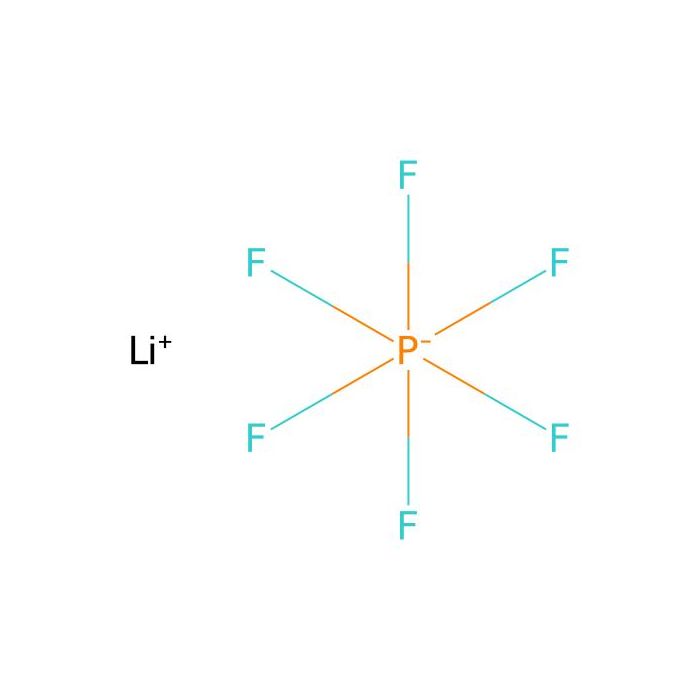
[Li+].F[P-](F)(F)(F)(F)F
IUPAC Name
lithium;hexafluorophosphate
InChIKey
AXPLOJNSKRXQPA-UHFFFAOYSA-N
INCHI
1S/F6P.Li/c1-7(2,3,4,5)6;/q-1;+1
Isomeric SMILES
[Li+].F[P-](F)(F)(F)(F)F
WGK Germany
3
UN Number
2923
Packing Group
I
Molecular Weight
151.90
Reaxy-Rn
11551515
Documentation
📋 Safety Data Sheet (SDS)
Comprehensive hazard, handling, storage, and regulatory compliance document.
Alkali metal fluoride - Inorganic lithium salt - Inorganic salt
Description
This compound belongs to the class of inorganic compounds known as alkali metal fluorides. These are inorganic compounds in which the largest halogen atom is fluorine, and the heaviest metal atom is an alkali metal.
External Descriptors
Not available
1. Djoumbou Feunang Y, Eisner R, Knox C, Chepelev L, Hastings J, Owen G, Fahy E, Steinbeck C, Subramanian S, Bolton E, Greiner R, and Wishart DS. ClassyFire: Automated Chemical Classification With A Comprehensive, Computable Taxonomy. Journal of Cheminformatics, 2016, 8:61.
We use cookies to ensure the website functions properly and, where permitted, to improve your experience. You can manage your preferences at any time in Settings. Learn more in our Cookie Policy.
Shall we send you a message when we have discounts available?
Remind me later
Thank you! Please check your email inbox to confirm.
Products are supplied to verified businesses, institutions, and qualified professionals for research and development use only. Not for use in humans, animals, diagnosis, or therapy.

 A2627439