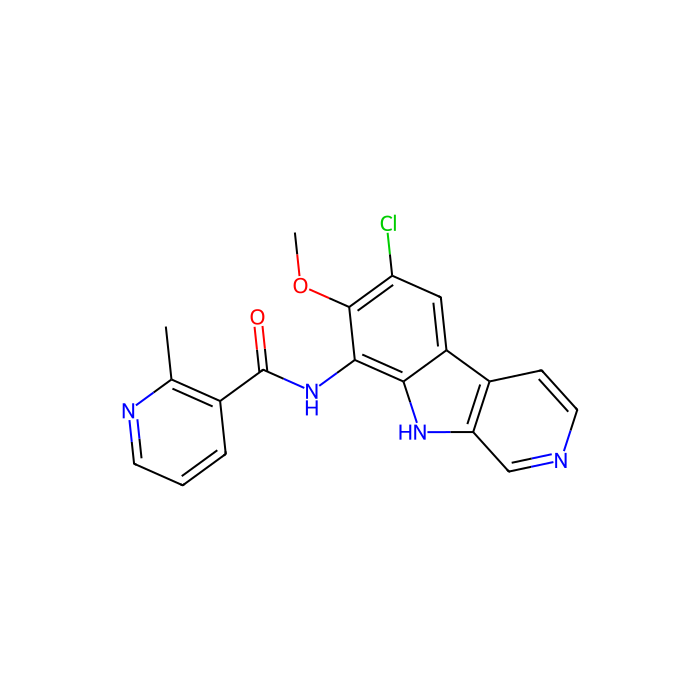
MLN120B - Moligand™, ≥98% , Inhibitor of inhibitor of nuclear factor kappa B kinase subunit beta, CAS No.783348-36-7, Inhibitor of inhibitor of nuclear factor kappa B kinase subunit beta

CAS: 783348-36-7 Cat. No.: M127370 Formula: C19H15ClN4O2 Molecular Weight: 366.8 EC Number: 809-486-6
AVAILABLE TO ORDER
GRADE & PURITY Moligand™ ? Moligand™ — Aladdin's line of ligands and bioactive small molecules. Use for receptor, pathway, and binding studies needing defined small-molecule tools. ≥98%
Synonyms
DTXSID50432993 | N-(6-Chloro-7-methoxy-9H-pyrido(3,4-b)indol-8-yl)-2-methylpyridine-3-carboxamide | NCGC00263021-01 | BDBM50309910 | N-(6-chloro-7-methoxy-9H-beta-carbolin-8-yl)-2-methyl-nicotinamide | N-(6-chloro-7-methoxy-9H-pyrido[3,4-b]indol-8-yl)-2-m
Storage
Store at -20°C
Shipped In
Ice chest + Ice pads
★
Size
USA
Germany (EU)*
Price
Qty
5mg
M127370-5mg
3 In stock
—

$35.90

$53.90
Save $18.00 (33.40%)
10mg
M127370-10mg
3 In stock
—

$64.90

$97.90
Save $33.00 (33.71%)
25mg
M127370-25mg
2 In stock
—

$140.90

$211.90
Save $71.00 (33.51%)
50mg
M127370-50mg
2 In stock
—

$237.90

$356.90
Save $119.00 (33.34%)
100mg
M127370-100mg
Made to order · 8–12 wks

$403.90

$605.90
Save $202.00 (33.34%)
Enter a quantity for the sizes you want to add.
🧪
Why this grade

Moligand™, ≥98% Moligand™ for sensitive chromatographic and analytical workflows requiring minimal baseline interference.

🌡

Storage & shipping

Store at -20°C Ships Ice chest + Ice pads Check lot-specific COA for exact specifications.

📋

Quality documents

SDS, COA, datasheet, and spec sheet available for download. Lot-specific COA accessible via lot number lookup.

📚

Literature proof

Cited in 0 peer-reviewed publications across chromatography, organic synthesis, and cross-coupling reactions.

Overview

MLN120B is a potent and effective IKKbeta inhibitor.

Specifications

Synonyms
DTXSID50432993 | N-(6-Chloro-7-methoxy-9H-pyrido(3,4-b)indol-8-yl)-2-methylpyridine-3-carboxamide | NCGC00263021-01 | BDBM50309910 | N-(6-chloro-7-methoxy-9H-beta-carbolin-8-yl)-2-methyl-nicotinamide | N-(6-chloro-7-methoxy-9H-pyrido[3,4-b]indol-8-yl)-2-m
Specifications & Purity
Moligand™, ≥98%
Biochemical and Physiological Mechanisms
ML120B is a potent inhibitor of IKK-2 (IC50 = 60 nM). ML120B is orally bioavailable, and inhibits paw swelling, bone and cartilage degradation, and weight loss in rat adjuvant-induced arthritis.
Storage
Store at -20°C
Shipped In
Ice chest + Ice pads
This product requires cold chain shipping. Ground and other economy services are not available.
Grade
Moligand™
Action Type
INHIBITOR
Mechanism of action
Inhibitor of inhibitor of nuclear factor kappa B kinase subunit beta
Purity
≥98%
Names and Identifiers
Pubchem Sid
Pubchem Sid Url
https://pubchem.ncbi.nlm.nih.gov/substance/504765108
Canonical Smiles
CC1=C(C=CC=N1)C(=O)NC2=C3C(=CC(=C2OC)Cl)C4=C(N3)C=NC=C4
IUPAC Name
N-(6-chloro-7-methoxy-9H-pyrido[3,4-b]indol-8-yl)-2-methylpyridine-3-carboxamide
InChIKey
ZNOLRTPMNMPLHY-UHFFFAOYSA-N
INCHI
1S/C19H15ClN4O2/c1-10-11(4-3-6-22-10)19(25)24-17-16-13(8-14(20)18(17)26-2)12-5-7-21-9-15(12)23-16/h3-9,23H,1-2H3,(H,24,25)
Isomeric SMILES
CC1=C(C=CC=N1)C(=O)NC2=C3C(=CC(=C2OC)Cl)C4=C(N3)C=NC=C4
Molecular Weight
366.8
Reaxy-Rn
10379640
Reaxys-RN_link_address
https://www.reaxys.com/reaxys/secured/hopinto.do?context=S&query=IDE.XRN=10379640&ln=

Documentation

📋 Safety Data Sheet (SDS)

Comprehensive hazard, handling, storage, and regulatory compliance document.

Download SDS →

✅ Certificate of Analysis (COA)

Lot-specific quality data. Enter your lot number to retrieve the exact COA.

Look up COA →

📊 Datasheet

Quick-reference summary of product specifications and applications.

View datasheet →

🔬 Specification Sheet

Full quality attributes and acceptance criteria for this grade.

View spec sheet →

Advanced Data

Taxonomic Classification

Taxonomy Tree

KingdomOrganic compounds
SuperclassOrganoheterocyclic compounds
ClassIndoles and derivatives
SubclassPyridoindoles
Intermediate Tree Nodes Not available
Direct ParentBeta carbolines
Alternative Parents Nicotinamides  Methoxyanilines  Indoles  Anisoles  Methylpyridines  Alkyl aryl ethers  Aryl chlorides  Pyrroles  Heteroaromatic compounds  Secondary carboxylic acid amides  Azacyclic compounds  Organonitrogen compounds  Organochlorides  Organic oxides  Hydrocarbon derivatives  
Molecular FrameworkAromatic heteropolycyclic compounds
Substituents Beta-carboline - Indole - Nicotinamide - Pyridinecarboxamide - Pyridine carboxylic acid or derivatives - Methoxyaniline - Anisole - Phenol ether - Methylpyridine - Alkyl aryl ether - Benzenoid - Pyridine - Aryl chloride - Aryl halide - Pyrrole - Heteroaromatic compound - Secondary carboxylic acid amide - Carboxamide group - Azacycle - Carboxylic acid derivative - Ether - Hydrocarbon derivative - Organic oxygen compound - Organic oxide - Organohalogen compound - Organic nitrogen compound - Organochloride - Organonitrogen compound - Organooxygen compound - Aromatic heteropolycyclic compound
DescriptionThis compound belongs to the class of organic compounds known as beta carbolines. These are compounds containing a 9H-pyrido[3,4-b]indole moiety.
External Descriptors Not available
3D Structure
Interactive Chemical Structure Model


Associated Targets(Human)
IKBKB Tchem Inhibitor of nuclear factor kappa-B kinase subunit beta (2 Activities)
Activity TypeActivity Value -log(M)Mechanism of ActionActivity ReferencePublications (PubMed IDs)
ABL1 Tclin Tyrosine-protein kinase ABL (18331 Activities)
Activity TypeRelationActivity valueUnitsAction TypeJournalPubMed IddoiAssay Aladdin ID
EGFR Tclin Epidermal growth factor receptor erbB1 (33727 Activities)
Activity TypeRelationActivity valueUnitsAction TypeJournalPubMed IddoiAssay Aladdin ID
INSR Tclin Insulin receptor (5558 Activities)
Activity TypeRelationActivity valueUnitsAction TypeJournalPubMed IddoiAssay Aladdin ID
ERBB2 Tclin Receptor protein-tyrosine kinase erbB-2 (7851 Activities)
Activity TypeRelationActivity valueUnitsAction TypeJournalPubMed IddoiAssay Aladdin ID
PDGFRB Tclin Platelet-derived growth factor receptor beta (5195 Activities)
Activity TypeRelationActivity valueUnitsAction TypeJournalPubMed IddoiAssay Aladdin ID
IGF1R Tclin Insulin-like growth factor I receptor (8605 Activities)
Activity TypeRelationActivity valueUnitsAction TypeJournalPubMed IddoiAssay Aladdin ID
KIT Tclin Stem cell growth factor receptor (10667 Activities)
Activity TypeRelationActivity valueUnitsAction TypeJournalPubMed IddoiAssay Aladdin ID
CSNK2A1 Tchem Casein kinase II alpha (3512 Activities)
Activity TypeRelationActivity valueUnitsAction TypeJournalPubMed IddoiAssay Aladdin ID
DAPK3 Tchem Death-associated protein kinase 3 (2108 Activities)
Activity TypeRelationActivity valueUnitsAction TypeJournalPubMed IddoiAssay Aladdin ID
MAPK11 Tchem MAP kinase p38 beta (2785 Activities)
Activity TypeRelationActivity valueUnitsAction TypeJournalPubMed IddoiAssay Aladdin ID
LCK Tclin Tyrosine-protein kinase LCK (9212 Activities)
Activity TypeRelationActivity valueUnitsAction TypeJournalPubMed IddoiAssay Aladdin ID
MAPK14 Tchem MAP kinase p38 alpha (12866 Activities)
Activity TypeRelationActivity valueUnitsAction TypeJournalPubMed IddoiAssay Aladdin ID
GSK3B Tclin Glycogen synthase kinase-3 beta (11785 Activities)
Activity TypeRelationActivity valueUnitsAction TypeJournalPubMed IddoiAssay Aladdin ID
PRKACB Tchem cAMP-dependent protein kinase beta-1 catalytic subunit (589 Activities)
Activity TypeRelationActivity valueUnitsAction TypeJournalPubMed IddoiAssay Aladdin ID
MAP2K6 Tchem Dual specificity mitogen-activated protein kinase kinase 6 (1284 Activities)
Activity TypeRelationActivity valueUnitsAction TypeJournalPubMed IddoiAssay Aladdin ID
MYLK Tchem Myosin light chain kinase, smooth muscle (1267 Activities)
Activity TypeRelationActivity valueUnitsAction TypeJournalPubMed IddoiAssay Aladdin ID
CSNK1G1 Tchem Casein kinase I gamma 1 (2496 Activities)
Activity TypeRelationActivity valueUnitsAction TypeJournalPubMed IddoiAssay Aladdin ID
FGFR2 Tclin Fibroblast growth factor receptor 2 (3405 Activities)
Activity TypeRelationActivity valueUnitsAction TypeJournalPubMed IddoiAssay Aladdin ID
FGFR1 Tclin Fibroblast growth factor receptor 1 (9149 Activities)
Activity TypeRelationActivity valueUnitsAction TypeJournalPubMed IddoiAssay Aladdin ID
STK3 Tchem Serine/threonine-protein kinase MST2 (3069 Activities)
Activity TypeRelationActivity valueUnitsAction TypeJournalPubMed IddoiAssay Aladdin ID
CSNK1D Tchem Casein kinase I delta (4546 Activities)
Activity TypeRelationActivity valueUnitsAction TypeJournalPubMed IddoiAssay Aladdin ID
MAP2K5 Tchem Dual specificity mitogen-activated protein kinase kinase 5 (650 Activities)
Activity TypeRelationActivity valueUnitsAction TypeJournalPubMed IddoiAssay Aladdin ID
CAMK2B Tchem CaM kinase II beta (1626 Activities)
Activity TypeRelationActivity valueUnitsAction TypeJournalPubMed IddoiAssay Aladdin ID
SRC Tclin Tyrosine-protein kinase SRC (10310 Activities)
Activity TypeRelationActivity valueUnitsAction TypeJournalPubMed IddoiAssay Aladdin ID
MAP2K3 Tchem Dual specificity mitogen-activated protein kinase kinase 3 (632 Activities)
Activity TypeRelationActivity valueUnitsAction TypeJournalPubMed IddoiAssay Aladdin ID
CHEK2 Tchem Serine/threonine-protein kinase Chk2 (4015 Activities)
Activity TypeRelationActivity valueUnitsAction TypeJournalPubMed IddoiAssay Aladdin ID
PDPK1 Tchem 3-phosphoinositide dependent protein kinase-1 (3758 Activities)
Activity TypeRelationActivity valueUnitsAction TypeJournalPubMed IddoiAssay Aladdin ID
PRKAA2 Tchem AMP-activated protein kinase, alpha-2 subunit (1328 Activities)
Activity TypeRelationActivity valueUnitsAction TypeJournalPubMed IddoiAssay Aladdin ID
AKT2 Tchem Serine/threonine-protein kinase AKT2 (4301 Activities)
Activity TypeRelationActivity valueUnitsAction TypeJournalPubMed IddoiAssay Aladdin ID
AKT3 Tchem Serine/threonine-protein kinase AKT3 (3157 Activities)
Activity TypeRelationActivity valueUnitsAction TypeJournalPubMed IddoiAssay Aladdin ID
CHUK Tchem Inhibitor of nuclear factor kappa B kinase alpha subunit (3170 Activities)
Activity TypeRelationActivity valueUnitsAction TypeJournalPubMed IddoiAssay Aladdin ID
IKBKB Tchem Inhibitor of nuclear factor kappa B kinase beta subunit (5554 Activities)
Activity TypeRelationActivity valueUnitsAction TypeJournalPubMed IddoiAssay Aladdin ID
DAPK2 Tchem Death-associated protein kinase 2 (740 Activities)
Activity TypeRelationActivity valueUnitsAction TypeJournalPubMed IddoiAssay Aladdin ID
AURKB Tchem Serine/threonine-protein kinase Aurora-B (6805 Activities)
Activity TypeRelationActivity valueUnitsAction TypeJournalPubMed IddoiAssay Aladdin ID
RPS6KA4 Tchem Ribosomal protein S6 kinase alpha 4 (2104 Activities)
Activity TypeRelationActivity valueUnitsAction TypeJournalPubMed IddoiAssay Aladdin ID
ROCK1 Tclin Rho-associated protein kinase 1 (4723 Activities)
Activity TypeRelationActivity valueUnitsAction TypeJournalPubMed IddoiAssay Aladdin ID
PIM1 Tchem Serine/threonine-protein kinase PIM1 (9629 Activities)
Activity TypeRelationActivity valueUnitsAction TypeJournalPubMed IddoiAssay Aladdin ID
PKN2 Tchem Protein kinase N2 (1991 Activities)
Activity TypeRelationActivity valueUnitsAction TypeJournalPubMed IddoiAssay Aladdin ID
CSK Tchem Tyrosine-protein kinase CSK (2395 Activities)
Activity TypeRelationActivity valueUnitsAction TypeJournalPubMed IddoiAssay Aladdin ID
JAK3 Tclin Tyrosine-protein kinase JAK3 (8349 Activities)
Activity TypeRelationActivity valueUnitsAction TypeJournalPubMed IddoiAssay Aladdin ID
RPS6KA5 Tchem Ribosomal protein S6 kinase alpha 5 (3355 Activities)
Activity TypeRelationActivity valueUnitsAction TypeJournalPubMed IddoiAssay Aladdin ID
PRKCE Tchem Protein kinase C epsilon (1520 Activities)
Activity TypeRelationActivity valueUnitsAction TypeJournalPubMed IddoiAssay Aladdin ID
PRKD3 Tchem Protein kinase C nu (2315 Activities)
Activity TypeRelationActivity valueUnitsAction TypeJournalPubMed IddoiAssay Aladdin ID
PRKCI Tchem Protein kinase C iota (2821 Activities)
Activity TypeRelationActivity valueUnitsAction TypeJournalPubMed IddoiAssay Aladdin ID
PRKD1 Tchem Protein kinase C mu (1904 Activities)
Activity TypeRelationActivity valueUnitsAction TypeJournalPubMed IddoiAssay Aladdin ID
RAF1 Tclin Serine/threonine-protein kinase RAF (4169 Activities)
Activity TypeRelationActivity valueUnitsAction TypeJournalPubMed IddoiAssay Aladdin ID
SYK Tclin Tyrosine-protein kinase SYK (7372 Activities)
Activity TypeRelationActivity valueUnitsAction TypeJournalPubMed IddoiAssay Aladdin ID
PLK1 Tchem Serine/threonine-protein kinase PLK1 (28605 Activities)
Activity TypeRelationActivity valueUnitsAction TypeJournalPubMed IddoiAssay Aladdin ID
ITK Tclin Tyrosine-protein kinase ITK/TSK (3699 Activities)
Activity TypeRelationActivity valueUnitsAction TypeJournalPubMed IddoiAssay Aladdin ID
JAK1 Tclin Tyrosine-protein kinase JAK1 (8569 Activities)
Activity TypeRelationActivity valueUnitsAction TypeJournalPubMed IddoiAssay Aladdin ID
Associated Targets(non-human)
Cdk4 Cyclin-dependent kinase 4 (3 Activities)
Activity TypeRelationActivity valueUnitsAction TypeJournalPubMed IddoiAssay Aladdin ID
PIK3CA PI3-kinase p110-alpha subunit (51 Activities)
Activity TypeRelationActivity valueUnitsAction TypeJournalPubMed IddoiAssay Aladdin ID
Prkcd Protein kinase C delta (192 Activities)
Activity TypeRelationActivity valueUnitsAction TypeJournalPubMed IddoiAssay Aladdin ID
Mapk1 MAP kinase ERK2 (650 Activities)
Activity TypeRelationActivity valueUnitsAction TypeJournalPubMed IddoiAssay Aladdin ID
Fgfr4 Fibroblast growth factor receptor 4 (138 Activities)
Activity TypeRelationActivity valueUnitsAction TypeJournalPubMed IddoiAssay Aladdin ID
Fgfr3 Fibroblast growth factor receptor 3 (21 Activities)
Activity TypeRelationActivity valueUnitsAction TypeJournalPubMed IddoiAssay Aladdin ID
Camk2g CaM kinase II gamma (1 Activities)
Activity TypeRelationActivity valueUnitsAction TypeJournalPubMed IddoiAssay Aladdin ID
Tec Tyrosine-protein kinase TEC (25 Activities)
Activity TypeRelationActivity valueUnitsAction TypeJournalPubMed IddoiAssay Aladdin ID
rep Replicase polyprotein 1ab (378 Activities)
Activity TypeRelationActivity valueUnitsAction TypeJournalPubMed IddoiAssay Aladdin ID
pknB Serine/threonine-protein kinase pknB (356 Activities)
Activity TypeRelationActivity valueUnitsAction TypeJournalPubMed IddoiAssay Aladdin ID
CDPK1 Calcium-dependent protein kinase 1 (793 Activities)
Activity TypeRelationActivity valueUnitsAction TypeJournalPubMed IddoiAssay Aladdin ID
CRK2 Cell division control protein 2 homolog (194 Activities)
Activity TypeRelationActivity valueUnitsAction TypeJournalPubMed IddoiAssay Aladdin ID
Mechanisms of Action
Certificates(CoA,COO,BSE/TSE and Analysis Chart)
C of A & Other Certificates(BSE/TSE, COO):
Analytical Chart:

Find and download the COA for your product by matching the lot number on the packaging.

6 results found

Lot NumberCertificate TypeDateItem
C2623039Certificate of AnalysisApr 07, 2026 M127370
A2206049Certificate of AnalysisJul 15, 2025 M127370
A2206050Certificate of AnalysisJul 15, 2025 M127370
A2206052Certificate of AnalysisJul 15, 2025 M127370
A2206054Certificate of AnalysisJul 15, 2025 M127370
A2206055Certificate of AnalysisJul 15, 2025 M127370
Chemical and Physical Properties
Solubilityinsoluble in H2O; ≥13.2 mg/mL in DMSO; ≥8.53 mg/mL in EtOH with gentle warming and ultrasonic
Molecular Weight366.800 g/mol
XLogP33.100
Hydrogen Bond Donor Count2
Hydrogen Bond Acceptor Count4
Rotatable Bond Count3
Exact Mass366.088 Da
Monoisotopic Mass366.088 Da
Topological Polar Surface Area79.900 Ų
Heavy Atom Count26
Formal Charge0
Complexity522.000
Isotope Atom Count0
Defined Atom Stereocenter Count0
Undefined Atom Stereocenter Count0
Defined Bond Stereocenter Count0
Undefined Bond Stereocenter Count0
The total count of all stereochemical bonds0
Covalently-Bonded Unit Count1
Documents & Articles
Solution Calculators
Reviews

Customer Reviews

Application Protocols

No vendor-validated biological assay protocols or dilutions are provided for this SKU.

General/literature-style guidance for small-molecule probes (non-spec):

  • Biochemical IKK pathway assays: Prepare DMSO stocks; perform dose–response (e.g., 10-point half-log series) with constant vehicle percentage. Include control inhibitors and orthogonal readouts (e.g., kinase activity vs. substrate phosphorylation).
  • Cell-based NF-κB reporter assays: Treat cells with serial dilutions of compound, then stimulate pathway (e.g., TNF-α) and quantify reporter signal; include vehicle-only and stimulation-only controls.
  • Western blot readouts: Assess IκBα phosphorylation/degradation or p65 nuclear translocation as pathway markers; maintain matched DMSO controls.

Practical notes:

  • Verify compound integrity by LC–MS before critical experiments.
  • Use low-adsorption plates/tubes and pre-warm media to minimize precipitation.
  • Record final DMSO concentration and exposure time in ELN for reproducibility.

For detailed SOPs or compound-specific conditions, consult primary literature or develop lab-specific protocols.

Biological Roles

Context for research use (literature, general):

  • MLN120B is widely cited as a small-molecule modulator used to interrogate the IKKβ (IKK2)–NF-κB signaling axis. Inhibition of IKKβ prevents phosphorylation-triggered degradation of IκB proteins, thereby suppressing NF-κB nuclear translocation and transcriptional activity in model systems. This enables researchers to probe the role of NF-κB signaling in cell responses to cytokines, stress, or pathogen-associated signals.
  • Utility in systems biology: Employed in transcriptomic, proteomic, and reporter-based assays to map pathway dependence and to deconvolute upstream receptor or adaptor contributions (e.g., TLR or TNF-receptor signaling in model cell lines).
  • Chemical biology controls: Often used alongside unrelated NF-κB modulators or genetic perturbations (siRNA/CRISPR) for orthogonality.

Cautions:

  • Potency, selectivity, and off-target profiles may vary by assay format and species. Validate concentration ranges empirically and consult primary references for context.
  • No therapeutic or diagnostic claims are made; this compound is provided strictly for research use.
Buffer Applications

This product is not a buffering agent. However, buffer composition is relevant when preparing working solutions for biochemical or cell-based assays.

General guidance (non-spec):

  • Biochemical assays: Use standard assay buffers (e.g., 20–50 mM HEPES or Tris, pH 7.2–7.5, with 50–150 mM NaCl, 0.01% Tween-20 if needed). Maintain a consistent final DMSO concentration across controls and treatments.
  • Cell culture: Add compound from sterile DMSO stocks directly to culture media to achieve the desired working concentration; ensure the final DMSO percentage is within the cell line’s tolerance (often ≤0.1–0.2%).
  • Adsorption/precipitation: Pre-wet plasticware with media or include minimal serum/protein to reduce nonspecific adsorption of hydrophobic ligands. Inspect for precipitation after dilution.

For any buffer-sensitive readouts, perform a small compatibility screen varying ionic strength, pH, and detergent at fixed compound concentration.

Green Alternatives

As a research probe, MLN120B itself is not replaceable by a “green solvent,” but greener choices can be made in how it is handled and formulated for experiments.

Greener handling considerations (general):

  • Prefer DMSO over DMF/NMP when compatible; DMSO has a more favorable hazard profile and broad assay compatibility.
  • Use aqueous buffers with minimal organic cosolvent at the working concentration (e.g., ≤0.1–0.2% DMSO when assay performance allows).
  • Employ microscale assay formats (96–384 well) to minimize solvent and compound usage.
  • Choose PTFE syringe filters and low-adsorption plastics to reduce the need for repeat preparations.

Comparison (general):

  • DMSO vs DMF/NMP: DMSO typically offers lower toxicity and better biodegradability; DMF and NMP are effective solvents but have more stringent regulatory and occupational exposure considerations.

Waste minimization:

  • Consolidate organic waste streams, maintain segregated halogenated vs non-halogenated containers, and neutralize aqueous waste per institutional EHS guidance.
Pharmaceutical Uses

This product is supplied strictly for research use and is not intended for human or veterinary use.

Relevant research/manufacturing contexts (general):

  • Can serve as a reference standard or tool compound in drug discovery to benchmark new chemical entities targeting components of the NF-κB pathway.
  • Utilized in assay development and validation (e.g., enzymatic IKKβ assays, reporter gene systems) to establish dynamic range and positive-control inhibition.
  • Formulation R&D: Limited-scale pre-formulation studies (solubility screens, excipient compatibility) may be performed to inform discovery-stage PK/PD experiments in non-clinical research.

Compliance status:

  • No pharmacopeial monograph is implied or provided for this item.
  • GMP status: Not GMP; not for clinical applications.

If a GLP- or GMP-like quality level is required for regulated studies, contact us to discuss custom sourcing or higher-tier analytical packages.

Physical Properties

Item-specific physico-chemical specifications are not provided in this listing.

  • Appearance: Not specified for this item; refer to CoA/Spec Sheet.
  • Molecular weight: Not specified for this item; refer to CoA/Spec Sheet.
  • Molecular formula: Not specified for this item; refer to CoA/Spec Sheet.
  • Melting point: Not specified for this item; refer to CoA/Spec Sheet.
  • Boiling point: Not applicable/Not determined for a non-volatile research solid; refer to CoA/Spec Sheet.
  • Density: Not specified for this item; refer to CoA/Spec Sheet.
  • Solubility: Not specified for this item; refer to CoA/Spec Sheet.
  • LogP/logD: Not specified for this item; refer to CoA/Spec Sheet.
  • pKa(s): Not specified for this item; refer to CoA/Spec Sheet.
  • Refractive index: Not applicable (solid) / Not specified for this item; refer to CoA/Spec Sheet.

General/literature guidance (non-spec):

  • Small-molecule kinase-pathway probes of this class are commonly handled as DMSO stock solutions (e.g., 10–50 mM) due to low aqueous solubility; working dilutions are prepared into aqueous buffers with a final DMSO content typically ≤0.1–0.5% v/v, as assay tolerance permits. Verify actual solubility and stability for this lot via CoA or small-scale tests.
Quality & Grades
  • Grade/Purity: Moligand™

What Moligand™ generally signifies:

  • Intended for use as a research ligand/biological probe candidate in screening, profiling, and mechanism-of-action studies. Emphasis is placed on identity and suitability for discovery workflows rather than on ultra-trace contaminant specifications required for GMP or clinical use.
  • Typical quality controls may include structural identity (e.g., NMR/HRMS), purity by HPLC/UPLC, and confirmation against known literature identity. Exact tests and acceptance criteria for this SKU are not listed here.

Item-specific notes:

  • Purity, residual solvent levels, water content, and impurity limits: Not specified for this item; refer to CoA/Spec Sheet.
  • Stabilizers/inhibitors: Not specified for this item; refer to CoA/Spec Sheet.
  • UV cutoff or LC baseline suitability: Not specified for this item; refer to CoA/Spec Sheet.

Guidance for researchers:

  • For screening assays, verify purity and concentration by an orthogonal method if your application is highly purity-sensitive (e.g., biophysics, target deconvolution).
  • If you require analytical reagent grade or pharmacopoeial compliance, contact us for options; this Moligand™ listing is for research use only.
Reaction & Applications

This SKU is supplied as a defined small-molecule research compound; it is not primarily intended as a synthetic reagent. Applications are centered on its use as a chemical probe.

Research applications (general, literature context):

  • Tool compound for modulating the NF-κB/IKK pathway in biochemical and cellular studies. Researchers commonly employ such probes to dissect pathway dependence, validate target engagement in cells, and benchmark new inhibitor chemotypes.
  • Use in target/pathway validation: Time-course studies, dose–response characterization, and washout/recovery experiments to explore reversibility and kinetics of signaling changes.
  • Chemical biology workflows: Chemical rescue/antagonism experiments, combination studies with upstream/downstream modulators, and orthogonal assay confirmation (e.g., biochemical enzyme inhibition vs. cell-based reporter assays).

Practical tips:

  • Prepare concentrated stock solutions in DMSO; avoid freeze–thaw cycling (see Storage tab).
  • Confirm identity/purity by LC–MS or HPLC against the supplied CoA when quantitative interpretation is required.
  • Include proper vehicle controls (matched DMSO) and evaluate potential off-target effects with counter-screens.

Note: No medical or clinical use is intended; this product is for laboratory research only.

Reaction Conditions

This section typically applies to reagents used in chemical synthesis. MLN120B is supplied as a finished small-molecule probe; no specific synthetic reaction conditions are associated with its use.

General laboratory handling conditions (non-spec):

  • Stock preparation: Dissolve in dry, anhydrous DMSO to prepare concentrated stocks (e.g., 10–50 mM). Vortex and, if needed, sonicate briefly to aid dissolution. Avoid moisture ingress to the stock vial.
  • Working solutions: Dilute into assay buffer or cell culture media with thorough mixing to avoid local over-concentration; maintain consistent vehicle (DMSO) across controls.
  • Light/temperature: Many heteroaromatic small molecules are light- and heat-sensitive; minimize exposure to bright light and avoid prolonged heating. Store at the recommended temperature (see Storage tab).

Yield/performance expectations: Not applicable.

For any synthetic derivatization or route scouting, consult the primary literature for MLN120B or related scaffolds; conditions will vary widely based on the chosen transformation.

Safety & Handling

Authoritative safety information resides in the product’s SDS. The following are general laboratory practices for handling research small molecules.

  • GHS classification, signal word, pictograms, H-statements: Not specified for this item; refer to the SDS.
  • Primary hazards (general): Low-volatility organic solids may cause irritation to skin, eyes, and respiratory tract; toxicity profiles vary by compound. Avoid inhalation of dust and contact with skin/eyes. Handle in a fume hood when weighing or dissolving.
  • PPE: Lab coat, safety glasses, and appropriate chemically resistant gloves (e.g., nitrile). Use dust control practices and eye protection during weighing.
  • Incompatibilities: Strong oxidizers, strong acids/bases, and reactive reducing agents may be incompatible depending on functional groups (consult SDS/CoA). Avoid prolonged exposure to moisture, light, and elevated temperature.
  • First aid (general):
    • Inhalation: Move to fresh air; seek medical attention if symptoms occur.
    • Skin contact: Wash with soap and water; remove contaminated clothing.
    • Eye contact: Rinse cautiously with water for several minutes; remove contact lenses if present and easy; seek medical attention if irritation persists.
    • Ingestion: Rinse mouth; seek medical attention.
  • Spill/cleanup: Avoid dust formation; collect with inert absorbent; dispose per local regulations.
  • Fire: Use CO2, dry chemical, or foam; combustion may produce irritating/toxic fumes; firefighters wear SCBA.

Always consult the SDS for the specific lot before use.

Solvent Selection

This product is a small-molecule research tool rather than a solvent; solvent choice here refers to dissolving/stock preparation for assays.

General/literature-based guidance (non-spec):

  • Primary stock solvent: DMSO is typically preferred for hydrophobic kinase-pathway modulators due to high solubilizing power and chemical compatibility across many assays.
  • Secondary options: DMF or NMP can be used if DMSO solubility is limited; ensure biological system tolerance and assess potential interference.
  • Aqueous work: Prepare working dilutions by adding the DMSO stock into buffered aqueous media (e.g., PBS, assay buffer, or culture media) with vigorous mixing to avoid local supersaturation; keep final DMSO ≤0.1–0.5% v/v as the system allows.
  • Co-solvents/surfactants: Small fractions of ethanol, PEG-400, or nonionic surfactants (e.g., 0.01–0.05% Tween-20) may assist solubilization in biochemical assays; validate for your readout.

Selection tips:

  • Prioritize DMSO for highest solubility and stability; switch to DMF/NMP only if justified and compatible with the assay.
  • Filter sterilize through 0.22 µm PTFE for cell-based work if needed; avoid cellulose ester filters if using strong organic solvents.
Storage & Reconstitution
  • Storage conditions (item-specific): Store at -20°C (as provided). Protect from moisture and light. Keep container tightly closed.
  • Shipping: Ice chest + ice pads (as provided).
  • Appearance: Not specified for this item; refer to CoA/Spec Sheet.

Reconstitution and handling (general, non-spec):

  • Solvent: Use anhydrous DMSO to prepare a concentrated stock solution. Filter sterilize through a 0.22 µm PTFE filter for cell-based applications if required.
  • Aliquoting: Divide stock into single-use aliquots (e.g., 10–50 µL) in amber or low-bind tubes to avoid repeated freeze–thaw and adsorption losses.
  • Freeze–thaw: Minimize cycles; repeated thawing can degrade sensitive small molecules and alter potency. Store aliquots at −20°C or −80°C per your lab’s practices.
  • Working solutions: Prepare immediately before use. Avoid long-term storage of aqueous dilutions; many hydrophobic probes have limited stability in water-based media.
  • Stability/shelf life: Not specified for this item; refer to CoA/Spec Sheet and SDS. Perform periodic QC (e.g., LC–MS) for extended projects.

Disposal: Dispose of solutions and solids in accordance with institutional and local regulations for organic chemical waste.

Structure & Identity

Brief: MLN120B is a small‑molecule chemical probe commonly used to modulate the NF-κB signaling pathway in research settings (reported in literature as an IKKβ/IKK2 pathway inhibitor). Item-specific identifiers are limited in this listing.

  • Product name: MLN120B (research tool compound)
  • CAS: 783348-36-7 (as provided)
  • PubChem CID: 9929127 (as provided)
  • Grade: Moligand™ (see Quality & Grades tab)
  • InChIKey: Not specified for this item; refer to CoA/Spec Sheet.
  • SMILES: Not specified for this item; refer to CoA/Spec Sheet.
  • Molecular formula: Not specified for this item; refer to CoA/Spec Sheet.
  • Molecular weight: Not specified for this item; refer to CoA/Spec Sheet.

Structural features (general, literature context):

  • MLN120B is described in the literature as an aryl-heteroaryl small molecule with features typical for ATP-competitive kinase-pathway modulators (e.g., multiple aromatic rings, heteroatoms enabling H-bonding, and lipophilic moieties for target engagement). Exact atom connectivity for this SKU is not specified here; consult the CoA/SDS for definitive structure.

2D description (general):

  • Multi-ring scaffold containing heteroatoms (N, O and/or others) arranged to present H-bond donor/acceptor pairs and planar aromatic surfaces compatible with kinase-pocket interactions (literature, general).
Synthetic Utility

MLN120B is provided as a finished research compound and is not generally used as a synthetic building block.

Notes for synthetic chemists (general):

  • While not intended for derivatization, researchers occasionally prepare structural analogs to explore SAR around the MLN120B chemotype. Such efforts usually involve modifications on peripheral aryl/heteroaryl substituents while retaining core H-bonding vectors.
  • If analoging is desired, typical transformations may include late-stage cross-couplings (e.g., Suzuki–Miyaura, Buchwald–Hartwig) on halogenated intermediates of the scaffold, amide couplings, or heteroaryl N-oxide reductions, depending on the specific published route for the chemotype.

Caveat:

  • No route-of-synthesis, intermediate identities, or functional handles are specified for this SKU. For synthetic campaigns, consult the primary literature on MLN120B or related scaffolds and confirm any proposed derivatization on independently synthesized material.
Target Specificity

Antibody-style target specificity (antigen/clone/isotype/species) does not apply to this small-molecule product.

General literature context (non-spec): MLN120B is reported as a chemical probe used to modulate the IKKβ–NF-κB signaling pathway. Exact potency and selectivity values vary by assay; consult primary references and the product’s CoA for any available characterization notes.

No item-specific target-binding specifications are provided in this listing.

Need help choosing the grade?

Our grade selection guide covers purity, stabilizer status, and application suitability for all variants in our catalog.

View Moligand™ grade guide →

Shall we send you a message when we have discounts available?

Remind me later

Thank you! Please check your email inbox to confirm.

Oops! Notifications are disabled.