Necroptosis inhibitor. Blocks mixed lineage kinase domain-like protein (MLKL), a critical substrate of receptor-interacting serine-threonine kinase 3 (RIP3) during necrosis. Prevents MLKL-RIP1-RIP3 necrosome complex from interacting with downstream necros
Storage
Store at -20°C,Argon charged
Shipped In
Ice chest + Ice pads
This product requires cold chain shipping. Ground and other economy services are not available.
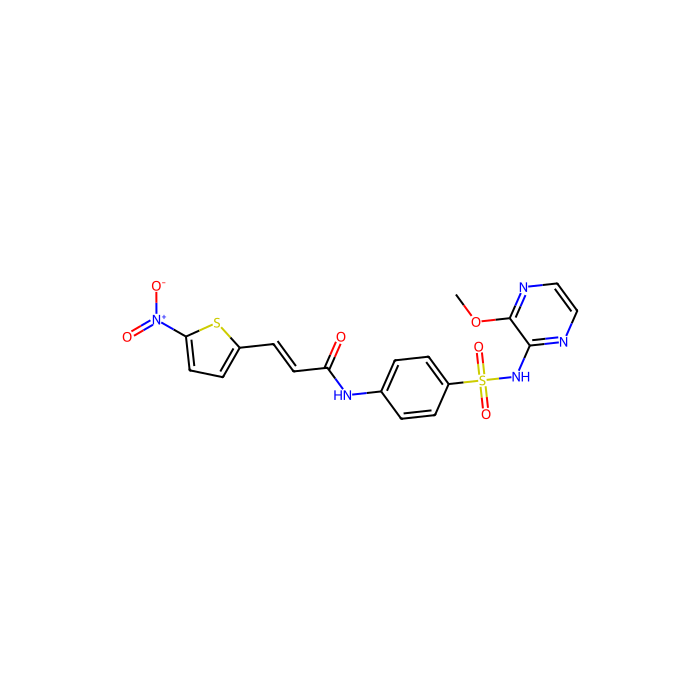
This compound belongs to the class of organic compounds known as benzenesulfonamides. These are organic compounds containing a sulfonamide group that is S-linked to a benzene ring.
External Descriptors
pyrazines - sulfonamide - thiophenes
1. Djoumbou Feunang Y, Eisner R, Knox C, Chepelev L, Hastings J, Owen G, Fahy E, Steinbeck C, Subramanian S, Bolton E, Greiner R, and Wishart DS. ClassyFire: Automated Chemical Classification With A Comprehensive, Computable Taxonomy. Journal of Cheminformatics, 2016, 8:61.
Determine the necessary mass, volume, or concentration for preparing a solution.
Dilution Calculator
Determine the dilution needed to prepare a stock solution.
Reconstitution Calculator
Reviews
Customer Reviews
Application Protocols
No tested applications or recommended protocols are provided in the product data for this SKU.
WB/IHC/IF/FC or other bioassay guidance: Not specified for this item.
Dilutions and positive controls: Not specified for this item.
General practice note (non-product-specific): Prepare fresh working solutions from frozen aliquots, maintain consistent vehicle controls, and document lot numbers and stock preparation details for reproducibility. For any protocol-specific parameters, consult peer-reviewed literature and adapt to your platform.
Biological Roles
This compound is widely recognized in the literature as a small-molecule research probe used to interrogate regulated cell death pathways. No biological details are provided in the product data for this SKU; the following describes general, literature-based context and should not be construed as product-specific claims.
Typical research context (literature/general knowledge): Utilized to study components of the necroptosis signaling cascade in cell-based and biochemical systems. Researchers employ such probes to dissect pathway nodes, timing, and dependence on upstream kinases and effector proteins using genetic and chemical perturbations.
Utility in mechanism studies: Small-molecule sulfonamides of this class are chosen for their ability to modulate protein function in a reversible or covalent fashion depending on the precise structure; they enable time-resolved interrogation of signaling vs genetic knockout approaches.
Experimental considerations: Outcomes can be highly context-dependent (cell type, species, expression levels, assay conditions). Concentration-response, exposure time, and off-target assessment (e.g., counterscreens) are essential for rigorous interpretation.
Important caveats:
No clinical/therapeutic use is claimed or supported here; this product is for research use only.
Target specificity, potency, and selectivity must be verified with the exact material in your assay system; consult primary literature and perform orthogonal validation where necessary.
Buffer Applications
This product is a small-molecule research probe and is not a buffering agent. Consequently, standard buffer system recipes (e.g., phosphate, HEPES, Tris) do not apply directly.
Practical note for assay use:
When dosing into biological buffers, prepare a concentrated stock (commonly in DMSO) and dilute into the assay buffer immediately before use with rigorous mixing to avoid precipitation.
Maintain consistent final cosolvent percentages across controls and treated samples to avoid confounding effects. Actual solubility and compatibility are not specified for this item; confirm empirically.
Green Alternatives
As Necrosulfonamide is a specific bioactive probe rather than a commodity solvent or reagent, direct “green alternative” substitution is typically not applicable.
Function-specific nature: Swapping Necrosulfonamide for a different molecule materially changes the biological mechanism under investigation; this is not analogous to replacing a solvent with a greener one.
Greener handling strategies (general):
Use minimal DMSO volumes and prepare concentrated stocks to reduce total solvent usage.
Choose lower-toxicity cosolvents (e.g., ethanol or aqueous buffers) when feasible for dilution steps, within assay constraints.
Minimize waste by scaling experiments appropriately and adopting microplate formats.
If your goal is to explore the same biological pathway with improved environmental profiles, consider alternative mechanistic probes or tool compounds documented in the literature, but note that any substitution must be justified by target engagement data rather than by green chemistry criteria alone.
Pharmaceutical Uses
No pharmacopeial status, excipient role, or formulation use is provided for this product, and no clinical or therapeutic applications are claimed.
Regulatory/compendial status: Not specified for this item; refer to CoA/Spec Sheet if applicable.
Typical context: Employed as a research-only tool compound in discovery biology and mechanistic studies. Not intended for human or veterinary use.
Formulation notes for research (general): When formulating for in vivo research models (if permitted by institutional protocols), researchers often use DMSO-based vehicles with co-solvents/surfactants; however, such practices must be justified, validated for tolerability, and approved by oversight committees. This listing makes no recommendations for in vivo use.
Physical Properties
Item-specific physico-chemical specifications have not been provided in the product data for this SKU.
Appearance: Not specified for this item; refer to CoA/Spec Sheet.
Melting point (MP): Not specified for this item; refer to CoA/Spec Sheet. (avoid treating literature values as specifications)
Boiling point (BP): Not applicable/rarely reported for this class; solids typically decompose before boiling at 1 atm. Not specified for this item.
Density: Not specified for this item; refer to CoA/Spec Sheet.
Solubility: Not specified for this item; refer to CoA/Spec Sheet.
LogP, pKa, refractive index: Not specified for this item; refer to CoA/Spec Sheet.
General expectations for aryl sulfonamide research probes (literature/general chemistry knowledge; not item-specific specs):
Many aryl sulfonamides are crystalline solids at ambient conditions.
Practical lab handling often uses DMSO to prepare concentrated stock solutions for biochemical assays; limited aqueous solubility is common unless ionizable groups are present.
Thermal stability varies; prolonged heating may cause decomposition.
Always verify any numerical property needed for your work from the lot-specific CoA to ensure alignment with your application’s requirements.
Quality & Grades
Grade/purity, stabilizer content, and analytical specification details are not provided in the product data for this SKU.
Grade/Purity: Not specified for this item; refer to CoA/Spec Sheet.
Typical characterization for small-molecule probes (general guidance): HPLC purity (area %), NMR identity, and HRMS are commonly reported. UV/Vis profile may be supplied for certain bioactive compounds; water and residual solvent content may be included where relevant.
Implications for use (general):
For biochemical assays and screening, higher HPLC purity (e.g., ≥95% area) is commonly sought to minimize off-target or background effects.
Knowledge of counter-ions, residual solvents, or polymorphic form can be important for reproducibility.
What is specific to this item (from product data):
Storage requires an inert atmosphere (argon charged) and −20 °C, indicating sensitivity to oxidation and/or hydrolysis typical of some aryl-sulfonamide probes.
Please consult the lot-specific CoA/Spec Sheet for exact purity, analytical methods, and any stabilizers used with this SKU.
Reaction & Applications
Necrosulfonamide is primarily used as a biochemical research probe rather than a general-purpose synthetic reagent. No manufacturer reaction/application details are provided in the product data for this SKU.
Synthetic chemistry usage: Not typically employed as a coupling partner or auxiliary. The sulfonamide functionality is generally a terminal feature rather than a versatile synthetic handle in this specific context.
Research application context (general knowledge): Frequently used in cellular and biochemical studies exploring programmed cell death signaling. Practical use centers on solution preparation, dosing, and stability rather than on bench transformations.
Practical tips (general, non-item-specific):
Prepare small DMSO master stocks, aliquot, and avoid repeated freeze–thaw to maintain integrity.
Protect from moisture and air as indicated by the product’s storage requirement (argon charged, −20 °C).
Confirm compound identity and purity by internal QC if results are highly sensitive to probe quality (e.g., LC–MS check of working stocks).
For any synthetic derivatization or immobilization efforts, verify reactivity of the specific sulfonamide motif and ring substitution pattern from the CoA/structure before planning transformations.
Reaction Conditions
No manufacturer-recommended synthetic reaction conditions are provided for this item, and Necrosulfonamide is not commonly used as a reagent in named organic reactions.
General laboratory handling for solution preparation (not synthetic conditions):
Solvent: DMSO is commonly selected for stock solutions; verify solubility with your lot.
Concentration: Prepare as concentrated as solubility and assay design allow to minimize vehicle volume; filter sterilize only if compatible with the compound and application.
Temperature and atmosphere: Product data specify storage at −20 °C under argon; when preparing solutions, minimize air/moisture exposure and return unused material promptly to cold, inert conditions.
If you plan to use this compound in chemical transformations (e.g., conjugation), first obtain the exact structural information and evaluate compatibility with your planned bases, nucleophiles, or coupling reagents.
Safety & Handling
Authoritative safety information is provided in the SDS. Product data for this SKU does not include explicit GHS classification details.
GHS classification, pictograms, signal word, hazard statements: Not specified for this item; refer to SDS.
General hazards (good laboratory practice for small-molecule sulfonamides; not item-specific): may cause irritation to skin, eyes, and respiratory tract. Avoid ingestion, inhalation, and contact.
Safe handling recommendations (defer to SDS for final guidance):
Use in a fume hood. Wear appropriate PPE: lab coat, safety glasses, and chemical-resistant gloves (e.g., nitrile). Avoid aerosol generation and dust formation.
Storage incompatibilities: keep away from strong oxidizers and strong bases/acids unless compatibility is established. Avoid prolonged exposure to light and moisture.
First aid (general): on skin/eye contact, rinse with plenty of water; remove contaminated clothing. If inhaled, move to fresh air. If ingested or upon any exposure concern, seek medical attention and provide SDS.
Special handling for this item (product data):
Storage: Store at −20 °C, argon charged.
Shipping: Ice chest + ice pads.
Waste: Dispose according to institutional, local, and national regulations for organic laboratory chemicals.
Solvent Selection
Item-specific solubility data are not provided. The following guidance reflects typical practices for aryl sulfonamide research probes and should be verified experimentally for this SKU.
Primary stock solvent: DMSO is commonly used to prepare concentrated stocks (e.g., 10–50 mM) for screening work due to broad solvating ability.
Alternative solvents: Dimethylformamide (DMF) and N-methyl-2-pyrrolidone (NMP) often dissolve polar aromatic sulfonamides; acetonitrile or ethanol may be suitable for intermediate polarity.
Aqueous systems: Direct water solubility may be limited. If aqueous delivery is needed, dilute a DMSO stock into buffered media with vigorous mixing; keep final DMSO ≤0.1–0.5% v/v as assay permits.
Polarity class (general): Sulfonamides are polar, hydrogen-bonding capable, and typically partition better into mid- to high-polarity organic solvents.
Comparison (general, not item-specific):
DMSO: highest solvency; compatible with many biochemical assays.
DMF/NMP: strong solvents but less favored biologically; consider for synthetic or preparative use.
MeCN/EtOH: greener and more volatile; may have limited capacity for higher-load stocks.
Always confirm actual solubility and stability of your specific lot in the chosen solvent before preparing working solutions.
Storage & Reconstitution
Item-specific storage and shipping conditions are provided; reconstitution guidance below is general best practice for small-molecule probes.
Storage (product data): Store at −20 °C, argon charged. Protect from moisture and air. Keep container tightly closed.
Shipping (product data): Ice chest + ice pads.
Reconstitution and handling (general guidance; not a specification):
Solvent: Use anhydrous DMSO to prepare a concentrated stock solution. Actual solubility is not specified for this item; determine empirically.
Aliquoting: Divide stock into single-use aliquots in inert-atmosphere vials or crimp-sealed tubes to minimize headspace oxygen and moisture.
Freeze–thaw: Avoid repeated freeze–thaw cycles. Thaw at room temperature, mix gently, and use promptly. Discard any aliquot that shows precipitation, discoloration, or unexpected LC–MS profile.
Light/air: Limit exposure to air and light during weighing and solution prep; consider working under argon or nitrogen if feasible.
Always consult the lot-specific CoA and SDS for definitive guidance on stability, retest dates, and any special precautions.
Structure & Identity
Necrosulfonamide is a small-molecule research probe widely used in programmed cell death pathway studies. Item-specific identity fields provided with this listing are limited.
CAS: 1360614-48-7 (product data)
InChIKey: Not specified for this item; refer to CoA/Spec Sheet. (product data field present but unspecified)
SMILES: Not specified for this item; refer to CoA/Spec Sheet.
Molecular formula: Not specified for this item; refer to CoA/Spec Sheet.
Molecular weight: Not specified for this item; refer to CoA/Spec Sheet.
Structural features (general chemistry knowledge about the compound class):
Contains a sulfonamide functional group (–SO2–NH–), consistent with the name “necrosulfonamide.”
Typically built on an aryl scaffold bearing electrophilic and hydrogen-bonding features characteristic of many bioactive sulfonamides. Exact substitution pattern is not specified for this item.
2D description (general): one or more aromatic rings substituted with a sulfonyl group connected to an amide/amine nitrogen; additional ring substituents may tune electronics and binding but are not item-specified here.
Notes:
For definitive structure confirmation (SMILES, InChI, formula, exact MW), consult the product CoA/Spec Sheet or the SDS provided by Aladdin Scientific for this exact SKU.
Synthetic Utility
Necrosulfonamide is not primarily used as a synthetic building block. Nevertheless, general chemical features of aryl sulfonamides inform potential reactivity:
Functional group profile (general): Sulfonamide (–SO2–NR–) is strongly electron-withdrawing and can influence adjacent aromatic substitution patterns. N–H sulfonamides (if present) can be deprotonated under strong basic conditions for N-functionalization; however, specific feasibility depends on the exact structure (not specified for this item).
Stability considerations: Aryl sulfonamides typically show high thermal and oxidative stability in neutral media but can hydrolyze under forcing acidic/basic conditions. Protect from prolonged exposure to strong nucleophiles if sensitive substituents are present.
Derivatization: If one intends to derivatize this molecule (e.g., for immobilization or probe optimization), knowledge of the actual substitution pattern and leaving groups is mandatory—consult the CoA/structure first.
Given its primary role as a bioactive probe, the most valuable “utility” is in providing a defined chemical perturbation of a biological pathway rather than participating in classical synthetic transformations.
Target Specificity
Target, binding mode, potency, and selectivity data are not provided in the product data for this SKU.
Target identity: Not specified for this item; refer to CoA/Spec Sheet or primary literature relevant to your application.
Assay notes: If employing this compound as a pathway probe, validate activity and specificity in your assay system using appropriate orthogonal controls (genetic perturbation, independent chemotypes, and negative controls).
Frequently Asked Questions
What is the purity of this product?
This product is supplied at ≥99% purity (chemical assay). Lot-specific values are stated on the Certificate of Analysis.
How should this product be stored?
Store at ?20 °C under argon. It is supplied under an argon blanket; reseal under inert gas after each use.
How is this product shipped?
This product ships in an insulated container with ice pads. Unpack on arrival and transfer it to the storage condition stated above.
What are the CAS number, molecular formula and molecular weight?
The CAS Number is 1360614-48-7, the molecular formula is C18H15N5O6S2, and the molecular weight is 461.47 g/mol. InChIKey FNPPHVLYVGMZMZ-XBXARRHUSA-N.
What documentation is provided?
Available product documentation, including Certificates of Analysis (COA), Safety Data Sheets (SDS), and specification sheets, is shown in the product document area. Document availability and access follow the current site policy.
We use cookies to ensure the website functions properly and, where permitted, to improve your experience. You can manage your preferences at any time in Settings. Learn more in our Cookie Policy.
Shall we send you a message when we have discounts available?
Remind me later
Thank you! Please check your email inbox to confirm.
Products are supplied to verified businesses, institutions, and qualified professionals for research and development use only. Not for use in humans, animals, diagnosis, or therapy.

 B2301086