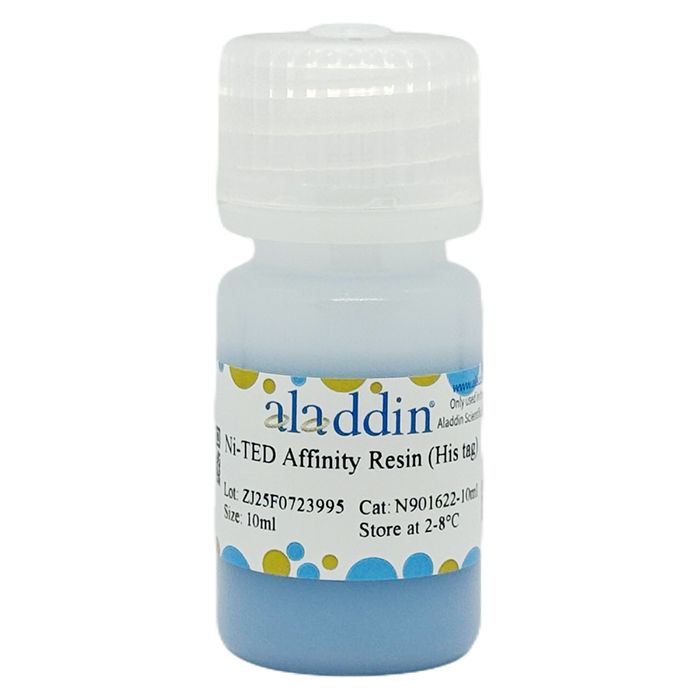
Ni-TED Affinity Resin 6FF (His tag) is a metal chelate affinity resin with the lowest metal ion leaching rate. The ligand is a tris-carboxymethyl ethylene diamine (TED) group, the coordinated metal ion is Ni²⁺, and FF stands for Fast Flow. The penta-coordinate structure formed between the TED ligand and Ni²⁺ in this product exhibits excellent stability, offering outstanding tolerance to chelating agents, reducing agents, acids, alkalis, and other reagents. It can be used under conditions such as 10 mM EDTA, 100 mM β-ME, or 50 mM DTT, maintains excellent chromatographic performance after 24 hours of treatment at pH 1 or pH 14, and can also be stored long-term in 10 mM NaOH. The imidazole concentration required in the elution buffer is lower than that needed for other metal chelate resins.
Therefore, Ni-TED Affinity Resin 6FF (His tag) is suitable for the following purification systems:
When the target protein contains cysteine or is oxygen-sensitive and requires the addition of β-ME or DTT;
When the target protein contains cysteine and exhibits metal reactivity, requiring the addition of DTT and EDTA;
When the target protein is susceptible to hydrolysis by metal proteases, requiring the addition of EDTA;
When the target protein is sensitive to high concentrations of imidazole, requiring a reduction in imidazole concentration in the elution buffer;
When the eukaryotic expression system itself contains β-ME or EDTA;
When strict requirements exist for the metal ion content in the final product.
The ligand coupling process of Ni-TED Affinity Resin 6FF has been specially designed to significantly enhance the pressure/flow rate characteristics of the final product, with maximum flow rate and pressure resistance exceeding 1500 cm/h and 0.5 MPa, respectively. Through optimization of the ligand modification process, this product achieves a good balance between affinity (capacity) and specificity (selectivity): while the binding capacity for histidine-tagged proteins exceeds 20 mg/mL, the sample purity after single-step purification can reach over 90%.
Aladdin Ni-TED Affinity Resin 6FF (His tag) is stored in 20% ethanol, with a settled gel to storage solution ratio of 1:1. The product specification refers to the actual volume of the settled gel.
Parameter
| Value / Description
|
Matrix
| 6% cross-linked agarose
|
Ligand ①
| Tris-carboxymethyl ethylene diamine, chelating ~60 μmol Ni²⁺/mL
|
Particle size range ②
| 45~165 μm
|
Mean particle size
| ~90 μm
|
Dynamic binding capacity ③
| ≥20 mg/mL histidine-tagged protein
|
Recommended operating flow rate ④
| 60~300 cm/h
|
Maximum flow rate and pressure ⑤
| 1500 cm/h,0.5 MPa
|
Operating pH
| 3–12 (recommended working pH), 3–12 (long-term stability); 2–14 (short-term stability)
|
Chemical stability
| 1) Purification buffers: common aqueous buffers, may contain 10 mM EDTA, 100 mM β-ME, or 50 mM DTT.
2) CIP treatments: 1 M NaOH, 1–2 M NaCl, 70% ethanol, 30% isopropanol, 0.1–0.5% nonionic surfactants.
3) The resin remains stable after treatment for specific periods in the following solutions: 10 mM NaOH (long-term), 0.1 M HCl (24 h), 6 M guanidine hydrochloride (24 h).
|
Storage
| 20% ethanol, 2–8°C
|
Shelf life
| 5 years |
Notes:
① The tris-carboxymethyl ethylene diamine (TED) group has a ten-atom spacer arm between the ligand and the base bead, providing more efficient capture for the affinity resin.
② More than 90% of the beads are within this particle size range.
③ Dynamic binding capacity at 10% breakthrough (DBC<sub>10%</sub>). Tested with histidine-tagged recombinant protein expressed in E. coli, with a residence time of 6 minutes.
④ Not limited to this flow rate range. The appropriate flow rate should be determined based on column height. Typically, a residence time of 2–6 minutes during sample loading maintains excellent affinity capture capacity and purification efficiency. The flow rate during CIP should generally not exceed 150 cm/h.
⑤ Maximum tested flow rate and corresponding pressure at a column height of 10 cm.
Introduction to Metal Chelate Affinity Chromatography
Metal chelate affinity chromatography is based on the imidazole groups of histidine, thiol groups of cysteine, and indole groups of tryptophan on the surface of protein molecules. These groups can form coordinate bonds with Ni²⁺, Co²⁺, Cu²⁺, Zn²⁺, etc., enabling the separation and purification of biomacromolecules. Among these, the purification of proteins with six or more histidine tags using Ni²⁺ as the chelated ion is the most common application. This manual also uses this system as an example to briefly explain the affinity principle of Ni-TED Affinity Resin 6FF (His tag) (Figure 1).
After the base beads are modified with TED ligands, the ligand possesses five coordination groups, with two nitrogen atoms and three oxygen atoms forming a stable chelate with Ni²⁺. Ni²⁺ can form an octahedral structure with a coordination number of 6, with the remaining free coordination site available to bind to solvent molecules or protein molecules. The coordination binding between Ni²⁺ and the imidazole groups of histidine-tagged proteins constitutes the specific binding process between the resin and the target protein. Increasing the imidazole concentration in the buffer allows elution of the target protein through competitive binding.
Non-specific adsorption mainly arises from ionic interactions and interactions between metal ions and histidine/cysteine/tryptophan-containing proteins. The former can be suppressed by increasing the ionic strength of the buffer (by adding 500 mM NaCl); the latter can be addressed by adding a small amount of imidazole (~5 mM) to the loading buffer or by adding imidazole during the wash step.

Figure 1: Schematic diagram of the purification principle of Ni-TED Affinity Resin 6FF (His tag)
Usage Reference
1. Column Packing
The following describes the column packing method when connected to a chromatography system.
(1) The temperature of all required materials should match the chromatography operating temperature, and degassing of liquids is recommended.
(2) Calculation of resin volume: Settled resin volume = column volume × compression ratio (the compression ratio of Ni-TED Affinity Resin 6FF (His tag) is 1.15). Settled volume refers to the stable volume of the resin after complete natural sedimentation in 20% ethanol preservation solution. The compression ratio can be achieved by lowering the column adaptor or by packing at high flow rates.
(3) Resin washing: After thoroughly mixing the resin suspension and measuring the volume, remove the liquid, wash with approximately 3 resin volumes of purified water, repeat 3 times to remove the preservation solution.
(4) Preparation of resin suspension: Transfer the resin to a suitable container, add packing buffer to prepare a 50–75 v% suspension (the original packaging resin volume fraction is 67%), and mix well before use.
(5) Pre-packing preparation: Add packing buffer to the cleaned chromatography column from the bottom, remove air from the bottom frit and column bottom, leave a small amount of distilled water in the column, tighten the bottom cap, and ensure the column is perpendicular to the floor.
(6) Packing: Slowly pour the mixed resin suspension along the inner wall of the chromatography column in one go (use a packing reservoir if necessary), avoiding introduction of air bubbles. After adding the resin, fill the column with packing buffer, tighten the top cap, and connect to the chromatography system.
(7) Compaction: Allow the resin to settle naturally (or at a low flow rate of 50–150 cm/h). After the interface is clear and stable, remove the packing reservoir, install the top adaptor, and lower it to the interface. Continue packing at a high flow rate (column pressure not exceeding 0.3 MPa) until the interface is clear and stable, then mark the stable column height. After stopping the pump, lower the top adaptor to the position below the marked position corresponding to the compression ratio, tighten the adaptor, and complete the packing. After packing, equilibrate the resin in the column at a high flow rate.
Packing Condition
| Ni-TED Affinity Resin 6FF (His tag)
|
Compression Factor
| 1.15
|
Packing Flow Rate
| 600 cm/h |
2. Column Efficiency Determination and Evaluation
After packing and before use, the packing quality of the chromatography column can be verified by column efficiency determination and evaluation. Column efficiency is typically assessed using Height Equivalent to a Theoretical Plate (HETP) and asymmetry factor (As).
Column efficiency can be determined using acetone or NaCl as the sample. Prepare the sample solution and mobile phase according to the table below.
Tracer
| 1.0% Acetone
| 0.8~1.0 M NaCl
|
Sample Volume
| 1.0% CV
| 1.0% CV
|
Mobile Phase
| Pure Water
| 0.4 M NaCl
|
Flow Rate
| 30 cm/h
| 30 cm/h
|
Detector
| UV-280 nm
| Conductivity
|
Calculate HETP, N, and As using:
HETP = L / N
N = 5.54 × (Vʀ / Wₕ)²
As = a / b
Where: L = column height; Vʀ = retention volume; Wₕ = peak width at half height; a = first half-peak width at 10% peak height; b = second half-peak width at 10% peak height.
Generally, the HETP value should be less than three times the average particle size of the resin (i.e., HETP/D50 < 3, where D50 is the average particle size of the resin), and As should be between 0.8 and 1.5.
3. Equilibration and Loading
(1) Metal chelate resins are compatible with buffer systems such as phosphate and Tris-HCl, with the system 20 mM PB + 500 mM NaCl (pH 7.4) being the most commonly used. The initial buffer is called the equilibration buffer, designated as Buffer A. Buffer A is characterized by containing no or low levels of imidazole, with a pH mostly between 7 and 8, being weakly alkaline. In practice, if the sample loading volume is particularly large, to reduce costs, one may choose not to add imidazole and NaCl to the sample solution to suppress non-specific adsorption, but instead remove impurities by washing after loading.
(2) Before loading, equilibrate the chromatography column with Buffer A at the operating flow rate. This process typically requires 5–10 column volumes of Buffer A, and is considered complete when detection signals such as conductivity and pH remain constant and correspond to those of Buffer A.
(3) The loading amount can be set based on "mg target protein/mL resin", typically 50–80% of the DBC<sub>10%</sub>. In addition to DBC<sub>10%</sub>, the loading amount can also be determined by testing the target protein in the flow-through during loading. After loading, re-equilibrate the chromatography column with 3–10 column volumes of Buffer A.
4. Wash
Adding 5–40 mM imidazole to Buffer A to wash the chromatography column removes non-specifically bound impurity proteins. The higher the imidazole concentration, the more thorough the removal of impurity proteins, but this may reduce the yield of the target protein. Conditions can be rapidly optimized through stepwise washing (e.g., 5 mM, 10 mM, 20 mM...). The wash volume is typically 3–10 column volumes.
5. Elution
The most commonly used elution method is increasing the imidazole concentration in the elution buffer (adding imidazole to Buffer A). Stepwise or linear gradient elution in the range of 0–500 mM is recommended to determine optimal conditions. For most histidine-tagged proteins, complete elution of the target protein can be achieved with an imidazole concentration of 50–150 mM.
6. Cleaning-in-Place (CIP)
If column pressure increases or to avoid cross-contamination, the metal ions can be stripped off and a CIP process performed. The following solvents can be used for CIP: 2 mol/L NaCl, 1 mol/L NaOH, 70% ethanol, or 30% isopropanol. CIP effectively removes impurities on the resin, with backflushing being more effective. After cleaning, remove the above solvents with 3–5 column volumes of purified water.
CIP Process
| Purpose
|
2 M NaCl, 0.5–2 CV; water, 3–5 CV.
| Removal of impurities bound through ionic interactions.
|
1 M NaOH, contact time of 1–2 hours (longer for endotoxin removal); Buffer A, 5–10 CV; water, 3–5 CV.
| Removal of protein precipitates, hydrophobic proteins, or endotoxins and other impurities.
|
30% isopropanol or 70% ethanol, 5–10 CV; water, 3–5 CV.
| Removal of tightly bound lipoproteins and liposomes. |
7. Resin Storage
The initial preservation solution for the resin is 20% ethanol. After use, it can continue to be stored in 20% ethanol. The storage temperature should be 2–30°C, and freezing should be avoided.

 ZJ26F0535128