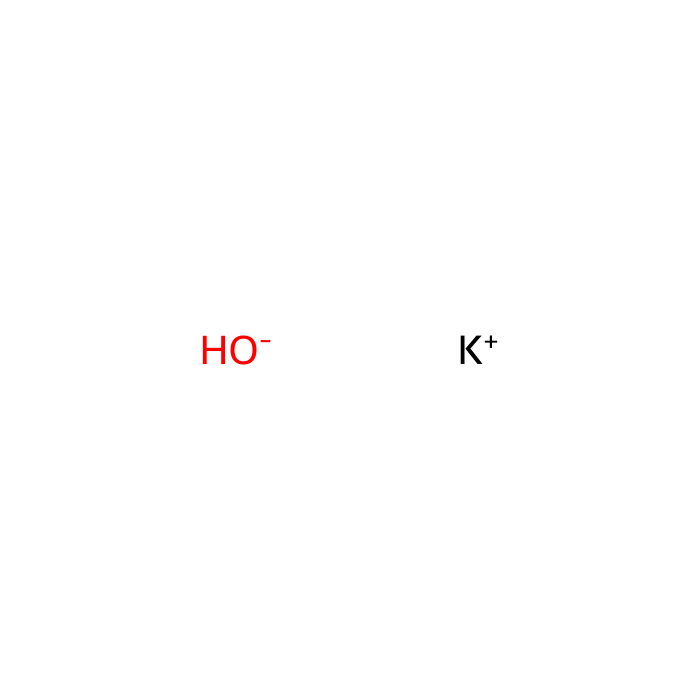
Potassium hydroxide - Anhydrous Grade, ≥99.95% metals basis , CAS No.1310-58-3

CAS: 1310-58-3 Cat. No.: P431767 Formula: KOH Molecular Weight: 56.11 EC Number: 215-181-3
AVAILABLE TO ORDER
GRADE & PURITY Anhydrous Grade ? Anhydrous grade — water removed and packaged dry for moisture-sensitive chemistry. Use in reactions where even trace water would interfere or quench. ≥99.95% metals basis
Synonyms
potasio hidroxido | KALI CAUSTICUM [HPUS] | Potassium hydroxide solution 10% (wt/v) in methanol | POTASSIUM HYDROXIDE | potassium -hydroxide | UN1814 | POTASSIUM HYDROXIDE [WHO-DD] | Potassium hydroxide, pellets, Trace Metals Grade 99.95% | INS NO.525 | K
Storage
Room temperature,Desiccated
Shipped In
FedEx DG Service
★
Size
USA
Germany (EU)*
Price
Qty
5g
P431767-5g
Made to order · 8–12 wks

$345.90

$403.90
Save $58.00 (14.36%)
25g
P431767-25g
Made to order · 8–12 wks

$915.90

$1,068.90
Save $153.00 (14.31%)
Enter a quantity for the sizes you want to add.
🧪
Why this grade

Anhydrous Grade, ≥99.95% metals basis Anhydrous Grade for sensitive chromatographic and analytical workflows requiring minimal baseline interference.

🌡

Storage & shipping

Room temperature,Desiccated Ships FedEx DG Service Check lot-specific COA for exact specifications.

📋

Quality documents

SDS, COA, datasheet, and spec sheet available for download. Lot-specific COA accessible via lot number lookup.

📚

Literature proof

Cited in 2827 peer-reviewed publications across chromatography, organic synthesis, and cross-coupling reactions.

Overview

Potassium hydroxide (KOH) is also known as caustic potash. It is a strong alkali or a solid base compound that can be used in a variety of industrial applications. It finds its usage in the production of soaps, cleaners and detergents.

Specifications

Synonyms
potasio hidroxido | KALI CAUSTICUM [HPUS] | Potassium hydroxide solution 10% (wt/v) in methanol | POTASSIUM HYDROXIDE | potassium -hydroxide | UN1814 | POTASSIUM HYDROXIDE [WHO-DD] | Potassium hydroxide, pellets, Trace Metals Grade 99.95% | INS NO.525 | K
Specifications & Purity
Anhydrous Grade, ≥99.95% metals basis
Storage
Room temperature,Desiccated
Shipped In
FedEx DG Service
Grade
Anhydrous Grade
Purity
≥99.95% metals basis
Names and Identifiers
Canonical Smiles[OH-].[K+]
IUPAC Namepotassium;hydroxide
InChIKeyKWYUFKZDYYNOTN-UHFFFAOYSA-M
INCHI1S/K.H2O/h;1H2/q+1;/p-1
Isomeric SMILES [OH-].[K+]
WGK Germany 1
UN Number UN 1814
Packing Group II
Molecular Weight 56.11
Reaxy-Rn 11342937
Reaxys-RN_link_address https://www.reaxys.com/reaxys/secured/hopinto.do?context=S&query=IDE.XRN=11342937&ln=

Documentation

📋 Safety Data Sheet (SDS)

Comprehensive hazard, handling, storage, and regulatory compliance document.

Download SDS →

✅ Certificate of Analysis (COA)

Lot-specific quality data. Enter your lot number to retrieve the exact COA.

Look up COA →

📊 Datasheet

Quick-reference summary of product specifications and applications.

View datasheet →

🔬 Specification Sheet

Full quality attributes and acceptance criteria for this grade.

View spec sheet →

Advanced Data

Taxonomic Classification

Taxonomy Tree

KingdomInorganic compounds
SuperclassMixed metal/non-metal compounds
ClassAlkali metal oxoanionic compounds
SubclassAlkali metal hydroxides
Intermediate Tree Nodes Not available
Direct ParentAlkali metal hydroxides
Alternative Parents Inorganic salts  Inorganic oxides  Inorganic hydrides  
Molecular FrameworkNot available
Substituents Alkali metal hydroxide - Inorganic hydride - Inorganic oxide - Inorganic salt
DescriptionThis compound belongs to the class of inorganic compounds known as alkali metal hydroxides. These are inorganic compounds in which the largest oxoanion is hydroxide, and in which the heaviest atom not in an oxoanion is an alkali metal.
External Descriptors alkali metal hydroxide
3D Structure
Interactive Chemical Structure Model


Certificates(CoA,COO,BSE/TSE and Analysis Chart)
C of A & Other Certificates(BSE/TSE, COO):
Analytical Chart:
Chemical and Physical Properties
SolubilityH2O: soluble 1120g/L
Boil Point(°C)1324 °C
Melt Point(°C)380°C
Molecular Weight56.106 g/mol
XLogP3
Hydrogen Bond Donor Count1
Hydrogen Bond Acceptor Count1
Rotatable Bond Count0
Exact Mass55.9664 Da
Monoisotopic Mass55.9664 Da
Topological Polar Surface Area1.000 Ų
Heavy Atom Count2
Formal Charge0
Complexity2.000
Isotope Atom Count0
Defined Atom Stereocenter Count0
Undefined Atom Stereocenter Count0
Defined Bond Stereocenter Count0
Undefined Bond Stereocenter Count0
The total count of all stereochemical bonds0
Covalently-Bonded Unit Count2
Documents & Articles
The Guide to Anhydrous Grade for Reagents
Nanowires: Properties, Preparation Routes, and Process Selection (Comprehensive Analysis of Top-Down and Bottom-Up Approaches with Recommended Aladdin Reagents)
How to Choose a Hydrogen Evolution (HER) Catalyst: Kinetic Barriers in Water Electrolysis, AWE/PEM/AEM Pathways, and a Materials-Family Roadmap (with a Product Map)
NiMH Nickel–Metal Hydride Batteries: A Full View of the MH (Metal Hydride) Negative Electrode—Working Mechanism, Materials Families, and a Selection Map (with Tables 1–2)
Selection of Common Research Salts: A Task Map for Alkali Metal Salts & Alkaline Earth Metal Salts (with Product Tables 1–6)
How to Make the Suzuki–Miyaura Reaction Robust: Pinpoint the Bottleneck and Lock in a Reproducible Operating Window (with Selection Navigation and Product Tables 1–5)
Ferulic Acid: Structural Features, Preparation Routes, and Key Points for Research Applications
Preparation Methods and Precautions for Silane Coupling Agent Primer Solutions
Experimental Selection Logic for Phase-Transfer Catalysts: Choosing Catalysts by Phase-State System, Source of Anionic Species, and Reaction Task
Perovskite Oxides for Energy and Environmental Catalysis: How Oxygen Vacancies, B-Site Metals, and the Metal–Oxygen Bond Network Regulate Reaction Performance
Microscopic Interpretation and Taxonomic Value of Iodine Staining Reaction in Fungal Spores
Microbial Morphological Identification: Observation Systems, Staining Methods, and Result Interpretation
Potassium Fatty Acid Soaps: Structure and Formulation Applications—Production Processes, Alkalinity, Foam Control, and Low-Foam Cleaning
Why Do Phenolic Resins Have Good Heat and Chemical Resistance? Analyzing the Source of Their Performance from Molecular Structure to Cured Networks
What Is Silica Sol: Mechanism of Action, Application Scenarios, and Selection Criteria for Nanosilica Dispersions
Why LABSA (Sulfonic Acid) Is Commonly Used in Household Cleaning Formulations: Neutralization Mechanism, Detergency Action, and Formulation Application Points
From Structure to Rheology: How Carbomer Forms Gel Structures and Enables Thickening, Suspension, and Auxiliary Emulsion Stabilization
What Is the Difference Between Triethanolamine and Diethanolamine: Understanding Their Formulation Functions, Application Differences, and Selection Logic from a Molecular-Structure Perspective
Why Can 6501 (Cocamide DEA) Stabilize Foam and Build Viscosity? Structural Mechanism, 1:1/1:1.5 Differences, and Application Selection
Differences, Functions, and Selection Guidelines for Sodium Hydroxide Flakes, Granules, Liquid Caustic Soda, and Caustic Soda in Household and Personal Care Product Manufacturing: The Functional and Application Logic of Sodium Hydroxide
Why Daily Chemical Formulations Need Alkaline Ingredients: From pH Adjustment and Saponification to Detergency Boosting and Selection Logic
Degreasing Agents from a Molecular-Structure Perspective: How AEO, APG, and Related Surfactants Can Replace Nonylphenol Ethoxylates (NPE)
From Structure to Selection: Mechanisms and Application Assessment of Low-Foam Oil and Wax Removal with Fatty Acid Methyl Ester Ethoxylates (FMEE)
Sodium Metasilicate in Cleaning Applications: Hydration-Form Differences, Mechanisms of Action, and Selection Logic
What Is an Etchant? Etching Mechanisms for Revealing Metallographic Microstructures, Selection Methods, and Applications of Related Wet-Etching Reagents
Mechanisms and Troubleshooting of Foam Reduction in Personal and Household Care Formulations: Film Rupture, Weak Interfacial Films, Insufficient Surfactant Supply, and Phase-State Disturbance
Why Are Daily Chemical Products Prone to Viscosity Thinning in Summer? Core Mechanisms, Troubleshooting Methods, and Solutions
Key Variable in the Long-Term Stability of Waterborne Pigment Concentrates: How Dispersant Molecular Weight Distribution (MWD) Affects Pigment Dispersion, Surface Adsorption-Layer Formation, and Storage Stability
Potential Mechanisms of Succinic Acid in Acne Care: From Dicarboxylic Acid–Base Equilibria to Metabolic Antagonism Among Skin Microorganisms
Overcoming the Electronic-Effect Limitations of Nucleophilic Aromatic Substitution in Fluoroarenes: Anion Activation, Concerted Substitution, and HF Capture by t-Bu-P4
3,3-Spiro-α-Proline Building Blocks: Structural Features, Complementary Synthetic Routes, and Multigram-Scale Preparation
Citations of This Product
Solution Calculators
Reviews

Customer Reviews

Frequently Asked Questions

What does the trace-metals specification mean?
This product is specified at ≥99.95% on a trace-metals basis. That figure describes metallic impurity content rather than overall chemical assay, so it is the relevant specification for ICP-MS, semiconductor and battery applications. Lot-specific values are stated on the Certificate of Analysis.
What does Anhydrous Grade mean?
Anhydrous Grade indicates that the material has been processed and tested for moisture-sensitive chemistry. Specifications focus on the impurities that affect performance in that application — for example, metal content for electronics, particle size for batteries, refractive index for optics, or moisture content for moisture-sensitive processes.
How should this product be stored?
Store in a cool place, desiccated. Keep the container tightly closed with desiccant — the material is moisture-sensitive.
How is this product shipped?
This product is classified as dangerous goods and ships via FedEx DG Service. Ground and other economy services are not available, and delivery to some destinations or address types may be restricted.
What are the CAS number, molecular formula and molecular weight?
The CAS Number is 1310-58-3, the molecular formula is KOH, and the molecular weight is 56.11 g/mol. InChIKey KWYUFKZDYYNOTN-UHFFFAOYSA-M.
What documentation is provided?
Available product documentation, including Certificates of Analysis (COA), Safety Data Sheets (SDS), and specification sheets, is shown in the product document area. Document availability and access follow the current site policy.

Shall we send you a message when we have discounts available?

Remind me later

Thank you! Please check your email inbox to confirm.

Oops! Notifications are disabled.