ProPrime Taq DNA Polymerase is a mutant enzyme obtained by site-directed mutagenesis of wild-type Taq enzyme using genetic engineering techniques. Compared with the wild-type, this enzyme has higher affinity for templates and stronger resistance to inhibitors. It exhibits high tolerance to endogenous and exogenous interferents in clinical samples, enabling direct amplification of whole blood, crude extracts from fecal samples, and crude extracts from plant samples, which effectively reduces steps such as sample pretreatment and DNA extraction.This enzyme has a fast amplification rate, making it suitable for rapid PCR; it also has high detection sensitivity, which is applicable for low-template detection.
It can be used in probe-based quantitative real-time PCR (qPCR) detection assays.
This antibody-modified enzyme is modified with three monoclonal antibodies, which simultaneously block the 5’-3’ polymerase activity and 5’-3’ exonuclease activity of Taq enzyme. Before high-temperature heating, the blocking effect of the antibodies on the polymerase activity can effectively inhibit non-specific amplification caused by non-specific annealing of primers or primer dimers under low-temperature conditions, thereby improving the specificity and efficiency of amplification. The blocking effect of the antibodies on the exonuclease activity can reduce the cleavage of fluorescent probes under low-temperature conditions, ensuring a stable baseline in qPCR and obtaining a good S-shaped amplification curve.
When the amplification reaction system is heated to 95°C for 2.5 minutes, the modified antibodies denature and dissociate, releasing the polymerase activity and exonuclease activity of Taq enzyme. Therefore, no special inactivation treatment is required, and the enzyme can be used under conventional PCR reaction conditions.
When used with the improved amplification buffer, it can be quickly thermally activated, effectively increasing the amount of reaction products and improving the sensitivity, specificity, and anti-interference ability of the PCR reaction.
Scope of Application
Hot-start qPCR amplification, direct whole blood amplification, anti-interference amplification, rapid PCR, and ARMS (Amplification Refractory Mutation System)
Precautions
- For most amplification reactions, the initial denaturation time can be set at 95°C for 2.5 minutes. If the template is complex, the denaturation time can be adjusted appropriately.
- The extension time should be determined according to the length of the PCR product. For example, when amplifying a 2kb fragment of human genomic DNA, the extension time can be as fast as 15 seconds. If it is a complex template (such as using whole blood as a template for amplification), the extension time can be appropriately prolonged.
Other Precautions
- When performing PCR amplification using whole blood as a template, the volume of whole blood added is recommended to be controlled within 20% (v/v) of the reaction system volume.
- When used for quantitative real-time PCR (qPCR), the volume of whole blood added is recommended to be ≤ 5% (v/v) of the reaction volume; excessive addition of blood samples will affect the collection of fluorescent signals.
Usage Method
Preparation before Reaction System Configuration
1.1 Dissolve and mix all solutions required for the reaction at room temperature or 4°C, then place them on an ice bath or in an ice box. It is recommended to aliquot the reaction solutions for use to avoid repeated freezing and thawing.
1.2 The volume of the reaction system can be adjusted proportionally according to the project requirements, as long as the final concentration of each component remains consistent.
1.3 Refer to the table below to set up the quantitative real-time PCR (qPCR) reaction system. It is recommended that the preparation of the qPCR reaction system be carried out on an ice bath or in an ice box:
| Component | Volume Added | Final Concentration |
|---|
| 5×GN Buffer (without Mg²⁺) | 10 μL | 1× | | dNTPs (25 mM each) | 0.4 μL | 0.2 mM | | Template DNA | 5 - 10 μL | — | | Forward Primer (10 μM) | 1 μL | 0.2 μM | | Reverse Primer (10 μM) | 1 μL | 0.2 μM | | Probe (10 μM) | 0.5 μL | 0.1 μM | | ProPrime Taq DNA Polymerase (5U/μL) | 0.5 μL | 2.5 U/50 μL | | MgCl₂ (100 mM) | 1 μL | 2 mM | | ddH₂O | To 50 μL | — | | Total Volume | 50 μL | — |
|
*Recommended amounts of different types of templates in a 50 μL reaction volume are as follows:
Mammalian genomic DNA: 0.1 - 1 μg
E. coli genomic DNA: 10 - 100 ng
Plasmid DNA: 0.1 - 10 ng
1.4 The recommended amount of Mg²⁺ is 2 mM - 6 mM.
1.5 Vigorous shaking should be avoided during the preparation process. Mix the solution by gently pipetting up and down or slightly vortexing, then centrifuge at room temperature for a few seconds.
Reaction Procedure
1. Conventional Qualitative PCR (taking the amplification of a 1 kb fragment as an example)
| Step Name | Temperature | Time | Number of Cycles |
|---|
| Heat Shock | 95°C | 2min30s | 1 | | Denaturation | 95°C | 20s | 30 - 35 | | Annealing | 55°C | 20s | 30 - 35 | | Extension | 72°C | 40s | 30 - 35 | | Extension | 72°C | 7min | 1 | | Storage | 12°C | ∞ | 1 |
|
2. Fluorescent Quantitative PCR
| Step Name | Temperature | Time | Number of Cycles |
|---|
| Heat Shock | 95°C | 2min30s | 1 | | Denaturation | 95°C | 15s | 35 - 40 | | Annealing + Extension | 55°C | 40s | 35 - 40 |
|
a. The settings of the PCR reaction (including temperature, time, number of cycles, etc.) need to be adjusted according to factors such as the template, primers, length of the PCR product, and GC content.
b. The extension time should be set based on the length of the PCR product. Generally, the fastest extension time for each 1 kb of product is 15 seconds. For example, if the length of the PCR product is 1 kb, the extension time can be set to 15 seconds; if the length of the PCR product is 2 kb, the extension time can be set to 30 seconds. If the amplification effect is not ideal, the extension time can be appropriately extended to 45 seconds, and so on for fragments of other lengths.
Experimental Examples
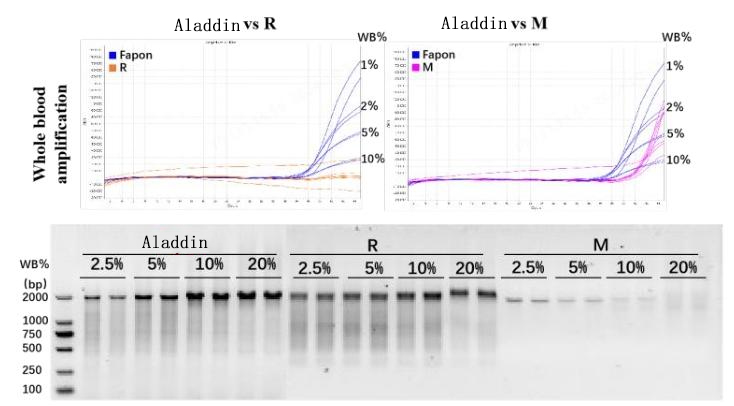
1. In direct whole blood amplification, the tolerance to whole blood of two competing products and Aladdin Taq DNA Polymerase was compared. The results showed that Aladdin Taq DNA Polymerase had stronger tolerance to whole blood: it could tolerate 10% whole blood in qPCR projects and 20% whole blood in PCR projects.
2. Using λDNA as the template to amplify a 1 kb target fragment, Aladdin antibody-modified enzyme exhibits higher amplification sensitivity, and its amplification efficiency with low template is significantly better than that of two competing products.
.jpg)
3.Using human genomic DNA as the template to amplify a 2 kb target fragment, the Aladdin antibody-modified enzyme can amplify the target fragment in a shorter extension time, with an average extension rate of 7.5 seconds per kilobase (s/kb), making it suitable for rapid PCR.
.jpg)


 ZJ26F0333690