GRADE & PURITYCarrier Free?Carrier-free — supplied without added carrier protein/stabilizer. Use when carriers (e.g. BSA) would interfere with conjugation or sensitive assays.His Tag?His tag grade — recombinant protein bearing a His tag for affinity purification/detection. Use to purify, immobilize, or detect the tagged protein.≥95%(SDS-PAGE)
Carrier Free,His-Tag,≥95%(SDS-PAGE) Carrier Free,His Tag for sensitive chromatographic and analytical workflows requiring minimal baseline interference.
🌡
Storage & shipping
Store at -20°C,Avoid repeated freezing and thawing Ships Ice chest + Ice pads Check lot-specific COA for exact specifications.
📋
Quality documents
SDS, COA, datasheet, and spec sheet available for download. Lot-specific COA accessible via lot number lookup.
📚
Literature proof
Cited in 0 peer-reviewed publications across chromatography, organic synthesis, and cross-coupling reactions.
Overview
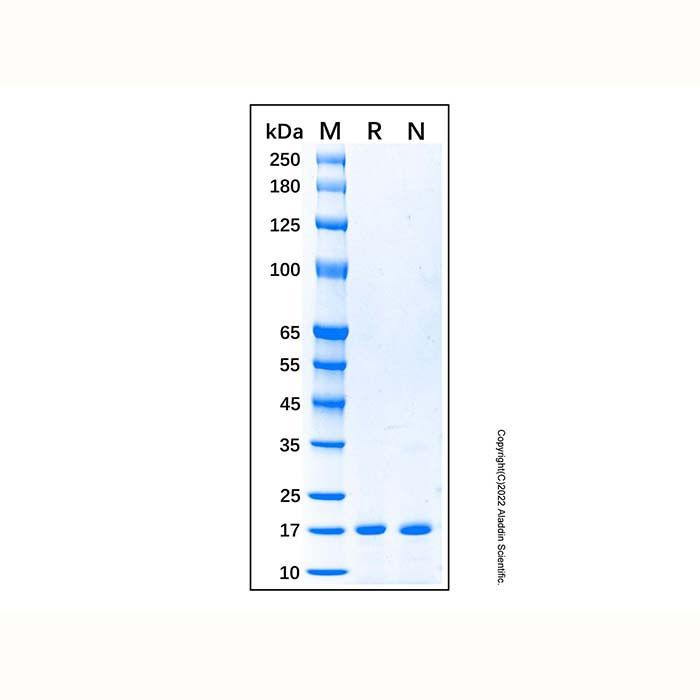
Purity: ≥95%, by SDS-PAGE visualized with Coomassie® Blue Staining. Description: Cystatin C, also known as Cystatin-3 (CST3) is a secreted type 2 cysteine protease inhibitor synthesized in all nucleated cells, has been proposed as a replacement for serum creatinine for the assessment of renal function, particularly to detect small reductions in glomerular filtration rate. The mature, active form of human cystatin C is a single non-glycosylated polypeptide chain consisting of 120 amino acid residues, with a molecular mass of 13,343-13,359 Da, and containing four characteristic disulfide-paired cysteine residues. Cystatin C is a low-molecular-weight protein that has been proposed as a marker of renal function that could replace creatinine. Indeed, the concentration of Cystatin C is mainly determined by glomerular filtration and is particularly of interest in clinical settings where the relationship between creatinine production and muscle mass impairs the clinical performance of creatinine. Since the last decade, numerous studies have evaluated its potential use in measuring renal function in various populations. More recently, other potential developments for its clinical use have emerged. In almost all the clinical studies, Cystatin C demonstrated a better diagnostic accuracy than serum creatinine in discriminating normal from impaired kidney function, but controversial results have been obtained by comparing this protein with other indices of kidney disease, especially serum creatinine-based equations, such as early atherosclerosis, Alzheimer's dementia, vascular aneurysms, hyperhomocysteinaemia and other neurodegenerative diseases. Cystatin C could be a useful clinical tool to identify HIV-infected persons. In addition, its expression is up-regulated in malignance of certain tumor progression.
Specifications
Product Name
Recombinant Human Cystatin C Protein
Synonyms
AD 8 | AD8 | Amyloid angiopathy and cerebral hemorrhage | ARMD11 | bA218C14.4 | bA218C14.4 (cystatin C) | Cst 3 | Cst3 | CST3 protein | Cystatin 3 | Cystatin-3 | Cystatin-C | Cystatin3 | CystatinC | CYTC_HUMAN | Epididymis secretory protein Li 2 | Gamma t
17.1 kDa, under reducing conditions; 17.1 kDa, under non-reducing conditions
Molecule Type
Protein
Storage and Shipping
Shape
Liquid
Storage
Store at -20°C,Avoid repeated freezing and thawing
Shipped In
Ice chest + Ice pads
Stability And Storage
Store at -20°C for 1 year. Avoid freeze / thaw cycle.
Images
Recombinant Human Cystatin C Protein (rp169603) - SDS-PAGE 2 μg/lane of Recombinant Human Cystatin C Protein was resolved with SDS-PAGE under reducing (R) and non-reducing (N) conditions and visualized by Coomassie® Blue staining, showing a band at 17.1 kDa.
Documentation
📋 Safety Data Sheet (SDS)
Comprehensive hazard, handling, storage, and regulatory compliance document.
We use cookies to ensure the website functions properly and, where permitted, to improve your experience. You can manage your preferences at any time in Settings. Learn more in our Cookie Policy.
Shall we send you a message when we have discounts available?
Remind me later
Thank you! Please check your email inbox to confirm.
Products are supplied to verified businesses, institutions, and qualified professionals for research and development use only. Not for use in humans, animals, diagnosis, or therapy.

 ZJ24F0506345