GRADE & PURITYMoligand™?Moligand™ — Aladdin's line of ligands and bioactive small molecules. Use for receptor, pathway, and binding studies needing defined small-molecule tools.≥98%
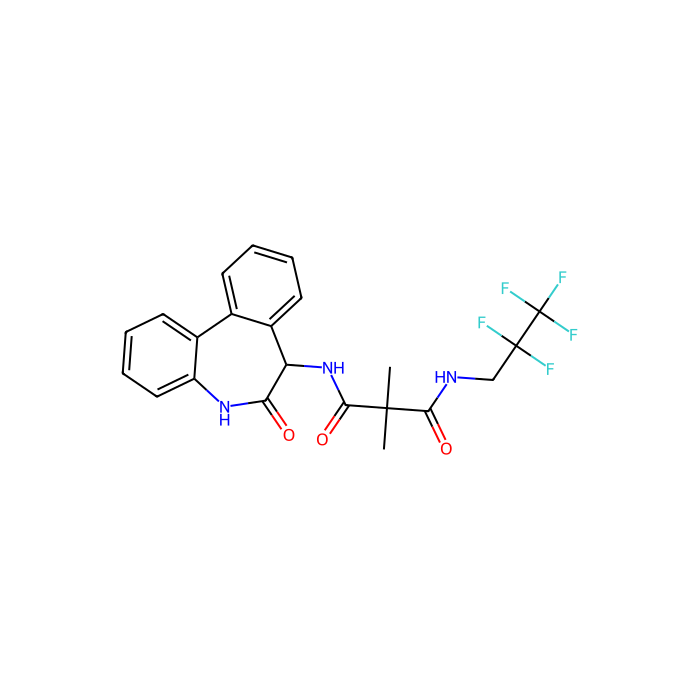
RO4929097 is an orally bioavailable, small-molecule gamma secretase (GS) inhibitor with an IC50 of 4 nM. It binds to GS and blocks activation of Notch receptors, which may inhibit tumor cell proliferation. RO4929097 inhibits Notch process
Storage
Store at -20°C
Shipped In
Ice chest + Ice pads
This product requires cold chain shipping. Ground and other economy services are not available.
This compound belongs to the class of organic compounds known as dibenzazepines. These are compounds with two benzene rings connected by an azepine ring. Azepine is an unsaturated seven-member heterocycle with one nitrogen atom replacing a carbon atom.
1. Djoumbou Feunang Y, Eisner R, Knox C, Chepelev L, Hastings J, Owen G, Fahy E, Steinbeck C, Subramanian S, Bolton E, Greiner R, and Wishart DS. ClassyFire: Automated Chemical Classification With A Comprehensive, Computable Taxonomy. Journal of Cheminformatics, 2016, 8:61.
Determine the necessary mass, volume, or concentration for preparing a solution.
Dilution Calculator
Determine the dilution needed to prepare a stock solution.
Reconstitution Calculator
Reviews
Customer Reviews
Application Protocols
No item-specific, validated application protocols are provided in the Product Data for this entry.
General research-use workflow (non-item-specific):
Stock preparation: Dissolve the solid in anhydrous DMSO to a convenient concentration (e.g., 10–50 mM), vortex until homogenous, and aliquot to minimize freeze–thaw cycles.
Assay dosing: Dilute stocks into assay medium immediately before use. Maintain consistent final solvent content across all wells/samples. Include vehicle controls and, if available, an orthogonal comparator compound.
Concentration–response: Establish a full curve (e.g., 10–12 points, half-log spacing) spanning expected activity; confirm hill slope and fit quality.
Stability checks: Verify compound integrity in assay medium over the experiment duration using LC–MS or HPLC.
Please consult your institutional SOPs and the primary literature for assay-specific parameters. For authoritative safety guidance, refer to the SDS.
Biological Roles
General literature context (not item-specific claims):
RO4929097 is commonly referenced as a small-molecule modulator of γ-secretase, a multi-subunit intramembrane protease complex responsible for regulated intramembrane proteolysis of several type I membrane proteins, including Notch receptors and APP family substrates. Modulation of γ-secretase can alter downstream signaling cascades, notably the Notch pathway, which governs cell fate decisions, differentiation, and proliferation.
In cell-based systems, pathway engagement is often monitored via changes in Notch intracellular domain (NICD) levels, reporter genes driven by CSL/RBP-Jκ, or downstream target transcripts (e.g., HES/HEY family) after compound treatment. Orthogonal assays (e.g., Western blot, ELISA, qPCR) are typically used to corroborate pathway effects and to distinguish on-target from off-target biology.
Off-target considerations: γ-Secretase processes multiple substrates; pathway-selective outcomes depend on cell type, expression levels, and assay context. Titration experiments, time-course profiling, and counterscreens against unrelated readouts are recommended to establish specificity in a given system.
Important note:
No biological potency, selectivity, or kinetic parameters are specified for this catalog item. Users should consult primary literature and generate in-house dose–response data under their exact assay conditions. All uses are for research only; no clinical or diagnostic use is intended or implied.
Buffer Applications
Not typically applicable: RO4929097 is a hydrophobic small-molecule ligand rather than a buffer component. It does not form classical buffering systems.
Practical guidance for use in buffered assays (general):
Prepare a concentrated stock in DMSO (or a suitable organic solvent) and dilute into the assay buffer immediately before use. Maintain constant solvent percentage across controls and treated samples.
Common assay buffers (HEPES, PBS, Tris) can be used provided the compound remains in solution at the working concentration. Add compound last, with mixing, to minimize precipitation. If needed, include a minimal co-solvent fraction (e.g., 0.1–0.5% DMSO) to maintain solubility.
If precipitation occurs, consider warming to 25–37 °C, using co-solvent strategies, or employing solubilizing excipients (e.g., cyclodextrins) after verifying lack of assay interference.
Green Alternatives
Context: RO4929097 is a small-molecule ligand used in analytical/biological assays rather than as a bulk solvent or reagent. “Green alternatives” therefore focus on how you prepare and handle solutions rather than replacing the compound itself.
Greener handling strategies (general):
Minimize DMSO volume by preparing higher-concentration stocks and dosing small volumes to achieve the desired final concentration, keeping DMSO ≤0.1–0.5% v/v where feasible.
Prefer ethanol or water-based co-solvent systems where compatible with assay biology and compound solubility/stability.
Use micro-scale dissolution studies to avoid solvent waste; adopt 96-well dissolution scouting for HTS campaigns.
Implement closed, low-evaporation containers to reduce solvent emissions; reuse glassware where validated to limit single-use plastics.
Comparison (general solvent choices for dissolution):
DMSO: Highest solvating power; not green but efficient at low volumes.
Ethanol: More sustainable profile; may require larger volumes due to lower solubility.
Aqueous + cyclodextrin or mild surfactants: Potentially greener if compatible; requires validation for assay interference.
Waste considerations:
Consolidate organic waste and avoid halogenated solvents where unnecessary. Apply microscale workflows and automate to reduce repeats and waste.
Pharmaceutical Uses
This product is supplied strictly for research use only, as stated in the Product Data. No clinical, diagnostic, or therapeutic uses are supported or implied.
As a research ligand, RO4929097 may be formulated into DMSO or ethanol stocks for in vitro assays or ex vivo studies. For in vivo research in animals (if permitted by your institution), co-solvent systems (e.g., PEG400, ethanol/DMSO/saline) are sometimes employed; however, this catalog entry provides no item-specific formulation guidance. Verify solubility, stability, and vehicle tolerability independently and follow all ethical and regulatory requirements.
No pharmacopeial monograph, excipient role, or GMP status is provided for this item.
For any regulated application, obtain detailed quality documentation and perform full qualification; otherwise, limit use to nonclinical research.
Physical Properties
Item-specific specifications:
Appearance: Not specified for this item; refer to CoA/Spec Sheet.
Molecular Weight: Not specified for this item; refer to CoA/Spec Sheet.
Key properties frequently consulted for small-molecule ligands (this item):
Melting point (MP): Not specified for this item; refer to CoA/Spec Sheet.
Boiling point (BP): Not applicable/rarely used for solids of this class; not specified for this item.
Density: Not specified for this item; refer to CoA/Spec Sheet.
Refractive index: Not applicable for solids; not specified.
Solubility (item-specific): Not specified for this item; refer to CoA/Spec Sheet.
General/literature guidance (non-spec, for planning only):
Solubility: Compounds in this class are typically soluble in polar aprotic organic solvents (e.g., DMSO) and may show limited aqueous solubility. Typical working stocks in DMSO are often prepared at 10–50 mM for screening; confirm solubility empirically.
pKa/logP: Not specified here; consult databases (e.g., PubChem CID 49867930) or measure experimentally for your medium and temperature.
Hygroscopicity/photostability: Many drug-like heteroaromatics are non-hygroscopic but can be light sensitive; minimize light exposure as a precaution unless otherwise stated.
Always treat the above as general literature guidance. For exact numeric values relevant to this lot and specification limits, defer to the CoA/Spec Sheet and SDS.
Quality & Grades
Item-specific grade:
Grade/Purity: Moligand™ (as provided).
What Moligand™ typically implies (general description):
Moligand™ denotes a research-grade small-molecule ligand suitable for screening, target validation, and chemical biology workflows. Emphasis is typically placed on structural identity, appropriate purity for discovery research, and supply chain traceability.
How to interpret grade for your use case:
Discovery screening/assay development: Moligand™-grade materials are generally appropriate for in vitro biochemical or cell-based assays after verification of identity and purity by the user as needed.
Analytical expectations: Unless otherwise specified on the CoA, do not assume specific residual solvent limits, metal content, water content (Karl Fischer), or UV cutoff. If these are critical to your application, request the CoA/specification sheet for the shipped lot.
Stabilizers/additives: Not specified for this item; refer to CoA/Spec Sheet. If present, they can affect analytical readouts; adjust controls accordingly.
Verification and release:
Each lot should be accompanied by basic identity/purity confirmation on the CoA (e.g., HPLC purity, NMR/HRMS). Exact acceptance criteria for this item are Not specified for this item; refer to CoA/Spec Sheet.
Reaction & Applications
Scope note: RO4929097 is offered here as a research ligand/screening compound, not as a synthetic reagent or solvent. Hence, classical synthetic reaction applications (e.g., catalysis, cross-coupling solvent choices) are generally not applicable.
Relevant applications (research use):
Chemical biology and target modulation studies, including pathway interrogation and phenotypic screening where γ-secretase/Notch signaling is of interest (literature context; not item-specific claims). Use appropriate controls and confirm on-target effects via orthogonal assays.
Assay development: Serves as a reference small molecule in method development for protease pathway readouts (reporter assays, Western blot of pathway biomarkers, etc.). Validate concentration-response and cytotoxicity independently in your system.
Practical considerations:
Prepare concentrated DMSO stocks to facilitate accurate dosing. Confirm compound stability in your assay medium over the experiment duration (e.g., 4–48 h) by LC–MS if data are not available.
Include solvent controls at matched DMSO content and incorporate time controls to detect delayed effects.
Note: No item-specific application data are provided in the Product Data. The above are general literature-aligned uses for compounds of this class and should be validated in each laboratory setting.
Reaction Conditions
Not typically applicable: This catalog item is a research ligand rather than a reagent for promoting or undergoing named synthetic reactions. There are no item-specific reaction conditions provided.
If adapting for analytical method development (general guidance):
LC conditions: Reverse-phase UHPLC with C18 stationary phase, water/acetonitrile or water/methanol with 0.1% formic acid is commonly suitable for drug-like molecules. Optimize gradient and temperature for sharp peaks.
MS detection: Electrospray ionization (ESI±) is typical for heteroatom-containing small molecules; tune source conditions to mitigate in-source fragmentation if observed.
Stability checks: Perform short-term stability studies in your mobile phase and sample diluent; evaluate carryover and adsorption in autosampler vials (glass vs polymer) if low-concentration work is required.
For any synthetic transformation involving this scaffold (e.g., analoging for SAR), consult primary literature; no reaction condition data are provided for this item.
Safety & Handling
Item-specific hazard information (from Product Data):
GHS Signal Word: Not specified for this item; refer to SDS.
H-Statements: Not specified for this item; refer to SDS.
GHS Classification/Pictograms: Not specified for this item; refer to SDS.
Storage and transport (item-specific):
Storage Conditions: Store at −20 °C.
Shipped In: Ice chest + ice pads.
General laboratory safety (non-item-specific best practices):
Handle inside a chemical fume hood; avoid inhalation of dust and contact with skin/eyes. Wear appropriate PPE: lab coat, safety glasses, and suitable gloves (e.g., nitrile). Wash thoroughly after handling.
Avoid generating dust/aerosols. Use dedicated tools or weigh boats for solids. Cap containers promptly to limit moisture uptake and contamination.
Incompatibilities: Strong oxidizers and strong acids/bases may cause degradation for many organic ligands; avoid unnecessary exposure until compatibility is verified.
First aid overview: In case of skin contact, wash with soap and water. If in eyes, rinse cautiously with water for several minutes and seek medical attention if irritation persists. If inhaled, move to fresh air. If swallowed, rinse mouth and seek medical advice. Always follow the SDS for authoritative guidance.
Waste and spills:
Collect waste in appropriate organic waste streams. For small spills, avoid dust, use inert absorbent, and dispose per institutional and local regulations.
Authoritative source: Consult the SDS for this exact catalog item for definitive hazard classification and first-aid statements.
Solvent Selection
Applicability: This product is a small-molecule ligand (solid). Solvent choice is primarily for dissolution, stock preparation, and assay compatibility.
Item-specific solubility: Not specified for this item; refer to CoA/Spec Sheet. Perform a small-scale solubility screen before committing precious material.
General/literature guidance for compounds of this class:
Primary solvent: DMSO is commonly used due to high solvating power and assay compatibility at low v/v percentages.
Secondary solvents: DMF, ethanol, methanol, and isopropanol are frequent alternatives. For aqueous systems, use co-solvent approaches (DMSO or ethanol) and/or cyclodextrin formulations if compatible.
Buffer compatibility: Maintain final DMSO ≤0.1–0.5% v/v for sensitive cell-based assays, or ≤1–2% v/v for many biochemical assays, unless otherwise validated.
Practical tips:
Warm gently (room temperature to 37 °C) and vortex/sonicate to aid dissolution. Filter sterilize (0.22 µm) if sterility is required and the compound is stable.
Avoid prolonged exposure to strongly basic or strongly acidic media unless stability is known.
Conduct a micro-solubility test across candidate solvents (DMSO, ethanol, DMF, PBS with co-solvent) to determine workable conditions for your assay.
Comparison snapshot (general):
DMSO: Maximal solubility; widely accepted in HTS. Potential to interfere with some enzyme assays at higher percentages.
Ethanol: More volatile; lower solvating power than DMSO but often adequate for mg/mL-range stocks for lipophilic ligands.
DMF: Similar solvency to DMSO; consider toxicity and compatibility with biological assays.
Storage & Reconstitution
Item-specific storage and shipping:
Storage Conditions: Store at −20 °C (as provided).
Shipped In: Ice chest + ice pads (as provided).
General reconstitution guidance (non-item-specific; verify experimentally):
Solvent: DMSO is commonly used for hydrophobic research ligands. Start with 10–50 mM stock solutions. If aqueous working solutions are needed, dilute the DMSO stock into buffer with vigorous mixing to reach the desired final solvent percentage (e.g., ≤0.1–0.5% v/v where compatible).
Aliquoting: Divide into single-use aliquots in amber or foil-wrapped microtubes to limit light exposure and freeze–thaw cycles.
Freeze–thaw: Avoid repeated cycles. Thaw at room temperature, mix gently, and return unused portions to −20 °C promptly. Document the number of thaws per aliquot.
Stability: Item-specific shelf life and solution stability are Not specified for this item; refer to CoA/Spec Sheet. In general practice, short-term storage of DMSO stocks at −20 °C and protection from moisture/light are recommended until stability is confirmed by analytical testing.
Labeling and documentation:
Record solvent, concentration, preparation date, and lot number on each aliquot. Periodically check for precipitation or discoloration before use.
Structure & Identity
Brief overview: RO4929097 is a small-molecule research ligand commonly referenced as a γ-secretase/Notch pathway inhibitor in the chemical biology literature. Item-specific structural descriptors are largely not provided in the Product Data for this catalog entry.
Item-specific (from Product Data):
SKU: R127403
Product Name: RO4929097
CAS: 847925-91-1
PubChem CID: 49867930
InChIKey: 259758 (as provided; note: this appears non-standard/truncated for an InChIKey; consult CoA/Spec Sheet for the authoritative identifier)
SMILES: Not specified for this item; refer to CoA/Spec Sheet.
Molecular Formula: Not specified for this item; refer to CoA/Spec Sheet.
Molecular Weight: Not specified for this item; refer to CoA/Spec Sheet.
General/literature context (not item-specific):
RO4929097 is widely described in the literature as a small, heteroatom-containing organic molecule used to modulate intramembrane protease activity (γ-secretase) in biochemical systems. Detailed 2D structure and stereochemical descriptors should be sourced directly from a primary database (e.g., PubChem CID 49867930) or the product CoA for this batch.
Reported as a non-peptidic, drug-like scaffold with multiple aromatic/heteroaromatic features and heteroatoms that support target engagement. Exact ring systems, functional groups, and stereochemistry should be verified from the CoA or trusted databases for the specific lot.
Synthetic Utility
Not a synthetic building block: RO4929097 is offered as a finished small-molecule ligand for biological research. It is not typically used as a precursor or reagent in multistep organic synthesis.
General notes (when handling in an organic lab context):
If analog development or SAR work is planned, consult the primary literature for synthetic routes, protecting-group strategies, and diversification handles. The Product Data here does not include any functional-group specification or reactive handle details.
For analytical characterization in method development (QC/assay transfer), RO4929097 can function as a reference standard for retention time, ionization behavior in LC–MS, and UV–vis profiles, once verified by independent analysis.
Item-specific reactivity data (acidity/basicity, oxidation/reduction sensitivity, etc.) are Not specified for this item; refer to CoA/Spec Sheet or evaluate experimentally.
Target Specificity
Item-specific, validated target data are not provided in the Product Data for this catalog entry.
General literature context (non-item-specific):
RO4929097 is commonly described in the literature as a small-molecule modulator/inhibitor of γ-secretase, influencing Notch receptor processing among other substrates. Selectivity profiles can vary depending on assay format and substrate context because γ-secretase processes multiple type I membrane proteins.
User guidance:
Establish target engagement in your system using multiple orthogonal readouts (e.g., NICD levels, reporter assays, substrate cleavage profiling) and titration curves.
Because item-specific potency/selectivity data are not supplied here, users should generate or consult peer-reviewed data for the precise biological model and assay conditions employed.
Need help choosing the grade?
Our grade selection guide covers purity, stabilizer status, and application suitability for all variants in our catalog.
We use cookies to ensure the website functions properly and, where permitted, to improve your experience. You can manage your preferences at any time in Settings. Learn more in our Cookie Policy.
Shall we send you a message when we have discounts available?
Remind me later
Thank you! Please check your email inbox to confirm.
Products are supplied to verified businesses, institutions, and qualified professionals for research and development use only. Not for use in humans, animals, diagnosis, or therapy.

 I2224526