Rock DNA Polymerase is a thermostable high-fidelity polymerase. Compared with ordinary high-fidelity enzymes, it exhibits remarkable thermostability, maintaining no significant loss of activity after continuous incubation at 100℃ for 6 hours. This polymerase lacks 3'→5' exonuclease activity but offers higher fidelity than conventional Taq polymerase (approximately 5 times the fidelity of ordinary Taq polymerase). Additionally, it possesses strand displacement activity, enabling its application in WGS library construction based on DOP-PCR technology.
Product Features
1.Excellent specificity: Facilitates the amplification of target bands and minimizes non-specific products.
2.High sensitivity and amplification efficiency: Enables rapid and effective amplification of low-input templates.
3.Good uniformity: Efficiently amplifies templates with different GC contents and fragment ranges without altering the base composition or fragment distribution of products.
4.Optional 10×GC Enhancer available: Ensures optimal amplification of complex templates, such as high-GC templates or those with hairpin structures.
5.Strand displacement activity: Suitable for amplification processes in transposase-based library construction or WGS library construction based on DOP principles.
6.Tolerant to Mg²⁺: Allows flexible adjustment of Mg²⁺ concentration according to experimental needs for optimal amplification results.
FP1509151
| Component | 100U | 500U | Storage |
| FP1509151A | Rock DNA Polymerase (2.5 U/μL)
| 40μl | 200μl
| -20℃. Avoid freeze/thaw cycle. |
| FP1509151B | 5×Rock buffer (Mg²⁺ free)
| 400μl
| 2ml | -20℃. Avoid freeze/thaw cycle |
| FP1509151C | 200mM MgCl₂
| 20μl
| 100μl
| -20℃. Avoid freeze/thaw cycle |
PCR Amplification Procedure
Before the experiment, remove the 5×Rock buffer (Mg²⁺ free) from storage and allow it to thaw at room temperature. Vortex thoroughly, centrifuge briefly, and place it on ice along with Rock DNA Polymerase for later use. For amplifying high-GC templates, also thaw the 10×GC Enhancer at room temperature in advance.
1. PCR Reaction System Preparation (Perform on ice)
Component
| Volume (25μl System)
| Volume (50μl System)
|
|---|
| 5×Rock buffer(Mg²⁺ free) | 5μl | 10μl |
| 10×GC Enhancer(for high-GC templates) | 2.5μl | 5μl |
| 10mM dNTP | 0.5μl | 1μl |
| 200mM MgCl₂ | 0.25μl | 0.5μl |
| Primer(each 5μM) | 1-2.5μl | 2-5μl |
| Templates | —
| —
|
| Rock DNA Polymerase | 0.5μl | 1μl |
| ddH₂O | — | —
|
| Total | 25μl | 50μl |
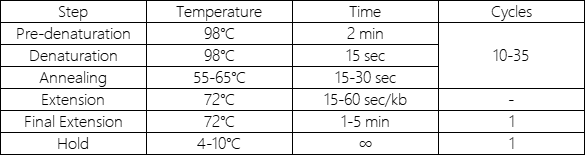
2. PCR Thermal Cycler Program Settings (Activate the heated lid and set to 105℃)
Notes
1.The final concentration of each primer is typically 0.2μM. The Tm value of primers is generally set above 55℃, which can be analyzed using relevant software. Optimal primer concentration and annealing temperature will yield ideal reaction results.
2.For templates with high GC content (GC > 55%), it is recommended to add 10×GC Enhancer to the reaction system. This allows effective amplification of templates with GC content up to 78%.
3.When using human genomic DNA as the template, 2ng~5ng is usually sufficient for amplification. For higher template inputs, reduce the number of PCR cycles.
4.If a two-step PCR program is used, the recommended annealing/extension temperature range is 68℃-75℃, with the extension time calculated as 30-60sec/kb.