Spherical alumina - ≥99.7%, Used as a filler, with a particle size of 5um , CAS No.1344-28-1

CAS: 1344-28-1 Cat. No.: S1492676 Formula: Al2O3 Molecular Weight: 101.96 EC Number: 215-691-6
AVAILABLE TO ORDER
GRADE & PURITY ≥99.7% Used as a filler, with a particle size of 5um
Synonyms
Aluminium oxide|Fasertonerde|Eta-alumina|Catapal S
Storage
Room temperature,Desiccated
Shipped In
Normal
★
Size
USA
Germany (EU)*
Price
Qty
500g
S1492676-500g
Made to order · 8–12 wks
$49.90
Enter a quantity for the sizes you want to add.

Overview

Spherical alumina produced by high-temperature melt spraying method has the characteristics of high sphericity and high content of alpha phase alumina. It exhibits superior performance when used as a filler for rubber, plastics, and ceramic raw materials.
Its particles have high sphericity and wide particle size distribution, which can be used for high-density filling of rubber and plastic, resulting in a mixture with low viscosity and good flowability. High density filling is possible, and compared to crystalline silicon powder, a mixture with high thermal conductivity and good heat dissipation can be obtained.
Due to its spherical appearance, the wear and tear on equipment such as mixers, molding machines, and molds is greatly reduced, which can extend the service life of the equipment.

Specifications

Synonyms
Aluminium oxide | Fasertonerde | Eta-alumina | Catapal S
Specifications & Purity
≥99.7%, Used as a filler, with a particle size of 5um
Storage
Room temperature,Desiccated
Shipped In
Normal
Purity
≥99.7%
Names and Identifiers
SMILES
O=[Al]O[Al]=O
InChI
1S/2Al.3O/q2*+3;3*-2
Isomeric SMILES
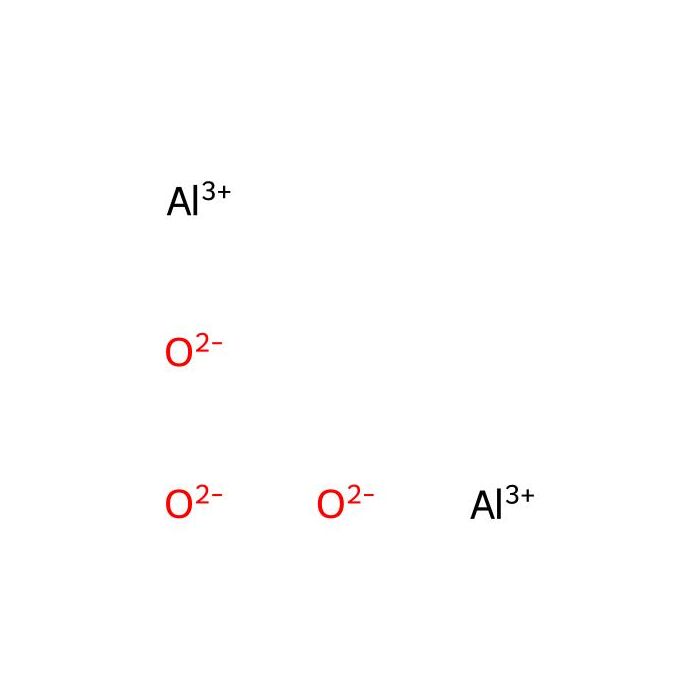
[O-2].[O-2].[O-2].[Al+3].[Al+3]
RTECS
BD1200000
Molecular Weight
101.96
Reaxys
11323344
Reaxys-RN_link_address
https://www.reaxys.com/reaxys/secured/hopinto.do?context=S&query=IDE.XRN=11323344&ln=

Advanced Data

3D Structure
Interactive Chemical Structure Model


Certificates (CoA,COO,BSE/TSE and Analysis Chart)
C of A & Other Certificates(BSE/TSE, COO):
Analytical Chart:

Find and download the COA for your product by matching the lot number on the packaging.

5 results found

Lot NumberCertificate TypeDateItem
C2604713C2604713Certificate of AnalysisFeb 10, 2026 S1492676
C2604715C2604715Certificate of AnalysisFeb 10, 2026 S1492676
G2631131G2631131Certificate of AnalysisFeb 10, 2026 S1492676
K2505708K2505708Certificate of AnalysisOct 27, 2025 S1492676
K2505709K2505709Certificate of AnalysisOct 27, 2025 S1492676
Chemical and Physical Properties
SensitivityHygroscopic;Moisture sensitive
Refractive Index1.768
Boil Point2977°C
Melt Point2000°C
Safety and Hazards(GHS)
RTECS
BD1200000
Reaxys
11323344
Reaxys-RN_link_address
https://www.reaxys.com/reaxys/secured/hopinto.do?context=S&query=IDE.XRN=11323344&ln=
Documents & Articles
Activated Carbon and Adsorbent Essentials
Molybdenum: Understanding This Key Element
How to Choose Alumina Products? — A Practical Guide from Fundamental Concepts to Application Categories
Immobilized Enzyme Technology and Its Applications in Biocatalysis
Nanowires: Properties, Preparation Routes, and Process Selection (Comprehensive Analysis of Top-Down and Bottom-Up Approaches with Recommended Aladdin Reagents)
Cobalt Catalysts—From Fundamentals to Practice: Mechanistic Insights, Selection Logic, and a One-Stop Aladdin Selection List
Minute-Scale Construction of Fluorinated Nitrogen-Bridged Bicycles: Pd(II)/Pd(IV) Cascade Chemistry and a Pd(IV) “Dyotropic (Paired-Migration)” Rearrangement Driving Strain-Release Ring Expansion
High-Refractive-Index vs Low-Refractive-Index Coating Materials: From AR/Waveguide Principles to a Formulation & Material-Selection Map (Including Product Category Tables A/B/C)
SOFC Solid Oxide Fuel Cells: From “What It Is and How It Generates Power” to a Key Materials Map, Application Scenarios, and Selection Navigation (Electrolytes / Electrodes / Interconnects / Sealing)
Panorama Guide to Lithium-Ion Battery Electrode Materials: Working Principles, Materials Map, and Selection Navigation (incl. Tables 1–4)
Post-Transition Metals and Their Salts: A Classification Guide from Definitions to Value-Chain Applications (Including Product Lists in Tables 1–4)
Optical & Optoelectronic Materials Selection Guide:Positioning materials, key metrics, and validation paths along “Generation → Guiding → Control → Readout” (with product navigation and Tables 1–4)
Ceramic Materials Guide: Basic Definitions, Classification Framework, and Research-Task-Oriented Selection (with Product Navigation and Tables 1–4)
Why Metal Nanocatalysts Can “Save Energy Yet Lose Performance Easily”: Durability Logic from Active Sites to Support/Interface Engineering (Including Selection Guide and Product Tables A–D)
Applications of Self-Assembled Monolayers (SAMs), Microcontact Printing, and Soft Lithography in Surface Functionalization and Micro/Nanopatterning
Self-Assembled Nanodielectrics (SANDs): Self-Assembled Nanodielectric Layers for Low-Voltage Thin-Film Transistors (with Product Selection Guide)
Research Value of Polyelectrolyte Multilayers: Layer-by-Layer Design of Interfacial Composition, Mass Transport, and Function
Polyetherimide (PEI): Structural Features, Main Properties, and Typical Application Directions
Experimental Selection and Outcome Assessment of Heterogeneous Metal Catalysts in Organic Synthesis
Limitations and Future Development of Epoxy Resins: Safety, Environmental Protection, Recycling, Bio-Based Materials, and High-Performance Trends
Four Core Applications of Epoxy Resins: Bonding, Protection, Load-Bearing, and Insulation Protection
Guide to Epoxy Resin Performance Design: System Composition, Key Properties, Process Control, and Application Selection
Guide to Selecting Polyurethane Coating Systems: Application Analysis for Wood, Flooring, Plastics, Automotive, and Industrial Protection
Comprehensive Performance Analysis of Polyurethane Coating Films: Soft/Hard Segment Structure, Microphase Separation, Crosslinking and Curing, and Selection of Representative Chemicals
Structure–Property Relationship of Silicone Resins: Mechanisms of Heat Resistance, Weatherability, Hydrophobicity, and Coating Performance Analysis
Silicone Resin Coating Formulation Design: From Application Conditions to Matching Resins, Pigments and Fillers, Curing, and Substrates
How Should Montmorillonite Be Rationally Modified? Organic Modification, Inorganic Modification, and Application-Oriented Selection and Validation
What Is Silica Sol: Mechanism of Action, Application Scenarios, and Selection Criteria for Nanosilica Dispersions
Diagnosis of Coating Performance Issues and Selection of Resin Modification Routes
Structural Design Logic of Common Resin Modification Technologies: Molecular Chain Structure, Functional Groups, Phase Structure, Crosslinked Networks, and Hybrid/Functional Design
Resin Polarity in Coating Formulations: From Molecular Structure to Dissolution, Compatibility, Interfacial Interactions, and Formulation Design
Signal Transduction Mechanism of Graphene Biosensors: From Molecular Recognition to Electrical/Optical Signal Readout and Materials Selection
Color-Development Mechanisms, Formulation Forms, and Selection/Application Logic of Colorants in Personal Care Products
Vanadium-Aluminum Master Alloy: Vanadium Source Control and Quality Essentials in High-End Titanium Alloy Melting
UVA Absorption Mechanism of Avobenzone: Keto–Enol Tautomerism, Photochemical Instability, and Formulation Photostabilization Strategies
Solid Supports in Packed Gas Chromatography Columns: Definition, Mechanisms of Action, Classification, and Selection
Citations of This Product
Solution Calculators
Reviews

Customer Reviews

Related Products

Aluminum oxide - PureSpectra™, Spectrum pure, ≥99.999% metals basis , CAS No.1344-28-1
Aluminum oxide G - for TLC , CAS No.1344-28-1
Aluminum oxide - PrimorTrace™, ≥99.99% metals basis, α-phase,0.40μm , CAS No.1344-28-1
Aluminium oxide,basic - 200-300 mesh≥70% , CAS No.1344-28-1
Aluminum oxide - ≥99.998% metals basis, Lumps , CAS No.1344-28-1
Aluminum oxide - PrimorTrace™, ≥99.99% metals basis, γ-phase,≤20nm , CAS No.1344-28-1
Aluminum oxide - Phosphotungstic acid modified alumina , CAS No.1344-28-1
Aluminum oxide - nanoparticles, <30 nm particle size, 20 wt. % in isopropanol , CAS No.1344-28-1
Aluminum oxide - PrimorTrace™, ≥99.99% metals basis, powder,5~6um, used for Used as an abrasive and in the production of crucibles, ceramics, refractory materials, and artificial gemstones. Used as a raw material for aluminum production and capable of for
Aluminum oxide - AR , CAS No.1344-28-1
Aluminum oxide - PrimorTrace™, ≥99.99% metals basis, for coating , CAS No.1344-28-1
Aluminum oxide - PrimorTrace™, ≥99.99% metals basis , CAS No.1344-28-1
alpha-Alumina trihydrate - 100-200 mesh≥75% , CAS No.1344-28-1
Aluminum oxide - PrimorTrace™, ≥99.99% metals basis, powder,6-7μm , CAS No.1344-28-1
Aluminum oxide - specific surface area:0.221m2/g , CAS No.1344-28-1
Vapor Phase Aluminum Oxide - Hydrophilicity, ≥98%, specific surface area(BET):100m2/g;particle size:10-30nm , CAS No.1344-28-1
Activated alumina - γ-phase,PH 7±1, Al2O3≥99%, Particle size 80-150 mesh , CAS No.1344-28-1
Activated alumina - γ-phase,PH 5±1, Al2O3≥99%, Particle size 80-150 mesh , CAS No.1344-28-1
Activated alumina - γ-phase,PH 9±1, Al2O3≥99%, Particle size 80-150 mesh , CAS No.1344-28-1
Activated alumina spheres - Suitable for general use,Used as adsorbent, particle size 1-3mm , CAS No.1344-28-1
Activated alumina spheres - Suitable for general use,Used as a desiccant, particle size 1-3mm , CAS No.1344-28-1
Activated alumina spheres - Used as a catalyst carrier, particle size 1-3mm , CAS No.1344-28-1
Microcrystalline alumina spheres - Used for grinding media, Al2O3≥95%, Particle size 20mm , CAS No.1344-28-1

Shall we send you a message when we have discounts available?

Remind me later

Thank you! Please check your email inbox to confirm.

Oops! Notifications are disabled.