Determine the necessary mass, volume, or concentration for preparing a solution.
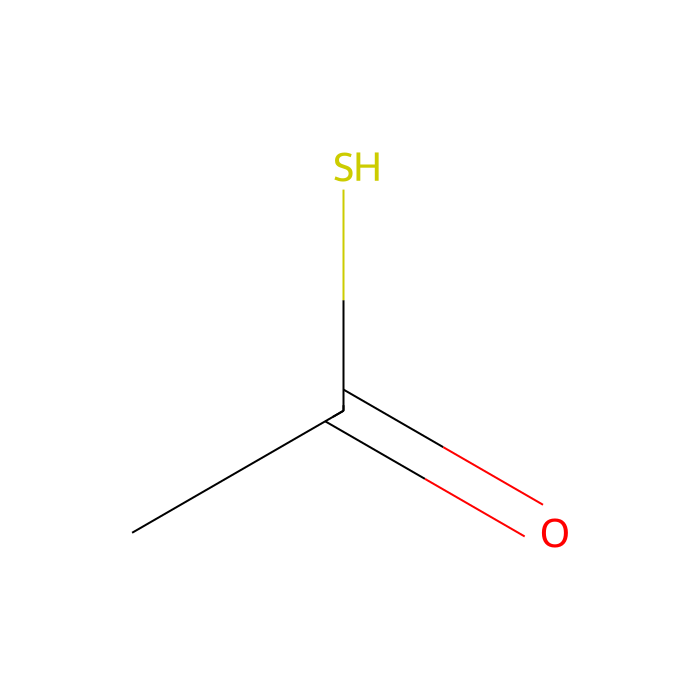
Thioacetic acid (TAA) can undergo:
• Enantioselective addition to nitroalkenes to form chiral 1,2-aminothiol derivatives in the presence of a novel sulfinyl urea organocatalyst. This method has been successfully employed in the synthesis of antifungal drug, sulconazole.
• Asymmetric Michael addition reaction with chalcones in the presence of a bifunctional amine thiourea catalyst to form synthetically useful thioesters.
• Asymmetric 1,6-conjugate addition with para-quinone methides in the presence of a chiral phosphoric acid catalyst to form chiral sulfur-containing diphenylmethane-type compounds.
• Conjugate addition to methacrylamides with chiral trans-2,5-disubstituted pyrrolidine auxiliaries to form chiral β-mercaptocarboxylic acid derivatives.
Thioacetic acid is a reagent for introduction of the thiol group into organic molecules.
A reagent for introduction of the thiol group into organic molecules.
Taxonomy Tree
| Kingdom | Organic compounds |
|---|---|
| Superclass | Organic acids and derivatives |
| Class | Carbothioic S-acids |
| Subclass | Not available |
| Intermediate Tree Nodes | Not available |
| Direct Parent | Carbothioic S-acids |
| Alternative Parents | Carbodithioic acids Thiocarboxylic acids and derivatives Carboxylic acids and derivatives Alkylthiols Organic oxides Hydrocarbon derivatives Carbonyl compounds |
| Molecular Framework | Aliphatic acyclic compounds |
| Substituents | Carbothioic s-acid - Carbodithioic acid - Thiocarboxylic acid or derivatives - Carboxylic acid derivative - Alkylthiol - Organic oxygen compound - Organic oxide - Hydrocarbon derivative - Organosulfur compound - Organooxygen compound - Carbonyl group - Aliphatic acyclic compound |
| Description | This compound belongs to the class of organic compounds known as carbothioic s-acids. These are organic acids with the general formula RCS-OH (R=H, organic group). |
| External Descriptors | thioacetic acid |
Find and download the COA for your product by matching the lot number on the packaging.
| Lot Number | Certificate Type | Date | Item |
|---|---|---|---|
| Certificate of Analysis | Jul 18, 2026 | T112604 | |
| Certificate of Analysis | Jul 03, 2026 | T112604 | |
| Certificate of Analysis | Jul 03, 2026 | T112604 | |
| Certificate of Analysis | Jul 03, 2026 | T112604 | |
| Certificate of Analysis | Jan 10, 2026 | T112604 | |
| Certificate of Analysis | Aug 06, 2025 | T112604 | |
| Certificate of Analysis | Aug 06, 2025 | T112604 | |
| Certificate of Analysis | May 13, 2025 | T112604 | |
| Certificate of Analysis | May 12, 2025 | T112604 | |
| Certificate of Analysis | May 12, 2025 | T112604 | |
| Certificate of Analysis | Jul 28, 2021 | T112604 | |
| Certificate of Analysis | Jul 28, 2021 | T112604 | |
| Certificate of Analysis | Jul 28, 2021 | T112604 |
| Solubility | Soluble in water. (27g/L) at 16°C. |
|---|---|
| Sensitivity | Air & Heat sensitive,Moisture sensitive. |
| Refractive Index | 1.463 |
| Flash Point | 52°F |
| Flash Point | 51.8 °F |
| Boil Point | 88-91.5°C |
| Melt Point | -17°C |
| Molecular Weight | 76.12 |
| XLogP3 | 0.300 |
| Hydrogen Bond Donor Count | 1 |
| Hydrogen Bond Acceptor Count | 2 |
| Rotatable Bond Count | 0 |
| Exact Mass | 75.9983 Da |
| Monoisotopic Mass | 75.9983 Da |
| Topological Polar Surface Area | 18.100 Ų |
| Heavy Atom Count | 4 |
| Formal Charge | 0 |
| Complexity | 33.000 |
| Isotope Atom Count | 0 |
| Defined Atom Stereocenter Count | 0 |
| Undefined Atom Stereocenter Count | 0 |
| Defined Bond Stereocenter Count | 0 |
| Undefined Bond Stereocenter Count | 0 |
| The total count of all stereochemical bonds | 0 |
| Covalently-Bonded Unit Count | 1 |
H225:Highly Flammable liquid and vapor
H301:Toxic if swallowed
H302:Harmful if swallowed
H314:Causes severe skin burns and eye damage
H317:May cause an allergic skin reaction
H318:Causes serious eye damage
P210:Keep away from heat, hot surface, sparks, open flames and other ignition sources. - No smoking.
P233:Keep container tightly closed.
P240:Ground/bond container and receiving equipment.
P241:Use explosion-proof [electrical/ventilating/lighting/.../] equipment.
P242:Use only non-sparking tools.
P243:Take precautionary measures against static discharge.
P260:Do not breathe dust/fume/gas/mist/vapors/spray.
P261:Avoid breathing dust/fume/gas/mist/vapors/spray.
P264:Wash hands [and …] thoroughly after handling.
P270:Do not eat, drink or smoke when using this product.
P272:Contaminated work clothing should not be allowed out of the workplace.
P280:Wear protective gloves/protective clothing/eye protection/face protection.
P321:Specific treatment (see ... on this label).
P330:Rinse mouth.
P363:Wash contaminated clothing before reuse.
P301+P330+P331:IF SWALLOWED: Rinse mouth. Do NOT induce vomiting.
P302+P352:IF ON SKIN: wash with plenty of water.
P303+P361+P353:IF ON SKIN (or hair): Take off Immediately all contaminated clothing. Rinse SKIN with water [or shower].
P304+P340:IF INHALED: Remove person to fresh air and keep comfortable for breathing.
P333+P313:IF SKIN irritation or rash occurs: Get medical advice/attention.
P362+P364:Take off contaminated clothing and wash it before reuse.
P370+P378:In case of fire: Use ... to extinguish.
P405:Store locked up.
P403+P235:Store in a well-ventilated place. Keep cool.
P501:Dispose of contents/container to an approved waste disposal plant.
P264+P265:Wash hands [and …] thoroughly after handling. Do not touch eyes.
P301+P316:IF SWALLOWED: Get emergency medical help immediately.
P301+P317:IF SWALLOWED: Get medical help.
P305+P354+P338:IF IN EYES: Immediately rinse with water for several minutes. Remove contact lenses if present and easy to do. Continue rinsing.
P317:Get emergency medical help.
P302+P361+P354:IF ON SKIN: Take off Immediately all contaminated clothing. Immediately rinse with water for several minutes.
P316:Get emergency medical help immediately.