Triethoxyvinylsilane(TEVS) - ≥97% , CAS No.78-08-0

CAS: 78-08-0 Cat. No.: T103647 Formula: C8H18O3Si Molecular Weight: 190.31 Beilstein Registry Number: 1767229 EC Number: 201-081-7 PubChem CID: 6516
AVAILABLE TO ORDER
GRADE & PURITY ≥97%
Synonyms
Vinyltriethoxysilane
Storage
Room temperature,Argon charged
Shipped In
FedEx DG Service
★
Size
USA
Germany (EU)*
Price
Qty
25ml
T103647-25ml
In stock ≥10
7 In stock
$16.90
100ml
T103647-100ml
In stock ≥10
7 In stock
$34.90
500ml
T103647-500ml
In stock ≥10
7 In stock
$99.90
Enter a quantity for the sizes you want to add.

Overview

product description:

Triethoxyvinylsilane(TEVS) is a silane coupling agent and an adhesion promoter which can be used for cross-linking and for providing an insulating layer with good mechanical and thermal properties.

Specifications

Synonyms
Vinyltriethoxysilane
Specifications & Purity
≥97%
Storage
Room temperature,Argon charged
Shipped In
FedEx DG Service
Purity
≥97%
Product Line
T103647-25ml
Names and Identifiers
Pubchem Sid
Pubchem Sid Url
https://pubchem.ncbi.nlm.nih.gov/substance/504751110
SMILES
CCO[Si](C=C)(OCC)OCC
IUPAC Name
ethenyl(triethoxy)silane
InChIKey
FWDBOZPQNFPOLF-UHFFFAOYSA-N
InChI
1S/C8H18O3Si/c1-5-9-12(8-4,10-6-2)11-7-3/h8H,4-7H2,1-3H3
Isomeric SMILES
CCO[Si](C=C)(OCC)OCC
WGK Germany
2
RTECS
VV6700000
PubChem CID
6516
UN Number
1993
Packing Group
III
Molecular Weight
190.31
Beilstein
1767229
Reaxys
1767229

Advanced Data

Taxonomic Classification

Taxonomy Tree

KingdomOrganic compounds
SuperclassOrganometallic compounds
ClassOrganometalloid compounds
SubclassOrganosilicon compounds
Intermediate Tree Nodes Alkoxysilanes
Direct ParentTrialkoxysilanes
Alternative Parents Silyl ethers  Organoheterosilanes  Organic metalloid salts  Organooxygen compounds  Hydrocarbon derivatives  
Molecular FrameworkAliphatic acyclic compounds
Substituents Trialkoxysilane - Silyl ether - Organoheterosilane - Organic metalloid salt - Organic oxygen compound - Hydrocarbon derivative - Organic salt - Organooxygen compound - Aliphatic acyclic compound
DescriptionThis compound belongs to the class of organic compounds known as trialkoxysilanes. These are organosilicon compounds with the general formula RO[Si](R')(OR'')OR''' (R-R''' = aliphatic organyl group).
External Descriptors Not available
3D Structure
Interactive Chemical Structure Model


Certificates (CoA,COO,BSE/TSE and Analysis Chart)
C of A & Other Certificates(BSE/TSE, COO):
Analytical Chart:

Find and download the COA for your product by matching the lot number on the packaging.

42 results found

Lot NumberCertificate TypeDateItem
C2613282C2613282Certificate of AnalysisFeb 05, 2026 T103647
C2613296C2613296Certificate of AnalysisFeb 05, 2026 T103647
C2613297C2613297Certificate of AnalysisFeb 05, 2026 T103647
C2613299C2613299Certificate of AnalysisFeb 05, 2026 T103647
J2612074J2612074Certificate of AnalysisFeb 05, 2026 T103647
K2504553K2504553Certificate of AnalysisOct 20, 2025 T103647
K2504634K2504634Certificate of AnalysisOct 20, 2025 T103647
K2504635K2504635Certificate of AnalysisOct 20, 2025 T103647
K2504636K2504636Certificate of AnalysisOct 20, 2025 T103647
H2528600H2528600Certificate of AnalysisAug 14, 2025 T103647
H2528592H2528592Certificate of AnalysisAug 14, 2025 T103647
H2528601H2528601Certificate of AnalysisAug 14, 2025 T103647
H2528602H2528602Certificate of AnalysisAug 14, 2025 T103647
K2125687K2125687Certificate of AnalysisMay 09, 2025 T103647
C2528548C2528548Certificate of AnalysisMar 20, 2025 T103647
C2528547C2528547Certificate of AnalysisMar 20, 2025 T103647
C2528546C2528546Certificate of AnalysisMar 20, 2025 T103647
C2528545C2528545Certificate of AnalysisMar 20, 2025 T103647
I2409251I2409251Certificate of AnalysisAug 28, 2024 T103647
I2409250I2409250Certificate of AnalysisAug 28, 2024 T103647
K2421433K2421433Certificate of AnalysisJul 29, 2024 T103647
K2421459K2421459Certificate of AnalysisJul 29, 2024 T103647
K2421460K2421460Certificate of AnalysisJul 29, 2024 T103647
E2423406E2423406Certificate of AnalysisMay 13, 2024 T103647
E2423376E2423376Certificate of AnalysisMay 13, 2024 T103647
D2416546D2416546Certificate of AnalysisApr 07, 2024 T103647
D2416502D2416502Certificate of AnalysisApr 07, 2024 T103647
D2416499D2416499Certificate of AnalysisApr 07, 2024 T103647
D2416498D2416498Certificate of AnalysisApr 07, 2024 T103647
C2518455C2518455Certificate of AnalysisMar 15, 2024 T103647
D2425516D2425516Certificate of AnalysisMar 15, 2024 T103647
D2425420D2425420Certificate of AnalysisMar 15, 2024 T103647
L2118210L2118210Certificate of AnalysisSep 12, 2023 T103647
K2125770K2125770Certificate of AnalysisAug 21, 2023 T103647
F2303664F2303664Certificate of AnalysisMay 23, 2023 T103647
F2303644F2303644Certificate of AnalysisMay 23, 2023 T103647
F2303642F2303642Certificate of AnalysisMay 23, 2023 T103647
F2303640F2303640Certificate of AnalysisMay 23, 2023 T103647
A2125377A2125377Certificate of AnalysisNov 14, 2022 T103647
L2212114L2212114Certificate of AnalysisOct 28, 2022 T103647
L2212154L2212154Certificate of AnalysisOct 28, 2022 T103647
L2212155L2212155Certificate of AnalysisOct 28, 2022 T103647
Chemical and Physical Properties
SolubilityMiscible with organic solvents.
SensitivityMoisture sensitive.
Refractive Index1.398
Flash Point93.2 °F
Flash Point34℃
Boil Point160-161°C
Molecular Weight190.31
XLogP3
Hydrogen Bond Donor Count0
Hydrogen Bond Acceptor Count3
Rotatable Bond Count7
Exact Mass190.103 Da
Monoisotopic Mass190.103 Da
Topological Polar Surface Area27.700 Ų
Heavy Atom Count12
Formal Charge0
Complexity110.000
Isotope Atom Count0
Defined Atom Stereocenter Count0
Undefined Atom Stereocenter Count0
Defined Bond Stereocenter Count0
Undefined Bond Stereocenter Count0
The total count of all stereochemical bonds0
Covalently-Bonded Unit Count1
Safety and Hazards(GHS)
Pictogram(s)
GHS02,   GHS07
Signal
Warning
Hazard Statements

H226:Flammable liquid and vapor

H316:Causes mild skin irritation

H319:Causes serious eye irritation

H333:May be harmful if inhaled

H335:May cause respiratory irritation

Precautionary Statements

P210:Keep away from heat, hot surface, sparks, open flames and other ignition sources. - No smoking.

P233:Keep container tightly closed.

P240:Ground/bond container and receiving equipment.

P241:Use explosion-proof [electrical/ventilating/lighting/.../] equipment.

P242:Use only non-sparking tools.

P243:Take precautionary measures against static discharge.

P261:Avoid breathing dust/fume/gas/mist/vapors/spray.

P264:Wash hands [and …] thoroughly after handling.

P271:Use only outdoors or in a well-ventilated area.

P280:Wear protective gloves/protective clothing/eye protection/face protection.

P303+P361+P353:IF ON SKIN (or hair): Take off Immediately all contaminated clothing. Rinse SKIN with water [or shower].

P305+P351+P338:IF IN EYES: Rinse cautiously with water for several minutes. Remove contact lenses if present and easy to do - continue rinsing.

P332+P313:IF SKIN irritation occurs: Get medical advice/attention.

P337+P313:IF eye irritation persists: Get medical advice/attention.

P370+P378:In case of fire: Use ... to extinguish.

P405:Store locked up.

P403+P233:Store in a well-ventilated place. Keep container tightly closed.

P403+P235:Store in a well-ventilated place. Keep cool.

P501:Dispose of contents/container to an approved waste disposal plant.

P304+P340+P312:IF INHALED: Remove person to fresh air and keep comfortable for breathing.Call a POISON CENTER or doctor. if you feel unwell.

WGK Germany
2
RTECS
VV6700000
Reaxys
1767229
Class
3
Documents & Articles
A Panoramic Guide to Silicone Materials: Structural Mechanisms, Core Properties, Value Chain, and Product Categories
A Hygrothermal Interface Guide for Silane Coupling Agents: From Failure Mechanisms to Evidence-Chain Troubleshooting and Selection (with Product Tables A–C)
Why Material Properties Are Limited by Interfaces: Mechanism of Action and Selection Guide for Silane Coupling Agents (Tables 1–4)
Silane Precursors in Sol-Gel Film Formation: Precursor Selection and Its Influence on Film-Formation Outcomes
Vinyl Silanes and Related Vinyl Functional Silanes: From Structural Features and Interfacial Action to Classification and Selection
Titanate Coupling Agents: Structural Features, Classification, Typical Applications, and Differences from Silane Coupling Agents
Preparation Methods and Precautions for Silane Coupling Agent Primer Solutions
Which Fillers and Substrates Are Suitable for Silane Coupling Agents: Surface Hydroxyls, Interfacial Bonding, and Experimental Verification
Understanding Silicone Resins from Their Structure: Siloxane Backbones, M/D/T/Q Units, and Coating Performance Regulation
Silicone Resin Coating Formulation Design: From Application Conditions to Matching Resins, Pigments and Fillers, Curing, and Substrates
What Is Silica Sol: Mechanism of Action, Application Scenarios, and Selection Criteria for Nanosilica Dispersions
Structural Design Logic of Common Resin Modification Technologies: Molecular Chain Structure, Functional Groups, Phase Structure, Crosslinked Networks, and Hybrid/Functional Design
Resin Polarity in Coating Formulations: From Molecular Structure to Dissolution, Compatibility, Interfacial Interactions, and Formulation Design
Application of Aldimine Latent Curing Agents in One-Component Moisture-Curing Polyurethane Systems —— Mechanism of CO₂ Bubble Control and Key Formulation Design Points
Citations of This Product
Solution Calculators
Reviews

Customer Reviews

Application Protocols

No antibody/biologic application data (WB, IHC, IF, FC) apply to this small-molecule organosilane.

General laboratory protocol examples (literature; for planning only):

  • Glass silanization with TEVS
    1. Clean glass slides; activate hydroxyl groups (e.g., oxygen plasma).
    2. Prepare 1% v/v TEVS in EtOH/H2O (90:10) with 0.5% v/v acetic acid; stir 10 min.
    3. Immerse slides 20 min at RT; rinse with ethanol; dry N2; cure 110 °C, 20 min.
    4. Proceed to thiol–ene grafting as needed.
  • Vinyl copolymer grafting (solution)
    1. Dissolve comonomers and TEVS in toluene (solids 20–40%).
    2. Add AIBN (0.5–1 wt% of monomers); degas; polymerize 70 °C, 4–8 h.
    3. Precipitate polymer; dry under vacuum.

These are illustrative, non-validated procedures. Optimize and validate for your system. Always consult the SDS and your institutional EHS guidelines before scaling.

Biological Roles

TEVS is a synthetic organosilane coupling agent without inherent biological function. It is used to engineer material–biomolecule interfaces rather than to participate in metabolism.

Relevant context (literature; for research materials science/bioconjugation):

  • Biointerface preparation: TEVS can create vinyl-terminated surfaces on glass, silica, or metal oxides. These surfaces enable subsequent attachment of biomolecules through thiol–ene click chemistry (e.g., cysteine-containing peptides) or radical grafting of biocompatible polymers.
  • Hybrid materials: Incorporation of vinyl groups into sol–gel silica matrices allows post-gelation functionalization under mild conditions, supporting biosensor or immobilized-enzyme architectures.
  • Protein/cell contact: Surface energy and functional group density strongly influence protein adsorption and cell adhesion. TEVS provides a hydrophobic, unsaturated layer; further derivatization (e.g., PEGylation via thiol–ene) is typically required to tune fouling or cell response.

Caveats

  • No endogenous biological role; not intended for in vivo or clinical use.
  • Residual unreacted silane and hydrolysis byproducts (ethanol, silanols) should be thoroughly removed prior to biological testing to minimize cytotoxic artifacts.
  • Surface characterization (XPS/Si 2p, C 1s; contact angle; fluorescence labeling of thiol–ene adducts) is recommended to validate coverage and reactivity for bioassay development.
Buffer Applications

TEVS is not a buffering agent and is not used to prepare biochemical buffers. It is a moisture-reactive organosilane employed for surface functionalization.

Practical note (literature for silanization workflows):

  • When performing controlled hydrolysis before surface deposition, practitioners often use dilute acetic acid in aqueous ethanol (e.g., 0.1–1% v/v AcOH; pH ~4–5) as the hydrolysis medium. This is not a buffering system for biological pH control but a catalyst environment to generate silanols uniformly.
  • After silanization, rinse substrates thoroughly with alcohol and dry under nitrogen to remove acidic residues; subsequent steps can employ true biological buffers (PBS, HEPES) only after full curing/condensation of the silane layer.
Green Alternatives

Sustainability considerations with TEVS center on solvent choice, VOCs, and moisture-reactive processing rather than the reagent itself.

Greener process options (literature/guidance):

  • Use aqueous ethanol (70–95% v/v) instead of aromatic hydrocarbons for silanization, when application tolerates faster hydrolysis/condensation. Benefits: reduced toxicity/odor, easier waste handling. Tradeoff: increased risk of premature oligomerization; prepare fresh solutions.
  • Replace THF with 2‑MeTHF or CPME for coupling or grafting reactions; both offer lower peroxide formation and partially bio-based sourcing (2‑MeTHF). Ensure comparable kinetics and solubility.
  • Consider supercritical CO2 deposition for uniform, solvent-free surface treatment on complex geometries (specialized equipment required).
  • Minimize VOCs via:
    • Vapor-phase silanization under controlled humidity rather than bulk solvent baths.
    • On-demand mixing and micro-scale priming to reduce leftover reactive solutions.

Comparison snapshot (qualitative, literature)

  • Toluene/heptane: low water content; higher VOC/air emissions; good control over hydrolysis.
  • Ethanol/water: greener, low toxicity; faster hydrolysis; potential gelation—use dilute (0.5–2% TEVS) and short dwell times.
  • 2‑MeTHF/CPME: greener ether alternatives; hydrophobic like toluene but lower toxicity; verify peroxide specs and manage peroxides via periodic testing despite improved profiles.

Waste and EHS

  • Collect hydrolysis residues (ethanol-containing) as flammable waste. Neutralize acidic catalysts before disposal per local regulations. Capture organosiloxane gels as solid hazardous waste.
Pharmaceutical Uses

No therapeutic applications are claimed. TEVS is supplied strictly for research use.

Formulation/manufacturing context (general, non-clinical):

  • As an adhesion promoter or surface primer, TEVS may be evaluated in R&D settings for bonding polymeric coatings to inorganic fillers or device components (e.g., glass, silica, metal oxides). Any such use in regulated manufacturing would require qualification of grade, extractables/leachables, and full compliance with applicable pharmacopeial or device standards—none of which are specified for this item.
  • Excipient status: Not specified for this item; refer to regulatory databases if excipient use is contemplated. Most vinylalkoxysilanes are not standard pharmacopeial excipients.
  • Processing notes (literature)
    • Hydrolysis generates ethanol; ensure solvent control and adequate drying/curing to minimize residuals.
    • Validate surface cleanliness and silane layer robustness (tape tests, contact angle, FTIR/XPS) if used upstream of coatings.

Important: This product is labeled For research use only and is not intended for human or animal therapeutic, diagnostic, or clinical applications.

Physical Properties

Item-specific specs are not provided in the Product Data; consult the CoA/Spec Sheet for definitive values. The following are typical literature properties of triethoxyvinylsilane (for technical planning only):

  • Physical state/appearance: colorless to pale liquid (literature; item-specific appearance: Not specified for this item; refer to CoA/Spec Sheet.)
  • Molecular formula: C8H18O3Si (literature)
  • Molecular weight: ~190.31 g/mol (literature)
  • Boiling point: ~160–162 °C at 101 kPa (literature)
  • Density: ~0.90–0.93 g/mL at 25 °C (literature)
  • Refractive index (nD20): ~1.390–1.395 (literature)
  • Vapor pressure: low at ambient temperature (literature qualitative)
  • Solubility:
    • Water: limited apparent solubility; undergoes hydrolysis to silanols with ethanol release (literature)
    • Organic: miscible with common aprotic solvents (toluene, heptane, THF, CPME, 2‑MeTHF) and alcohols (ethanol, isopropanol); avoid excess water (literature)
  • Hydrolysis/condensation: acid- or base-catalyzed hydrolysis of –OEt to –Si–OH, followed by condensation to siloxanes (literature)
  • LogP: expected moderately hydrophobic due to three ethoxy groups and vinyl functionality; quantitative value varies by source (literature; Not specified for this item.)
  • pKa: not applicable (no ionizable center under neutral conditions)

Important: Do not treat these literature values as the item’s specifications. For compliance-sensitive work (e.g., validated processes), use the lot-specific CoA.

Quality & Grades
  • Item-specific grade/purity: Not specified for this item; refer to CoA/Spec Sheet.

Context for professional users (general guidance):

  • Trialkoxysilanes used for surface modification and as adhesion promoters are commonly offered in grades such as “technical,” “industrial,” or “≥98%” assay. For chromatography or electronics, low-alkali/low-metal specifications and low UV-absorptivity may be requested. Absent explicit grade, verify assay, water content, acidity, and residual alcohol by CoA.
  • Stabilization: Some alkoxysilanes are shipped under inert gas (as here: argon charged) to mitigate hydrolysis/oxidation. They generally do not contain added stabilizers; if a stabilizer is present, it will be stated on the CoA. For this item, stabilizers/additives: Not specified for this item; refer to CoA/Spec Sheet.
  • What to check on receipt (best practice)
    • Assay by GC or NMR; water by Karl Fischer; acidity (as acetic acid equivalents) and residual ethanol; color/APHA and refractive index as identity checks.
    • Hydrolyzable chloride and metals are typically low for silanes; specific limits must be confirmed by CoA when process-critical.
  • Fitness-for-use examples
    • Surface silanization: favor low-water, low-acid lots; verify silanol formation rate in a small-screening hydrolysis test.
    • Polymer grafting: confirm inhibitor absence (if relevant) and monitor vinyl integrity by 1H NMR (vinyl protons ~6.0–6.3 ppm).
Reaction & Applications

TEVS serves as a bifunctional coupling agent: hydrolyzable trialkoxysilane for bonding to inorganic surfaces and a vinyl handle for subsequent polymerization or click-like transformations.

Key application families (literature):

  • Surface modification/adhesion promotion
    • Hydrolysis (acid-catalyzed, pH 4–5) to silanols and condensation onto hydroxylated substrates (glass, silica, alumina, metals/oxides). Forms covalent Si–O–M bonds and surface-tethered vinyl functionality.
    • Enhances adhesion of vinyl/unsaturated resins (e.g., styrenics, acrylates, unsaturated polyesters) to mineral fillers/fibers.
  • Polymer and network formation
    • Radical copolymerization via the vinyl group with styrene, acrylates, or maleates, yielding silane-functional copolymers that can further crosslink by moisture.
    • Thiol–ene additions to the vinyl moiety (UV or thermal initiation) to graft thiols (e.g., cysteine-bearing ligands for biointerfaces).
  • Cross-coupling chemistry
    • Vinyltrialkoxysilanes participate in Hiyama-type couplings with aryl/vinyl halides under fluoride activation, delivering substituted alkenes with high chemoselectivity.
  • Sol–gel and hybrid materials
    • Co-condensation with other alkoxysilanes (e.g., TEOS, MTES) to introduce pendant vinyl groups into silica networks for post-functionalization.

Practical tips

  • Control hydrolysis rate with dilute acetic acid (0.1–1% v/v) in ethanol/water; allow pre-hydrolysis (5–30 min) before substrate exposure.
  • For radical processes, remove inhibitors/oxygen (argon purge) and select initiators (AIBN, peroxides) tuned to the cure temperature.
  • Monitor surface coverage or conversion by contact angle, ATR-FTIR (νSi–O–Si ~1000–1100 cm−1), and 1H NMR of residual monomer.
Reaction Conditions

The following literature-based conditions provide practical starting points; optimize per system and consult primary sources.

  • Surface silanization (oxide substrates)
    • Pre-treatment: clean and hydroxylate surfaces (piranha, oxygen plasma, or base/acid wash; use appropriate safety protocols).
    • Hydrolysis: 0.5–2% v/v TEVS in EtOH/H2O (95:5 to 80:20) with 0.1–1% v/v acetic acid; stir 5–30 min to generate silanols.
    • Deposition: immerse or spin/spray coat for 10–60 min at RT; rinse with ethanol; cure 110–120 °C for 10–30 min or ambient overnight to promote condensation.
  • Vapor-phase silanization
    • Place substrates with a small reservoir of TEVS in a desiccator; control RH (30–60%) at RT to 80 °C for 1–4 h; post-cure as above.
  • Thiol–ene grafting on TEVS-modified surfaces
    • Photoinitiated: thiol (0.05–0.5 M) in solvent (ethanol or toluene), 0.5–2 wt% photoinitiator (e.g., DMPA); UV 320–365 nm, 5–30 min.
    • Thermal: AIBN (1–2 mol%), 60–80 °C, 1–4 h under inert gas.
  • Hiyama coupling (vinylsilane → substituted alkene)
    • Catalyst: Pd(PPh3)4 (1–5 mol%); Activator: TBAF (1.5–3 equiv, anhydrous);
    • Solvent: THF, 2‑MeTHF, or DMF; Temp: 25–70 °C; Time: 2–16 h; Typical yields: moderate to high depending on substrate.

Notes

  • Exclude moisture during non-hydrolytic steps; for hydrolytic silanization, freshly prepare solutions to minimize pre-condensation.
  • Validate outcomes via contact angle, AFM, XPS, and NMR/IR as appropriate.
Safety & Handling

Authoritative safety information resides in the SDS. Product-specific GHS details (signal word, pictograms, H-statements, classification) are Not specified for this item; refer to SDS. The guidance below reflects general handling of vinyl trialkoxysilanes.

  • General hazards (literature-based)
    • Typically classified as flammable liquid; vapors may form explosive mixtures with air.
    • Irritating to eyes/skin; hydrolysis liberates ethanol which is flammable and volatile.
    • Moisture-sensitive: uncontrolled hydrolysis/condensation can cause heat evolution and gelation.
  • Storage and incompatibilities
    • Per Product Data: Store at room temperature, argon charged. Keep tightly sealed under an inert atmosphere to exclude moisture and oxygen.
    • Incompatibles: strong acids/bases (accelerate hydrolysis/condensation), oxidizers, water/humidity, amines (can catalyze curing), and porous materials that retain moisture.
  • PPE and work practices
    • Wear chemical-resistant gloves (e.g., nitrile), safety goggles/face shield, lab coat; handle in a fume hood.
    • Use dry, inert-gas-purged transfer (syringe/septum or dry cannula). Keep away from ignition sources. Ground/bond during bulk transfers.
  • First aid (overview; defer to SDS)
    • Inhalation: move to fresh air; seek medical attention if symptoms persist.
    • Skin/eye contact: rinse with water for ≥15 minutes; remove contaminated clothing; obtain medical advice.
    • Ingestion: rinse mouth; do not induce vomiting; seek medical attention.
  • Fire response
    • Use dry chemical, CO2, or alcohol-resistant foam. Cool containers with water spray from a safe distance.

Always consult and follow the SDS and institutional EHS policies.

Solvent Selection

TEVS is a reactive liquid reagent rather than a bulk solvent. Solvent choice pertains to its application (hydrolysis/condensation for surface treatment or copolymerization of the vinyl group).

  • Polarity/miscibility profile (literature)
    • Miscible with many organic solvents: toluene, heptane, cyclohexane, THF, CPME, 2‑MeTHF, acetone, alcohols (EtOH, iPrOH). Limited apparent aqueous solubility; undergoes hydrolysis in water–alcohol mixtures.
  • Choosing solvents by application
    • Anhydrous deposition (self-assembly on hydroxylated substrates): nonpolar aprotic solvents (toluene, heptane) minimize premature hydrolysis; enables vapor or solvent-phase deposition.
    • Controlled hydrolysis for silanization: aqueous alcohols (95:5 to 70:30 EtOH/H2O) with trace acetic acid (pH 4–5) promote uniform silanol formation and surface bonding.
    • Polymer/cure with vinyl functionality: bulk or solution radical curing; solvents such as toluene, xylene, or ethyl acetate commonly used depending on comonomers and initiators.
  • Practical notes
    • Dry solvents rigorously for anhydrous processes; purge vessels with inert gas.
    • In alcohol–water media, prepare fresh working solutions to limit pre-condensation; discard gels or hazy solutions.

Brief comparison (literature; qualitative)

  • Toluene/heptane: best for moisture exclusion; slower hydrolysis.
  • Ethanol/water: greener, easy cleanup; faster hydrolysis, potential for oligomerization.
  • 2‑MeTHF/CPME: greener ethers with low peroxide tendency vs THF; good solubility and reduced VOC impact relative to aromatics.
Storage & Reconstitution
  • Storage conditions (from Product Data)
    • Store at room temperature, argon charged.
    • Shipped via FedEx DG Service.
  • Container/handling best practices (general guidance)
    • Keep tightly closed in moisture-free containers; use PTFE-lined caps or septa. Backfill headspace with dry argon/nitrogen after each use.
    • Use air-free techniques (syringe through septum) to minimize moisture and oxygen ingress. Avoid prolonged exposure of open containers to ambient humidity.
  • Stability considerations
    • Trialkoxysilanes slowly hydrolyze in the presence of moisture, forming silanols and ethanol, leading to viscosity increase and eventual gelation. Discontinue use if cloudiness, precipitate, or gel forms.
    • Do not refrigerate below solvent/monomer cloud points unless validated; condensation of atmospheric moisture during warm-up can accelerate degradation.
  • Reconstitution
    • Not applicable: supplied neat. If a working solution is needed, prepare fresh dilutions in dry solvent (e.g., toluene or ethanol) immediately before use. For hydrolysis-driven applications, prepare TEVS in EtOH/H2O with acid catalyst just prior to deposition.
  • Shelf-life and specifications
    • Item-specific shelf-life, inhibitor content, water content, and assay: Not specified for this item; refer to CoA/Spec Sheet.

Always inspect containers periodically and consult the SDS for additional storage and incompatibility guidance.

Structure & Identity

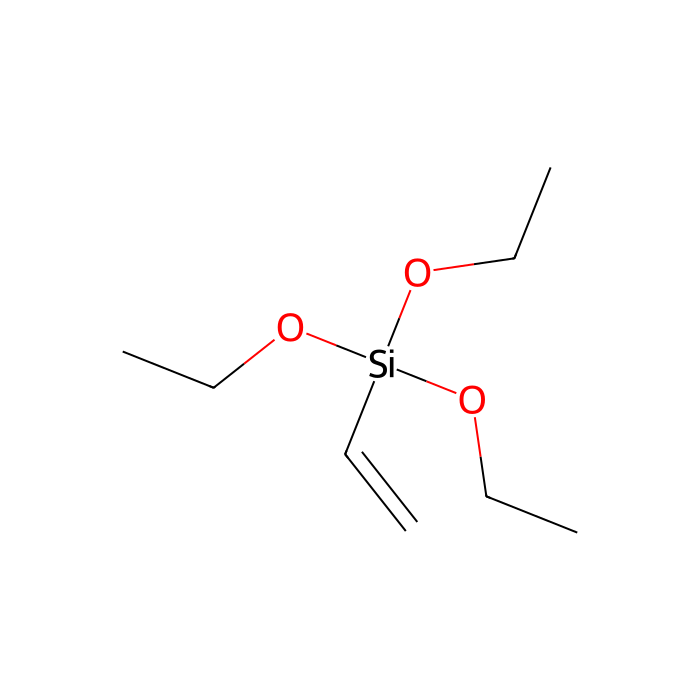
Triethoxyvinylsilane (TEVS) is a vinyl-functional trialkoxysilane coupling agent combining a hydrolytically labile Si(OEt)3 group with a polymerizable vinyl group.

  • Item-specific identifiers (from Product Data)
    • CAS: 78-08-0
    • SKU: T103647
    • InChIKey: 93765 (as provided)
    • Category: Chemical and biochemical reagents (research use only)
  • Literature/computed identifiers (general reference; not item-specific specs)
    • Common name: Triethoxyvinylsilane; TEVS
    • Molecular formula: C8H18O3Si (literature)
    • Molecular weight: ~190.31 g/mol (literature)
    • SMILES: C=CSi(OCC)OCC (literature)
  • Structural features (general chemistry description)
    • Functional groups: vinyl (–CH=CH2) attached to tetravalent Si, three ethoxy substituents [–O–CH2–CH3].
    • Silicon center: tetrahedral, sp3-like; no stereogenic centers.
    • Hydrolyzable alkoxy groups enable condensation to oxo‑siloxane networks on hydroxylated surfaces; the vinyl moiety allows subsequent radical/cationic copolymerization or thiol–ene reactions.
    • 2D description in words: a vinyl group bound to silicon; silicon is further bound to three –O–CH2CH3 groups radiating from the central Si.

Notes

  • Where exact identifiers or structure fields are not listed under Product Data (e.g., definitive SMILES/InChIKey), values above are provided as literature references only and should be verified against the product’s CoA/Spec Sheet for regulatory or QC-critical use.
Synthetic Utility

TEVS is a versatile synthon that integrates silicon-based surface chemistry with carbon–carbon and radical transformations via its vinyl group.

  • Functional handles
    • Si(OEt)3: Hydrolyzes to silanols that condense into Si–O–Si networks or form Si–O–M bonds to oxides—core to surface immobilization and sol–gel chemistry.
    • Vinyl (–CH=CH2): Engages in radical polymerization, thiol–ene click, hydroboration–oxidation, epoxidation, and can serve as a partner in cross-coupling after appropriate activation.
  • Named/representative transformations (literature)
    • Hiyama cross-coupling of vinylsilanes (fluoride-activated) with aryl/vinyl halides to furnish substituted alkenes with defined stereochemistry.
    • Thiol–ene additions (UV/thermal) for rapid, oxygen-tolerant conjugations on TEVS-modified surfaces.
    • Co-condensation with TEOS/organosilanes in sol–gel processes yields vinyl-functional hybrid silica, enabling post-gel functionalization or crosslinking.
  • Retrosynthetic value
    • Provides a convenient vinyl handle tethered to silica or glass, enabling late-stage diversification (e.g., grafting of ligands, polymers) without harsh conditions that might degrade the substrate.
  • Analytical control
    • 1H NMR: vinyl protons (~5.8–6.3 ppm) monitor conversion; 29Si NMR tracks siloxane formation; ATR-FTIR shows Si–O–Si and C=C bands.

Limitations

  • Moisture sensitivity complicates precise stoichiometry in solution reactions; use rigorously dry conditions or controlled hydrolysis protocols.
Target Specificity

Not applicable. This product is a small-molecule organosilane, not an antibody, probe, or biologic. No antigen/epitope specificity, species reactivity, clone, or isotype applies.

Frequently Asked Questions

What is the purity of this product?
This product is supplied at ≥97% purity (chemical assay). Lot-specific values are stated on the Certificate of Analysis.
How should this product be stored?
Store at room temperature under argon. It is supplied under an argon blanket; reseal under inert gas after each use.
How is this product shipped?
This product is classified as dangerous goods and ships via FedEx DG Service. Ground and other economy services are not available, and delivery to some destinations or address types may be restricted.
What are the CAS number, molecular formula and molecular weight?
The CAS Number is 78-08-0, the molecular formula is C8H18O3Si, and the molecular weight is 190.31 g/mol. InChIKey FWDBOZPQNFPOLF-UHFFFAOYSA-N.
What documentation is provided?
Available product documentation, including Certificates of Analysis (COA), Safety Data Sheets (SDS), and specification sheets, is shown in the product document area. Document availability and access follow the current site policy.

Shall we send you a message when we have discounts available?

Remind me later

Thank you! Please check your email inbox to confirm.

Oops! Notifications are disabled.