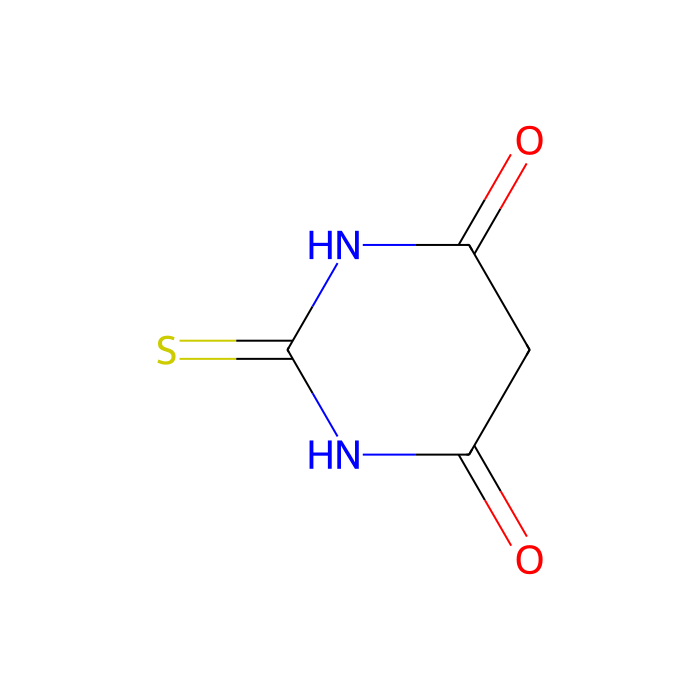
2-Thiobarbituric acid - Moligand™, ≥98% , CAS No.504-17-6

CAS: 504-17-6 Cat. No.: T108505 Formula: C4H4N2O2S Molecular Weight: 144.15 Beilstein Registry Number: 120663 EC Number: 207-985-8
AVAILABLE TO ORDER
GRADE & PURITY Moligand™ ? Moligand™ — Aladdin's line of ligands and bioactive small molecules. Use for receptor, pathway, and binding studies needing defined small-molecule tools. ≥98%
Synonyms
4,6-Dihydroxypyrimidine-2-thiol|2-Mercaptopyrimidine-4,6-dione|4,6-Dihydroxy-2-mercaptopyrimidine
Storage
Store at 2-8°C,Argon charged
Shipped In
Wet ice
★
Size
USA
Germany (EU)*
Price
Qty
5g
T108505-5g
In stock ≥10
—
$9.90
25g
T108505-25g
5 In stock
—
$11.90
100g
T108505-100g
5 In stock
—
$17.90
250g
T108505-250g
5 In stock
—
$37.90
500g
T108505-500g
3 In stock
—
$68.90
Enter a quantity for the sizes you want to add.

Overview

2-Thiobarbituric acid is a molecule made up of heteroatoms: nitrogen, sulphur and oxygen
Quantitating lipopolysaccharides, carrageenan, and sialic acids; used to detect lipid hydroperoxides and lipid oxidation

Specifications

Synonyms
4,6-Dihydroxypyrimidine-2-thiol | 2-Mercaptopyrimidine-4,6-dione | 4,6-Dihydroxy-2-mercaptopyrimidine
Specifications & Purity
Moligand™, ≥98%
Biochemical and Physiological Mechanisms
2-Thiobarbituric acid (TBA) is useful to quantitate lipopolysaccharides, carrageenan, and sialic acids. It is also used to detect lipid hydroperoxides and lipid oxidation.[1] It has applications in the field of medicine and biochemistry. TBA may possess the ability to prevent metal corrosion
Storage
Store at 2-8°C,Argon charged
Shipped In
Wet ice
This product requires cold chain shipping. Ground and other economy services are not available.
Grade
Moligand™
Purity
≥98%
Names and Identifiers
Pubchem Sid
Pubchem Sid Url
https://pubchem.ncbi.nlm.nih.gov/substance/504760788
SMILES
C1C(=O)NC(=S)NC1=O
IUPAC Name
2-sulfanylidene-1,3-diazinane-4,6-dione
InChIKey
RVBUGGBMJDPOST-UHFFFAOYSA-N
InChI
1S/C4H4N2O2S/c7-2-1-3(8)6-4(9)5-2/h1H2,(H2,5,6,7,8,9)
Isomeric SMILES
C1C(=O)NC(=S)NC1=O
WGK Germany
2
RTECS
CQ7700000
Alternate CAS
956086-95-6
UN Number
3335
Molecular Weight
144.15
Beilstein
120663

Advanced Data

Taxonomic Classification

Taxonomy Tree

KingdomOrganic compounds
SuperclassOrganoheterocyclic compounds
ClassDiazines
SubclassPyrimidines and pyrimidine derivatives
Intermediate Tree Nodes Pyrimidones
Direct ParentThiobarbituric acid derivatives
Alternative Parents Diazinanes  1,3-dicarbonyl compounds  Thioureas  Carboxylic acids and derivatives  Azacyclic compounds  Organopnictogen compounds  Organonitrogen compounds  Organic oxides  Hydrocarbon derivatives  
Molecular FrameworkAliphatic heteromonocyclic compounds
Substituents Thiobarbiturate - 1,3-diazinane - 1,3-dicarbonyl compound - Thiourea - Carboxylic acid derivative - Azacycle - Carbonyl group - Hydrocarbon derivative - Organic oxide - Organopnictogen compound - Organosulfur compound - Organooxygen compound - Organonitrogen compound - Organic oxygen compound - Organic nitrogen compound - Aliphatic heteromonocyclic compound
DescriptionThis compound belongs to the class of organic compounds known as thiobarbituric acid derivatives. These are organic compounds containing a 2-thioxodihydropyrimidine-4,6(1H,5H)-dione skeleton.
External Descriptors barbiturates
3D Structure
Interactive Chemical Structure Model


Certificates (CoA,COO,BSE/TSE and Analysis Chart)
C of A & Other Certificates(BSE/TSE, COO):
Analytical Chart:

Find and download the COA for your product by matching the lot number on the packaging.

66 results found

Lot NumberCertificate TypeDateItem
H2603487H2603487Certificate of AnalysisJul 03, 2026 T108505
H2603517H2603517Certificate of AnalysisJul 03, 2026 T108505
H2603531H2603531Certificate of AnalysisJul 03, 2026 T108505
H2603544H2603544Certificate of AnalysisJul 03, 2026 T108505
H2603545H2603545Certificate of AnalysisJul 03, 2026 T108505
H2603546H2603546Certificate of AnalysisJul 03, 2026 T108505
A2606498A2606498Certificate of AnalysisDec 18, 2025 T108505
D2621023D2621023Certificate of AnalysisDec 18, 2025 T108505
A2606503A2606503Certificate of AnalysisDec 18, 2025 T108505
A2606502A2606502Certificate of AnalysisDec 18, 2025 T108505
A2606501A2606501Certificate of AnalysisDec 18, 2025 T108505
A2606500A2606500Certificate of AnalysisDec 18, 2025 T108505
A2606504A2606504Certificate of AnalysisDec 18, 2025 T108505
D2515485D2515485Certificate of AnalysisApr 02, 2025 T108505
D2515429D2515429Certificate of AnalysisApr 02, 2025 T108505
D2515486D2515486Certificate of AnalysisApr 02, 2025 T108505
D2515487D2515487Certificate of AnalysisApr 02, 2025 T108505
D2515521D2515521Certificate of AnalysisApr 02, 2025 T108505
D2429427D2429427Certificate of AnalysisApr 22, 2024 T108505
D2429426D2429426Certificate of AnalysisApr 22, 2024 T108505
D2429425D2429425Certificate of AnalysisApr 22, 2024 T108505
D2429424D2429424Certificate of AnalysisApr 22, 2024 T108505
D2429423D2429423Certificate of AnalysisApr 22, 2024 T108505
D2429422D2429422Certificate of AnalysisApr 22, 2024 T108505
D2429421D2429421Certificate of AnalysisApr 22, 2024 T108505
D2429420D2429420Certificate of AnalysisApr 22, 2024 T108505
D2422211D2422211Certificate of AnalysisMar 15, 2024 T108505
D2422210D2422210Certificate of AnalysisMar 15, 2024 T108505
D2422213D2422213Certificate of AnalysisMar 15, 2024 T108505
L2501061L2501061Certificate of AnalysisJun 14, 2023 T108505
G23181310G23181310Certificate of AnalysisJun 14, 2023 T108505
G23181305G23181305Certificate of AnalysisJun 14, 2023 T108505
G23181304G23181304Certificate of AnalysisJun 14, 2023 T108505
G23181302G23181302Certificate of AnalysisJun 14, 2023 T108505
G23181299G23181299Certificate of AnalysisJun 14, 2023 T108505
G23181297G23181297Certificate of AnalysisJun 14, 2023 T108505
G23181296G23181296Certificate of AnalysisJun 14, 2023 T108505
B2309696B2309696Certificate of AnalysisJan 10, 2023 T108505
D2328038D2328038Certificate of AnalysisJan 10, 2023 T108505
B2309688B2309688Certificate of AnalysisJan 10, 2023 T108505
B2309690B2309690Certificate of AnalysisJan 10, 2023 T108505
B2309695B2309695Certificate of AnalysisJan 10, 2023 T108505
B2309699B2309699Certificate of AnalysisJan 10, 2023 T108505
B2309697B2309697Certificate of AnalysisJan 10, 2023 T108505
B2309698B2309698Certificate of AnalysisJan 10, 2023 T108505
B2309704B2309704Certificate of AnalysisJan 10, 2023 T108505
E2330075E2330075Certificate of AnalysisJan 10, 2023 T108505
E2330091E2330091Certificate of AnalysisJan 10, 2023 T108505
F2327382F2327382Certificate of AnalysisJan 10, 2023 T108505
L2228057L2228057Certificate of AnalysisNov 17, 2022 T108505
I2202182I2202182Certificate of AnalysisFeb 26, 2022 T108505
C2224547C2224547Certificate of AnalysisFeb 26, 2022 T108505
K2209133K2209133Certificate of AnalysisFeb 26, 2022 T108505
K2209129K2209129Certificate of AnalysisFeb 26, 2022 T108505
K2209128K2209128Certificate of AnalysisFeb 26, 2022 T108505
I2208483I2208483Certificate of AnalysisFeb 26, 2022 T108505
I2202184I2202184Certificate of AnalysisFeb 26, 2022 T108505
C2224551C2224551Certificate of AnalysisFeb 26, 2022 T108505
C2224548C2224548Certificate of AnalysisFeb 26, 2022 T108505
A2316099A2316099Certificate of AnalysisFeb 26, 2022 T108505
C2224549C2224549Certificate of AnalysisFeb 26, 2022 T108505
C2224550C2224550Certificate of AnalysisFeb 26, 2022 T108505
H2204191H2204191Certificate of AnalysisFeb 26, 2022 T108505
B2210137B2210137Certificate of AnalysisFeb 16, 2022 T108505
B2210151B2210151Certificate of AnalysisDec 30, 2021 T108505
L2128043L2128043Certificate of AnalysisDec 30, 2021 T108505
Chemical and Physical Properties
SolubilitySoluble in hot water.
SensitivityLight & Air Sensitive ;Hygroscopic
Melt Point235°C
Molecular Weight144.15
XLogP3-0.900
Hydrogen Bond Donor Count2
Hydrogen Bond Acceptor Count3
Rotatable Bond Count0
Exact Mass143.999 Da
Monoisotopic Mass143.999 Da
Topological Polar Surface Area90.300 Ų
Heavy Atom Count9
Formal Charge0
Complexity171.000
Isotope Atom Count0
Defined Atom Stereocenter Count0
Undefined Atom Stereocenter Count0
Defined Bond Stereocenter Count0
Undefined Bond Stereocenter Count0
The total count of all stereochemical bonds0
Covalently-Bonded Unit Count1
Safety and Hazards(GHS)
Pictogram(s)
Signal
Warning
Hazard Statements

H315:Causes skin irritation

H319:Causes serious eye irritation

H335:May cause respiratory irritation

Precautionary Statements

P261:Avoid breathing dust/fume/gas/mist/vapors/spray.

P264:Wash hands [and …] thoroughly after handling.

P271:Use only outdoors or in a well-ventilated area.

P280:Wear protective gloves/protective clothing/eye protection/face protection.

P321:Specific treatment (see ... on this label).

P302+P352:IF ON SKIN: wash with plenty of water.

P304+P340:IF INHALED: Remove person to fresh air and keep comfortable for breathing.

P305+P351+P338:IF IN EYES: Rinse cautiously with water for several minutes. Remove contact lenses if present and easy to do - continue rinsing.

P362+P364:Take off contaminated clothing and wash it before reuse.

P405:Store locked up.

P403+P233:Store in a well-ventilated place. Keep container tightly closed.

P501:Dispose of contents/container to an approved waste disposal plant.

P264+P265:Wash hands [and …] thoroughly after handling. Do not touch eyes.

P337+P317:If eye irritation persists: Get medical help.

P332+P317:If skin irritation occurs: Get medical help.

P319:Get medical help if you feel unwell.

WGK Germany
2
RTECS
CQ7700000
Documents & Articles
Fatty Acids from Basics to Lab Practice: Structural Classification, Research Uses, and Selection Tips (with an Aladdin Representative Product Quick-Reference Table)
Functions and Significance of Common Physiological and Biochemical Indices in Animals and Plants
Procyanidins: Structural Features and Key Points for Research and Application
Review of the Structural Characteristics, Biological Functions, and Application Advances of Lycopene
Comparison of Principles, System Control, and Result Interpretation in Hydroxyl Radical Scavenging Capacity Assays
The Role of Tannins in Astringency, Precipitation, and Antioxidant Activity of Plant Extracts
Construction and Evaluation Strategy of a Gentamicin-Induced Cell Injury Model
Principles, Method Selection, and Result Interpretation for Malondialdehyde Content Detection
Establishment and Evaluation Methods of Diabetic Animal Models
Establishment and Application of Animal Models of Epilepsy (EP)
Structural Characteristics of Ergothioneine, OCTN1-Mediated Uptake by Skin Cells, and Antioxidant Mechanisms
Are Lipids Fats? Understanding the Multiple Functions of Lipids from Cellular Metabolism to mRNA Delivery
Citations of This Product
Solution Calculators
Reviews

Customer Reviews

Frequently Asked Questions

What is the purity of this product?
This product is supplied at ≥98% purity (chemical assay). Lot-specific values are stated on the Certificate of Analysis.
What is Moligand??
Moligand? is one of Aladdin Scientific's premium product lines, formulated for high-purity applications across multiple workflows. Compared to standard grades in the same workflow, Moligand? products typically offer tighter specifications, more rigorous QC, and stronger lot-to-lot consistency.
How should this product be stored?
Store at 2–8 °C under argon. It is supplied under an argon blanket; reseal under inert gas after each use.
How is this product shipped?
This product ships chilled on wet ice. Unpack on arrival and transfer it to the storage condition stated above.
What are the CAS number, molecular formula and molecular weight?
The CAS Number is 504-17-6, the molecular formula is C4H4N2O2S, and the molecular weight is 144.15 g/mol. InChIKey RVBUGGBMJDPOST-UHFFFAOYSA-N.
What documentation is provided?
Available product documentation, including Certificates of Analysis (COA), Safety Data Sheets (SDS), and specification sheets, is shown in the product document area. Document availability and access follow the current site policy.

Shall we send you a message when we have discounts available?

Remind me later

Thank you! Please check your email inbox to confirm.

Oops! Notifications are disabled.