Alkaline Ethanol Differentiation Solution is prepared by mixing ethanol, potassium hydroxide, deionized water, and other components. As one of the main ingredients of the modified Highman Congo Red Staining Solution, it is primarily used for the differentiation of amyloid substances in Congo Red staining. This reagent is for research use only and not intended for clinical diagnosis or other purposes.
Materials to Be Prepared by Users
1. 10% neutral formalin, distilled water, a series of ethanol solutions, xylene or environment-friendly dewaxing solution, neutral balsam
2. Methanol Congo Red Staining Solution, Mayer's Hematoxylin Staining Solution
Operating Procedures (for Reference Only)
1. Perform routine fixation (10% neutral formalin fixative is commonly used), followed by routine dehydration and embedding.
2. Prepare sections with a thickness of 4 μm, then conduct routine dewaxing to water using xylene or environment-friendly dewaxing solution.
3. Immerse the sections in 0.5% Methanol Congo Red Staining Solution for 10-30 minutes, then discard the residual solution.
4. Differentiate the sections with Alkaline Ethanol Differentiation Solution for 1-5 seconds. Immediately transfer the sections to water to terminate differentiation, rinse twice with water, and then check under a microscope to ensure the differentiation reaches an appropriate level.
5. Rinse the sections with tap water for 5 minutes.
6. Stain the cell nuclei lightly with Mayer's Hematoxylin Staining Solution for 1-2 minutes or a shorter period. Rinse with tap water for 10 minutes.
7. Perform routine gradient dehydration with ethanol, clear the sections with xylene or environment-friendly clearing solution, and then mount the sections with neutral balsam.
Staining Results
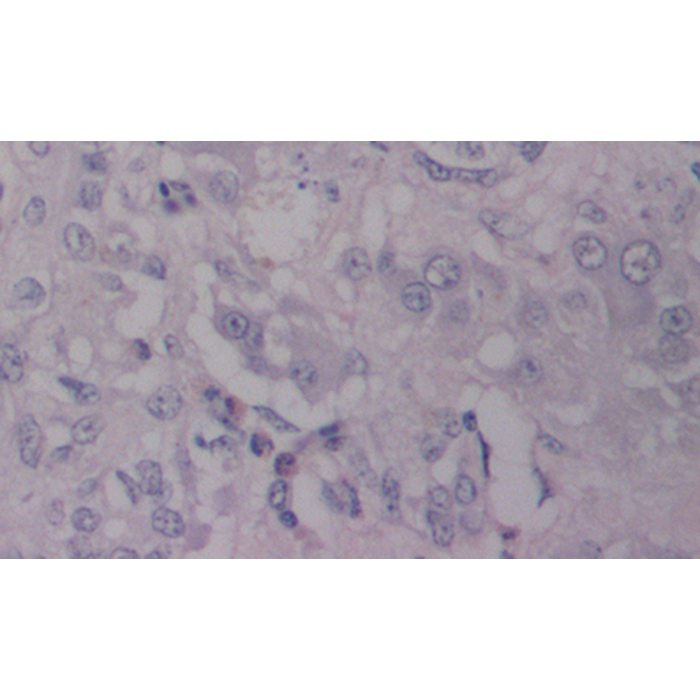
Under an optical microscope: Amyloid substances appear red, and cell nuclei appear blue.
Under a polarizing microscope: Amyloid substances exhibit yellow-green birefringence.
Modified Highman Staining (light staining effect; blue structures are nuclei)
Precautions
1. Ensure sections are fully dewaxed; otherwise, the staining effect will be affected.
2. When staining with Methanol Congo Red Staining Solution, immersion staining is recommended as much as possible. If drop staining is adopted, place the sections in a humid chamber to prevent the solution from evaporating.
3. The differentiation step with Alkaline Ethanol Differentiation Solution is crucial: If the differentiation time is too short, collagen fibers will also be stained red. If over-differentiation occurs, amyloid substances will be decolorized. In case of over-decolorization, rinse the sections, then re-immerse them in Congo Red Staining Solution for staining.
4. Dehydration should be carried out quickly to avoid decolorization.
5. This product contains potassium hydroxide, ethanol, and other components, and has slight corrosiveness. Handle with care.
6. Due to factors such as tissue specificity or environmental changes, the red color may sometimes be indistinct. In such cases, extend the staining time.
7. For your safety and health, wear a lab coat and disposable gloves during operation.
8. After opening the reagent, use it as soon as possible to avoid affecting the results of subsequent experiments.


 ZJ25F1230639