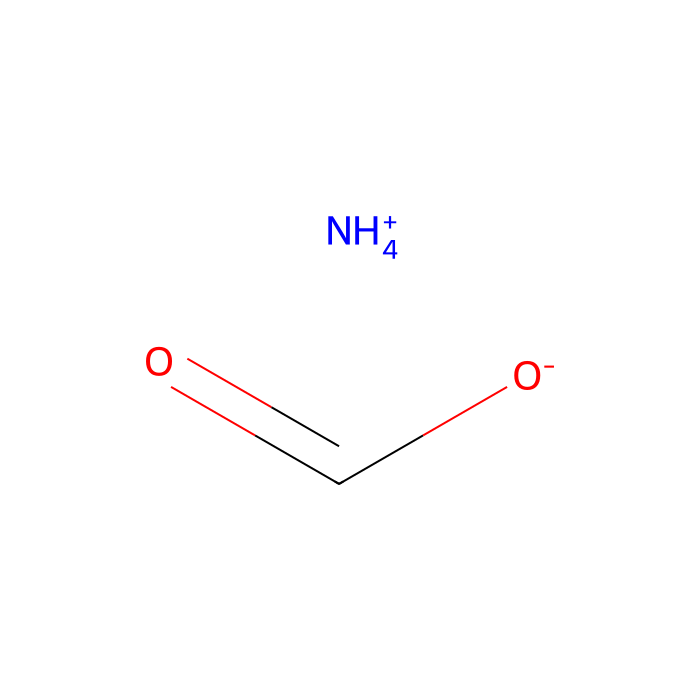
Ammonium formate - 10mM in DMSO , CAS No.540-69-2

CAS: 540-69-2 Cat. No.: A424621 Formula: CH5NO2 Molecular Weight: 63.06 Beilstein Registry Number: 3625095 EC Number: 208-753-9
AVAILABLE TO ORDER
GRADE & PURITY 10mM in DMSO
Synonyms
AMMONIUM FORMATE|540-69-2|Formic acid, ammonium salt|Formic acid ammonium salt|ammoniumformate|azanium formate|azanium;formate|Mravencan amonny|ammonium formiate|Ammonium formate-d5|HSDB 479|UNII-3801F9644E|FORMATE, AMMONIUM|Formic acid, ammonium salt (1:
Storage
Store at -80°C
Shipped In
Dry ice packs + Cold packs
★
Size
USA
Germany (EU)*
Price
Qty
1ml
A424621-1ml
2 In stock
—

$47.90

$69.90
Save $22.00 (31.47%)
Enter a quantity for the sizes you want to add.
🧪
Why this grade

10mM in DMSO for sensitive chromatographic and analytical workflows requiring minimal baseline interference.

🌡

Storage & shipping

Store at -80°C Ships Dry ice packs + Cold packs Check lot-specific COA for exact specifications.

📋

Quality documents

SDS, COA, datasheet, and spec sheet available for download. Lot-specific COA accessible via lot number lookup.

📚

Literature proof

Cited in 417 peer-reviewed publications across chromatography, organic synthesis, and cross-coupling reactions.

Overview

Phenolic benzyl protecting groups are quickly removed by ammonium formate and microencapsulated palladium under microwave irradiation.

Specifications

Synonyms
AMMONIUM FORMATE | 540-69-2 | Formic acid, ammonium salt | Formic acid ammonium salt | ammoniumformate | azanium formate | azanium;formate | Mravencan amonny | ammonium formiate | Ammonium formate-d5 | HSDB 479 | UNII-3801F9644E | FORMATE, AMMONIUM | Formic acid, ammonium salt (1:
Specifications & Purity
10mM in DMSO
Storage
Store at -80°C
Shipped In
Dry ice packs + Cold packs
This product requires cold chain shipping. Ground and other economy services are not available.
Names and Identifiers
Pubchem Sid
Pubchem Sid Url
https://pubchem.ncbi.nlm.nih.gov/substance/504760835
Canonical Smiles
C(=O)[O-].[NH4+]
IUPAC Name
azanium;formate
InChIKey
VZTDIZULWFCMLS-UHFFFAOYSA-N
INCHI
1S/CH2O2.H3N/c2-1-3;/h1H,(H,2,3);1H3
Isomeric SMILES
C(=O)[O-].[NH4+]
WGK Germany
1
Molecular Weight
63.06
Beilstein
3625095
Reaxy-Rn
3625095
Reaxys-RN_link_address
https://www.reaxys.com/reaxys/secured/hopinto.do?context=S&query=IDE.XRN=3625095&ln=

Documentation

📋 Safety Data Sheet (SDS)

Comprehensive hazard, handling, storage, and regulatory compliance document.

<<<<<<< HEAD Download SDS → ======= Download SDS → >>>>>>> release248-p3

✅ Certificate of Analysis (COA)

Lot-specific quality data. Enter your lot number to retrieve the exact COA.

Look up COA →

📊 Datasheet

Quick-reference summary of product specifications and applications.

View datasheet →

🔬 Specification Sheet

Full quality attributes and acceptance criteria for this grade.

View spec sheet →

Advanced Data

Taxonomic Classification

Taxonomy Tree

KingdomOrganic compounds
SuperclassOrganic acids and derivatives
ClassCarboxylic acids and derivatives
SubclassCarboxylic acids
Intermediate Tree Nodes Not available
Direct ParentCarboxylic acids
Alternative Parents Monocarboxylic acids and derivatives  Organic oxides  Organic nitrogen compounds  Hydrocarbon derivatives  Carbonyl compounds  
Molecular FrameworkAliphatic acyclic compounds
Substituents Monocarboxylic acid or derivatives - Carboxylic acid - Organic nitrogen compound - Organic oxygen compound - Organic oxide - Hydrocarbon derivative - Organooxygen compound - Carbonyl group - Aliphatic acyclic compound
DescriptionThis compound belongs to the class of organic compounds known as carboxylic acids. These are compounds containing a carboxylic acid group with the formula -C(=O)OH.
External Descriptors ammonium salt
3D Structure
Interactive Chemical Structure Model


Certificates (CoA,COO,BSE/TSE and Analysis Chart)
C of A & Other Certificates(BSE/TSE, COO):
Analytical Chart:
Chemical and Physical Properties
SensitivityHygroscopic
Melt Point(°C)116°C
Molecular Weight63.056 g/mol
XLogP3
Hydrogen Bond Donor Count1
Hydrogen Bond Acceptor Count2
Rotatable Bond Count0
Exact Mass63.032 Da
Monoisotopic Mass63.032 Da
Topological Polar Surface Area41.100 Ų
Heavy Atom Count4
Formal Charge0
Complexity7.500
Isotope Atom Count0
Defined Atom Stereocenter Count0
Undefined Atom Stereocenter Count0
Defined Bond Stereocenter Count0
Undefined Bond Stereocenter Count0
The total count of all stereochemical bonds0
Covalently-Bonded Unit Count2
Documents & Articles
Small-Molecule Inhibitors: A Practical Guide for Research Selection — A Minimal Evidence Chain and Scenario-Based Validation Framework (Including a Selection Matrix, Case Cards, and Product Tables 1–4)
Secondary Effects Behind Chromatographic Peak Tailing and Unstable Peak Shapes: How Residual Silanols (Si–OH) Affect Basic Compounds, and the Shortest Troubleshooting/Remediation Path (with Product Navigation and Tables 1–3)
Plant Omics Panorama: Workflow Frameworks and Multi-Omics Integration from Genomics to Transcriptomics, Proteomics, and Metabolomics
Ferulic Acid: Structural Features, Preparation Routes, and Key Points for Research Applications
Paeonol: Physicochemical Features, Uses, and Key Points for Research Applications
Famotidine: Physicochemical Features, Mechanism of Action, and Key Points for Research Applications
Flavones: Structural Features, Physicochemical Properties, and Key Points for Research and Applications
Roles of the Carboxypeptidase Family in Protein C-Terminal Processing and Experimental Analysis
Methodological Studies on Glycoprotein Structural Characterization and Quality Attribute Analysis
Understanding Cbz (Benzyloxycarbonyl): Selection Logic and Practical Value of a Classical Amino Protecting Group
From the Logic of Deprotection to Protecting Group Choice: Differences Among Bn, PMB, and Dmb in Experimental Design
Research Framework for Multi-Enzyme Digestion Strategies and Optimization of Proteomic Coverage
Technical Comparison and Method Selection for Hydroxyproline Determination
Experimental Assessment of Dibenzyl N,N-Diisopropylphosphoramidite for Alcohol O-Phosphorylation: Coupling, Oxidation, and Debenzylation
Porous Graphitic Carbon (PGC) Chromatography Columns: Creating New Selectivity for Challenging Separations through Molecular Shape and the π-Electron Cloud on the Graphitic Surface
β-Hydroxybutyrate Detection Methods and Metabolic Significance: Comparative Applications of Enzymatic Assays, Blood Ketone Meters, and LC-MS
Citations of This Product
Solution Calculators
Reviews

Customer Reviews

Shall we send you a message when we have discounts available?

Remind me later

Thank you! Please check your email inbox to confirm.

Oops! Notifications are disabled.