GRADE & PURITYMoligand™?Moligand™ — Aladdin's line of ligands and bioactive small molecules. Use for receptor, pathway, and binding studies needing defined small-molecule tools.≥99%
This compound belongs to the class of organic compounds known as azobenzenes. These are organonitrogen aromatic compounds that contain a central azo group, where each nitrogen atom is conjugated to a benzene ring.
External Descriptors
Not available
1. Djoumbou Feunang Y, Eisner R, Knox C, Chepelev L, Hastings J, Owen G, Fahy E, Steinbeck C, Subramanian S, Bolton E, Greiner R, and Wishart DS. ClassyFire: Automated Chemical Classification With A Comprehensive, Computable Taxonomy. Journal of Cheminformatics, 2016, 8:61.
Determine the necessary mass, volume, or concentration for preparing a solution.
Dilution Calculator
Determine the dilution needed to prepare a stock solution.
Reconstitution Calculator
Reviews
Customer Reviews
Application Protocols
No vendor-validated application protocols are provided for this item. For assay development, consider the following general, non-binding guidance:
Prepare a 10–50 mM DMSO stock; vortex/sonicate to dissolve. Store aliquots at −20 °C, protected from light. Verify concentration by UV–Vis using an empirically determined extinction coefficient at the azo λmax.
For enzymatic azoreductase assays: dilute stocks into phosphate buffer (pH 7.2) containing NADH; monitor absorbance decrease at the azo band over time. Include appropriate blanks and solvent controls.
For chemical reduction controls: use sodium dithionite in buffered aqueous media; quench and analyze by LC–MS to profile products.
These are general literature practices and not validated protocols for this specific product.
Biological Roles
Literature context (non-clinical, for research only)
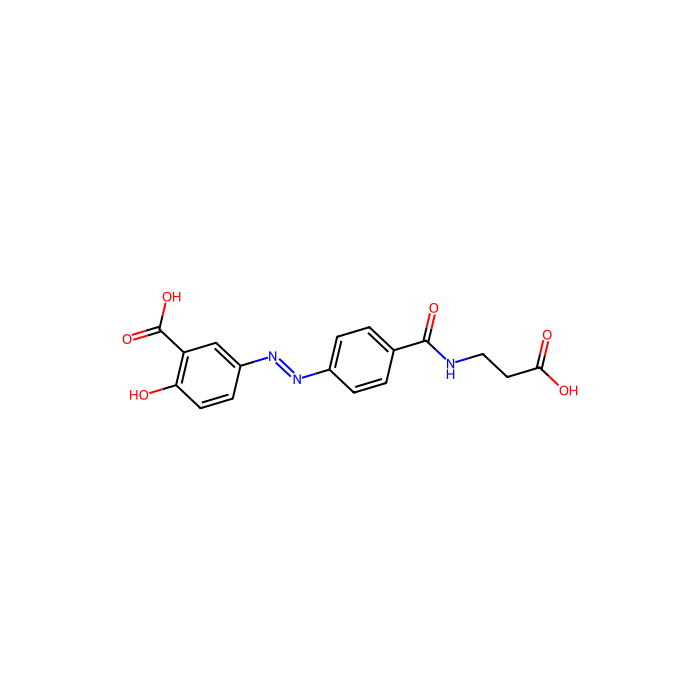
Balsalazide is an azo-linked conjugate designed to undergo reductive cleavage by bacterial azoreductases, yielding aromatic amines/phenols (e.g., salicylate derivatives). It is widely used in research as a model for colon-targeted prodrug design and microbiome-activated delivery.
The azo linkage serves as a biochemical trigger: under reducing conditions (e.g., in the presence of NADH-dependent azoreductases), the –N=N– bond is converted to hydrazo and then cleaved to amines/phenols.
The phenolic and carboxylic acid functionalities influence permeability, protein binding, and ionization state; these features are explored in ADME and transporter interaction studies.
Experimental considerations
In vitro systems (cell-free azoreductase assays, fecal slurry incubations, simulated intestinal fluids) are commonly used to profile reduction kinetics and metabolite identity.
Avoid making clinical/therapeutic inferences; this product is for laboratory research only.
Buffer Applications
Applicability
Balsalazide is not a buffering agent, but buffer choice critically affects its solubility, ionization, and azo stability in assays.
Practical guidance (literature)
For dissolution and spectroscopic work, use carbonate or borate buffers in the pH 8–10 range to increase ionization of carboxyl/phenolic groups, noting potential effects on azo stability over extended periods.
For enzymatic azoreductase assays, maintain near-neutral pH (e.g., phosphate buffer pH 7.0–7.5) with appropriate cofactors (e.g., NADH) to study reductive cleavage while preserving enzyme activity.
Include low organic content (≤1–2% DMSO) if stocks are prepared in DMSO. Filter buffers (0.22 µm) to reduce baseline noise in UV–Vis tracking of azo absorbance.
Green Alternatives
Context
Balsalazide is a solid research chemical rather than a solvent; “green alternatives” apply mainly to solvent choices and processing during handling and analysis.
Greener handling strategies (literature/general)
Prefer aqueous buffers (adjusted to mildly basic pH) over neat polar aprotic solvents when compatible with your assay, recognizing possible impacts on azo stability.
Use lower-toxicity solvents and minimize DMSO percentage in biological assays (<1–2% v/v where feasible).
Apply microscale methods and high-throughput screening workflows to reduce chemical use.
Example comparison (general guidance)
DMSO vs 2-MeTHF/EtOH co-solvent systems for preparative steps:
DMSO: excellent solubilizer, but persistent and less green.
EtOH or MeOH (with base): greener, volatile, but may require higher volumes and may affect stability.
Waste and safety
Segregate azo-containing waste and avoid mixing with strong reducers/oxidizers. Employ appropriate aqueous work-up to limit organic solvent usage.
Pharmaceutical Uses
Scope limitation
No medical or clinical claims are made. The information below pertains to formulation science and laboratory research contexts only.
Research/formulation context (literature)
Balsalazide and its salt forms are used as model compounds in studies of colon-targeted delivery systems (e.g., azo prodrugs) and in excipient compatibility testing under reducing vs. oxidative environments.
Investigations often examine polymorphism/solid-state behavior, pH-dependent solubility, and dissolution in simulated gastrointestinal media to inform prodrug design principles.
When evaluating dosage-form concepts in research, control the redox environment to avoid premature azo cleavage; employ light protection when necessary.
Physical Properties
Item-specific specifications: Not specified for this item; refer to CoA/Spec Sheet.
Literature/general properties (non-binding; for planning only)
Physical state: typically a solid, aromatic azo compound.
Solubility profile: sparingly soluble in neutral water; readily soluble in polar aprotic solvents (e.g., DMSO, DMF); solubility in basic aqueous media improves due to formation of carboxylate/phenolate salts (literature).
UV–Vis: azo chromophore exhibits strong absorption in the visible region with band shifts depending on pH and solvent polarity; useful for monitoring azo reduction (literature).
Partitioning: expected high polarity relative to simple aromatics due to multiple acidic groups; logP/logD strongly pH-dependent (literature).
Note: Do not treat the above as specifications. Consult the product CoA/SDS for exact values and handling limits.
Quality & Grades
Item-specific details
Grade/Purity: Moligand™ (as provided by Aladdin Scientific)
Appearance: Not specified for this item; refer to CoA/Spec Sheet.
What Moligand™ signifies (general explanation)
Moligand™ items are curated small-molecule reagents intended for research and discovery workflows (e.g., screening, target validation, chemical biology). Emphasis is placed on verified identity, traceability, and storage/shipping conditions that preserve integrity.
While typical analytical controls include NMR/LC–MS identity verification and purity assessment, exact purity percentage, residual solvents, and elemental/metal specs are not provided here and should be obtained from the item’s CoA.
Stabilizers/additives
No stabilizer information is specified for this item. If stabilizers or salt forms affect your assay (e.g., UV background, ionization in LC–MS), consult the CoA prior to use.
Practical implications
For bioassay and screening use, prepare fresh DMSO stocks and filter if needed. If low-UV absorbance is required (e.g., HPLC detection), confirm UV cutoff/impurity profile on the CoA before method development.
Reaction & Applications
Manufacturer Applications: Not specified beyond research use; see below for relevant research contexts.
Balsalazide is a canonical example of an azo-linked prodrug used to study colon-targeted delivery via microbial azoreductase cleavage. It serves as a probe for azo bond reduction kinetics, microbiome-mediated metabolism, and release of salicylate derivatives.
The prominent azo chromophore facilitates spectroscopic monitoring (UV–Vis) of reduction and hydrolysis pathways in enzyme assays and in vitro gastrointestinal models.
Analytical applications (literature)
Method development for LC–UV/LC–MS quantitation of azo prodrugs and their reduced products (hydrazo/aniline intermediates; salicylate release).
Evaluation of pH-dependent solubility and ionization using potentiometric titration and spectrophotometric pKa analysis.
Practical tips
Protect solutions from strong reducing environments unless studying cleavage. Maintain inert atmosphere only if required by ancillary reagents; the compound itself is generally air-stable as a solid.
When preparing calibrators for assays, confirm extinction coefficients at chosen wavelengths, as the azo band is solvent and pH dependent.
Reaction Conditions
General conditions for constructing related azo conjugates (literature guidance; not a protocol for this specific item’s manufacture)
Diazotization: anilines are treated with NaNO2/HX (HCl or HBF4) at 0–5 °C to form diazonium salts.
Azo coupling: diazonium salts couple with activated aromatics (e.g., phenols, anilides) under mildly basic conditions (pH 8–10; Na2CO3/NaHCO3) while maintaining low temperature initially, then allowing to warm to ambient.
Amide formation: carbodiimide (EDC/HOBt) or acid chloride methods in aprotic solvents (DMF, DCM) at 0–25 °C; alternatives include modern coupling agents (HATU, T3P).
Reductive cleavage studies (literature)
Chemical reduction with sodium dithionite in aqueous buffer (pH ~6–8) at room temperature efficiently converts azo to hydrazo/anilines; reactions can be monitored by UV–Vis decrease of the azo band.
Enzymatic reduction using azoreductase/NADH systems at 25–37 °C to mimic microbial metabolism.
Expected observations
Strong color changes accompany azo formation/cleavage; UV–Vis λmax shifts with pH and substituents. LC–MS confirms product identities.
Note: Conditions above are general literature practice and not item-specific specifications.
Safety & Handling
Item-specific hazard data
Signal word: Not specified for this item; refer to SDS.
H-statements: Not specified for this item; refer to SDS.
GHS classification/pictograms: Not specified for this item; refer to SDS.
General safety guidance for aromatic azo carboxylates (literature; for context)
Likely to cause irritation to eyes/skin upon contact and to the respiratory tract as dust. Avoid inhalation and contact.
PPE: lab coat, safety glasses or goggles, and appropriate chemical-resistant gloves (e.g., nitrile). Handle solids in a fume hood to avoid dust exposure.
Incompatibilities: strong oxidizing agents; strong reducing agents (may cleave azo bond); strong acids/bases can alter ionization and solubility. Avoid prolonged exposure to light/UV which may promote azo degradation in some systems.
First aid (overview; defer to SDS): rinse eyes with water for several minutes; wash skin with soap and water; move to fresh air if inhaled; seek medical attention if symptoms persist.
Spill response: avoid dust generation; collect mechanically and place in suitable container for disposal according to local regulations.
Always consult the product’s SDS for authoritative hazard, exposure limits, and disposal instructions.
Solvent Selection
Polarity and ionization (literature)
Balsalazide bears phenolic and carboxylic acid groups plus an amide; it is best handled in polar aprotic solvents for organic stocks and in basic aqueous buffers when an ionized form is acceptable.
Recommended solvents by task (general guidance)
Stock solutions for screening: DMSO (common), DMF. Warm gently and vortex/sonicate to assist dissolution. Filter through 0.22 µm if particulates persist.
Aqueous work: limited solubility at neutral pH; solubility improves in pH ≥ 8 buffers due to carboxylate/phenolate formation. Avoid extreme pH if azo stability is a concern.
Chromatography: for RP-HPLC, mobile phases with small amounts of base (e.g., ammonium bicarbonate or ammonium hydroxide) can improve peak shape of acidic analytes; monitor at visible wavelengths due to the azo chromophore.
Miscibility and alternates (literature)
DMSO is fully miscible with water and commonly used for assay dilution. For less hygroscopic stocks, NMP or DMAc are alternatives, but assess biocompatibility. For preparative work, MeOH/ACN with a base additive can aid dissolution.
Comparison snapshot (general)
DMSO: highest solvating power; assay-compatible in small percentages.
DMF/NMP: strong solvents; consider toxicity and assay interference.
Aqueous basic buffer: greener, but may impact azo stability over time; prepare fresh.
Storage & Reconstitution
Item-specific conditions (from Product Data)
Storage: Store at −20 °C.
Shipping: Ice chest + ice pads.
Practical guidance
Protect from light to limit potential azo photodegradation. Keep container tightly closed under inert headspace if feasible to minimize moisture uptake.
For working solutions: prepare fresh as needed. DMSO or DMF stock solutions can be aliquoted and stored at −20 °C. Avoid repeated freeze–thaw; use single-use aliquots.
Aqueous solutions: prepare immediately before use, adjusting pH as required. Prolonged exposure to strong reducing environments can cleave the azo bond; avoid unless intended.
Reconstitution (general)
Not specified for this item; refer to CoA/Spec Sheet for any solubility specifications. As a general approach, begin with a small volume of dry DMSO, then bring to final volume with buffer or solvent of choice while monitoring clarity. Filter if particulates remain.
Structure & Identity
Item-specific (from Product Data)
SKU: B330840
Product name: Balsalazide
CAS: 80573-04-2
InChIKey: 147154 (as provided)
SMILES: Not specified for this item; refer to CoA/Spec Sheet.
Molecular formula: Not specified for this item; refer to CoA/Spec Sheet.
Molecular weight: Not specified for this item; refer to CoA/Spec Sheet.
Literature/structural description (for context; not item specification)
Balsalazide is an aromatic azo compound linking a salicylate (2-hydroxybenzoic acid bearing an anilide/amide) to an aryl moiety via an –N=N– bond. It contains phenolic OH and carboxylic acid groups and an amide linkage. The overall framework comprises two benzene rings joined by an azo bridge with additional carboxylate functionality.
The 2D structure can be visualized as: a salicylic-acid-like ring (bearing o-OH and amide) connected through an amide to a para-aminobenzoate-derived ring that is further extended via an azo linkage to a β-alanine–like side chain (typical descriptors in the literature).
Synthetic Utility
Functional group leverage (literature)
Azo group (–N=N–): spectroscopic handle and cleavable linker enabling tracer studies of reductive fragmentation and release kinetics.
Phenol/carboxylic acids: sites for esterification, amide coupling, salt formation, and prodrug derivatization.
Amide: confers rigidity and hydrogen-bonding capacity; amenable to further derivatization (e.g., N-alkylation is typically avoided; acyl migration not expected under mild conditions).
Uses in synthesis and method development
Benchmark substrate for azoreductase-mimicking reductions using dithionite, zinc/ammonium formate, or catalytic hydrogenation to map stepwise cleavage.
Model for developing LC–MS workflows to track azo → hydrazo → aniline/phenol products.
Building block conceptually for creating libraries of azo-linked conjugates varying aryl electronics to tune reduction potential and release profiles.
Target Specificity
Not applicable. This product is a small-molecule reagent, not a biological affinity reagent (e.g., antibody/ligand with a defined protein target specificity). For biochemical context, see the Biological Roles and Reaction & Applications sections.
Need help choosing the grade?
Our grade selection guide covers purity, stabilizer status, and application suitability for all variants in our catalog.
We use cookies to ensure the website functions properly and, where permitted, to improve your experience. You can manage your preferences at any time in Settings. Learn more in our Cookie Policy.
Shall we send you a message when we have discounts available?
Remind me later
Thank you! Please check your email inbox to confirm.
Products are supplied to verified businesses, institutions, and qualified professionals for research and development use only. Not for use in humans, animals, diagnosis, or therapy.

 E2322035